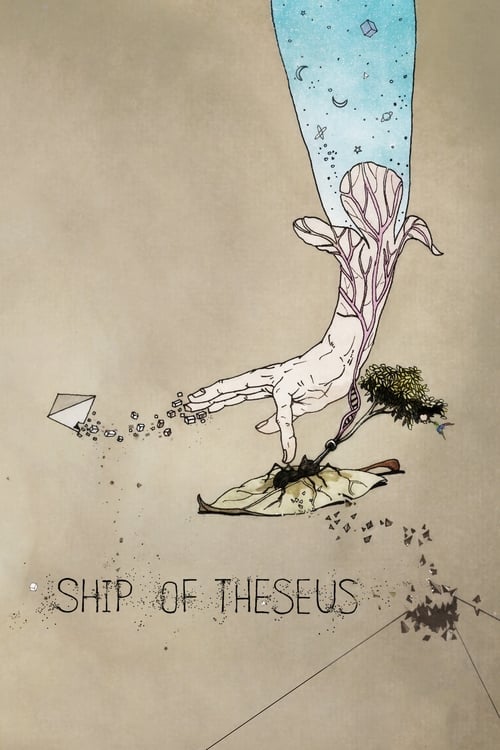
Ship of Theseus
2012 · Anand Gandhi
For when you want a film to chew on for days — ideas, ethics, identity — and you have the patience for a slow, thoughtful build. Watch it when your mind is awake, ideally with someone to talk to afterward.
What it's about
Three loosely connected stories, each hinging on a body that changes: a blind photographer whose sight is restored by a corneal graft and who finds her instinct unsettled by the gift; an ascetic monk fighting animal testing in court who falls ill and must decide whether to accept the very medicine he opposes; and a young stockbroker, fresh from a kidney transplant, pulled into questions about where organs come from. The title names the ancient puzzle underneath: if every part of a ship is replaced, is it still the same ship — and does the same go for us?
The experience
Contemplative and absorbing, with long conversations that genuinely earn their length — it makes big philosophical questions feel personal and urgent rather than abstract. It's the rare film that leaves you arguing with yourself on the way to bed.
The craft
Anand Gandhi shoots with unhurried naturalism, letting Mumbai's streets, hospitals, and monasteries ground the philosophy in lived texture. The triptych structure is the film's real craft move: three stories that rhyme rather than intersect neatly, each testing the same question from a different body.
Why it matters
A landmark of Indian independent cinema in the 2010s, it proved that rigorous, idea-driven filmmaking could find an audience there and became a touchstone for a new wave of Indian art-house directors.
Snapshot
Ship of Theseus is a triptych of philosophical fiction from India, built around the ancient thought-experiment its title names: if every plank of a ship is replaced over time, is it still the same ship? Anand Gandhi transposes that paradox of identity and continuity onto the body, staging three loosely connected stories in which a transplant, a disease, or the recovery of a sense forces a character to confront what remains of the self when its material parts change. An Egyptian-born blind photographer regains her sight through a corneal graft and finds her instinctive eye disturbed; an ascetic monk, a lawyer waging a court battle against animal testing, contracts cirrhosis and must decide whether to accept drugs developed through the very experiments he opposes; a young stockbroker, recovering from a kidney transplant, stumbles onto an organ-theft racket and pursues a form of justice that complicates his own comfortable certainties. Released into Indian theaters in 2013 after a festival run beginning in 2012, the film became a landmark of the country's new independent cinema — an unusually cerebral work that nonetheless found an audience, and that announced a distinctive authorial sensibility. It is prized for the seriousness of its ideas, the precision of its images, and its willingness to let argument and ambiguity, rather than plot mechanics, drive drama.
Industry & production
The film emerged outside the Mumbai mainstream, from the ecosystem of independent and "parallel" Indian filmmaking that gathered momentum in the late 2000s and early 2010s. It was produced by Sohum Shah — who also plays the stockbroker Navin — under the Recyclewala Films banner, a genuinely independent, self-financed enterprise rather than a studio production. This producer-as-star-and-believer model is characteristic of the period's low-budget Indian art cinema, where films were often willed into existence by a small circle of collaborators.
The decisive turn in the film's public life came when Kiran Rao — filmmaker and a prominent figure associated, through the Aamir Khan orbit, with championing distinctive Indian cinema — "presented" the film for its wider theatrical release. That endorsement gave a demanding, dialogue-heavy art film a visibility it would not otherwise have commanded, and helped secure a theatrical window in mid-2013. Precise budget and box-office figures are not something I can state reliably, and I will not invent them; the salient point is that the film was made cheaply, over an extended and interrupted production, and achieved a cultural footprint out of proportion to its scale. Its festival premiere at the Toronto International Film Festival in 2012, followed by further festival exposure and a National Film Award for Best Feature Film, converted critical prestige into the leverage needed for distribution.
Technology
Ship of Theseus is a digitally shot film, and its look is inseparable from that fact: the sensitivity of modern digital sensors underwrites the naturalistic, available-light-leaning approach that the cinematography favours, particularly in the interiors and low-light passages. Digital acquisition also suited the film's protracted, intermittent production, allowing a small crew to work flexibly across long shooting periods. Beyond the camera, the film is, at the level of subject, a meditation on medical technology — corneal grafting, immunosuppression and organ transplantation, pharmaceutical development and its dependence on animal experimentation. Technology is not merely the tool of production but the very engine of the drama: each story turns on a medical intervention that alters the body and thereby the person, making the film one of the more thoughtful screen treatments of bioethics from its national cinema.
Technique
Cinematography
The cinematography, by Pankaj Kumar, is the film's most immediately celebrated craft element and a large part of why an idea-driven work feels so sensuous. Kumar shoots with a strong sense of texture and light, alternating between compositions of quiet, painterly stillness and passages of restless, exploratory movement. The first story, centered on a blind then newly sighted photographer, is especially self-conscious about vision itself — about focus, blur, framing and the act of seeing — and the camera becomes a commentary on its protagonist's changing perception. Elsewhere the imagery leans toward a grounded naturalism, using real locations and their available light to keep the philosophical dialogue anchored in tactile reality. Kumar, who also shares story/writing credit, went on to shoot high-profile Indian features, and his work here is frequently cited as an early showcase of his eye.
Editing
Structurally the film is a triptych, and its editing must manage the tension between three self-contained novellas and a single unifying argument. Rather than intercutting the stories, the film presents them largely in sequence, trusting the viewer to carry the thematic thread — the persistence of identity through bodily change — across the seams, until a late convergence draws the strands together. Within scenes, the cutting is patient and often long-take-inclined, giving conversations and moral deliberations room to unfold at something closer to real-time rhythm. This restraint is a deliberate counter to conventional pacing: the film asks the audience to sit inside argument and doubt.
Mise-en-scène / staging
Gandhi stages his stories in recognizably contemporary Indian spaces — apartments, hospitals, courtrooms, a monastery, the streets — and uses that verisimilitude to keep abstract debate embodied. The monk's world is one of austerity and physical discipline; the photographer's is one of images, screens and framed vision; the broker's is one of glass, comfort and mobility, later disrupted by a journey into poorer, more precarious geographies. The contrast in physical worlds does thematic work, mapping different relations between body, belief and material circumstance.
Sound
The film's soundscape and score, credited to composers Naren Chandavarkar and Benedict Taylor, favour restraint and atmosphere over conventional emotional scoring. Sound is used to reinforce the film's attentiveness to perception — the ambient textures of the sighted and unsighted worlds, the quiet of the monastery, the din of the city — rather than to cue feeling. The overall aesthetic is closer to observational realism than to melodrama.
Performance
Performance is central to the film's success, and the standout is Neeraj Kabi as Maitreya, the ascetic monk. Kabi undertook a marked physical transformation for the role's later stages of illness, and the performance is notable for its interior stillness and conviction — a man whose ethics are lived in the body, then tested by that same body's failure. Aida El-Kashef brings a watchful intelligence to the photographer, Aaliya, and Sohum Shah gives the stockbroker Navin an everyman restlessness that lets the film's least ascetic character carry its most worldly moral questions. Supporting turns, including Vinay Shukla, ground the debates in credible human texture. The acting throughout is calibrated to naturalism, which is essential given how much of the film consists of people talking through ideas.
Narrative & dramatic mode
The dramatic mode is philosophical realism — closer to the essay-film and the novel of ideas than to conventional plotting. Each of the three stories is a moral fable with a genuine argument at its core, and the "action" is frequently a debate: the monk's disputations about ethics and suffering, the photographer's crisis of artistic instinct, the broker's confrontation with a system that trades in stolen organs. The film trusts dialogue and situation to generate tension, and it declines easy resolution; its characters change, but the film resists telling us whether they have improved. The triptych structure itself is a narrative wager, asking the audience to synthesize meaning across discrete stories, with the title's paradox as the interpretive key that binds them.
Genre & cycle
Nominally a drama, the film sits within the loosely defined cycle of Indian independent / "new wave" cinema that flourished around 2010–2015, works that used low budgets, realist aesthetics and serious themes to define an alternative to mainstream Bollywood. Internationally it belongs to the tradition of the philosophical portmanteau film and the cinema of ideas, closer in spirit to European art cinema than to genre filmmaking. It has no conventional genre machinery — no thriller propulsion, romance or spectacle — and its closest generic kin are other multi-strand, ethically driven art films.
Authorship & method
The film is decisively an author's work. Anand Gandhi directs and is its principal writer and conceptual architect; the film is the fullest expression of a sensibility he had developed across earlier short films and, unusually, across a stint writing for popular Indian television soap operas before turning to auteur cinema. His method here is Socratic — building stories as vehicles for philosophical inquiry into identity, ethics and mortality — and unhurried, developed over a long gestation.
His key collaborators shape the result substantially. Cinematographer Pankaj Kumar is more than a technician on the film; he shares in its story/writing development, and his images are integral to its meaning, especially in the vision-obsessed first story. Khushboo Ranka is credited among the writers, contributing to the screenplay's construction. Composers Naren Chandavarkar and Benedict Taylor provide a spare, atmospheric musical identity. Producer-actor Sohum Shah is a creative as well as financial engine, embodying the independent model in which the people who believe in a film are the ones who both fund and perform it. I want to be careful not to overstate the exact division of editorial labor, as the specific editing credits are not something I can attribute with full confidence; the collaborative, small-team character of the production is, however, well established.
Movement / national cinema
Ship of Theseus is one of the defining titles of the Indian independent renaissance of the early 2010s — a wave that, alongside films from directors such as Anurag Kashyap's orbit and other festival-facing Indian filmmakers, sought to prove that serious, form-conscious Indian cinema could reach audiences without mainstream conventions. It is at once deeply Indian in its settings, textures and concerns and consciously in dialogue with world art cinema. Within that national context, it stands out for its intellectualism: where much of the new wave pursued gritty realism or genre reinvention, Gandhi pursued metaphysics.
Era / period
The film is a product of the early-2010s moment in which digital filmmaking lowered the barrier to entry for independent Indian directors, film festivals offered a route to legitimacy, and figures within the mainstream began to lend their names to championing smaller work. Premiering in 2012 and released theatrically in 2013, it captures a transitional period for Indian cinema — one in which the space between Bollywood and the international art-house circuit was being actively enlarged. Its bioethical preoccupations also mark it as a film of an era increasingly conscious of medical technology's power to remake the body.
Themes
The governing theme is the persistence of identity through change — the Ship of Theseus paradox applied to the human person. Around it cluster the film's other concerns: the ethics of the body and of medicine (transplantation, animal testing, the organ trade); the relationship between perception and truth, most explicitly in the photographer's story about what it means to see; the tension between principle and survival, dramatized in the monk who must choose between his convictions and his life; and the question of moral responsibility across social distance, as the comfortable broker is forced to reckon with exploitation that underwrites his own recovery. Underneath runs a sustained meditation on mortality, consciousness and what, if anything, constitutes an enduring self. The film poses these as open questions, and its refusal to resolve them is its deepest thematic commitment.
Reception, canon & influence
Critically, Ship of Theseus was received as a major achievement and a signal that Indian independent cinema had produced a genuinely intellectual auteur film — it drew strong reviews on the festival circuit and in India, and its National Film Award for Best Feature Film sealed its institutional standing. It has since become a touchstone in discussions of modern Indian art cinema, regularly cited as one of the most important Indian films of its decade. (I'm describing the broad shape of its reception rather than quoting specific reviews or awards tallies I can't verify precisely.)
Looking backward, the film's influences are more literary-philosophical than cinematic: the identity paradox of its title, traditions of ethical and metaphysical inquiry, and the international lineage of the multi-strand art film and the cinema of ideas. Its realism and its trust in duration place it in conversation with world art-house practice rather than with any single antecedent.
Looking forward, its legacy is twofold. As a proof of concept, it emboldened the case that ambitious, idea-driven Indian films could be made independently and still find festivals, awards and audiences — a demonstration effect within the new wave. And it launched or elevated careers: cinematographer Pankaj Kumar went on to shoot prominent Indian features, producer-actor Sohum Shah became a significant figure in independent Indian film, and Neeraj Kabi's work here established him as a serious screen actor. Anand Gandhi himself became a reference point for a certain intellectual strain of Indian filmmaking, even as his subsequent output has been comparatively sparse. Its most durable influence may be the least tangible: it expanded the sense of what Indian cinema could be about, licensing philosophy and bioethics as legitimate subjects for serious, beautiful, audience-facing film.
Reception
It premiered quietly at Toronto in 2012, then got an unlikely Indian theatrical push in 2013 when Kiran Rao championed it — critics hailed it as a landmark, it won the National Film Award for Best Feature Film, and it's since settled in as the flagship of the 2010s Indian indie wave.
How Ship of Theseus was received, from release to now →
Influences: the films it descends from and the films it influenced
- Pather Panchali (1955) — Founds the Indian parallel-cinema grammar Ship of Theseus inherits: available-light, location-shot humanist realism that trusts unhurried observation of ordinary bodies and spaces to carry meaning without expository score.
- Uski Roti (1969) — Establishes the Indian New Wave's contemplative durational aesthetic — the held frame and refusal of narrative propulsion — that licenses Gandhi's long-take patience and his faith in duration as a philosophical instrument.
- Diary of a Country Priest (1951) — Model for the film's affect-suppressed performance and observational sound restraint, where interior spiritual/ethical crisis registers through undemonstrative faces and ambient quiet rather than dramatized emotion — Neeraj Kabi's ascetic monk is Bressonian in this precise sense.
- Blow-Up (1966) — Direct antecedent for the first story's vision-as-subject: a photographer protagonist whose apparatus and perception become the film's epistemological question, interrogating whether the eye (or lens) delivers truth.
- The Decalogue (1989) — Template for building discrete narratives as Socratic moral-philosophy vehicles — each self-contained story a controlled thought experiment in ethics — which is exactly Gandhi's method across his three panels.
- Three Colours: Blue (1993) — Model for the thematically-linked multi-film/multi-strand architecture in which separate stories rhyme conceptually rather than by plot, resolving into a single unifying idea — the structural logic behind Theseus's triptych-plus-coda.
- Stalker (1979) — Source for the metaphysical long take as duration-driven inquiry, where extended real-time movement through space becomes the medium of philosophical rumination on faith, mortality and meaning.
- Amores Perros (2000) — Reference for the tri-partite anthology whose separate lives are bound by a shared connective device (here organ transplantation, as the crash was there), each panel a variation on a governing thesis.
- Masaan (2015) — Carries forward the interwoven-strand humanist structure and available-light naturalism of the new wave, threading separate lives along the Ganges into a single meditation on mortality and continuity.
- An Insignificant Man (2016) — Produced through Gandhi's Recyclewala independent model with his co-writer directing, it transplants the film's observational restraint and idea-first rigor into vérité documentary.
- Newton (2017) — Inherits the cinema-of-ideas-as-realism approach — an ethical thought experiment (electoral duty) staged with deadpan naturalism and location authenticity rather than melodrama.
- Tumbbad (2018) — Direct team lineage: Pankaj Kumar's naturalistic, available-source lighting and Sohum Shah's producing-and-starring independent model carried into genre, proving the Theseus craft toolkit scales to mythic horror.
- The Disciple (2020) — Furthest extension of the strand: durational long takes and observational restraint applied to an identity-persistence question — whether a self devoted to an ideal can survive its own limitations — the Theseus paradox in an artist's life.
- Certified Copy (2010) — Contemporary cousin in the cinema of ideas: an identity paradox dramatized in real time through naturalistic dialogue and location shooting, staging abstract philosophy as lived, embodied situation rather than lecture.
- The Lunchbox (2013) — Parallel proof-of-concept for the early-2010s Indian indie: naturalistic, restrained-sound urban realism made independently and validated on the international festival circuit, demonstrating the same demonstration effect.
- Court (2014) — Extends the same observational long-take realism into contemporary Indian institutional spaces, using static, patient framing of a courtroom to make bureaucratic reality itself the subject of philosophical attention.
Similar films
- Pather Panchali (1955) — influence & lineage
- Masaan (2015) — influence & lineage
- All We Imagine as Light (2024) — shared sensibility
- Andhadhun (2018) — shared sensibility
- Life of Pi (2012) — shared sensibility
- Bāhubali: The Beginning (2015) — shared sensibility
- Syndromes and a Century (2006) — shared sensibility
- Aattam (2024) — shared sensibility