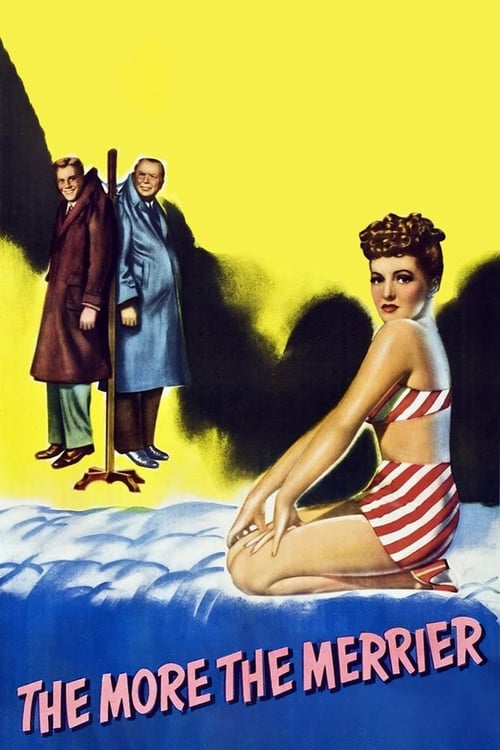
The More the Merrier
1943 · George Stevens
For a cozy night in when you want to fall in love — classic Hollywood comfort at its most charming. Zero challenge, maximum delight.
What it's about
Wartime Washington, D.C. is so overcrowded that renting out half your apartment counts as patriotism — which is how Connie Milligan, a briskly over-organized government worker, ends up with Benjamin Dingle, a mischievous older gentleman, as a tenant. Dingle promptly sublets half of his half to Joe Carter, a handsome young Army sergeant, and then sets about playing matchmaker in an apartment built for one.
The experience
Warm, fizzy, and precision-timed — a farce of shared bathrooms and morning schedules that keeps sliding into real romantic longing. It's laugh-out-loud funny and unexpectedly swoony, with one doorstep scene that's pure electricity.
Performances
Jean Arthur is at her best — flustered, funny, and quietly yearning; Charles Coburn won an Oscar as the twinkling meddler Dingle; and Joel McCrea underplays beautifully, letting a famous late-night courtship scene simmer on almost nothing but glances.
The craft
George Stevens directs cramped-quarters comedy with musical precision — the morning-routine choreography in the shared apartment is a master class in physical staging — while the script turns a real housing crisis into an engine for romance. It earned six Academy Award nominations, including Best Picture.
Why it matters
One of the most acclaimed American comedies of the war years and a template for the close-quarters romantic comedy; it also marked the high point of Stevens' comic career before the war changed the kinds of films he made.
Snapshot
The More the Merrier is a wartime romantic comedy produced by Columbia Pictures and released in 1943, at the height of American involvement in the Second World War. Directed by George Stevens, it stars Jean Arthur as Connie Milligan, a brisk, over-organized government worker in an overcrowded Washington, D.C.; Charles Coburn as Benjamin Dingle, the twinkling older gentleman who talks his way into half her apartment; and Joel McCrea as Joe Carter, the young Army sergeant to whom Dingle sublets half of his half. The premise turns a genuine social crisis — the acute housing shortage in the swollen wartime capital — into the engine of a farce about proximity, propriety, and desire. The film became one of the most acclaimed comedies of its year, earning six Academy Award nominations, including Best Picture, Best Director, and Best Actress, and winning Best Supporting Actor for Coburn. It stands near the end of Stevens's career as a maker of light comedy, made shortly before his wartime service abroad recast him as a graver, more monumental filmmaker.
Industry & production
The film was a Columbia Pictures production, made within the studio system at a moment when Hollywood was both a commercial industry and an arm of the war effort. Columbia in this period was Harry Cohn's lean, mid-major operation, home to Frank Capra's populist comedies and to Jean Arthur, one of the studio's most valuable stars. The More the Merrier fits squarely into Columbia's house strength in topical comedy: it takes a headline condition of 1943 — Washington bursting with war workers and nowhere to put them — and builds a self-contained comic machine around it.
George Stevens produced as well as directed, a mark of the authority he had accumulated after the successes of Gunga Din (1939), Woman of the Year (1942), and The Talk of the Town (1942). The screenplay is credited to Robert Russell, Frank Ross, Richard Flournoy, and Lewis R. Foster, with the original story credited to Russell and Ross; the tangle of names reflects the collaborative, much-revised nature of studio comedy writing rather than a single authorial voice. The production was essentially studio-bound, staged on Columbia soundstages, with the apartment set — the film's true theater of operations — doing much of the dramatic work.
Contextually, the film belongs to a Hollywood operating under wartime constraints: material rationing, the draft thinning the ranks of young leading men, and the industry's coordination with government messaging about civilian sacrifice. The More the Merrier threads this needle deftly, treating patriotic duty (Connie sublets out of a sense of obligation) as both sincere and a comic pretext. Precise budget and box-office figures for the film are not something I can state reliably, so I won't; what is clear from its Academy recognition and lasting reputation is that it was received as a prestige comedy rather than a programmer.
Technology
The picture was shot on black-and-white 35mm film in the standard Academy aspect ratio, using the conventional studio sound-on-film apparatus of the early 1940s. There is nothing about the film that announces technical novelty — it is not a showcase for color, deep-focus experiment, or optical spectacle in the way that, say, Citizen Kane (1941) had recently been. Its technology is the mature, largely invisible craft of the classical Hollywood studio at its most fluent: incandescent lighting, dolly-and-crane camera support, and the tight integration of camera, sound, and cutting that the system had perfected. Detailed records of the specific cameras and lenses used on this production are not well documented in the public literature, and I won't invent particulars; the meaningful point is that the film deploys standard tools with unusual finesse in the service of intimacy and timing.
Technique
Cinematography
The cinematography is credited to Ted Tetzlaff, a skilled Hollywood cameraman who would later direct (notably the 1949 thriller The Window). His work here is in the polished, unshowy register appropriate to romantic comedy: even, flattering key light on the stars, clean compositions, and a camera that moves to keep bodies in productive relation to one another within the cramped apartment. The photographic style serves the film's central problem — how to make a small set feel by turns claustrophobic and charged — by favoring medium and close framings that press the characters together. The celebrated nighttime courtship sequence, played largely on an exterior stoop, is lit and framed for softness and closeness, letting shadow and physical adjacency carry an erotic suggestion that the dialogue never states outright.
Editing
Otto Meyer edited the film, and the cutting is central to its comic and romantic effect. Screwball and character comedy live or die on timing, and The More the Merrier is precisely cut to the rhythms of overlapping routine — the morning-schedule sequence, in which the three tenants try to share one bathroom and one small kitchen without colliding, is a set piece of comic choreography that depends on editing to keep its clockwork legible and funny. Elsewhere the editing slows and lingers, most famously in the seduction scene, where the cutting yields to sustained proximity and the film lets a beat run long rather than clipping it for a gag. The result is a picture that modulates confidently between farcical acceleration and romantic suspension.
Mise-en-scène / staging
The apartment is the film's world, and Stevens stages within it with a strong sense of spatial logic: doorways, partitions, and the negotiated boundaries of "your half" and "my half" become dramatic and comic architecture. The housing shortage is not merely a plot premise but a staging principle — the whole comedy is about too many people in too little space, and the blocking makes that congestion palpable. Stevens repeatedly uses the geography of the flat (who can see whom, who must pass through whose room) to generate both farce and intimacy. The famous stoop scene relocates this logic outdoors, but the principle holds: two people pressed close, unable to keep a proper distance, with the physical setup doing the emotional work.
Sound
The sound design is conventional for its date and mostly transparent, prioritizing dialogue intelligibility — essential in a film so driven by rapid, overlapping talk. The musical score is by Leigh Harline, a composer associated with both Disney (he contributed to Pinocchio) and a range of studio pictures; his work here supports the tonal shifts between comic bustle and tender feeling without calling attention to itself. Coburn's recurring vocal motif — Dingle's habit of barking Admiral Farragut's "Damn the torpedoes! Full speed ahead!" — functions almost as a sonic signature for the character, a verbal tic that becomes a running gag and a statement of the film's matchmaking philosophy.
Performance
Performance is where the film is most extraordinary, and it rests on three finely calibrated turns. Jean Arthur, with her distinctive husky, catching voice, plays Connie as a woman whose rigid self-management is a brittle defense against her own feelings; her comedy is built from fluster, from the collapse of composure. Arthur received her only Academy Award nomination for acting for this role, a recognition of one of the great comedic performances of the studio era. Joel McCrea's Joe is relaxed, easy, and physically confident — a warm foil to Arthur's tightly wound Connie. And Charles Coburn's Dingle is the film's engine and its Oscar-winning centerpiece: a benevolent meddler, a self-appointed cupid whose delight in engineering the romance gives the picture its generous spirit. The three-way chemistry is the film's real special effect.
Narrative & dramatic mode
Structurally, the film is a chamber comedy that observes a near-unity of place: most of the consequential action occurs in and around one small apartment over a compressed span of time. Its dramatic mode is romantic comedy with a strong current of farce, organized around a classic device — the enforced cohabitation of people who should not, by the rules of propriety, be sharing space. Dingle operates as a plot-agent and matchmaker, a figure who exists partly outside the romance in order to push it forward, and his scheming supplies the causal machinery while Connie and Joe supply the feeling. The film manages a delicate tonal balance: it is bawdier and more physically frank than much comedy of its moment, yet it remains warm rather than cynical, and it resolves toward union and reconciliation in the traditional comic shape.
Genre & cycle
The More the Merrier sits in the tradition of American romantic and screwball comedy that had flourished since the mid-1930s, but it also marks that cycle's wartime inflection. Where classic screwball often pitted the sexes in combative, class-inflected mismatches, this film channels the same energies through a specifically 1943 situation — the crowded home front — and softens the screwball's abrasiveness into something more tender. It belongs to a small cluster of home-front comedies that mined civilian wartime conditions for humor, and it is among the most durable of them precisely because its premise (scarcity forcing intimacy) is both topical and archetypal. Within Stevens's own filmography it is a late entry in his comedy period, kin to The Talk of the Town in its blend of romance and social observation.
Authorship & method
As director-producer, George Stevens is the controlling authorial presence, and the film exemplifies the qualities that distinguished his pre-war work: meticulous attention to performance, a patient sense of timing, and a willingness to let scenes breathe past the point where a lesser comedy director would cut away for the laugh. Stevens was known as a careful, even painstaking craftsman who shaped effects through accumulation and rhythm rather than flash. The seduction sequence is often cited as the clearest evidence of his method here — its power comes from duration and restraint, from trusting the actors and the audience rather than the joke.
His key collaborators shaped the result materially: cinematographer Ted Tetzlaff supplied the clean, intimate images; editor Otto Meyer gave the comedy its precise pulse; composer Leigh Harline underscored the tonal shifts; and the writing team of Russell, Ross, Flournoy, and Foster built the durable comic architecture. The film's authorship is best understood as the disciplined studio collaboration of the period, presided over by a director at the peak of his comic powers. It is worth noting the biographical hinge: shortly after this film, Stevens went to war, leading a combat photography unit and filming, among other things, the liberation of Dachau. The director who returned made A Place in the Sun, Shane, and Giant — graver, more monumental works. The More the Merrier is thus a kind of farewell to Stevens the comedian.
Movement / national cinema
The film is a product of classical Hollywood at its most assured — the studio system's mode of tightly integrated, star-driven, genre-organized filmmaking. It does not belong to any avant-garde or self-conscious movement; its "movement," if the term applies, is the mainstream American commercial cinema of the early 1940s and its particular wartime variant, in which entertainment and morale-building were intertwined. As American national cinema, it is notable for how thoroughly it domesticates the war: the conflict is present everywhere as pressure and pretext — the housing crisis, Joe's imminent deployment, the ethos of civilian duty — without a single battle scene.
Era / period
1943 places the film at the emotional center of the American home-front experience: the war effort fully mobilized, Washington swollen with personnel, young men in uniform and on the verge of shipping out. The film registers its era with unusual specificity. The scarcity that drives the plot is not a comic contrivance but a documented condition of the wartime capital, and the shadow of Joe's coming departure gives the romance a gentle urgency that a peacetime version could not carry. The picture belongs to that stretch of the studio era just before the postwar shift, when American movies would begin absorbing darker, more disillusioned tones. It is a comedy poised on the near edge of that change.
Themes
The film's governing theme is intimacy produced by scarcity — the way enforced closeness breaks down the barriers people erect around themselves. Connie's over-planned life, with its schedules and its "sensible" fiancé, is a structure of control that the crowded apartment dismantles; the film argues, gently, for feeling over management, for spontaneity over the safe arrangement. Running alongside is the theme of matchmaking and benevolent meddling embodied by Dingle, whose interference frames romance as something that sometimes needs an outside hand. There is also a quietly subversive treatment of propriety and desire: the film is remarkably candid, for 1943 and within the constraints of the Production Code, about physical attraction, staging its most charged scene as a triumph of implication. And underneath it all runs the wartime theme of transience — of connection formed in the knowledge that it may soon be interrupted.
Reception, canon & influence
Critically and within the industry, The More the Merrier was received as one of the finest comedies of its year, a judgment ratified by its six Academy Award nominations — Best Picture, Best Director for Stevens, Best Actress for Jean Arthur, Best Supporting Actor for Charles Coburn (the film's single win), and nominations in the story and screenplay categories. Arthur's nomination is historically poignant as the only Oscar recognition of her acting in a major career, and Coburn's win crowned one of the great character-actor turns of the era.
Looking backward, the film draws on the screwball and romantic-comedy traditions of the preceding decade — the mismatched-couple structure, the fast verbal comedy, the matchmaker device — and on Stevens's own prior successes in the form. Looking forward, its most concrete legacy is its 1966 remake, Walk, Don't Run, which transplanted the housing-shortage premise to Tokyo during the 1964 Olympics and is remembered chiefly as Cary Grant's final screen role — a direct testament to the durability of the original's construction. More diffusely, the film's celebrated courtship scene has been repeatedly cited by critics and filmmakers as a model of eroticism achieved through suggestion, restraint, and duration rather than explicitness, and it remains a touchstone in discussions of how classical Hollywood conveyed desire under the Code. Within George Stevens's career, the film holds a special place as the last full flowering of his gift for comedy before the war redirected him toward gravity and scale. It endures as a beloved, frequently revived example of the American studio comedy at its most humane and precisely made.
A Deleuzian reading
Two people sit on a stoop in Washington on a summer night, talking about the day the way you talk when you don't want to say the real thing.
The full Deleuzian reading of The More the Merrier →
Reception
A genuine wartime hit — it charmed 1943 audiences with its Washington housing-shortage premise and pulled six Oscar nominations — and it's since settled into 'best romantic comedy you haven't seen' status, routinely rediscovered and evangelized by classic-Hollywood fans.
How The More the Merrier was received, from release to now →
How to watch The More the Merrier: what to notice on a first viewing
- Watch how the apartment splits into 'your half' and 'my half.' Doorways and partitions become the comedy's real architecture, with three tenants negotiating who can see whom and who must pass through whose room. The whole apartment does the work a single bedsheet did in an earlier comedy.
- Watch the morning bathroom-and-kitchen routine time three tenants at once. Otto Meyer's editing keeps three overlapping schedules legible as pure comic choreography, a traffic problem solved by cutting rather than by dialogue. The comedy comes purely from the constraints of a system, not from any joke told.
- Watch Jean Arthur's composure crack a little at a time. Arthur plays Connie's rigid scheduling as a brittle defense, and the comedy is built from fluster, the visible collapse of self-management. Her stubbornness reads as temperament rather than heroism, which keeps the film from turning soft.
- Listen for Dingle barking 'damn the torpedoes, full speed ahead.' Coburn's recurring line becomes a verbal tic and a running gag that doubles as his whole matchmaking philosophy toward Connie and Joe. The catchphrase tells you exactly what kind of meddler you're dealing with.
The whole guide to watching The More the Merrier, with the keys for a rewatch →
Influences: the films it descends from and the films it influenced
- It Happened One Night (1934) — Establishes the device of forcing two strangers to partition a single sleeping space — the 'Walls of Jericho' blanket — so that propriety itself becomes the erotic apparatus, the direct model for the seed's one-apartment enforced cohabitation.
- Alice Adams (1935) — Stevens's own earlier proof that holding a social scene (the sweltering disastrous dinner) far past the comfort point extracts feeling from sheer duration — the sustained-duration technique the seed later applies to seduction.
- The Awful Truth (1937) — McCarey's improvisatory method of letting comedy accumulate from actors' behavior rather than cutting to the gag taught the patient, breathing comic pulse that Stevens's editing here inherits.
- Easy Living (1937) — Fixes Jean Arthur's flustered working-girl dignity as a comic register and builds screwball from economic scarcity — the exact persona and scarcity-driven engine Stevens redeploys.
- The Shop Around the Corner (1940) — Routes desire through indirection, closed doors, and what goes unspoken in a confined workplace — the Lubitschean eroticism-by-suggestion-under-the-Code that the seed's courtship scene refines.
- The Talk of the Town (1942) — The immediate prior film: Jean Arthur again anchoring a three-person forced-household triangle sharing one dwelling, a near-literal structural rehearsal for the seed's cohabitation comedy.
- Vivacious Lady (1938) — Stevens working out screwball comic timing around a secret-marriage propriety premise, honing the patient reaction-shot rhythm the seed depends on.
- The Apartment (1960) — Makes a contested, shared apartment the very machinery of romance and moral compromise, extending the seed's spatial-logic-apartment premise into a bittersweet register.
- Pillow Talk (1959) — Re-stages enforced proximity between antagonists via a shared party-line telephone, sustaining desire through Code-era innuendo and suggestion rather than explicitness.
- Walk, Don't Run (1966) — The direct remake, transplanting the housing-shortage cohabitation to the 1964 Tokyo Olympics with Cary Grant assuming Coburn's matchmaker-meddler function intact.
- Barefoot in the Park (1967) — Turns a cramped walk-up apartment into the entire comic arena, extending the seed's staging of intimacy and friction generated purely by confined domestic space.
- Annie Hall (1977) — Advances courtship through sustained real-time conversational duration and walk-and-talk restraint rather than plot event, the modern heir to the seed's celebrated talk-driven seduction.
- Standing Room Only (1944) — Part of the identical home-front cycle, turning the wartime Washington housing shortage into a forced-proximity farce that mirrors the seed's premise beat for beat.
- The Doughgirls (1944) — Overcrowds a single wartime D.C. hotel suite into a comic pressure-cooker of enforced cohabitation, the same scarcity-as-farce-engine staged in one confined set.
- The Palm Beach Story (1942) — A contemporary screwball driving romance through matchmaker-meddler intervention and rapid propriety-and-desire negotiation, sharing the seed's Code-era engine of intimacy under social constraint.
Similar films
- The Apartment (1960) — influence & lineage
- It Happened One Night (1934) — influence & lineage
- The Awful Truth (1937) — influence & lineage
- The Shop Around the Corner (1940) — influence & lineage
- The Best Years of Our Lives (1946) — shared sensibility
- Mrs. Miniver (1942) — shared sensibility
- Some Like It Hot (1959) — shared sensibility
- Casablanca (1943) — shared sensibility