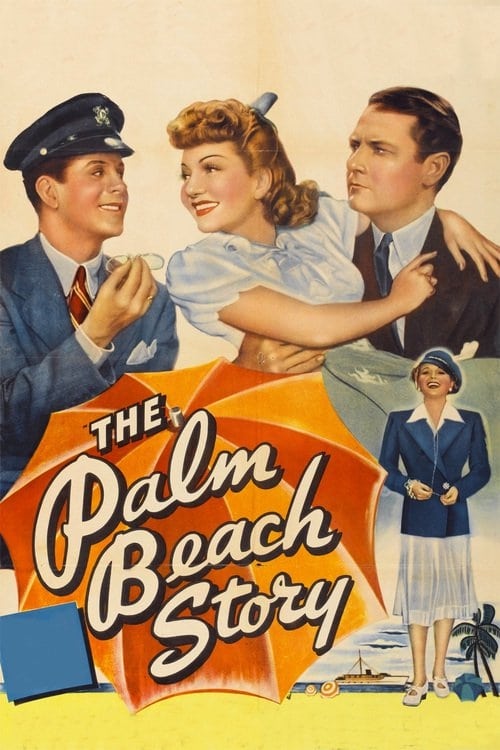
The Palm Beach Story
1942 · Preston Sturges
For a night when you want to laugh hard and feel clever doing it — vintage comfort viewing with a cynical streak, perfect solo or as a date movie for people who like their romance with teeth.
What it's about
Gerry Jeffers loves her husband Tom, a broke New York inventor with a grand scheme and no backers — so she decides the practical thing is to divorce him, marry a millionaire, and fund the invention with her new fortune. She hops a train to Palm Beach and promptly lands J.D. Hackensacker III, one of the richest men alive, while his much-married sister sets her sights on Tom, who has come chasing after his wife.
The experience
Fast, silly, and razor-sharp all at once — the dialogue crackles, the complications pile up at screwball speed, and a train sequence involving a drunken hunting club is pure sustained lunacy. It's ninety-odd minutes of nonstop pleasure.
Performances
Claudette Colbert is effortlessly funny and completely in command as Gerry, Joel McCrea plays the exasperated straight man to perfection, and Rudy Vallee's mild, penny-counting millionaire is one of the great comic supporting turns.
The craft
Preston Sturges wrote and directed, and his machinery runs frictionless: dialogue that pings like a pinball table, a huge gallery of comic bit players, and a structure with an audaciously absurd opening and ending that bookend the farce. The wit is in the writing, and every line is built to land.
Why it matters
A peak of Sturges's astonishing early-1940s run and a cornerstone of screwball comedy — its cheerful cynicism about money, marriage, and sex remains startlingly modern.
Snapshot
The Palm Beach Story is the fifth film Preston Sturges directed from his own screenplay in under three years, and the one in which his comic machinery runs at its most frictionless and its most nihilistic. Gerry Jeffers (Claudette Colbert), broke and clear-eyed, concludes that the most valuable asset in her marriage is herself, and resolves to liquidate it: she will leave her inventor husband Tom (Joel McCrea), divorce him in Palm Beach, marry money, and finance his airport-suspended-over-a-city scheme with the proceeds. What she finds in Florida is John D. Hackensacker III (Rudy Vallee), a fortune so large it has become a personality disorder, and his much-married sister, the Princess Centimillia (Mary Astor), who wants Tom. Around this quadrangle Sturges arranges a two-minute wordless prologue nobody can parse until the last shot, a train car full of drunken millionaires firing shotguns at crackers, and a closing title that retracts its own happy ending.
It is the most purely farcical of the great Sturges comedies — less morally invested than Sullivan's Travels, less romantically wounded than The Lady Eve — and for that reason it has often been treated as the lightweight of the run. That reading undersells it. Beneath the speed is the least sentimental account of marriage, sex, and money in American studio comedy of the period: not a film in which love conquers economics, but one in which love is candidly described as an economic instrument and the joke is that everyone already knows it.
Industry & production
The film was produced and released by Paramount at the end of 1942, the studio where Sturges had spent the 1930s as a highly paid contract writer before engineering the deal that changed the profession. In 1939–40 he sold Paramount the script that became The Great McGinty for a nominal sum — the figure is reported variously and small — on the condition that he direct it. It worked; McGinty won him the first Academy Award for Original Screenplay, and Paramount let him run. Christmas in July (1940), The Lady Eve (1941), Sullivan's Travels (1941), and The Palm Beach Story followed in rapid succession, with The Miracle of Morgan's Creek, Hail the Conquering Hero, and The Great Moment to come. No one in the sound era had yet held that combination of authorship and autonomy inside a major studio; Sturges's success is the proximate cause of the writer-director as a normal Hollywood category.
The picture ran into the Production Code before it ran into a camera. Sturges developed it under the title Is Marriage Necessary?, which the Breen Office would not permit, and the substitution of a geographic title for a rhetorical one is the single most legible trace of Code pressure on the film. The premise itself — a wife who leaves a husband she still loves in order to sell her marriageability to a richer man — sits directly on the Code's prohibitions regarding divorce, adultery, and the treatment of marriage as a business. Sturges's solution was not to soften the idea but to speak it aloud so quickly and so wittily that it passes as banter. Gerry's account of what a woman's body is worth in the marketplace ("You have no idea what a long-legged gal can do without doing anything") is franker than most of what the Code was actually catching, and it survives because it is phrased as sociology.
Production took place under wartime conditions, with the industry already absorbing material rationing and personnel losses, yet the film is conspicuously free of the war: no uniforms, no bond drives, no home-front pieties. Palm Beach in this film is a place where money still behaves as it did in 1929. The escapism is deliberate and, in 1942, faintly perverse.
The film's precise commercial performance is not something the surviving record reports cleanly, and figures attached to it elsewhere should be treated with suspicion. It was received as a Sturges picture in a run of Sturges pictures, did respectable business, and went unrecognized at the Academy Awards.
Technology
Standard Paramount practice of the period: 35mm nitrate black-and-white negative, Academy ratio (1.37:1), optical soundtrack recorded on the studio's Western Electric system, and a house post-production apparatus — art department under supervising art director Hans Dreier, with Ernst Fegté designing, and gowns by Irene — that could deliver a Park Avenue duplex, a Pullman club car, a Florida hotel lobby, and a millionaire's yacht without leaving the lot.
The most technologically consequential department here is process photography. The extended train sequence is built on rear-projection and transparency work of the kind Paramount's process unit, long headed by Farciot Edouart, had refined to industry-leading quality by the early 1940s. This matters aesthetically, not just logistically: Sturges wanted the train to be a stage — a fixed, crowded, talkable space with the illusion of forward motion behind it — and process work let him block long dialogue takes inside a moving vehicle without cutting to exteriors. The same is true of the Erl-King-class yacht material and the Florida location illusion. Almost the entire film is a studio construction of places the audience already had picture-postcard images of, and Sturges exploits the artificiality rather than concealing it.
Technique
Cinematography
Victor Milner, who had shot Lubitsch at Paramount (Trouble in Paradise among them) and The Lady Eve for Sturges the previous year, photographs the film in a bright, even, high-key register that refuses to editorialize. There is very little expressive lighting; the comedy is not being underlined. Milner's real contribution is depth and breadth of field — Sturges's frames routinely hold four to eight speaking bodies, and the compositions keep faces legible at multiple planes so that a gag can be built on someone reacting in the background.
Sturges's camera is mobile but not showy: it reframes, pans, and dollies to follow bodies through rooms rather than cutting them into pieces. He is notably sparing with close-ups, and the effect is to keep performers whole. When you can see an actor's legs, a slammed door, and a listening third party in one shot, the comedy becomes spatial and physical rather than a series of punchlines assembled in the cutting room.
Editing
Stuart Gilmore, Sturges's editor across the middle Paramount films, cuts the dialogue scenes conservatively — long takes, few reaction inserts, an aversion to the shot-reverse-shot metronome. The exception is the title sequence, which is the most densely cut two minutes in the entire Sturges corpus: a silent-comedy prologue of running maids, unconscious bodies, a bride sprinting for a wedding, doors, telephones, and a taxi, delivered in fast-motion fragments over the credits and driven by the William Tell Overture. It is deliberately incomprehensible. The film then proceeds for ninety minutes as though the prologue had never happened, and resolves it in the final thirty seconds with the revelation that both Gerry and Tom have identical twins. The structure is a joke about narrative closure itself: the film ends where it began, "and they lived happily ever after — or did they?"
Mise-en-scène / staging
Sturges stages like a playwright who has discovered that a camera can hold a crowd. The Ale and Quail Club — a shooting party of elderly, armed, alcoholic millionaires who adopt Gerry, then destroy the train car around her — is the purest example: an anarchic set piece with no plot function, sustained for minutes, in which the frame simply becomes too full. Critics have called it a digression; it is better understood as the film's thesis rendered as slapstick. The rich in this film are not villains, they are weather.
The Wienie King (Robert Dudley), a deaf Texas sausage millionaire who wanders into the Jeffers apartment inspecting it as a prospective tenant and hands Gerry the money that launches the plot, is the film's structural scandal: a deus ex machina who arrives twice, unmotivated both times, and who is given the single most beautiful line Sturges ever wrote about aging. The staging refuses to mark him as significant. He simply enters, transacts, and shuffles out.
Sound
The dialogue is fast, overlapping, and written for interruption; Sturges's characters talk past each other and finish sentences that were never going to arrive. Around the talk he layers a comic soundscape — hunting horns, baying dogs, shotgun blasts, a small orchestra materializing under a window at night. Victor Young is credited with the score, and its principal function is to be blandly romantic in exactly the places where the writing is being cold-blooded.
Sound is also characterization. Vallee's Hackensacker, cast against a national memory of Vallee as the megaphone crooner of the late 1920s, serenades Gerry with "Goodnight, Sweetheart" — a joke that requires the audience to know who Rudy Vallee used to be. Sig Arno's Toto speaks a pan-European gibberish reducible to "Greetings" and "Nitz," a running gag about the Continental parasite that also quietly registers the émigré texture of wartime Hollywood.
Performance
Colbert, eight years past It Happened One Night and one of the most technically assured comediennes in the industry, plays Gerry as a woman who has done the arithmetic and is not embarrassed by the result. Her control of tempo — the ability to deliver a mercenary proposition with the warmth of an endearment — is what keeps the character from reading as monstrous. (Her reported insistence on being photographed from her left side is a long-standing anecdote of the period; whatever the constraint, Milner accommodates it invisibly.)
McCrea, fresh from Sullivan's Travels, does the harder and less rewarded job: the straight man whose sincerity is the surface the jokes bounce off. Vallee's Hackensacker is the film's most surprising achievement, a stiff, thrifty, fundamentally decent man whose fortune has left him with no idea how to be a person — a parody of Rockefeller thrift (the itemized expense book, the dime-adjacent sensibility) played with real pathos. Mary Astor, arriving from The Maltese Falcon and an Academy Award for The Great Lie, throws herself into the Princess Centimillia at a speed that borders on hysteria and lands one of the film's best lines about the era's only fixed point: "Nothing is permanent in this world — except for Roosevelt."
Around them, the Sturges stock company — William Demarest, Franklin Pangborn, Jimmy Conlin, Robert Warwick, Torben Meyer, Chester Conklin, Al Bridge, Roscoe Ates — supplies a repertory density unusual in studio filmmaking, several of them veterans of Sennett-era silent comedy whose faces carry two decades of American slapstick into a 1942 drawing-room farce.
Narrative & dramatic mode
The film is a comedy of remarriage that treats remarriage as an accounting correction. Its dramatic engine is not misunderstanding but candor: everyone states their interests plainly, and the complications arise from the fact that stated interests conflict. Structurally it is a picaresque — apartment, train, Palm Beach, yacht — bracketed by a prologue that withholds its meaning and an epilogue that detonates it. The twin ending is not a cheat so much as a formal declaration that the happy ending is a mechanism, available in duplicate, and that the film knows it.
Genre & cycle
This is late screwball. The cycle that opened with It Happened One Night (1934) — starring, not incidentally, the same actress on the same kind of journey — was largely exhausted by 1942, its energies migrating toward wartime comedy and film noir. The Palm Beach Story arrives with the conventions fully mature and available for stress-testing: the mismatched couple, the class collision, the transit-as-courtship, the ridiculous rich. Stanley Cavell's Pursuits of Happiness (1981) canonized The Lady Eve among its seven comedies of remarriage but did not include this one, and the omission is instructive — Cavell's remarriage films are about the moral education of a couple, and The Palm Beach Story declines to educate anybody. Its couple ends where it started, only richer and doubled.
Authorship & method
Sturges wrote his own scripts and directed them essentially as written, with a stock company he cast repeatedly and a technical crew — Milner, Gilmore, Dreier's art department — he worked with across multiple pictures. His method was verbal-first: the script contained the rhythm, and the direction existed to protect it, which is why the staging favors long takes and full figures.
His background is unusual for a Hollywood writer and legible in the film. Raised partly in Europe by his mother Mary Desti, a friend of Isadora Duncan; a businessman and inventor before a writer (he patented improvements to lipstick); a Broadway success with Strictly Dishonorable (1929); then the author of The Power and the Glory (1933), whose fractured flashback construction is regularly cited as a precursor to Citizen Kane, and of Easy Living (1937) and Remember the Night (1940) for Mitchell Leisen. The European boulevard comedy, the American vaudeville turn, and the inventor's fascination with mechanisms all meet in this film, where the plot is a machine and the ending is its patent claim.
Movement / national cinema
American studio comedy at the end of its classical peak, produced inside the Paramount house style whose presiding intelligence was Ernst Lubitsch. The Lubitsch inheritance is direct — worldly, sexually knowing, Continental in accent, willing to let money and desire be the same subject — and Milner's presence links the two bodies of work physically. Against that runs a native strain: Sennett slapstick, minstrel-descended vaudeville rhythms, and the American tall tale. Sturges is the point where the two traditions are held in the same frame, sometimes in the same shot.
Era / period
A 1942 film about 1930s money, made for an audience at war. The Depression is over, replaced by wartime full employment; Palm Beach is a fantasy of a leisure class that the war was in the process of taxing and rationing into a different shape. The film's refusal to acknowledge any of this is its period signature. Its one topical joke — Roosevelt as the only permanent thing — dates it precisely.
Themes
Marriage as a market. Sexual attraction as capital that depreciates and must be spent. The absurdity of inherited wealth and the decency it sometimes fails to destroy. Male sincerity as an economic liability. And, running under the farce, an unsentimental theory of time: the Wienie King's speech about the hands of time creeping along, destroying "that which yesterday was young," is the only moment the film stops moving, and it is spoken by a comic grotesque who sells sausages.
Reception, canon & influence
Contemporary reviews were broadly favorable without treating the film as an event; it was received as another Sturges, in a period when there was another Sturges roughly twice a year. The detailed contemporary critical record for this title is thinner than for The Lady Eve or Sullivan's Travels, and it has generally been ranked below both.
Its critical fortunes track Sturges's. James Agee wrote seriously about him in the 1940s; Manny Farber and W. S. Poster's "Preston Sturges: Success in the Movies" (1954) made the case for him as a major and characteristically American artist. Andrew Sarris, in The American Cinema (1968), consigned Sturges to the "Less Than Meets the Eye" category — an assessment that now reads as the auteurist establishment's blind spot regarding comedy, and one that later criticism has thoroughly reversed. The film has been restored, issued on disc in curated editions, and revived steadily; among Sturges specialists it is frequently the connoisseur's pick.
Backward, the film draws on Lubitsch's Paramount comedies, on It Happened One Night (with Colbert re-boarding the train), on the Marx Brothers' brand of institutional anarchy, on European boulevard farce, and on the silent slapstick embodied by the aging comics Sturges cast.
Forward, its influence is diffuse but real. The most consequential legacy is structural: Sturges's writer-director bargain opened the path that Billy Wilder, John Huston, and eventually the New Hollywood generation walked through. Aesthetically, the repertory-company model and the collision of erudite dialogue with pratfall physical comedy run directly to Peter Bogdanovich's What's Up, Doc? (1972), to the Coen brothers — The Hudsucker Proxy and Intolerable Cruelty, the latter a divorce-for-money farce that is unthinkable without this film — and to Wes Anderson's use of a recurring troupe. Wilder and I. A. L. Diamond's late comedies inherit the tone: characters who say the transactional truth out loud and are funnier for it.
What has not been imitated successfully is the ending. The twin coda remains one of the most audacious formal gestures in a Hollywood comedy — a film that supplies its own happy resolution, then holds it up and asks the audience to notice how easily one was manufactured.
A Deleuzian reading
A deaf Texas sausage millionaire wanders into a Park Avenue apartment he's thinking of renting, walks the rooms, hands the current tenant's broke young wife a wad of cash, says the loveliest thing Preston Sturges ever wrote about growing old, and shuffles out.
The full Deleuzian reading of The Palm Beach Story →
Reception
A hit in 1942 as part of Sturges's astonishing hot streak, it was long treated as the 'fun one' next to The Lady Eve and Sullivan's Travels — but it's since been reappraised as maybe his purest, fastest, most anarchic comedy, a fixture on best-screwball lists.
How The Palm Beach Story was received, from release to now →
How to watch The Palm Beach Story: what to notice on a first viewing
- Watch how many speaking people fit in a single shot. Sturges and cinematographer Victor Milner hold four to eight bodies in frame at once, favoring full figures and reframing pans over cutting to close-ups. A joke can be built on someone reacting quietly at the back of the frame.
- Listen for characters talking over each other and finishing nothing. The dialogue is written for interruption, characters cutting each other off and completing sentences that were never going to arrive in the first place. The rhythm of the talk is doing as much comedy as any single line.
- Notice how bright and even the lighting stays throughout. Milner photographs the film in a flat, high-key register with almost no shadow or mood lighting, refusing to visually underline any joke. The comedy is left to land entirely on its own, without help from the lighting.
- Watch the train car fill up until it's too crowded. A whole club of armed, drunk millionaires takes over Gerry's train car for minutes, escalating on pure gag logic with no real function in the plot. Sturges treats chaos itself as the joke, not a means to some other punchline.
- Notice how casually the film treats the man who hands Gerry money. The Wienie King enters twice, unexplained both times, and the staging never marks him as important, just another guest passing through the apartment. The film refuses to flag its own most consequential moment as consequential.
The whole guide to watching The Palm Beach Story, with the keys for a rewatch →
Influences: the films it descends from and the films it influenced
- Seven Chances (1925) — Keaton's undercranked mass pursuit and his conception of a marriage deadline as a piece of engineering are the silent-comedy substrate of Sturges's fast-motion credit prologue and of a plot built and sprung like a patented mechanism.
- Trouble in Paradise (1932) — Lubitsch's Paramount house grammar — seduction and solvency conducted in the same suave vocabulary, the decisive transaction elided behind a closed door — is what Sturges inherits and deliberately coarsens in the Wienie King's cash-for-nothing courtship.
- The Power and the Glory (1933) — Sturges's own script invented 'narratage,' a chronology that opens at its end and loops back — the closed-circuit architecture he reuses here, where the wedding raced through under the credits is the one the twin coda finally explains.
- Duck Soup (1933) — The Ale and Quail Club's shotgun demolition of a Pullman car is Marxian institutional anarchy imported whole: a chartered fraternal order handed a set piece that escalates purely by gag logic and touches the plot only by getting the car uncoupled.
- It Happened One Night (1934) — Colbert boarding a southbound train as a runaway wife, her fare underwritten by strangers, moving through an episodic road structure — Sturges re-stages his own star's Capra vehicle and turns its sponsored-passage economics from romance into an openly quoted price.
- Twentieth Century (1934) — Hawks and Hecht–MacArthur established the train as a pressure chamber for farce — a fixed row of compartments an ensemble ricochets through at rising volume — which is the staging template for the club car and the Ale and Quail rampage.
- Easy Living (1937) — Sturges's own screenplay already holds the engine — a woman lifted through the class system by an unearned windfall, plus a mass-destruction comic set piece (the Automat riot) staged as pure escalation — which here he finally directs himself instead of surrendering to another man's camera.
- The Awful Truth (1937) — McCarey codified the remarriage comedy's middle movement — the interposed third party who exists to be out-timed — and the loose overlapped delivery that lets each line land on the tail of the last; Hackensacker and the Princess are that machinery run at higher RPM.
- The Lady Eve (1941) — The companion piece in method: courtship as a confidence game kept on a ledger, a heroine who runs the con, and long-take deep-staged two-shots that hold both figures full-length so the writing, not the cutting, sets the rhythm.
- Bringing Up Baby (1938) — Sturges inherited Baby's editorial logic of complication stacking — each scene adds an unresolved complication rather than clearing a prior one — with the Ale & Quail Club sequence functioning as a direct structural echo of Baby's escaped-leopard escalation.
- Remember the Night (1940) — The full flowering of the eccentric-supporting-character, overlapping-dialogue comedy whose seeds are the oddball bit players (the shoplifting hearing, the farm relatives) written into Remember the Night.
- Midnight (1939) — Carries forward the champagne-comedy of marital masquerade and mistaken wealth, staged as glittering set-piece theatricality among the idle rich.
- Some Like It Hot (1959) — Wilder's Pullman-berth party is the Ale and Quail Club rebuilt as a nightclub in motion, and the Florida resort second act — a comic millionaire courting under a false identity, with a yacht as the closing argument — reproduces this film's entire back half.
- The Apartment (1960) — Wilder and Diamond took Sturges's writer-director bargain and his habit of letting characters name the transaction out loud — favors, keys and bodies itemized in plain commercial language — and held the accounting a beat longer, until it stung.
- What's Up, Doc? (1972) — An explicit revival: hotel-suite ensemble farce with doors and adjacent rooms as the machine, a heroine who functions as a plot device aimed at a passive man, and Sturges's specific collision of high-diction dialogue with pratfall physical comedy.
- The Hudsucker Proxy (1994) — The Coens rebuild the 1940s dialogue meter and the plot-as-patented-invention, then resolve it with an unembarrassed deus ex machina — an angel stopping the clock — which is the twin-brother coda's trick of supplying a manufactured happy ending and letting you see the seams.
- Intolerable Cruelty (2003) — A divorce-for-money farce that treats the prenuptial agreement exactly as Sturges treats the Wienie King's roll of bills — marriage as an enforceable contract whose terms are stated aloud — and cycles a repertory of grotesques through single-scene turns.
- The Grand Budapest Hotel (2014) — Anderson extends the stock-company model — a recurring troupe spent one scene at a time — over a resort hotel running on rich patrons' legacies, inside a nested frame that closes the story back onto its own opening.
- Glass Onion: A Knives Out Mystery (2022) — Sturges's rapid-fire ensemble comedic dialogue, where class-aware wordplay and social performance collide in overlapping group scenes, is Johnson's cited influence for Blanc's verbal style and the broader comedic rhythm of the Benoit Blanc series.
- Anora (2024) — Structural model for fusing knockabout physical comedy with class-based fury in the same scene: economic position determines romantic outcome, and the farce mechanics never obscure the financial transaction at the film's center — the specific combination Baker reconstructs in Anora's second-act siege.
- The Wedding Banquet (1993) — Source of the farce-rhythm editing Tim Squyres deploys — comedic escalation built by cutting on entrances, near-exposures, and overlapping cross-purposes among characters who each know a different part of the lie.
- The Miracle of Morgan's Creek (1944) — Constructs farce on a foundational lie sustained by overlapping-speech velocity, the same secret-driven structure Morgan's Creek escalates around Trudy's amnesiac marriage.
- His Girl Friday (1940) — Hawks pushed overlapping dialogue to its density limit inside a remarriage plot where the ex-husband recaptures the wife by controlling the professional machinery around her — the same wager Sturges makes that a scene can be carried by talk laid over talk in a sustained take.
- Sullivan's Travels (1941) — The same year's undercranked land-yacht chase confirms fast-motion montage as a standing Sturges device, and it deploys the identical stock company — Demarest, Pangborn — as one-scene vaudeville turns dropped into an otherwise verbal picture.
- Unfaithfully Yours (1948) — Late Sturges on the same blueprint: a marriage adjudicated by a mechanism — three immaculate fantasy set pieces followed by a real one that jams — with the gag located precisely in the gap between an elegant plan and its physical execution.
- The Philadelphia Story (1940) — Carries the remarriage plot forward into Sturges's register, staging reconciliation through a comedy of moneyed manners and the threat of a comically inadequate alternative suitor.
- Hail the Conquering Hero (1944) — Its Ale-and-Quail-club anarchy is the same Sturges crowd-tableau technique — a mob of eccentrics overwhelming the frame with overlapping noise — that Hail turns into the welcoming-committee chaos.
- The More the Merrier (1943) — A contemporary screwball driving romance through matchmaker-meddler intervention and rapid propriety-and-desire negotiation, sharing the seed's Code-era engine of intimacy under social constraint.
Similar films
- It Happened One Night (1934) — influence & lineage
- The Lady Eve (1941) — influence & lineage
- Trouble in Paradise (1932) — influence & lineage
- Sullivan's Travels (1941) — influence & lineage
- Some Like It Hot (1959) — influence & lineage
- What's Up, Doc? (1972) — influence & lineage
- His Girl Friday (1940) — influence & lineage
- The Awful Truth (1937) — influence & lineage