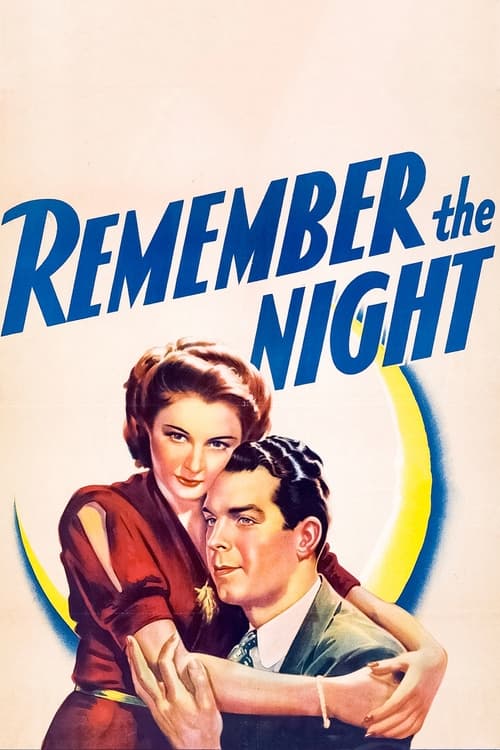
Remember the Night
1940 · Mitchell Leisen
For the holidays, or any night you want a good cry wrapped inside a good laugh — a romance about kindness changing a person, perfect when you need to believe people can be decent to each other.
What it's about
Days before Christmas, New York assistant district attorney John Sargent gets a shoplifting trial postponed — then, feeling guilty that his maneuver leaves the defendant, Lee Leander, in jail over the holiday, posts her bail. Through a chain of accidents he ends up driving her home to Indiana, where his warm, welcoming family takes in a woman who has never known anything like them. Somewhere between the courtroom and the farmhouse, the two fall in love — with the trial still waiting back in New York.
The experience
Unexpectedly tender for a film that starts in a courtroom — it glides from screwball banter into genuine warmth, and the Christmas homecoming scenes have a glow that sneaks past your defenses. It's funny, then it's moving, and the ache underneath is real.
Performances
Barbara Stanwyck and Fred MacMurray, in the first of their screen pairings, have chemistry that makes the whole improbable journey feel inevitable — Stanwyck especially, playing a hardened woman thawing by degrees without a single false note.
The craft
Preston Sturges wrote the script, and it shows: the dialogue crackles while the story quietly braids courtroom drama, road picture, and family homecoming into one arc. Mitchell Leisen directs with a light, generous touch that gives the small kindnesses room to land.
Why it matters
It launched the Stanwyck–MacMurray partnership that would take a much darker turn later in the decade, and it has steadily earned its place as one of the great overlooked Christmas films.
Snapshot
Remember the Night is a Paramount holiday romance that quietly braids courtroom procedural, road picture, and homecoming melodrama into a single, unusually tender arc. Assistant district attorney John Sargent (Fred MacMurray), anticipating that a Christmas-week jury will go soft on a defendant, engineers a postponement in the shoplifting trial of Lee Leander (Barbara Stanwyck) — then, stung by the thought that his own maneuver leaves her jailed through the holiday, posts her bail and, by a chain of accidents and impulses, ends up driving her from New York back to their shared home state of Indiana. What begins as an awkward errand becomes a study in how environment, family, and love reshape a person. The film is now best known for two things it launched: the screen partnership of Stanwyck and MacMurray, who would reunite four years later as the murderous lovers of Double Indemnity, and the last screenplay Preston Sturges wrote for another director before he began directing his own. It is a modest picture with an outsized reputation among admirers of 1930s–40s Hollywood craftsmanship.
Industry & production
The film was produced and released by Paramount Pictures in the last stretch of Hollywood's classical studio system at its most confident. It sits squarely within Paramount's house style of the period — polished, cosmopolitan, romantic — and within Mitchell Leisen's run of urbane comedies and romances for the studio (Hands Across the Table, Easy Living, Midnight). Leisen both directed and, per the standard accounts, took a producing hand in the picture, which is consistent with his reputation as a director who controlled the total look and feel of his films.
The production's most consequential backstage fact is the friction between Leisen and screenwriter Preston Sturges. Sturges had written a long, dialogue-rich script, and Leisen — as he did on their earlier collaborations — trimmed and reshaped it for the screen. Sturges's dissatisfaction with how directors handled his material is a well-documented motivation for his push to direct, which he achieved the same year with The Great McGinty. Remember the Night thus marks a hinge point: it is effectively the end of Sturges the screenwriter-for-hire and the threshold of Sturges the auteur. Exactly how much of the finished film's shape reflects Leisen's cutting versus Sturges's page is a matter where memoir and interview color the record; the safest statement is that the tension was real and formative for Sturges's career.
Precise budget and box-office figures for the film are not something I can cite reliably, so I won't assign numbers to it.
Technology
Remember the Night is a conventional black-and-white, optical-sound feature of its moment, made on 35mm nitrate stock with the studio's standard Academy ratio. There is nothing technologically experimental about it; its interest lies in the assured deployment of mature studio tools rather than in innovation. The production relies on the customary blend of location-suggesting process work and controlled soundstage construction — notably rear-projection for driving sequences, which lets the leads play long, intimate two-shots inside the car while the "road" unspools behind them. This process-plate intimacy is central to the film's design: the automobile becomes a mobile chamber for conversation, a technical convenience turned into a dramatic engine. Interior farm and courtroom sets are built and lit on stage in the Paramount manner, giving the filmmakers total command of light, and the winter exteriors are largely conjured through set dressing and lighting rather than genuine location shooting.
Technique
Cinematography
Photography is by Ted Tetzlaff, a Paramount-associated cameraman who would later shoot Hitchcock's Notorious and then turn director himself (The Window). His work here is glossy in the studio idiom — soft, flattering key light on Stanwyck, clean high-key comedy in the daylight scenes, and a warmer, more shadowed register for the nighttime and hearthside passages. The visual grammar is classical and largely invisible: balanced compositions, controlled depth, and a preference for sustaining performance in the frame rather than fragmenting it. The car interiors, lit to keep both faces legible against the process plate, are the showcase of his restraint.
Editing
The film was cut by Doane Harrison, a figure whose later importance outstrips his fame: he became Billy Wilder's trusted editor and de facto editorial adviser for years. The cutting in Remember the Night is measured and dialogue-led, giving scenes room to breathe — the picture is confident enough to let a comic exchange or a moment of quiet feeling play at length rather than accelerating it. The tonal management across the film's shifts — courtroom briskness, road-comedy digression, the chill of the visit to Lee's mother, the warmth of the Sargent farmhouse — is largely an editorial and structural achievement, modulating rhythm so the abrupt emotional gear-changes read as organic.
Mise-en-scène / staging
Leisen came to directing from costume and art direction (he had been a designer for Cecil B. DeMille), and his films are prized for the expressiveness of their décor and staging. Here the governing contrast is spatial and moral: the sterile, unforgiving interior of Lee's mother's house versus the crowded, warm, ornament-laden Sargent home at Christmas. Domestic space does the thematic work — the Sargent farmhouse, with its mother (Beulah Bondi), Aunt Emma (Elizabeth Patterson), and the hired man Willie (Sterling Holloway), is staged as an ideal of belonging that Lee has never known, and the film lets her react to that abundance rather than explaining it in dialogue. Leisen stages the ensemble around domestic rituals — cooking, decorating, music at the piano — so that character emerges through participation in a household.
Sound
The sound design is standard classical-era optical recording, prioritizing clean dialogue. Music is used sparingly and pointedly, and the film incorporates diegetic music-making in its homecoming sequences — song around the piano is part of how the Sargent house is characterized as a place of shared feeling. I'd flag the specific song attributions as the kind of detail worth verifying against the film rather than asserting from memory.
Performance
The acting is the film's enduring glory. Stanwyck gives Lee a hard, self-protective wit that gradually softens without ever tipping into sentimentality; she plays a woman braced for rejection, and the performance lives in the small recalibrations when warmth is offered instead. MacMurray, in one of the roles that established his likable-straight-man persona, underplays effectively, letting Stanwyck drive the emotional current. Their chemistry — easy, teasing, unforced — is precisely what makes their later inversion in Double Indemnity so startling. Among the supporting players, Beulah Bondi's mother is the moral center of the household, and Elizabeth Patterson and Sterling Holloway supply the comic-domestic texture that keeps the film from curdling into melodrama.
Narrative & dramatic mode
Structurally the film is a road picture bracketed by New York courtrooms: it opens on the machinery of prosecution, detours into a cross-country journey and two contrasting homecomings, then returns to the legal reckoning it deferred. The dramatic mode is romantic comedy-drama with a genuine ethical spine. Sturges's screenplay turns on a debate about human nature — whether people are the product of environment and love or of some fixed moral character — and it stages that debate concretely through the two mothers and the two households. The comedy is character-driven and situational (a memorable interlude with rural law enforcement, the improvised intimacies of travel) rather than farcical, and it earns the tonal shift into the film's serious final movement, in which love and duty are set against each other and resolved through renunciation rather than easy wish-fulfillment. The ending's insistence that Lee face her trial — that redemption require accountability — gives the romance a moral seriousness rare in the holiday-picture mode.
Genre & cycle
Remember the Night belongs to several overlapping cycles at once. It is a Christmas film, part of the durable Hollywood tradition of holiday-set redemption stories. It is a road movie built on the enforced-proximity romance, a structure that runs from It Happened One Night (1934) forward. And it participates in the studios' romantic-comedy cycle of the late 1930s — the sophisticated, class-crossing love stories Leisen specialized in — while leaning harder into melodrama and moral drama than most. It also carries faint traces of the fallen-woman and redemption cycles of early-30s cinema, refracted through post-Code sensibility: Lee's criminality is real, but the film's interest is in whether she can be re-formed by love and belonging.
Authorship & method
The film is a genuinely divided authorship, which is part of what makes it fascinating. Mitchell Leisen directs with his characteristic emphasis on décor, warmth, and performance, and his tonal control — the ability to move a scene from comedy to feeling without a seam — is the film's directorial signature. Preston Sturges supplies the screenplay, and the verbal wit, the appetite for eccentric supporting characters, and the underlying argument about environment and character are unmistakably his; the picture is a crucial document of Sturges's sensibility on the eve of his directing career, and of the frustration that pushed him into the director's chair. Ted Tetzlaff provides the glossy, unobtrusive cinematography; Doane Harrison the patient, dialogue-respecting cut; and the score is credited to Frederick Hollander (Friedrich Hollaender), the émigré composer best remembered for his work with Marlene Dietrich, whose contribution here is restrained and supportive rather than showy. The collaboration's central tension — Sturges's words shaped by Leisen's hand — is the interpretive key to the film's authorship.
Movement / national cinema
This is mainstream American studio cinema at the height of the classical Hollywood system, not the product of any avant-garde or national movement. What it does register, at the level of craft, is the deep bench of European émigré talent in Hollywood by 1940 — Hollander's presence being one thread of that migration. But the film's idiom is thoroughly domestic: it is a Paramount picture in the Paramount manner, and its "movement" is simply the confident classical style itself.
Era / period
Released in early 1940, the film sits at the tail end of the Depression decade and just before America's entry into the Second World War — a moment when Hollywood's romantic comedies increasingly reached for warmth, home, and reassurance. Its Christmas-and-family emphasis, its faith in the redemptive power of a good household, and its gentle moral seriousness all read as of that transitional period. It is also firmly a Production Code-era film: Lee's crime and eventual accountability, and the chaste-but-charged handling of the road romance, reflect the moral bookkeeping the Code required, which the screenplay turns to dramatic advantage rather than merely obeying.
Themes
The film's controlling theme is the tension between nature and nurture — whether a person is fixed by character or made by environment and love. It literalizes this through its paired mothers: the cold, rejecting parent who helped shape Lee's drift into crime, and the loving Sargent household that models what belonging can do. Related themes cluster around it: home and homecoming as moral geography; love versus duty, resolved not by evasion but by Lee's choice to face her trial; redemption through accountability rather than through romance alone; and the meaning of honesty and self-respect. The Christmas setting is not decorative but thematic — it is the season of second chances and of families gathered, against which Lee's isolation and possible reclamation are measured.
Reception, canon & influence
Remember the Night was received in 1940 as an accomplished, well-liked Paramount romance, buoyed by its stars, though I'd treat any specific contemporary review quotations or grosses as things to verify rather than assert. Its critical standing has risen considerably over time. Later writers — particularly admirers of Sturges and of Leisen (whose directorial reputation has undergone significant rehabilitation, notably through David Chierichetti's advocacy) — have championed the film as one of the finest of its kind, and it has become a perennial in Christmas-film revivals and repertory programming.
Looking backward, the film draws on the enforced-proximity road romance codified by It Happened One Night, on the sophisticated romantic-comedy tradition Leisen himself had helped build at Paramount, and on the earlier fallen-woman/redemption melodramas that its plot gently updates. Looking forward, its influence is felt most concretely in what it set in motion for its collaborators: it consolidated Sturges's determination to direct, launching one of the great writer-director careers of the 1940s; it began the Stanwyck–MacMurray partnership that Double Indemnity would later exploit by inverting the pair's genial warmth into noir menace; and it fed into the enduring lineage of the Hollywood Christmas-redemption picture. Doane Harrison's editorial career, meanwhile, would run straight into the Billy Wilder collaboration that defined much of postwar Paramount and beyond. As legacy, Remember the Night is now valued less as a landmark than as a near-perfect specimen — the case that is often made for it is that it demonstrates how much emotional and moral substance the classical studio system could deliver inside a modest, seasonal package.
A Deleuzian reading
Start inside the car.
The full Deleuzian reading of Remember the Night →
Reception
A solid hit in January 1940, then quietly overshadowed for decades — partly because Preston Sturges and Billy Wilder spent years trashing director Mitchell Leisen's reputation. TCM airings and a long-overdue 2010 DVD release turned it into cinephiles' favorite 'secret' Christmas movie, and Leisen's stock has been climbing ever since.
How Remember the Night was received, from release to now →
How to watch Remember the Night: what to notice on a first viewing
- Notice how bare Lee's mother's house looks against the Sargent farmhouse. Leisen fills the Sargent home with ornaments, cooking smells, and family clutter, while Lee's mother's house stays cold and empty, both shot with the same steady camera. The two houses argue Lee's whole case before anyone speaks a word of dialogue.
- Watch Stanwyck's face when warmth is offered instead of rejection. Stanwyck plays Lee as braced for a slap that never lands, and each scene lets her flinch soften a little more without ever tipping into sentimentality. You watch a hardened woman learn, scene by scene, that decency might actually be real.
- Listen for the family singing around the piano at the farmhouse. Leisen lets the Sargent household make its own music instead of scoring the scene, so shared song becomes proof of belonging rather than commentary on it. Music made by the family, not for them, is what makes this house feel different from the one Lee grew up in.
- Notice how long Leisen lets a quiet scene simply play out. Doane Harrison's cutting rarely accelerates a scene toward its point, giving comic exchanges and moments of feeling room to breathe rather than snapping to the next beat. The unhurried pace lets the shift from comedy to sincerity feel earned instead of abrupt.
The whole guide to watching Remember the Night, with the keys for a rewatch →
Influences: the films it descends from and the films it influenced
- It Happened One Night (1934) — Codified the enforced-proximity road-picture chassis Sturges reuses — two mismatched travelers thrown into serial overnight domestic setups (motor courts, a borrowed farmhouse) where intimacy is manufactured by shared confinement rather than declared.
- Easy Living (1937) — The prior Sturges-scripted, Leisen-directed Paramount picture that first established the exact divided-authorship method here: Sturges's verbal architecture and eccentric bit players filtered through Leisen's décor-first, performance-protecting hand.
- Midnight (1939) — Leisen's immediately prior demonstration of the tonal control that is the film's signature — sliding a scene from wisecrack to genuine feeling without a visible seam, staged inside glossy, decor-driven Paramount interiors.
- Hands Across the Table (1935) — Leisen's earlier MacMurray romantic comedy that fixed his method of building romance through behavior in furnished domestic space rather than plot, letting the actor's warmth carry scenes with minimal cutting.
- Trouble in Paradise (1932) — The Paramount sophisticated-comedy template of decor-driven staging and elegant ellipsis that Leisen absorbed directly as a Lubitsch art director before moving to the chair.
- Baby Face (1933) — Established the Stanwyck fallen-woman persona built on a nature-versus-nurture argument — hardness as environmental product, not innate — which Remember the Night gently updates and redeems.
- Ladies of Leisure (1930) — Capra's redemption-through-love melodrama that shaped Stanwyck's screen type: the guarded working-class woman whose defenses are dismantled by exposure to a stable domestic world.
- The Great McGinty (1940) — Sturges's directorial debut, the career he forced open precisely out of frustration at handing this screenplay to another director — carrying over his environment-forms-the-man thesis and stock company of grotesques.
- Christmas in July (1940) — Sturges now directing his own dialogue-led material, extending the same nature-versus-nurture argument (a man's worth as a function of circumstance and luck) with his signature rapid verbal comedy.
- The Lady Eve (1941) — Sturges directs Stanwyck as a con artist whose redemption trades on the identical genial-warmth register, proving what his script for Leisen could only supply from behind the words.
- The Palm Beach Story (1942) — The full flowering of the eccentric-supporting-character, overlapping-dialogue comedy whose seeds are the oddball bit players (the shoplifting hearing, the farm relatives) written into Remember the Night.
- Double Indemnity (1944) — Deliberately inverts the Stanwyck–MacMurray pairing minted here — recasting their established screen geniality and easy warmth as predatory noir menace, weaponizing the audience's prior affection for the couple.
- The Apartment (1960) — Doane Harrison's patient, dialogue-respecting cutting method — which ran straight from Remember the Night into his lifelong Wilder partnership as editor/associate producer — governs this holiday-set redemption, again starring MacMurray.
- Christmas in Connecticut (1945) — Extends the Stanwyck-led Christmas-comedy strand, using the same idealized-holiday-home setting as the machine that thaws a hardened urban woman.
- It's a Wonderful Life (1946) — Consolidates the Hollywood Christmas-redemption picture that Remember the Night helped set in motion — the seasonal frame as an engine for moral accounting and earned grace.
- Meet John Doe (1941) — A parallel Stanwyck vehicle wedding cynicism to a Christmas-set redemption climax, developing the same seasonal-accountability structure in the same period.
Similar films
- The Lady Eve (1941) — influence & lineage
- It's a Wonderful Life (1946) — influence & lineage
- Double Indemnity (1944) — influence & lineage
- Midnight (1939) — influence & lineage
- The Apartment (1960) — influence & lineage
- Meet Me in St. Louis (1944) — shared sensibility
- The Miracle of Morgan's Creek (1944) — shared sensibility
- Stagecoach (1939) — shared sensibility