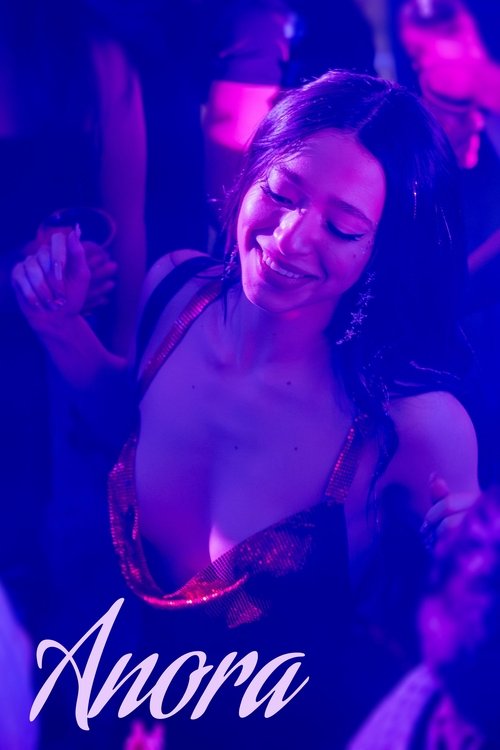
Anora
2024 · Sean Baker
Palme d'Or to five-Oscar sweep for a $6M sex-worker screwball — a triumph narrative complicated by sex-work-representation debates and the Madison intimacy-coordinator conversation; the film that crowned both Sean Baker and Neon.
For when you want a wild night out of a movie — raucous, sexy, screamingly funny — but are open to it sneaking up on your heart. More bracing than cozy; it's a comedy that leaves a bruise.
What it's about
A young stripper and sex worker from Brighton Beach, Brooklyn gets her Cinderella moment when she meets the party-animal son of a Russian oligarch and impulsively marries him in Las Vegas. When the news reaches his parents in Moscow, they send a fixer and his crew to Brooklyn to make the marriage disappear — and Ani is not the type to go quietly.
The experience
It starts as a giddy, neon-lit whirlwind, swerves into one of the funniest extended stretches of chaos in recent movies, and then, without warning, gets real. You'll laugh hard and then find yourself sitting with an ache — the tonal whiplash is the whole ride.
Performances
Mikey Madison is a revelation as Ani — ferocious, fast-talking, and heartbreak-proof right up until she isn't — a star-making, award-winning turn. Yura Borisov, as the quietest of the hired heavies, does remarkable things with almost no dialogue.
The craft
Baker writes and edits with screwball timing — the home-invasion-gone-sideways centerpiece plays like a modern silent comedy — while the film's look shifts from candy-colored club glamour to wintry Brooklyn realism as the fairy tale drains away. It's gorgeous on film and worth the biggest screen you can find.
Why it matters
Winner of the Palme d'Or at Cannes 2024 and a sweep of major Oscars including Best Picture, it turned Sean Baker's long-running independent project — telling sex workers' stories with humor and dignity — into a mainstream triumph.
Snapshot
Sean Baker's seventh feature is a genre-defying triptych built on the ruins of the Cinderella myth. Anora ("Ani") Mikheeva, a Brighton Beach sex worker and exotic dancer of Uzbek descent, marries Ivan Zakharov, the dissolute son of a Russian oligarch, during a week-long Las Vegas bender. When news reaches Ivan's parents in Moscow, a fixer and two associates are dispatched to Brooklyn to dissolve the marriage by any means available. What begins as a giddy romantic comedy curdles into an extended, physically exhausting farce before collapsing into devastating social realism — the film's generic volatility enacting its argument about class, labor, and the American Dream's selective admissions policy. Anora won the Palme d'Or at the 2024 Cannes Film Festival under jury president Greta Gerwig, ending a thirteen-year drought for American cinema at the competition's summit.
Industry & production
Baker produced the film through his own shingle alongside longtime producing partner Alex Coco, maintaining the lean, independent infrastructure that has characterized his work since Tangerine (2015). Shooting took place primarily on location in Brooklyn's Brighton Beach neighborhood — the largest Russian-speaking émigré enclave in the United States — as well as Manhattan and Las Vegas, with Baker and his team working within real strip clubs and private residences rather than constructed sets wherever possible. Neon, the specialty distributor responsible for Parasite's U.S. theatrical run, acquired North American rights following the Cannes triumph; the film went on to accumulate a theatrical gross that far exceeded expectations for a work of its formal register and subject matter. Baker wrote the screenplay himself, as has been his consistent practice since Starlet (2012), drawing on research into the Brighton Beach community and on conversations with workers in the sex industry — a constituency whose labor and interiority he has made his primary subject across several films.
Technology
Anora was photographed on 35mm film by cinematographer Drew Daniels, a deliberate choice that imparts grain, depth-of-field gradients, and a warmth to skin tones that digital acquisition in comparable low-light environments typically struggles to replicate. The decision to shoot on photochemical stock aligns Baker with a cohort of American independent directors — among them Sean Price Williams and Bradford Young — for whom film grain is not nostalgia but a present-tense aesthetic commitment with specific perceptual consequences: the strip club interiors glow and pulse rather than resolve into the clinical clarity of contemporary digital images. Post-production followed a conventional photochemical-to-digital intermediate pipeline. Baker edited the film himself using non-linear software, as is his established practice, shaping a runtime of approximately 139 minutes from what was by all accounts a substantial amount of footage, particularly during the film's extended second-act action sequences.
Technique
Cinematography
Daniels's work on Anora extends a practice visible in his collaborations with Trey Edward Shults (Waves, 2019) and Ti West (X, 2022): an ability to modulate between intimate handheld proximity and more formally composed, observational distance depending on the dramatic register of a scene. The Brighton Beach strip club sequences favor a warm, enveloping palette — deep reds and the amber of stage lighting — that renders Ani's workplace as glamorous on its own terms rather than squalid, a refusal to code the environment with sociological contempt. The Manhattan penthouse belonging to Ivan's family introduces cooler, harder light and wider frames, the spatial opulence of the apartment functioning as a compositional argument about the distance between the film's two social worlds. During the film's long central section — the farcical search for Ivan through Brooklyn — Daniels deploys a more agitated handheld grammar, the camera sweating through the same physical exertion as the characters.
Editing
Baker's editing is the film's most audacious formal element. The transition between the film's three modal phases — romantic comedy, screwball farce, social realism — is accomplished without chapter breaks or title cards, the cuts simply refusing to deliver the tonal resolution each section seems to promise. The second act in particular sustains an unusually long comedic sequence that would buckle under conventional cutting rhythms; Baker allows scenes to breathe past the point of comfort, generating genuine physical unease in the viewer that mirrors Ani's own entrapment. The final scenes are edited with exceptional patience, foregrounding silence and real-time duration over expressive montage.
Mise-en-scène / staging
Baker's staging consistently refuses the theatrical axis: characters move across depth planes rather than along a proscenium, and the blocking within the Zakharov house during the second act exploits interior architecture for physical comedy in a manner reminiscent of classical Hollywood farce without replicating its spatial geometry. The film is alert to thresholds — doorways, car windows, the entrance to the strip club — as sites where social worlds collide. Ani's apartment and her work environment are staged with an anthropological specificity that avoids set-dressing fetishism; the accumulation of brand-name objects and domestic clutter reads as observed rather than curated.
Sound
The sound design moves fluidly between the saturating bass of club music (which functions almost as a protective architecture around Ani in her professional life) and the abrupt acoustic exposure of exterior Brooklyn — traffic, wind, the mundanity of the world outside the fantasy. The score by Matthew Hearon-Smith operates at the margins of scenes rather than anchoring them emotionally from the center, a restraint that throws the film's climactic silences into sharp relief.
Performance
Mikey Madison's performance as Ani is a feat of sustained tonal intelligence: she must hold comedic physicality, defensive aggression, erotic confidence, and profound vulnerability in simultaneous solution, and does so without the seams showing. Her Russian — learned for the role — threads through scenes at sufficient idiomatic depth to signal Ani's cultural positioning in the Brighton Beach community without announcing itself as an actor's studied accomplishment. Yura Borisov, the Russian actor known internationally for Compartment No. 6 (Juho Kuosmanen, 2021), plays Igor, Toros's associate who is initially presented as menacing muscle and reveals, across the film's third act, a quiet moral attention to Ani that becomes the emotional hinge of the entire picture. Borisov's stillness — what he withholds — is as expressive as any explicit declaration. Karren Karagulian as Toros and Vache Tovmasyan as Garnick supply the film's extended comic middle section with escalating physical commitment that never descends to caricature.
Narrative & dramatic mode
Anora is structured as a deliberate generic triptych whose seams are part of the argument. Act one operates as a romantic comedy with neorealist textures, establishing Ani's agency, desire, and vulnerability through scenes of genuine warmth. Act two is extended screwball farce, the classical mechanism of mistaken identity replaced by the more brutal apparatus of class power: the fixer and his associates are not comic villains but professional instruments of a wealthy family's will, and the comedy generated by their ineptitude and by Ivan's cowardice cannot fully neutralize the coercion underlying their presence. Act three abandons comic machinery entirely for a social-realist mode that strips the Cinderella narrative to its material substrate — Ani as a worker who briefly held an asset (the marriage) that has been reclaimed by those with structural power to reclaim it. The final scene in the car between Ani and Igor does not resolve this but renders it with the kind of tact that only sustained formal discipline can earn.
Genre & cycle
The film belongs to a loose cycle of contemporary American independent cinema that recasts genre frameworks — romantic comedy, fairy tale, crime procedural — through a social-realist lens oriented toward working-class and precarious subjects: adjacent to but distinct from Eliza Hittman's Never Rarely Sometimes Always (2020) or Kelly Reichardt's body of work. It engages directly with the Cinderella template, specifically the shadow of Garry Marshall's Pretty Woman (1990), whose fantasy of upward mobility through romantic attachment it systematically disassembles. The screwball tradition — Hawks, Sturges, Wilder — is metabolized rather than quoted; Baker is interested in what happens when the formal machinery of screwball (the runaway chase, the manic ensemble, the tempo of misunderstanding) is applied to power asymmetries that the classical mode could aestheticize away.
Authorship & method
Baker writes, directs, edits, and co-produces his own films, a degree of creative consolidation unusual even within independent American cinema. His consistent thematic preoccupations — sex workers, undocumented immigrants, people living on the economic periphery of major American cities, the texture of precarious work — constitute a recognizable authorial project pursued across a decade of increasingly ambitious features. His collaboration with Drew Daniels, extending from Red Rocket (2021), represents a productive creative partnership: Daniels's facility across film stocks and with available and practical light has allowed Baker to maintain his commitment to location-based naturalism at higher production values. Baker's practice of editing his own films — a relatively uncommon auteurist position — means that the rhythm of the finished work is inseparable from the rhythm of his writing and directing: pacing is not applied to the footage but grown from within it.
Movement / national cinema
Anora is legible as American independent cinema in the lineage established by John Cassavetes — investment in performance over production design, willingness to follow characters past the point where genre would conventionally resolve them — and in the tradition of social-realist filmmaking practiced by the Dardenne brothers in Belgium and Ken Loach in Britain, though Baker's engagement with genre and comedy separates him from the austerity of either. The film's Brighton Beach setting places it within a specifically New York cinema tradition — the city as immigrant palimpsest, each community occupying and transforming the same physical geography — that runs from Elia Kazan through Martin Scorsese and Spike Lee. Its engagement with the Russian émigré world is without obvious American precedent in mainstream or independent fiction film.
Era / period
The film arrives in a moment when the Palme d'Or and the American independent sector are in renewed conversation after years of perceived European critical preference for European and East Asian cinema. It is contemporary in its treatment of platform-economy labor conditions, oligarchic wealth, and the particular precariousness of immigrant communities in Trump-era and post-Trump-era New York, without being topical in a way that would date it. Its 35mm photography participates in a broader early-2020s independent film culture reassessment of photochemical acquisition.
Themes
Class and its material enforcement is the film's primary subject: the annulment is not primarily a legal procedure but a demonstration of where power actually resides when it is organized against a person without resources or institutional protection. The American Dream is engaged not as abstraction but as a specific contractual promise that Brighton Beach communities hold — and that the film shows being voided in real time. Labor is treated with consistent dignity: Ani's work as a dancer and sex worker is rendered as skilled, physically demanding professional practice, not as pathology or victimhood. Gender and power are legible in every scene, but Baker is careful to distribute moral complexity across the ensemble rather than reducing characters to representatives of structural positions. The film is also, unexpectedly and genuinely, about tenderness: Igor's quiet solicitude in the film's closing minutes — offered without agenda or transaction — functions as a kind of structural counterweight to everything that precedes it.
Reception, canon & influence
Critical reception was exceptional by any measure. The Palme d'Or jury's decision signaled a reassessment of Baker's standing within world cinema; the film subsequently swept through festival awards circuits before dominating the 97th Academy Awards in March 2025, where it won Best Picture, Best Director, Best Original Screenplay, and Best Film Editing, among other honors. The performance of a film this formally unconventional — with its extended second-act farce and its refusal of a consoling resolution — at the highest level of American industry recognition was widely noted as genuinely unusual.
Looking backward, the film's forebears include the social comedies of Preston Sturges, particularly their combination of genuine class anger with knockabout physical comedy; the Cassavetes tradition of performance-anchored realism; and the neorealist school in its insistence on location and non-professional or semi-professional casting in supporting roles. The Dardenne brothers are a credible influence on the film's terminal act. The fairy-tale inversion places it in implicit dialogue with Agnès Varda's feminist revisionism and with Sally Potter, though Baker arrives at his critique through genre mechanics rather than formal experiment.
Looking forward, Anora's influence on American independent cinema will likely be felt in its demonstration that formal and tonal ambition — genre-shifting, extended and uncomfortable middle sections, refusal of resolution — is commercially and critically viable at scale. Whether it occasions a wave of imitations is less certain; Baker's specific combination of empathy, formal control, and willingness to follow characters into genuine darkness is not easily reproduced. Its status as the first American Palme d'Or winner since Terrence Malick's The Tree of Life (2011), and its subsequent Academy recognition, ensures its position in the canon of 2020s American cinema regardless of what it directly occasions.
A Deleuzian reading
What stays with you is the snow on the windshield and how small the car has become.
The full Deleuzian reading of Anora →
Reception
It premiered at Cannes in May 2024 and took the Palme d'Or, then rode a rare festival-to-Oscars wave all the way to five Academy Awards including Best Picture — an indie shot for around $6 million out-muscling the studios. Post-sweep, the inevitable recalibration set in: now it's the film everyone re-argues when ranking 2024.
How Anora was received, from release to now →
Influences: the films it descends from and the films it influenced
- Nights of Cabiria (1957) — Establishes the Cinderella-inversion template Baker explicitly inherits: a sex worker's sincere romantic aspiration is methodically exploited by a man she trusts, ending in devastated persistence rather than rescue or moral resolution — the structural blueprint for Anora's refusal of consolation.
- The Palm Beach Story (1942) — Structural model for fusing knockabout physical comedy with class-based fury in the same scene: economic position determines romantic outcome, and the farce mechanics never obscure the financial transaction at the film's center — the specific combination Baker reconstructs in Anora's second-act siege.
- Shadows (1958) — Establishes the performance-anchored urban-location method Baker works within: handheld camera in real New York spaces with semi-improvised social interaction, treating the location as a collaborator in performance rather than a backdrop — the foundational grammar of the Cassavetes tradition Baker claims.
- A Woman Under the Influence (1974) — Performance architecture of tonal simultaneity: Rowlands holds comedy, distress, and threat in coexistence within a single extended take, establishing the template for the kind of performance Baker demands — and achieves — through Anora's second-act farce and its aftermath.
- Jeanne Dielman, 23 quai du Commerce, 1080 Bruxelles (1975) — Founding formal precedent for threshold spaces as mise-en-scène grammar — doorways and counter edges as sites where social labor becomes visible — and for extended duration that converts routine action into accumulating pressure; both devices are structural to Anora's staging and editorial rhythm.
- Killer of Sheep (1978) — American independent precedent for location-based working-class portraiture that refuses to aestheticize poverty: formal control maintained without sentimentality, labor rendered visible as the texture of daily life rather than as dramatic event — the lineage Baker inherits and extends to sex work.
- Umberto D (1952) — Neorealist casting method Baker explicitly applies: non-professional or semi-professional actors in supporting roles grounding the fiction in observed social texture; class indifference shown through structural position rather than villainous intent — the specific neorealist inheritance the dossier names.
- Cléo from 5 to 7 (1962) — A female protagonist whose social existence is conditioned by others' projections onto her; Varda uses real Paris locations and non-professional encounters to anatomize the fairy-tale female role from the inside, providing a template for Baker's Cinderella critique through inhabitation rather than external commentary.
- Rosetta (1999) — Close-follow handheld stays physically committed to a working-class woman through the defeat of her aspirations without offering consolation in the terminal act; direct precedent for Baker's final-act mode in which the camera's proximity to Anora substitutes for the editorial sympathy the narrative refuses to provide.
- Working Girls (1987) — Non-moralizing procedural depiction of sex work as labor and transaction, with the granular attention to the trade's mechanics and money that echoes Borden's research-driven realism.
- Prince of Broadway (2010) — Karagulian's harried middleman is drafted here and completed as Toros; the braided pursuit across a single night, the sex-work economy shot inside its actual rooms, and Baker's own editing of the material are the same four planks, funded.
- Tangerine (2015) — The prior full instantiation of Baker's complete authorial method — writer-director-editor, sex-worker protagonist, location naturalism, tonal simultaneity between comedy and genuine distress — establishing the project that Anora extends to its highest level of formal and industrial ambition.
- Red Rocket (2021) — The film establishing the Baker-Daniels cinematographic vocabulary Anora inherits: 35mm film stock, warm mixed-source practical lighting, handheld naturalism on location; the collaboration that translated Baker's thematic project into a specific photographic syntax.
- Parasite (2019) — Generic triptych as formal argument: sequential genre shifts (social comedy → domestic thriller → horror) used as the structural mechanism of class critique, with threshold spaces — the staircase, the basement — carrying the spatial logic of economic stratification in a direct formal parallel to Anora's three-act genre migration.
- Uncut Gems (2019) — Extended-duration sequences of sustained social discomfort with diegetic sound architecturally layered — overlapping calls, crowd noise, ambient television — preventing viewer detachment; the formal model for Anora's second-act farce, in which discomfort is extended past the conventional point of comedic or dramatic relief.
- Moonlight (2016) — 35mm film stock combined with warm practical light deployed as an ethical position toward a protagonist on the economic margin: the cinematographic texture functioning as an argument about social dignity rather than as aesthetic decoration — the precedent Baker-Daniels activates in their treatment of Anora.
- Shoplifters (2018) — Location-based naturalism with warm available light and non-professional supporting cast; performance withholding as the carrier of suppressed interiority; class critique delivered through structural observation rather than editorial emphasis; terminal act refuses consolation in precisely the register Baker arrives at.
- Left-Handed Girl (2025) — Same authorial fingerprint of a braided marginal-lives ensemble that pivots late from comic energy into raw melodrama, mirroring this film's late melodramatic reveal.
- Blue Film (2026) — Runs the same transaction-to-recognition arc from the worker's professional competence outward, sustaining long club-and-bedroom sequences in which the client's world, not hers, is the thing that finally breaks open.
Similar films
- Strange Darling (2024) — often watched together
- One Battle After Another (2025) — often watched together
- The Housemaid (2025) — shared sensibility
- Promising Young Woman (2020) — shared sensibility
- Babygirl (2024) — shared sensibility
- All We Imagine as Light (2024) — shared sensibility
- Anatomy of a Fall (2023) — shared sensibility
- I Want Your Sex (2026) — shared sensibility
All the films related to Anora →
Watch it with: curated runs of related films
- Fast Talk & Fur Coats — A run of quick-witted charmers who disguise, con, and sweet-talk their way across class lines — watch them near each other and the century between Lubitsch and Sean Baker collapses into one long, glittering grift.