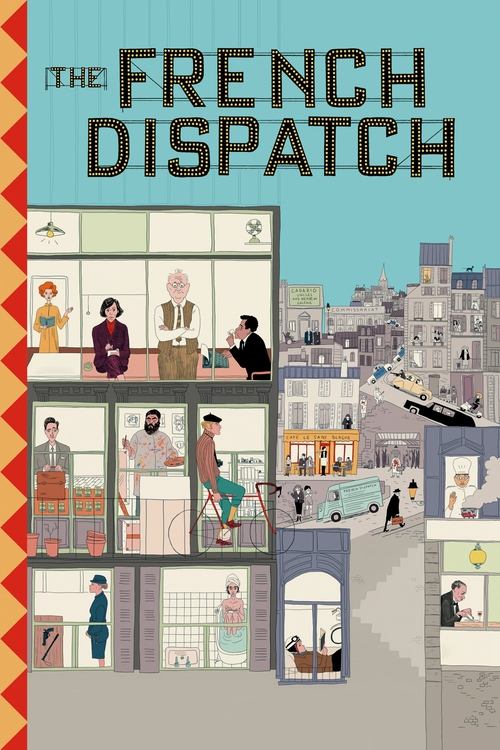
The French Dispatch of the Liberty, Kansas Evening Sun
2021 · Wes Anderson
His style became so recognizable it turned into a TikTok filter trend and AI-parody genre, prompting discourse about whether pastiche had swallowed the artist; Asteroid City and The Phoenician Scheme kept the "self-parody or late-style depth" argument alive. Finally won his first Oscar for a Roald Dahl short.
For when you want to be dazzled rather than gripped — a night for savoring style, wit, and detail, ideally when you're alert enough to keep up. More a box of chocolates than a meal; challenge disguised as comfort.
What it's about
An American magazine based in a small French town is putting out its final issue after the death of its beloved founding editor. The film is that issue brought to life: an obituary, a bicycle tour of the town, and three feature stories — an imprisoned painter and the art dealer who discovers him, a student uprising covered by a reporter who can't stay out of the story, and a kidnapping that turns on a police chef's cooking.
The experience
Dense, fast, and playful — jokes, compositions, and asides arrive quicker than you can catch them, with sudden pockets of melancholy hidden inside the whimsy. It's a film you graze on first viewing and feast on the second.
Performances
A murderer's row of actors doing precise miniature work: Bill Murray's gruff, protective editor, Benicio del Toro's growling imprisoned painter, Jeffrey Wright's melancholy food writer delivering some of the most affecting monologue work in any Anderson film.
The craft
Anderson's most concentrated formalism: aspect ratios shift, color gives way to black-and-white, live action breaks into animation, and every frame is composed like a magazine layout. The writing pastiches mid-century long-form journalism with real affection. A film literally built from craft — the more attention you give it, the more it returns.
Why it matters
A love letter to The New Yorker and the vanishing culture of literary magazines, it marked the point where Anderson's style reached full maximalism — polarizing critics but cementing the anthology-as-object approach he'd keep pushing.
Snapshot
The French Dispatch is Wes Anderson's tenth feature and his most concentrated act of formal maximalism: an anthology film built as a printed magazine come to life. The conceit is that the Kansas-born expatriate editor Arthur Howitzer Jr. (Bill Murray) has died, and by his instruction the French-based literary supplement he built — the French Dispatch of the Liberty, Kansas Evening Sun — will publish one final issue and then dissolve. The film is that issue, rendered as an obituary, a short travelogue, three feature articles, and a colophon. Set in the invented French town of Ennui-sur-Blasé and shot in Angoulême, it functions as Anderson's love letter to The New Yorker and to a vanished mid-century culture of long-form journalism, the writer-as-stylist, and the editor who protects prose against the world. It is at once his most fragmented narrative and his most tightly controlled visual object — a film about the labor of arranging words and images on a page that is itself obsessively arranged.
Industry & production
The film was produced by Anderson's regular collaborators — Anderson himself, Steven Rales (through Indian Paintbrush), Jeremy Dawson, and Octopusfilm — and distributed by Searchlight Pictures (the former Fox Searchlight, absorbed into Disney during the film's gestation). It was shot largely on location in Angoulême in the Nouvelle-Aquitaine region of France in late 2018 and into 2019, with the medieval hill town and its stairways, courtyards, and apartments standing in for Ennui-sur-Blasé. Anderson has long favored the practical, on-location, ensemble-residency mode of production — cast and crew housed together, working from a shared base — and The French Dispatch extended that method.
Its release was disrupted by the COVID-19 pandemic. Originally slated for 2020, it was pulled and eventually premiered in competition at the Cannes Film Festival in July 2021 before a theatrical release that autumn. The cast is one of the largest Anderson has assembled, drawing both his repertory company (Murray, Owen Wilson, Tilda Swinton, Adrien Brody, Willem Dafoe, Jason Schwartzman, Bob Balaban, Anjelica Huston as narrator) and newer additions (Benicio del Toro, Frances McDormand, Timothée Chalamet, Jeffrey Wright, Léa Seydoux, Lyna Khoudri, Stephen Park, Mathieu Amalric). Precise budget and box-office figures I will not assert here; what is clear is that the film performed as a specialty release rather than a wide commercial success, consistent with its dense, essayistic design.
Technology
Anderson and cinematographer Robert Yeoman shot the film photochemically on 35mm, in keeping with their decades-long practice, and the film makes its material substrate part of its meaning: the switching between formats and stocks is legible as an editorial choice, like a magazine's layout. The most conspicuous technical strategy is the constant shifting of aspect ratio — passages in the boxy Academy ratio (1.37:1) alternate with anamorphic widescreen — and the interleaving of black-and-white and color, sometimes within a single scene, so that a photograph "blooms" into color at a moment of emphasis. These transitions are motivated diegetically as the difference between reportage and memory, or between the printed and the felt.
The film also incorporates a hand-drawn 2D animated sequence for a police-car chase in the final story, a mode Anderson had approached differently in his stop-motion features (Fantastic Mr Fox, Isle of Dogs) but here deploys as a flat, comic-strip register appropriate to a magazine. Elsewhere he uses live tableaux vivants, miniatures, and theatrical devices — figures freezing into painted stillness — that are "technological" less in a digital sense than in the sense of stagecraft. The overall philosophy is analog and artisanal: effects that could be achieved on a soundstage or in-camera are preferred to the invisible digital seam.
Technique
Cinematography
Yeoman's camera is, as ever in Anderson, planimetric — organized on axes parallel and perpendicular to the frame, favoring dead-center framing, frontal address, and 90-degree whip pans between symmetrically placed subjects. The French Dispatch pushes this toward the condition of a comic panel or a magazine spread: characters are arranged in friezes; the camera tracks laterally past compartmentalized rooms as if turning pages. The alternation of monochrome and color is the film's signature photographic gesture, and Yeoman modulates lighting to make each register feel like a distinct print process. The formal restriction is total and deliberate; the pleasure lies in the density of information packed into each static or laterally gliding composition.
Editing
Cut by Andrew Weisblum, Anderson's longtime editor, the film is structured as discrete articles rather than a continuous story, and the editing must therefore do the work of a table of contents — introducing bylines, cross-heads, and pull-quotes. Within scenes the cutting is precise and often rhythmic to the point of percussion, snapping between symmetrical setups. The anthology form means the film's macro-editing is essentially curatorial: sequencing self-contained pieces of varying length and tone (a brief cycling tour, a long art-world caper, a political romance, a culinary thriller) so they accumulate into a coherent "issue."
Mise-en-scène / staging
This is the film's center of gravity. Production designer Adam Stockhausen (an Oscar winner for The Grand Budapest Hotel) and costume designer Milena Canonero build a fully imagined mid-century French townscape of cafés, garrets, prisons, and newsrooms, rendered in Anderson's controlled palette. Anderson stages in cross-section — dollhouse cutaways of buildings — and in theatrical tableaux, and repeatedly breaks the fourth wall via lecture, voiceover, and to-camera narration, so that mise-en-scène becomes explicitly a mode of presentation. The maximalism is legible as thematic: the density of the frame mirrors the density of good magazine prose.
Sound
Alexandre Desplat, Anderson's principal composer since Fantastic Mr Fox, supplies a score of chamber textures, harpsichord and piano figures, and jaunty period pastiche that keeps the film light on its feet even in its darker turns. The sound design leans heavily on narration — much of the film is spoken, in the cadences of a writer reading their own copy aloud — so that the human voice, delivering polished sentences, is arguably the dominant sonic element. Period and French-inflected source music underscore the expatriate setting.
Performance
The acting style is deliberately presentational and clipped — Anderson's signature deadpan, in which strong feeling is delivered flat and fast. Within that constraint several performances register strongly: Jeffrey Wright's Roebuck Wright narrates with a mournful, precise eloquence; Benicio del Toro plays the imprisoned painter Moses Rosenthaler with hulking melancholy against Léa Seydoux's still, watchful muse-and-prison-guard Simone; Frances McDormand's journalist Lucinda Krementz holds a rueful reserve; Timothée Chalamet's student revolutionary Zeffirelli is all callow earnestness; and Bill Murray's editor presides over the whole with weary tenderness. The mode subordinates psychological realism to type and diction, which is the point — these are figures in an essay.
Narrative & dramatic mode
The film is an anthology framed as a magazine issue, with a nested, self-announcing structure: an obituary for the editor; a short "Local Color" travelogue narrated by the cycling reporter Herbsaint Sazerac (Owen Wilson); then three feature stories — "The Concrete Masterpiece" (the Arts & Artists desk), "Revisions to a Manifesto" (Politics/Poetry), and "The Private Dining Room of the Police Commissioner" (Tastes & Smells) — closing on the writers gathered to compose Howitzer's obituary. Each story is narrated by its author-character, frequently as a lecture or a televised interview, so the dramatic mode is that of reported experience: we are always aware of a writer shaping the tale. This produces a doubled temporality — the event and its telling — and a persistent irony, since the narrators are characters whose stylistic vanity and blind spots are part of the subject. The overarching drama is elegiac: the death of an editor, and with him a whole ethic of writing.
Genre & cycle
Generically the film braids comedy, drama, caper, romance, and thriller across its segments, unified less by genre than by tone. It belongs to two recognizable cycles. First, Anderson's own late-career anthology and frame-narrative cycle, extending from the nested chronicling of The Grand Budapest Hotel toward the still more compartmentalized Asteroid City (2023) that would follow — a run of films about storytelling apparatuses (hotels, magazines, theater, television). Second, the broader tradition of the portmanteau or omnibus film, and specifically the "magazine film," in which discrete tales are gathered under an editorial umbrella. Its subject — journalism and the newsroom — also places it in loose dialogue with the newspaper-picture tradition, though refracted through European art cinema rather than Hollywood reporter comedy.
Authorship & method
The French Dispatch is a paradigmatic Wes Anderson film — arguably the fullest statement of his auteur signature — and it foregrounds authorship as its very theme. Anderson wrote the screenplay from a story he developed with frequent collaborators Roman Coppola, Hugo Guinness, and Jason Schwartzman. His method here is one of curated homage: the magazine and its staff are modeled on The New Yorker and the writers Anderson has said he admires. Anderson has publicly acknowledged the New Yorker inspiration and named touchstones; the specific one-to-one mappings often cited by critics — the editor Howitzer as a composite of Harold Ross and William Shawn; Roebuck Wright as a fusion of James Baldwin and A.J. Liebling; Lucinda Krementz's May-1968 dispatch echoing Mavis Gallant; Sazerac evoking Joseph Mitchell; the art writer Berensen recalling Rosamond Bernier — are partly confirmed by Anderson and partly critical inference, and the reader should treat the finer attributions as interpretive rather than authorized fact.
The key collaborators are the constants of Anderson's mature filmmaking: cinematographer Robert Yeoman (his DP since Bottle Rocket), composer Alexandre Desplat, editor Andrew Weisblum, production designer Adam Stockhausen, and costume designer Milena Canonero. This stable repertory of craftspeople, working in a consistent visual grammar across films, is itself central to Anderson's authorship — the "Wes Anderson style" is a genuinely collective house style, refined over two decades.
Movement / national cinema
Anderson is an American independent filmmaker whose sensibility is thoroughly transnational and Europhile. The French Dispatch is a French-set, French-shot American production that pays homage to American magazine writing about France, and it draws visibly on French cinema — the New Wave in particular, most explicitly in the May 1968 student-uprising segment, which evokes Godard's political films of that moment and the café-and-barricade iconography of the period. It sits within no organized movement but rather within Anderson's own idiolect, a post-classical stylization that fuses American storybook nostalgia with European art-cinema self-reflexivity. Its production in France, with a partly French cast, marks it as a genuinely cross-national work rather than a Hollywood studio product in the conventional sense.
Era / period
The film is set in a stylized mid-twentieth century — roughly the 1950s to 1970s, the golden age of the print magazine and the milieu of the celebrity long-form writer — with the student-revolt story fixing one segment around 1968. This period setting is essential to its elegy: the film mourns a moment when magazines could sustain writers of idiosyncratic voice and when editors defended prose as an end in itself. It was made and released, however, at the turn of the 2020s, and its nostalgia is inseparable from the contemporary decline of print journalism; the "final issue" conceit reads as a lament for a culture already passing. The COVID-delayed 2021 release positioned it as one of the first major auteur films to reach cinemas as they reopened.
Themes
The film's governing subject is writing itself — the craft of the sentence, the discipline of the paragraph, and the near-sacred relationship between writer and editor. Howitzer's editorial creed ("try to make it sound like you wrote it that way on purpose") and his tolerance for his writers' extravagances frame the whole as a defense of style. Related themes cluster around it: expatriation and belonging, the condition of the American abroad translating a foreign world for readers back home; art and its commodification, dramatized in the imprisoned painter whose work is exploited by dealers; political idealism and its disillusionment, in the student manifesto and the older journalist's compromised objectivity; and grief and endings, since the film is structurally an obituary. Throughout runs a melancholy about loneliness — nearly every narrator is a solitary observer — and a conviction that careful attention, rendered in careful language, is itself a form of love and a bulwark against oblivion.
Reception, canon & influence
Critically, The French Dispatch was among the most divisive films of Anderson's career — widely admired for its craft, wit, and ambition, and just as widely charged with airlessness, with a design so total that emotion is suffocated beneath ornament. Admirers took it as the apotheosis of his style and a moving tribute to a dying literary culture; skeptics found it a beautiful catalog with no pulse. It became a flashpoint in the long-running critical debate over whether Anderson's precision liberates or embalms feeling.
The influences on the film run backward to The New Yorker and its mid-century writers, to the French New Wave (especially the 1968-era political films and the café-culture iconography of Godard and his contemporaries), to European art cinema's self-reflexive framing, and to the visual traditions of comic strips, illustration, and stagecraft. Anderson's own back catalog is the most immediate precursor: the nested storytelling of The Grand Budapest Hotel is the direct formal parent.
Its forward legacy is best seen within Anderson's subsequent work. The magazine-as-film experiment fed directly into the still more nested, theater-and-television framing of Asteroid City (2023) and the storytelling apparatus of The Phoenician Scheme (2025), confirming a late phase preoccupied with narration, media, and the machinery of telling. Beyond Anderson, the film reinforced and accelerated the broader cultural circulation of the "Wes Anderson aesthetic" — symmetrical, pastel, deadpan — which by the 2020s had become a widely imitated visual shorthand, including a wave of social-media pastiche. Whether The French Dispatch settles into the canon as a masterpiece or a magnificent curio remains genuinely unsettled; the record so far shows a film more respected for its virtuosity than universally loved, and one whose full standing will depend on how later criticism weighs Anderson's formalism against the emotional coolness his detractors describe.
A Deleuzian reading
A black-and-white shot holds.
The full Deleuzian reading of The French Dispatch of the Liberty, Kansas Evening Sun →
Reception
It premiered at Cannes in 2021 after a full year of COVID delay and instantly split critics — 'the most Wes Anderson movie ever made' was meant as both praise and complaint. It's since been quietly reappraised, with the density that exhausted reviewers in 2021 now read by fans as the whole point.
How The French Dispatch of the Liberty, Kansas Evening Sun was received, from release to now →
How to watch The French Dispatch of the Liberty, Kansas Evening Sun: what to notice on a first viewing
- Watch for the moment a gray shot turns to color. Most of the film is monochrome. Then one image, or one patch of it, blooms into color and the story moves on without explaining itself. The rule is never stated. You pick it up by feel. The story does not change when the color arrives. The print process changes, and color marks what somebody felt rather than reported.
- Notice the frame change shape between and inside the stories. Yeoman shoots dead center, frontal, on axes square to the walls, then whip-pans ninety degrees to the next arrangement. The picture switches between the boxy Academy square and anamorphic widescreen as it goes. A narrower frame works the way a narrower column works on a page. The same information arrives with a different weight.
- Watch the camera glide sideways through a building with its wall removed. Stockhausen builds cafes, garrets, prisons, and newsrooms in cutaway, and Anderson tracks laterally past them room by room. Nothing waits in the next room, because the next room is already in the shot. There is no suspense in the space next door. You get a whole building readable at a glance, like a magazine spread.
- Listen for how often someone is reading their own copy aloud. Sazerac lectures while he pedals. Roebuck Wright recounts a kidnapping from a television studio. Every story arrives already written and delivered by its author. Desplat's harpsichord and chamber figures stay under the voices. The speaking body is almost never the acting body. You watch one thing while hearing a polished sentence about it.
- Watch how flat the actors deliver strong feeling. Anderson's cast speaks fast and level. Del Toro plays hulking melancholy, Seydoux stays still and watchful, McDormand holds a rueful reserve. Nobody raises a voice to match what is happening to them. The volume is wrong on purpose. You read these people by posture and diction instead of by what their faces admit.
Influences: the films it descends from and the films it influenced
- The Grand Budapest Hotel (2014) — Its Russian-doll narration (author → aged Zero → the hotel's past) and per-era aspect-ratio switching between 1.37, 1.85 and 2.35 is the direct template for Dispatch's nested reportage and ratio shifts.
- The Life Aquatic with Steve Zissou (2004) — The full-ship cross-section cutaway of the Belafonte, tracked laterally room-to-room, is Anderson's own prototype for the cross-section tableau staging used throughout Ennui-sur-Blasé.
- Playtime (1967) — Deep-focus planimetric wides that distribute simultaneous business across a frame-wide built set, the compositional source of Dispatch's flattened, activity-packed tableaux.
- Vivre sa vie (1962) — Its numbered twelve-tableau structure with printed chapter headings and flat frontal staging in black-and-white is the New Wave source of the anthology-in-chapters grammar.
- La Chinoise (1967) — The Maoist student cell in primary-color rooms with slogan intertitles is directly quoted by the May-'68 'Revisions to a Manifesto' chapter's chessboard-revolt iconography.
- Le Plaisir (1952) — A portmanteau of Maupassant short stories bound together by a first-person literary narrator, the precedent for the magazine-issue anthology stitched by dominant voice-over.
- Citizen Kane (1941) — The 'News on the March' newsreel obituary and portrait-assembled-from-multiple-witnesses structure prefigures the editor's-obituary frame and the reported-testimony construction of each dispatch.
- The Red Balloon (1956) — Storybook Parisian street geography treated as a hand-built toy city, an avowed Anderson touchstone for the model-town cartography of Ennui-sur-Blasé.
- Day for Night (1973) — A reflexive homage to a working craft institution staffed by an affectionate repertory ensemble, the model for treating the magazine itself as the film's beloved, dying workplace.
- The Shop Around the Corner (1940) — The 'Lubitsch touch' of Continental ensemble comedy confined to a single institution feeds Anderson's deadpan-presentational handling of an office full of eccentric staff.
- Asteroid City (2023) — Pushes the nested media apparatus further by wrapping a color stage play inside a black-and-white TV documentary, escalating Dispatch's b&w-to-color coding and framing-device machinery.
- The Wonderful Story of Henry Sugar (2023) — Takes voice-narration-dominance and presentational deadpan to an extreme, with actors reciting Dahl's prose verbatim while stagehands change scenery on camera — the theatricalized telling Dispatch anticipated.
- The Phoenician Scheme (2025) — Continues the late-phase preoccupation with narration and the mechanics of telling, extending the reported/framed-experience apparatus formalized in Dispatch and Asteroid City.
- Isle of Dogs (2018) — Extends the same curatorial editing — titled movements, intertitle chaptering and inserted graphic panels — into stop-motion, a parallel test of anthology sequencing.
- Poor Things (2023) — A chaptered narrative that moves from black-and-white into saturated color using fisheye and aspect distortions plus deadpan-presentational performance, a contemporary variant of the same tableau-and-transition toolkit.
- The Triplets of Belleville (2003) — Near-wordless hand-drawn animation whose caricatural ligne-claire motion is the same tradition Anderson's Dispatch car-chase cartoon interlude draws on.
Similar films
- The Grand Budapest Hotel (2014) — influence & lineage
- Asteroid City (2023) — influence & lineage
- The Phoenician Scheme (2025) — influence & lineage
- Isle of Dogs (2018) — influence & lineage
- The Life Aquatic with Steve Zissou (2004) — influence & lineage
- Pulp Fiction (1994) — shared sensibility
- Fantastic Mr. Fox (2009) — shared sensibility
- The Mastermind (2025) — shared sensibility
All the films related to The French Dispatch of the Liberty, Kansas Evening Sun →