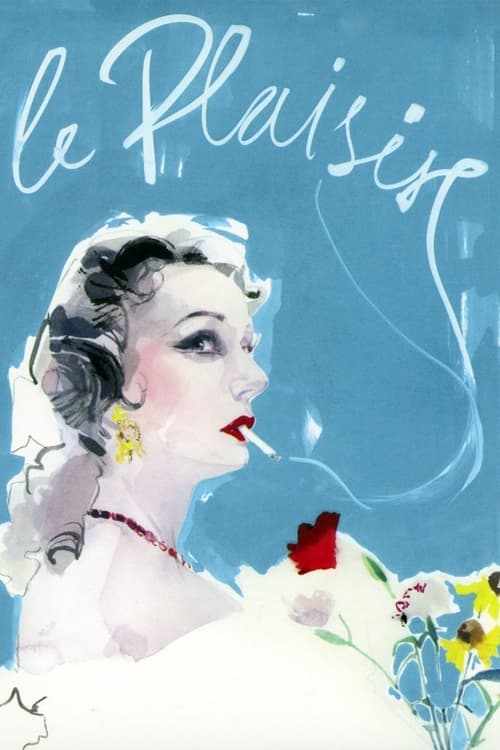
Le Plaisir
1952 · Max Ophüls
For an evening when you want elegance with an ache in it — champagne cinema that leaves a bittersweet aftertaste. A comfort watch for lovers of classic French film, and a gateway if you've never tried one.
What it's about
Three tales of pleasure adapted from Guy de Maupassant, introduced by the author's own voice as narrator. An aging dandy hides behind a mask so he can keep dancing at the balls of his youth; a brothel madam closes shop for a day and takes her girls to the countryside for her niece's first communion; a painter falls for his model and the affair curdles into obsession. Each story asks what pleasure costs, and each answers differently.
The experience
It glides — the camera waltzes through ballrooms and country lanes with astonishing grace, and the tone slips from farce to tenderness to something quietly devastating without ever jolting you. It's sumptuous and light on its feet, then suddenly it isn't, and the melancholy lands harder for arriving so gently.
Performances
Danielle Darrieux brings warmth and wit to the brothel girls' country outing, and Jean Gabin is wonderfully earthy as the farmer who falls for her — two of France's greatest stars in generous, relaxed form.
The craft
Max Ophüls was cinema's great master of the moving camera, and this may be his most virtuosic French film — long, flowing takes that swirl through crowded dance halls and peer through windows, turning every scene into choreography. The omnibus structure is handled with rare tonal control, three different registers held together by one sensibility. It rewards a big screen, where the sheer sweep of the camerawork becomes physical.
Why it matters
A touchstone of French cinema's post-war golden age and a film that generations of directors have cited for its camera choreography; it cemented Ophüls's reputation as the poet of pleasure and its price.
Snapshot
Three stories drawn from Guy de Maupassant — "Le Masque," "La Maison Tellier," "Le Modèle" — linked by a narrator who steps before the camera to announce, with Gallic directness, that this is a film about pleasure. Each tale complicates the promise: the first tells of an aged dandy who hides behind a mask to keep dancing; the second follows a brothel madam who shuts up shop and takes her girls to a country communion; the third tracks a painter whose model becomes his obsession and nearly his murderer. Together they form Max Ophüls's most structurally daring French work, an omnibus that moves from farce to pastoral elegy to mordant tragedy without losing its tonal coherence. The governing irony is Maupassant's — pleasure carries a hidden price — but the film belongs wholly to Ophüls: it is organized around one of cinema's great opening tracking shots, a mise-en-scène of unstoppable camera movement, and a compassion for women that was remarkable in early 1950s commercial cinema.
Industry & production
Le Plaisir was produced by Stera Films and CCFC (Compagnie Commerciale Française Cinématographique) for the French market, with André Paulvé among the key producers. It was Ophüls's second film in his returned French period, following the international success of La Ronde (1950), which had demonstrated that literary adaptation of a classic author — Schnitzler in that case — could be both critically prestigious and commercially viable. Le Plaisir was in some sense a more demanding wager: Maupassant's three stories are tonally disparate, the middle story ("La Maison Tellier") runs nearly an hour on its own, and the subject of a brothel in the countryside occupied a delicate position in the postwar French moral climate. The film was shot in studio interiors and on location in Normandy, a natural choice given Maupassant's Norman roots.
The screenplay was co-adapted by Ophüls and Jacques Natanson, who also collaborated with him on La Ronde. The narrator — voiced by Jean Servais, who appears briefly on screen — was a deliberate Brechtian device that Ophüls and Natanson used to announce and modulate tone between episodes, though Ophüls's use of it is more playful and literary than alienating. The film's budget and production ambitions were consistent with the level of "prestige literary adaptation" that defined the dominant mode of quality French cinema in the period — the mode that Cahiers du Cinéma critics were, at that very moment, beginning to systematically attack.
Technology
Le Plaisir was shot in black and white, 35mm. The choice of monochrome, already becoming slightly unfashionable in prestige productions by 1952, suits the Maupassant source material: its clarity reads as a period realism, connecting the imagery to late-nineteenth-century illustration and photography, and it allows cinematographer Christian Matras to sculpt with high-contrast lighting in ways that color would diffuse. The extended dance sequences and the long Normandy pastoral of "La Maison Tellier" both benefit from a tonal range that the orthochromatic and panchromatic stocks of the era rendered with particular richness.
No special-format or widescreen processes were employed. The film predates the CinemaScope era (Ophüls would shoot Lola Montès in Scope and color in 1955), and its visual grammar is fundamentally that of the late classical European studio system: theatrical in depth, dependent on camera movement rather than lens focal length for spatial expressiveness.
Technique
Cinematography
Christian Matras — Ophüls's central collaborator across the French quartet (La Ronde, Le Plaisir, Madame de..., Lola Montès) — is responsible for the film's visual character. The opening of "Le Masque" is the supreme demonstration: a sustained tracking shot that sweeps through a crowded dance hall following a masked figure in a frenzied polka. The camera circles, advances, retreats, and re-engages without a cut, transmitting both the ecstasy of the dance and its ominous excess. The shot is calibrated not merely to show virtuosity but to implicate the viewer in the masked man's delirium before the mask is removed and the narrative turns somber.
Throughout the film, Matras and Ophüls use cranes, dollies, and elaborate tracking rigs to keep the camera in near-continuous motion. The effect is not restlessness but a kind of temporal suspension — as if the camera, like Ophüls's characters, is trying to outrun mortality. In "La Maison Tellier," however, the movement shifts register: outdoor scenes in Normandy are lit with a diffused naturalism reminiscent of Impressionist painting, the flat northern light giving the communion sequence a pastoral softness that stands in deliberate contrast to the enclosed, artificial world of the dance hall.
Editing
The editing structure is tripartite by design, with the narrator serving as the seam between stories. Within each episode the cutting is classical in rhythm, but Ophüls's long takes mean that individual shots carry unusually large amounts of dramatic information. In "La Maison Tellier," sequences in the country church are cut with a gentle elongation — close-ups of the prostitutes weeping at the communion held slightly longer than conventional continuity editing would demand — to accumulate emotional weight. The film does not cut as a reflex; it cuts as a punctuation mark at the end of something the camera has already fully inhabited.
Mise-en-scène / staging
Ophüls stages his films in depth. Interiors are layered so that doorways, mirrors, arches, and frames-within-frames create receding planes of action; characters enter and leave these planes as the camera tracks, so that the spatial world feels populated beyond the immediate focal point. In the brothel sequences of "La Maison Tellier," the staging organizes the women into compositions that suggest a domestic community — they are presented not as individual commodities but as a social group with their own hierarchy, affections, and internal life, an approach that reads as quietly radical in the period context.
The masked ball in "Le Masque" uses the studied chaos of crowd choreography: extras are staged and re-staged into the background so that each pass of the tracking shot reveals new faces, new pairs, new social configurations. The effect is of a world too full and too fast to comprehend, which is precisely the dying man's experience.
Sound
The score — composed by Joe Hajos (Josef Hajos), with period waltzes, polkas, and salon pieces — is inseparable from the film's argument. Music in Ophüls is almost never ambient; it participates in the drama as an analog to desire and time. The dance music of "Le Masque" is heard at full pitch before it degrades into pathos; the country hymns of "La Maison Tellier" represent the world the women are excluded from even as they weep for it. The narrator's voice-over in Jean Servais's measured, slightly melancholic register provides an oral counterpoint to the visual exuberance, establishing a literary framing that anchors all three episodes in a shared tone of elegiac irony.
Performance
The ensemble spans registers appropriate to each episode. Madeleine Renaud's Madame Tellier is the film's moral center — pragmatic, warm, genuinely moved by the communion, and entirely without hypocrisy. Danielle Darrieux appears in "La Maison Tellier" as Rosa, one of the girls, bringing the luminous but contained quality that made her an important figure in French cinema across four decades. The performances in "Le Modèle" are more compressed and intense, in keeping with the story's shift toward obsession and violence. Across all three segments, Ophüls elicits a naturalness from his actors that stands slightly against the theatrical tendency of quality French cinema of the period — the characters feel inhabited rather than presented.
Narrative & dramatic mode
The omnibus structure is unusual but not arbitrary. Each of the three Maupassant stories enacts a different mode of the same tragic irony: "Le Masque" operates as grotesque comedy that turns into pathos; "La Maison Tellier" is a pastoral digression, almost a short novel, that allows the longest development of character and environment before returning to the quotidian sadness of the women's lives; "Le Modèle" is the most compressed and the most bitter, ending with the model's survival and the painter's ambiguous ruin. The narrator frames all three as illustrations of a thesis — pleasure seeks its own negation — but Ophüls's visual sympathy complicates any schematic reading. The film's dramatic mode is ultimately Chekhovian rather than moralistic: these lives are presented with compassion for the distance between what people want and what they can have.
Genre & cycle
Le Plaisir belongs to the postwar French literary adaptation cycle — a prestige industrial mode in which canonical nineteenth-century authors (Flaubert, Balzac, Maupassant, Zola) were adapted with care for period mise-en-scène, theatrical acting talent, and literary fidelity. This cycle was the dominant form of French "quality" cinema from the mid-1940s through the mid-1950s, and it drew the systematic criticism of the Cahiers du Cinéma's politique des auteurs precisely because it tended to privilege the source author over the film director. Ophüls is the critical exception to this rule: his literary adaptations are so thoroughly personal in their mise-en-scène that Truffaut and the Cahiers writers cited him as a model auteur even within the quality tradition, distinguishing his films from the "scenarists' cinema" they otherwise disparaged.
As an anthology film Le Plaisir also sits within a European tradition of episodic literary cinema that extends back to silent film and continues through postwar Italian neorealism's own omnibus experiments.
Authorship & method
Max Ophüls (born Maximilian Oppenheimer, 1902, Saarbrücken) had one of the more labyrinthine careers in cinema: a stage director in Germany who moved to film in the late silent era, he left Germany for France in 1933, worked in France and Italy, emigrated to Hollywood in 1941, made four American films of considerable distinction (including Letter from an Unknown Woman, 1948), and returned to France in the late 1940s. Le Plaisir is the product of his mature European homecoming, drawing on the Viennese operetta tradition, Central European literary irony, and French naturalism simultaneously.
His key collaborator was Christian Matras, one of the finest cinematographers working in French cinema, whose ability to execute sustained camera movements with precision and expressiveness was essential to Ophüls's method. Jacques Natanson brought literary intelligence and dialogue craft to the script. Ophüls's working method was reputedly intensive and demanding on set — he reportedly rehearsed camera movements as carefully as theatrical blocking, treating the moving camera as a performing instrument.
Movement / national cinema
Le Plaisir belongs to French cinema of the Fourth Republic era, made within the institutional structures of the French studio system but by a director who remained in important ways an outsider — German-born, with an American interlude, a European cosmopolitan rather than a French filmmaker in any national-cultural sense. This position allowed Ophüls a freedom from French generic convention that the quality tradition's native practitioners rarely displayed. His films belong to French cinema by virtue of language, production, and cast while drawing on a sensibility formed across three national cinemas.
Era / period
The films are set in the Belle Époque — the late nineteenth century of Maupassant's own writing life — and this temporal displacement is central to Ophüls's project in his French period. The Belle Époque represents a world of pleasure made possible by strict social hierarchy, a world Ophüls treats with neither nostalgia nor contempt but with the analytical compassion of someone who knows it is gone. Shot in the early 1950s, a decade after the Occupation, the Belle Époque setting carries an unstated weight: this is a film about a France that vanished, made by a German-Jewish exile who had reason to measure the cost of lost worlds.
Themes
The governing theme is the inseparability of pleasure and loss — each story literalizes a different form of the paradox. Age and the refusal of aging ("Le Masque"), the grace available to people excluded from grace ("La Maison Tellier"), the violence latent in erotic possession ("Le Modèle"): these are Maupassant's themes, but Ophüls amplifies them through camera movement itself. The tracking shot that circles the dancer doesn't only depict pleasure — it enacts it, and in its unbroken arc it also enacts the compulsion that makes pleasure self-destructive.
Women and their social position are a consistent preoccupation. The prostitutes of "La Maison Tellier" are treated as fully human subjects, capable of genuine piety and genuine feeling, placed within a social structure that Ophüls observes without editorializing. The film's most extended episode gives them the most time, the most interiority, and the most dignity of any French film of the period in its treatment of this social type. Time — its passage, its acceleration in pleasure, its weight in regret — is the film's ultimate subject.
Reception, canon & influence
Critical reception: Le Plaisir was well received by French critics on its release and consolidated the prestige that La Ronde had established. The Cahiers du Cinéma writers who were beginning to articulate auteur theory in the early 1950s regarded Ophüls with particular admiration; the evidence of his stylistic signature across all four of his returned French films made him an ideal case for the argument that direction, not literary source, was a film's organizing intelligence. The film does not appear to have achieved the broad popular reach of La Ronde, whose round-dance structure had a cleaner commercial hook.
Influences on the film (backward): The immediate source is Maupassant's three stories, which Ophüls and Natanson adapted with fidelity to their tonal range. Ophüls's own German sound films — particularly Liebelei (1933), his most celebrated pre-exile work — established the combination of romantic irony, sustained camera movement, and tragic denouement that Le Plaisir inherits. The French poetic realism of the 1930s (Renoir especially) informs the Normandy pastoral sequences; the operetta and Viennese stage tradition shapes the Ball sequences; Hollywood melodrama of the 1940s, particularly the women's picture, gave Ophüls tools for directing female interiority that he applies with considerable nuance in "La Maison Tellier."
Legacy (forward): Ophüls's four French films collectively formed a crucial inheritance for the French New Wave. The fluid long take as an expressive rather than merely technical instrument, the refusal to use cutting as a substitute for staging, the camera as an instrument of desire and temporal experience — these pass directly into the vocabulary of Truffaut, Godard, Rivette, and Rohmer. Rivette in particular, with his own long narratives and attention to mise-en-scène as duration, can be read partly as a Ophüls heir. The compassionate treatment of women outside bourgeois respectability in "La Maison Tellier" has a traceable line to certain strands of French cinema's engagement with women's social margins in subsequent decades. Le Plaisir is less frequently cited than Madame de... or Lola Montès in discussions of Ophüls's canonical standing, but its structural ambition — the sustained tonal range of the omnibus, the opening shot's place among the great unbroken takes in film history — gives it a claim on the viewer's attention that closer acquaintance consistently rewards.
A Deleuzian reading
The camera finds a man dancing and will not let him go.
The full Deleuzian reading of Le Plaisir →
Reception
A commercial disappointment in France in 1952 — audiences found its blend of gaiety and cruelty unsettling — it's since risen to sit alongside The Earrings of Madame de... at the summit of Ophüls' reputation, helped by restorations and decades of filmmaker worship.
How Le Plaisir was received, from release to now →
Influences: the films it descends from and the films it influenced
- Liebelei (1933) — Ophüls's pre-exile template for the ballroom-as-desire-space establishes the slow lateral tracking shot following dancing couples that Le Plaisir's opening sequence directly inherits, using camera movement as embodied longing rather than neutral observation.
- La Ronde (1950) — The visible compère narrator (Anton Walbrook) seaming autonomous vignettes is the direct formal model that Le Plaisir refines into Jean Servais's disembodied literary voice-over, eliminating the on-screen intermediary while preserving the narrator's function as tonal and temporal ironist between episodes.
- Letter from an Unknown Woman (1948) — Ophüls's Hollywood collaboration with Franz Planer on the sustained-take exploration of female interiority through a literary epistolary voice-over is the American template that Le Plaisir's Matras partnership reconceives in naturalist European light in 'La Maison Tellier.'
- Une Partie de Campagne (1936) — Renoir's own Maupassant pastoral adaptation establishes the visual model — impressionist light through riverside foliage, ambiguous sympathy for women constrained by social role — that Le Plaisir's 'La Maison Tellier' Normandy sequences inhabit as a direct inheritance.
- La Règle du Jeu (1939) — Renoir's deep-focus crowd choreography tracking simultaneously through multiple social performances in enclosed interiors is the formal ancestor of Ophüls's 'Le Masque' ball sequence, where lateral camera movement and staging depth hold an entire social world in tragicomic suspension.
- Der letzte Mann (1924) — Murnau's entfesselte Kamera — the principle that the camera may move freely through space to follow or precede human action — is the technical genealogy Ophüls absorbed during his Berlin theater years and that surfaces directly in Le Plaisir's celebrated opening unbroken crane-and-dolly movement.
- Lola Montès (1955) — Le Plaisir's three-vignette omnibus structure reaches its architectural conclusion here: the circus-spectacle framing device doubles the omnibus seams Ophüls first systematized in Le Plaisir, with the narrator now embodied as ringmaster rather than literary voice-off presiding over fragmented memory.
- Hiroshima mon amour (1959) — Marguerite Duras's literary voice-over — prose rhythms that contradict rather than caption the images, creating temporal displacement between spoken memory and visible present — translates the Ophülsian narrator-as-temporal-ironist device Le Plaisir's Jean Servais voice established into the register of trauma and forgetting.
- Jules et Jim (1962) — Truffaut, who wrote Cahiers criticism advocating for Ophüls's camera as instrument of desire, translates Le Plaisir's fluid tracking-shot grammar and literary-register narrator seaming temporal ellipses directly into New Wave idiom, the crane shots following the trio rhyming with Ophüls's ballroom mobility.
- L'Amour fou (1969) — Rivette extends Le Plaisir's long-take-as-punctuation principle to its logical extreme in a four-hour exploration of rehearsal space, replacing the cut with endurance as the film's formal unit and enacting the argument that Ophüls's sustained mise-en-scène duration is itself the expressive content.
- Ma Nuit chez Maud (1969) — Rohmer's literary-register first-person narration creates the same ironic gap between what the voice retrospectively claims and what the images reveal that Le Plaisir's Jean Servais achieves: pleasure narrated with knowing retrospective distance, desire structured through the discrepancy between prose and image.
- GoodFellas (1990) — Scorsese's Copacabana sequence — a single sustained crane-and-dolly following entry through a nightclub without a cut — is the most-cited American descendant of Le Plaisir's opening sustained-movement grammar, the camera embodying the protagonist's desire to belong to the social world it traverses.
- Short Cuts (1993) — Altman transposes Le Plaisir's prestige-literary omnibus model — multiple stories structured as autonomous vignettes about desire, accident, and mortality — into American naturalism, applying the same anthology formal respect to Raymond Carver that Ophüls gave Maupassant.
- Eyes Wide Shut (1999) — Kubrick's New Year's Eve party and Somerton ritual sequences deploy lateral tracking through rooms of social performance and ceremonial desire without cutting — the camera circling pleasure's surface without penetrating it — directly inheriting Le Plaisir's grammar of sustained social-space movement as instrument of erotic and temporal suspension.
- The French Dispatch of the Liberty, Kansas Evening Sun (2021) — A portmanteau of Maupassant short stories bound together by a first-person literary narrator, the precedent for the magazine-issue anthology stitched by dominant voice-over.
- The Dead (1987) — Ophüls adapts Maupassant by keeping the author's narrating voice on the soundtrack rather than dramatizing it, the precedent that licenses transferring Joyce's closing prose intact as voice-over.
- House of Pleasures (2011) — The "Maison Tellier" episode supplies both the brothel-as-household-economy ensemble and the single excursion out of the house into daylight, plus Ophüls's practice of keeping the camera outside windows and doorways so the viewer is positioned as a paying visitor rather than an intimate.
- Madame de... (1953) — Christian Matras reprised immediately from Le Plaisir brings the same impressionist-diffused black-and-white lighting grammar and sustained circular camera movement into a concentrated single-object narrative, the earrings circled by the camera as the ballroom dancer had been circled.
- The Life of Oharu (1952) — Contemporary picaresque of pleasure and its cost, built from sweeping mobile camera choreography through period space, sharing Oharu's episodic architecture of a woman passed from milieu to milieu.
Similar films
- The Earrings of Madame de... (1953) — influence & lineage
- La Ronde (1950) — influence & lineage
- The Rules of the Game (1939) — influence & lineage
- Lola Montès (1955) — influence & lineage
- Jules and Jim (1962) — influence & lineage
- The Last Laugh (1924) — influence & lineage
- Letter from an Unknown Woman (1948) — influence & lineage
- House of Pleasures (2011) — shared sensibility