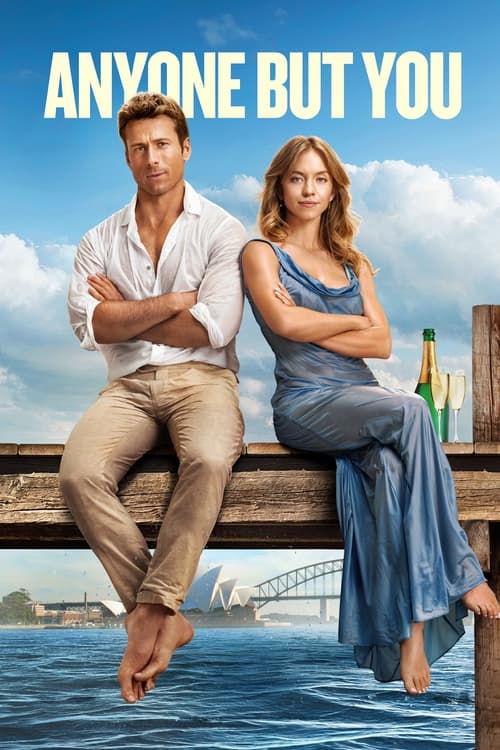
Anyone but You
2023 · Will Gluck
For a girls' night, a date night, or any evening you want to turn your brain off and grin — zero challenge, all comfort, with a soundtrack you'll be humming after.
What it's about
Bea and Ben have one great first date that curdles into mutual loathing — and then fate seats them at the same destination wedding in Sydney, Australia. To keep the peace, deflect meddling families, and needle their exes, they agree to pretend to be a couple, which goes about as smoothly as fake dating between two people this combustible ever does.
The experience
Sun-drenched, raunchy, and deliberately old-fashioned in its pleasures — big stars, gorgeous scenery, escalating farce. It's the kind of comedy that knows exactly what it is and commits, sight gags and all.
Performances
Sydney Sweeney and Glen Powell's sparring chemistry is the whole show — two movie stars visibly having fun trading insults until the insults stop meaning what they say.
The craft
Will Gluck builds the whole thing on the bones of Shakespeare's 'Much Ado About Nothing' — the bickering leads, the scheming friends, even lines from the play slipped on screen — and shoots Sydney's harbor and beaches like a travel brochure you want to climb into. It's glossy, bright studio craftsmanship aimed squarely at a good time.
Why it matters
A word-of-mouth sleeper that grew week after week into a global hit, it was widely credited with proving the theatrical romantic comedy — and the old-school movie-star vehicle — still works.
Snapshot
Anyone but You is a studio romantic comedy directed by Will Gluck and written by Gluck with Ilana Wolpert, released by Sony Pictures through its Columbia and TriStar arms in December 2023. It stars Sydney Sweeney and Glen Powell as Bea and Ben, two would-be lovers whose promising first encounter curdles into mutual antagonism, only for them to be thrown back together at a destination wedding in Sydney where they agree to fake a relationship. The film is openly modeled on Shakespeare's Much Ado About Nothing — it borrows the "merry war" of Beatrice and Benedick, condenses their names into Bea and Ben, and punctuates itself with on-screen lines from the play. Made on a modest budget (reported at roughly $25 million) and opening to soft reviews and a quiet first weekend, it became the defining sleeper story of its season, building through word of mouth and a resurgent Natasha Bedingfield needle-drop to gross over $200 million worldwide. Its significance is less aesthetic than industrial: it is widely credited with demonstrating that the theatrical, star-driven romantic comedy — a form largely exiled to streaming in the late 2010s — could still draw audiences to cinemas.
Industry & production
The film sits at the intersection of two industry currents. The first is the post-pandemic hunger for mid-budget, non-franchise theatrical product; the second is Sony's positioning as the major studio most willing to keep releasing star-vehicle comedies theatrically while rivals routed them to streaming services. Produced by Joe Roth and Jeff Kirschenbaum's Roth/Kirschenbaum Films alongside Gluck's own Olive Bridge Entertainment, it was financed and distributed by Sony/Columbia. The budget — commonly cited around $25 million — is characteristic of the "adult comedy" tier that had become endangered, and the film's return on that figure was the story: an eightfold-plus theatrical multiple that trade coverage repeatedly framed as a proof-of-concept for the genre's theatrical viability.
Production centered on Sydney and the New South Wales coast, with the destination-wedding premise motivating extensive location shooting around Sydney Harbour and its landmarks. The Australian setting reflects both narrative logic and the practical economics of overseas production incentives. Marketing became inseparable from the film's fortunes: the studio and the culture around the release leaned heavily into speculation about the two leads' off-screen rapport, a promotional dynamic that generated durable social-media attention through the fall and into the December opening. That campaign, and the film's slow-burn commercial arc, are now standard reference points in discussions of how rom-coms can be sold in a fragmented attention economy.
Technology
Anyone but You is a conventionally produced digital studio comedy and does not present a notable technological case study; the record on its specific camera and finishing pipeline is thin, and I will not invent particulars. It was shot digitally, as is near-universal for the contemporary studio rom-com, and finished for standard theatrical and subsequent home/streaming distribution. The more consequential "technology" around the film is distributional and social rather than photographic: its success was mediated by platforms — TikTok in particular — where the recurring use of Bedingfield's 2004 single "Unwritten" was recirculated as a soundtrack meme, feeding back into ticket sales. In that sense the film is a useful specimen of how algorithmic music-and-clip culture now functions as an unofficial marketing layer for theatrical releases.
Technique
Cinematography
Photographed by Danny Ruhlmann, the film adopts the bright, high-key, postcard-clean look that governs the modern travel-destination romance. Sydney is shot as spectacle — harbor vistas, sun, water, and architecture serving as an aspirational backdrop that flatters the couple and underlines the fantasy register of the genre. The cinematography is legible and unobtrusive rather than expressive; its job is to keep two attractive performers well-lit, comprehensible in wide and medium two-shots, and continuously readable during physical comedy. This is a deliberate aesthetic choice consistent with the commercial rom-com tradition, not a shortcoming: the camera prioritizes clarity of geography and face over stylization.
Editing
Cut by Tia Nolan (with the editorial team including Kim Boritz-Brehm), the film runs on comic timing more than on any montage signature. Nolan, a frequent Gluck collaborator, shapes the picture around the reversal — the whiplash from first-date warmth to sustained hostility — and around the escalating farce of the fake-relationship charade. The editing's central task is rhythm: landing jokes, managing the ensemble of wedding-party subplots, and pacing the set pieces (including the running physical-comedy gags) so that humiliation and tenderness alternate at a steady clip. It is craftsmanlike, invisible cutting in service of performance.
Mise-en-scène / staging
The staging is organized around the destination-wedding container, a setting that conveniently confines the antagonists together and supplies a rotating cast of relatives, exes, and meddlers — the modern equivalent of Shakespeare's scheming Messina household. Gluck stages the film as a comedy of proximity and enforced performance: Bea and Ben must publicly enact a couple while privately warring, so much of the blocking concerns eavesdropping, overheard misdirection, and the gap between the face shown to the wedding party and the truth. This is a direct structural inheritance from Much Ado's gulling scenes, translated into contemporary group-vacation choreography.
Sound
The most discussed sonic element is the diegetic and needle-drop use of Natasha Bedingfield's "Unwritten," which recurs across the film and functions as a running motif tied to Bea and Ben's arc; the song's prominence drove a genuine cultural revival of the 2004 track. The original score is credited to Este Haim (of the band HAIM) and Chris Stracey, working in the pop-inflected idiom typical of the genre. Sound design otherwise serves comedy and clarity — dialogue-forward mixing, music cues that steer the emotional register, and the ambient texture of coastal Sydney as pleasant wallpaper.
Performance
The film lives or dies on its two leads, and the consensus — even among lukewarm reviews — is that Sweeney and Powell supply the chemistry the genre requires. Sweeney plays Bea with a mix of guardedness and impulsiveness; Powell leans into a light, self-deprecating leading-man register that draws on classical rom-com masculinity. Both commit to physical comedy and to the vulnerability the reconciliation demands. The surrounding ensemble fills the wedding-party archetypes, but the picture is engineered as a two-hander, and its commercial afterlife has been read partly as a star-making or star-confirming vehicle, particularly for Powell.
Narrative & dramatic mode
The dramatic mode is high comedy in the antagonists-to-lovers tradition: two verbally sparring principals whose hostility is transparently a defense against attraction, maneuvered together by circumstance and by third parties invested in the match. The screenplay's spine is the "merry war" of Much Ado About Nothing — the film even foregrounds its source with on-screen Shakespeare — and it reproduces the play's engine of overheard conversations and staged misunderstandings, whereby friends trick each combatant into believing the other is secretly in love. Onto this it grafts the contemporary "fake dating" premise, a durable modern rom-com convention in which a pretended relationship becomes a real one. The result is a farce of performance and misdirection: the comedy derives from the distance between public display and private feeling, and the resolution arrives when the performance collapses into sincerity.
Genre & cycle
Anyone but You is a textbook studio romantic comedy, and its importance is best understood at the level of the cycle rather than the individual film. Through the 2010s the theatrical rom-com had contracted sharply, its output absorbed by Netflix and other streamers and its stars migrating to television and franchises. The film arrived as a test case for whether the form could return to cinemas, and its unexpected commercial success made it a rallying reference in trade and critical writing about a possible rom-com "revival." It belongs squarely to the destination-wedding subgenre and the fake-relationship subgenre, and it self-consciously positions itself within the long lineage of screwball and antagonists-to-lovers comedy that runs from 1930s Hollywood through the Nora Ephron era to the present. Its Shakespearean adaptation lineage also links it to the tradition of teen and studio comedies built on the Bard — a tradition Gluck himself brushed against in Easy A, which riffed on The Scarlet Letter within a similarly literate teen-comedy frame.
Authorship & method
Will Gluck is the film's clearest authorial signature. His body of work — Easy A (2010), Friends with Benefits (2011), and the Peter Rabbit films — established him as a director of glossy, joke-dense, structurally confident commercial comedies, often literate about their own genre and fond of fourth-wall-adjacent playfulness and pop-song scoring. Anyone but You extends that profile: a classical text repurposed as accessible mainstream entertainment, propelled by star chemistry and music. Gluck wrote the screenplay with Ilana Wolpert, produced the film, and shaped it as a return to the R-leaning adult comedy he had worked in earlier in his career.
His key collaborators reinforce the house style. Cinematographer Danny Ruhlmann supplies the clean, sunlit destination look. Editor Tia Nolan, a recurring Gluck partner, governs the comic timing. Composers Este Haim and Chris Stracey provide the pop-forward score, while the film's most memorable musical decision — the saturation of "Unwritten" — functions as an authorial choice about how music can carry a rom-com's emotional throughline. Producers Joe Roth and Jeff Kirschenbaum, veterans of studio commercial filmmaking, anchor the production on the business side. The method, in sum, is old-fashioned in the best sense: recognizable stars, a proven narrative template, buoyant music, and a picturesque location, assembled with professional efficiency for a broad audience.
Movement / national cinema
The film is a product of mainstream American studio filmmaking and does not belong to any art-cinema movement. Its national-cinema interest is twofold and largely industrial. First, it is an American picture that made Sydney and the New South Wales coast central to its imagery, part of the long pattern of Hollywood productions using Australia as both location and production base. Second, and more importantly, it is a document of the American studio system's post-2020 recalibration — an artifact of Sony's particular strategy of defending theatrical comedy at a moment when the category's survival was in question.
Era / period
Anyone but You is emphatically a film of the early-2020s post-pandemic recovery. Its release in December 2023 coincided with an industry anxiously seeking non-franchise theatrical successes, and its slow, word-of-mouth-driven climb — unusual in an era of front-loaded opening weekends — made it a period-defining example of how a film could still "have legs." Culturally it is stamped by its moment: the TikTok-fueled revival of a two-decade-old pop song, the promotional weaponization of celebrity-relationship speculation, and the framing of the release as a bellwether for an entire endangered genre. It is difficult to imagine the film's trajectory in any other period; its success was as much about 2023's media ecology as about anything on screen.
Themes
Beneath the farce, the film works a small set of durable romantic-comedy themes. The central one is the defense of hostility as a mask for desire — the idea, inherited from Much Ado, that the fiercest antagonism can be the truest sign of attraction. Adjacent to it is the theme of performance and authenticity: the fake-relationship conceit dramatizes how pretending to feel something can become the vehicle for feeling it, and how public display and private truth eventually have to converge. The wedding setting foregrounds themes of coupling, family expectation, and the social pressure to pair off, with the ensemble functioning as a chorus that both meddles and mirrors. Finally, the "Unwritten" motif carries a lightly earnest theme of self-authorship and openness to the unplanned — the notion that a life, like a romance, is best left unfinished and unfixed.
Reception, canon & influence
Critical reception was mixed-to-lukewarm. Reviewers frequently praised the leads' chemistry and the film's easy watchability while faulting the screenplay's contrivances and the broadness of its comedy; it was received as pleasant, disposable studio entertainment rather than a critical event. The gap between that tepid critical response and the film's enormous commercial performance became a central talking point — a reminder that rom-com success has often been an audience phenomenon more than a critical one.
The influences on the film are explicit and traceable: Much Ado About Nothing as structural and thematic source; the screwball and antagonists-to-lovers lineage of classic Hollywood; the destination-wedding and fake-dating conventions of the modern rom-com; and Gluck's own literate-comedy sensibility. Its influence forward is chiefly industrial. Because it grossed over $200 million worldwide from a modest budget and did so on the strength of word of mouth, it became the go-to evidence in trade and critical arguments that the theatrical romantic comedy was commercially alive, and it is regularly cited as having helped catalyze renewed studio investment in the genre. It also functioned as a career accelerant for its stars — Powell's ascent as a leading man is often narrated with this film as a pivot — and as a case study in social-media-driven marketing and the revival of catalog music through film placement. Whether Anyone but You enters any lasting artistic canon is doubtful; its secure place is in the industrial history of the 2020s, as the sleeper hit that reopened the argument about the rom-com's theatrical future.
Sources: Wikipedia: Anyone but You, The Movie Database, The Numbers).
A Deleuzian reading
Two people stand with their arms around each other for the benefit of a wedding party, and say something unforgivable to each other through their teeth.
The full Deleuzian reading of Anyone but You →
Reception
Written off on release — a soft $6M opening and shrugging reviews had it pegged as a flop — until word of mouth and TikTok turned it into a $200M+ sleeper phenomenon, the biggest theatrical rom-com hit in years. Now it's less 'is it good?' than 'the movie that proved the theatrical rom-com wasn't dead.'
How Anyone but You was received, from release to now →
How to watch Anyone but You: what to notice on a first viewing
- Watch where their hands go while they insult each other. Bea and Ben hold each other for the benefit of the wedding party and say unforgivable things through their teeth. The arm is a prop in an agreed performance and a hand on a waist at the same time. The fake-relationship premise issues an alibi for every touch, so no gesture in the film can be settled either way.
- Count how long both leads stay in one shot together. Danny Ruhlmann keeps them legible in wide and medium two-shots and holds off on isolating either face. The framing stays open where a close-up would close the question. A face alone would tell you what someone actually feels. The two-shot is the only frame that keeps the gesture undecided.
- Listen for conversations one of them is meant to overhear. Friends stage talk for a combatant to catch by accident, straight out of Much Ado About Nothing, which the film quotes on screen. Nothing said is false. The address is the lie. You know more than either of them in almost every scene, and the comedy runs on that gap.
- Notice how bright and even the Sydney light is. Harbor, water, sun and architecture shot as postcard spectacle, with everything high key and unfussy. Nothing is expressive and nothing is in shadow. The look is the standard of the destination romance. The clarity is the requirement. Two bodies have to stay readable at all times for the comedy to work.
- Listen for the same 2004 pop song coming back. Natasha Bedingfield's Unwritten recurs across the film, sometimes played in the scene, sometimes over it, tied to where Bea and Ben stand with each other. Este Haim and Chris Stracey handle the rest of the score. A song about a story not yet written rides an arc about two people denying a story has started. It later left the film and sold the tickets.
The whole guide to watching Anyone but You, with the keys for a rewatch →
Influences: the films it descends from and the films it influenced
- Much Ado About Nothing (1993) — Supplies the direct engine — the 'gulling' scenes in which friends stage overheard conversations to trick two sparring wits (Beatrice/Benedick) into love, which Anyone but You lifts as its overheard-misdirection device and antagonists-to-lovers spine.
- His Girl Friday (1940) — Establishes the overlapping, machine-gun screwball banter between combative equals that Gluck's two-hander chemistry-pacing descends from.
- The Awful Truth (1937) — The comedy-of-remarriage prototype where staged hostility performs as a mask over desire — the 'hostility-as-mask' template the film runs on.
- It Happened One Night (1934) — Founds the forced-proximity travel comedy between antagonists made to share intimate space (the Walls of Jericho), the comedy-of-proximity staging device.
- Bringing Up Baby (1938) — Model for the escalating physical-mishap screwball in which the woman relentlessly dismantles the man's composure, feeding the comic-timing edit rhythm.
- 10 Things I Hate About You (1999) — Set the template of modernizing a Shakespeare comedy (here The Taming of the Shrew) into a glossy, pop-scored studio rom-com pitched at a broad young audience.
- When Harry Met Sally... (1989) — The talky antagonistic two-hander built from verbal set-piece sparring and a slow antagonism-to-love burn that the leads' bickering-dialogue structure inherits.
- The Proposal (2009) — Near-direct plot cousin: a fake relationship forced by circumstance and dragged to a family destination with a wedding backdrop, the fake-dating/destination scaffold reused.
- Easy A (2010) — Gluck's own literate, self-aware comedy that codified his house style — pop-song emotional throughline and fourth-wall-adjacent playfulness carried forward here.
- Friends with Benefits (2011) — Gluck's earlier R-leaning adult rom-com that meta-mocks genre clichés while indulging them, leaning on star chemistry and pop scoring exactly as this film does.
- Forgetting Sarah Marshall (2008) — The R-rated destination-resort comedy (Hawaii) that fused raunch with romance, direct precedent for the film's full-frontal nudity gags and vacation-set staging.
- To All the Boys I've Loved Before (2018) — Revives the fake-dating contrivance and chemistry-first casting for a theatrical, adult-skewing rom-com in the commercial slipstream TATBILB reopened for the genre.
- Fly Me to the Moon (2024) — A post-Anyone-but-You adult star-driven studio rom-com (Tatum/Johansson) greenlit into the theatrical revival this film was credited with catalyzing.
- Anyone but You (marketing case) (2024) — Its 'Unwritten' catalog-song saturation and TikTok-driven word-of-mouth became the template subsequent rom-coms copied for needle-drop-as-marketing and social virality.
- Crazy Rich Asians (2018) — The glossy destination-wedding studio rom-com with high-key travelogue cinematography that proved the theatrical genre could still open big on spectacle.
- Destination Wedding (2018) — A distilled two-hander of misanthropic antagonists thrown together at someone else's destination wedding — the same proximity-antagonism premise stripped to two actors.
- Ticket to Paradise (2022) — The immediately-preceding destination (Bali) wedding rom-com powered by bickering-exes star chemistry (Clooney/Roberts), part of the same revival wave and marketing playbook.
- Set It Up (2018) — Foregrounds the manufactured-relationship/scheming device — two people engineering a fake romance — that is the mechanical center of Anyone but You's plot.
- Red, White & Royal Blue (2023) — The same-year enemies-to-lovers studio rom-com revival (structured on Much Ado About Nothing), demonstrating in parallel the theatrical-banter-plus-glossy-locations formula RWRB runs on.
Similar films
- People We Meet on Vacation (2026) — shared sensibility
- Palm Springs (2020) — shared sensibility
- Finding Emily (2026) — shared sensibility
- About Time (2013) — shared sensibility
- How to Lose a Guy in 10 Days (2003) — shared sensibility
- The Fall Guy (2024) — shared sensibility
- We Live in Time (2024) — shared sensibility
- Eternity (2025) — shared sensibility