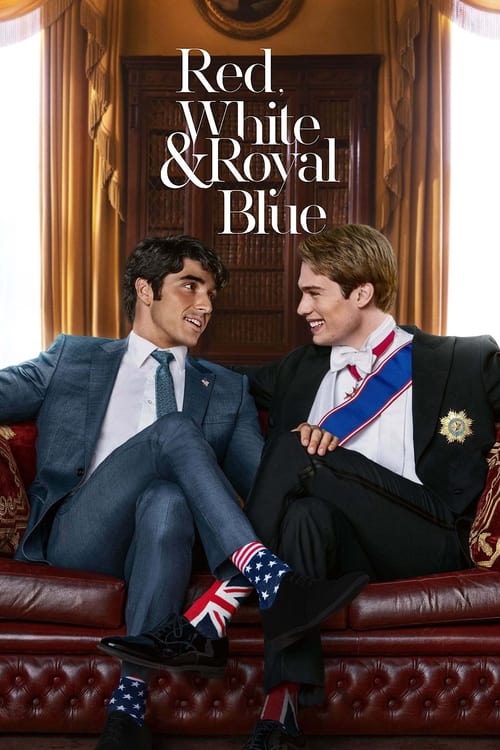
Red, White & Royal Blue
2023 · Matthew López
For a cozy night in when you want to fall in love and know it's going to be okay. Pure comfort viewing — reach for it when you want banter, longing glances, and a happy sigh at the end.
What it's about
Alex is the American president's son; Henry is a British prince; and after a tabloid-worthy disaster at a royal wedding, the two longtime rivals get forced into a staged public friendship to smooth over transatlantic relations. Photo ops and fake smiles slowly give way to actual conversations, and the feud starts sparking into something neither of them planned for — something that could upend both of their very public lives.
The experience
Frothy, flirty, and unabashedly wish-fulfillment — it moves fast, keeps the banter coming, and lets the romance be swoony without irony. There's a warm sincerity under the gloss that sneaks up on you.
Performances
Taylor Zakhar Perez and Nicholas Galitzine have the easy, teasing chemistry the whole film rests on — Galitzine in particular gives the buttoned-up prince a wounded reserve that makes the thaw feel earned.
The craft
Playwright Matthew López, in his feature directing debut, brings a theater writer's ear for the volley of enemies-to-lovers dialogue, and the film leans into glossy fantasy versions of the White House and royal palaces. It's built for the couch rather than the big screen — bright, handsome, and paced like a page-turner.
Why it matters
One of the defining streaming-era romances, it proved a queer love story could be a mainstream crowd-pleaser event and became a touchstone for the wave of book-to-screen romance adaptations.
Snapshot
Red, White & Royal Blue is a streaming-era romantic comedy adapted from Casey McQuiston's 2019 bestselling novel, released by Amazon Studios on Prime Video in August 2023. It marks the feature directorial debut of Matthew López, the playwright who became the first Latino writer to win the Tony Award for Best Play (for The Inheritance, 2021). The film transposes an enemies-to-lovers wish-fantasy into the corridors of transatlantic power: Alex Claremont-Diaz (Taylor Zakhar Perez), the telegenic son of a first-term U.S. president, and Prince Henry of Wales (Nicholas Galitzine), a constitutionally boxed-in "spare," are shoved into a public friendship after a cake-toppling brawl at a royal wedding, and the détente curdles, unexpectedly, into love. Its cultural significance is less formal than emblematic: it is one of the most prominent studio-scale, big-budget-adjacent gay romantic comedies to reach a mass audience through a major streaming platform, arriving as the queer rom-com was consolidating from art-house novelty into commercial genre. The film is glossy, unabashedly optimistic, and politically utopian by design — a mode that is itself the point.
Industry & production
The film was produced by Amazon Studios in association with Berlanti/Schechter Films — Greg Berlanti's shingle, whose fingerprints on mainstream queer storytelling (Love, Simon, Dawson's Creek, the Arrowverse) situate the project within a specific producing lineage. The property arrived pre-sold: McQuiston's novel was a New York Times bestseller with an intensely engaged fanbase, and the adaptation carried the commercial logic of proven IP into a market segment — earnest queer romance — that theatrical distributors had historically treated as risky. Routing the film to Prime Video rather than cinemas is the single most consequential industrial fact about it. Amazon's model favors global simultaneous release, algorithmic discovery, and completion metrics over opening-weekend gross, which reframes "success" as engagement rather than box office. Amazon publicly characterized the film as a strong performer and a driver of subscriber engagement, and greenlit a sequel; however, because streamers do not release audited viewership figures, precise numbers are not part of the reliable public record, and specific viewership or "most-watched" claims should be treated with caution.
Principal photography took place in England, with London and surrounding estates and interiors standing in for both Washington and the British settings — an economical consolidation given that the novel splits its geography across the Atlantic. The screenplay is credited to López and Ted Malawer. Casting drew press attention for pairing two relatively emerging leads with an established supporting ensemble: Uma Thurman as President Ellen Claremont (playing, notably, with a Texan accent), Clifton Collins Jr. as Alex's father, Sarah Shahi as the harried deputy chief of staff Zahra, Rachel Hilson as Nora, and Stephen Fry as the King. The budget has not been disclosed in verified detail, but the production values — location shooting, period-adjacent royal pageantry, a recognizable cast — signal an investment well above the micro-budget tier that had characterized much prior queer cinema.
Technology
Technologically the film is conventional for its moment: a digital-capture, streaming-first production finished for high-dynamic-range home viewing rather than theatrical projection. The specific camera and lens packages are not part of the well-documented public record, so it would be irresponsible to specify them. What is worth naming is the platform technology itself as a formative constraint. A film built for Prime Video is graded and mixed for a heterogeneous viewing environment — phones, laptops, and living-room televisions — which tends to favor bright, legible, high-key imaging and a clean, front-loaded sound mix over the darker, more theatrically demanding registers a cinema release might tolerate. The film's polished, well-lit look is consistent with that delivery pipeline.
Technique
Cinematography
The cinematography is credited to Stephen Goldblatt, ASC, BSC — a veteran whose résumé spans The Prince of Tides, Batman Forever, Angels in America, Julie & Julia, and The Help. His involvement is one of the film's more interesting authorship signatures, lending a classical, character-forward craftsmanship to material that could have been shot flatly. The visual strategy is warm and burnished: golden-hour exteriors, candlelit and lamp-lit interiors for the intimate scenes, and a palette that leans into the title's own chromatic promise — reds, whites, and royal/navy blues threaded through costume and production design. The camera favors the two leads' faces and the charged physical distance between them, using the vocabulary of the classical romance — the meaningful two-shot, the reaction cut, the slow closing of proximity — rather than showy formal invention. It is cinematography in service of romance legibility.
Editing
The editing follows commercial rom-com grammar: brisk in its comic and expository stretches, patient in its romantic set-pieces, with the genre-standard use of montage to compress the couple's growing intimacy (letters, texts, stolen encounters across cities). The specific editor is not something I can attribute with confidence from the reliable record, and I will not guess a name. Structurally, the cutting manages the novel's epistolary interludes — the emails and messages between Alex and Henry — as an editing and graphic problem, a challenge any modern romance adapting digital-native courtship must solve.
Mise-en-scène / staging
Mise-en-scène is where López's theatrical background is most legible. The film stages power as architecture: the ordered symmetry of state rooms, the pageantry of the royal wedding, the performance of public appearances — all of it a designed apparatus of surveillance against which private feeling must hide. Production and costume design do heavy thematic work, contrasting the buttoned, tradition-bound formality of Henry's world with the looser, brighter register around Alex. The recurring visual motif of thresholds and enclosed rooms — palaces, offices, the literal and figurative closets of institutional life — externalizes the drama of concealment.
Sound
The sound design and music work in a pop-forward, contemporary register typical of the streaming rom-com, using needle-drops and an emotive score to underline romantic beats. I am not able to confirm the composer's identity from the reliable record and will not invent an attribution; this is a genuine thin spot. What can be said is that the mix is clean and dialogue-prioritized, consistent with home-viewing delivery, and that music functions conventionally as emotional signposting rather than as a disruptive or ironic force.
Performance
Performance is the film's engine. Taylor Zakhar Perez plays Alex as verbally quick, ambitious, and defended by charm, and the role hinges on his character's real-time discovery of his own bisexuality — a self-recognition the performance has to render as revelation rather than switch-flip. Nicholas Galitzine's Prince Henry is the more interiorized creation: melancholic, precise, carrying the weight of institutional duty and inherited grief, his restraint the counterweight to Perez's extroversion. The film's success rests almost entirely on their chemistry, and critics broadly credited the pairing. Among the supporting cast, Sarah Shahi's comic timing as the exasperated fixer and Uma Thurman's stylized presidential turn drew particular notice; Stephen Fry supplies gravitas as the monarch.
Narrative & dramatic mode
The dramatic mode is comic romance in its purest wish-fulfillment form: the enemies-to-lovers arc, a structure as old as Much Ado About Nothing and Pride and Prejudice, in which antagonism is revealed to be misrecognized attraction. The narrative runs on the classic rom-com clock — meet (badly), banter, thaw, fall, expose, rupture, reconcile — and its central engine of suspense is not whether the lovers belong together but whether the institutions surrounding them will permit it. The film layers a light political-thriller mechanism onto the romance (a threatened leak, an election, the machinery of scandal) so that the private relationship is continuously imperiled by public consequence. Crucially, the film operates in a consciously utopian register: it imagines a contemporary America with a woman Democratic president and a world in which a gay relationship between a first son and a prince becomes, ultimately, a survivable and even celebrated public fact. This optimism is a deliberate authorial choice, positioning the film against the tragedy that has historically shadowed queer screen romance.
Genre & cycle
The film belongs squarely to the mainstream queer romantic comedy cycle of the late 2010s and early 2020s — the movement of gay romance from the margins of independent and festival cinema toward the center of commercial, studio-backed entertainment. Its immediate siblings include Love, Simon (2018), the Netflix series and film adjacent Heartstopper and Alex Strangelove, and the theatrical experiments Fire Island (2022) and Bros (2022). Within that cycle, Red, White & Royal Blue is distinguished by its scale, its glossiness, and its embrace of the most conventional Hollywood romance architecture rather than a subcultural or revisionist one. It also sits inside a second, older genre lineage: the royal-romance fantasy — commoner-meets-royal, Roman Holiday, The Prince & Me, The Princess Diaries — which the film queers while otherwise honoring its rules. The result is a hybrid that reads as familiar precisely because it grafts a gay love story onto two of the most reassuring templates in popular cinema.
Authorship & method
The dominant authorial signature is Matthew López's. Coming from the theater — and from The Inheritance, a landmark work of contemporary gay drama explicitly in dialogue with E. M. Forster — López brought to his screen debut a sensibility attuned to queer interiority, to the tension between public role and private self, and to romance as a serious moral subject rather than mere confection. His co-writing with Ted Malawer shaped the adaptation's compression of McQuiston's novel, and his stated fidelity to the book's optimism is a defining directorial decision. The key craft collaborator on record is cinematographer Stephen Goldblatt, whose classical eye grounds the film. The other technical leads — editor and composer in particular — are not ones I can reliably attribute here, and I flag that rather than fabricate credits. The source author, Casey McQuiston, is the essential upstream author: the film is faithful adaptation, not reinvention, and its voice, characters, and worldview originate with the novel.
Movement / national cinema
The film resists tidy national-cinema classification. It is an American-financed (Amazon), American-set-and-authored story physically produced in the United Kingdom with a transatlantic cast, and distributed globally without national theatrical anchoring. In that sense it belongs less to any national cinema than to the placeless, platform-native production model of the global streamer — content designed to travel, shot where economics and locations align, addressed to a worldwide simultaneous audience. If it belongs to a "movement," it is the movement of mainstream LGBTQ+ storytelling into the commercial center, a cultural rather than aesthetic formation.
Era / period
Red, White & Royal Blue is a document of the early-2020s streaming boom and of a particular moment in queer visibility. It arrives after Love, Simon had proven a studio appetite for gay teen romance and amid a broader normalization of LGBTQ+ leads in mainstream entertainment — while also arriving into an intensifying political climate around queer and trans rights, which gives its sunny optimism a defensive, even aspirational charge. Its alternate-present political setting (a Democratic woman president) reads as a deliberate counterfactual, a soft utopia offered against the harder realities of the years surrounding its release.
Themes
The film's central theme is the collision of private love and public duty — the closet reimagined at the scale of the state and the crown. It is explicitly a story about bisexual self-discovery (Alex) set beside the weary self-suppression of institutional life (Henry), and it treats coming out not as a single dramatic beat but as an ongoing negotiation with power, family, media, and history. Secondary themes include the burden of inherited role and dynastic tradition (the monarchy as gilded cage), the performance of political image, class and cultural difference across the Atlantic, and — insistently — hope. The film argues, in its very form, that queer people are entitled to the frictionless happy ending that popular romance has long reserved for straight couples, and that giving them that ending is itself a political act.
Reception, canon & influence
Critical reception was generally warm if not rapturous: reviewers broadly praised the leads' chemistry, the film's charm, and its confident embrace of romantic-comedy pleasure, while some found the material safe, over-glossy, or narratively frictionless — the standard critical tax on wish-fulfillment. Its more decisive reception was popular: an engaged fan audience, strong reported engagement on Prime Video, and enough demonstrated demand for Amazon to greenlight a sequel, signaling franchise ambition rare for the queer rom-com.
The influences on the film run backward through two clear channels: the classical enemies-to-lovers romance (from Austen and Shakespeare through When Harry Met Sally), and the modern glossy studio rom-com — the Working Title/Richard Curtis tradition of Notting Hill and Four Weddings and a Funeral and the royal-fantasy line of Roman Holiday and The Princess Diaries — all filtered through the specific queer sensibility of López and McQuiston and the immediate precedent of Love, Simon's commercial breakthrough. Its influence forward is best understood as consolidating rather than originating: the film helped demonstrate that a big, sincere, unambiguously gay romantic comedy could function as mainstream franchise IP on a major platform, strengthening the commercial case for the genre and paving the way — via its own announced sequel and the appetite it revealed — for further studio investment in queer romance. Its longer legacy is still being written, but its place in the atlas is clear: a node where the oldest templates of popular romance were handed, without apology, to a gay love story at the center of the culture.
A Deleuzian reading
A wedding cake goes over.
The full Deleuzian reading of Red, White & Royal Blue →
Reception
Critics shrugged (a soft-mixed reception in August 2023), but it instantly became one of Prime Video's most-watched originals, and the fandom won: within a year Amazon had greenlit a sequel — the rare streaming rom-com that turned audience devotion into a franchise.
How Red, White & Royal Blue was received, from release to now →
How to watch Red, White & Royal Blue: what to notice on a first viewing
- Watch the distance between them shrink shot by shot. Goldblatt frames Alex and Henry in two-shots and reaction cuts, and the physical space between their bodies closes gradually across scenes rather than jumping. The camera measures the relationship in inches before either man admits anything out loud.
- Notice red, white and blue worked into nearly every scene. Costume and production design keep threading the title's own colors through the frame, while the lighting stays golden-hour warm, in candlelit or lamp-lit interiors, for nearly every intimate scene. The color scheme is the title, worked into the wardrobe and the walls before it is ever said aloud.
- Count the doorways and thresholds the two men stand in. Lopez keeps staging Alex and Henry inside symmetrical state rooms and framed by doorways, the architecture of a public life neither of them chose. The rooms themselves are what stand between the two men, not any person in the story.
- Watch how still Henry holds himself next to Alex. Galitzine plays Henry as restraint: buttoned, precise, carrying duty in his posture. Perez's Alex stays looser and louder in the same frame, and the contrast is built into costume as much as acting. You can read what institution each man carries just from how he stands in a room.
- Listen for pop songs arriving right as a feeling peaks. The soundtrack leans on needle-drops and an emotive score that cue you to a romantic beat directly, rather than working against or beside what you see. The music never leaves you guessing what a scene wants you to feel.
The whole guide to watching Red, White & Royal Blue, with the keys for a rewatch →
Influences: the films it descends from and the films it influenced
- When Harry Met Sally... (1989) — Nora Ephron's dialectical-banter screenplay architecture, in which sustained verbal antagonism IS the courtship, is the engine RWRB reuses to convert Alex and Henry's mutual contempt into foreplay.
- Roman Holiday (1953) — Establishes the royalty-incognito romance whose motor is the collision between institutional duty and stolen private desire; RWRB keeps the constrained-royal blueprint and its bittersweet 'the role wins' tension while flipping the ending to wish-fulfillment.
- The Princess Diaries (2001) — Codifies the modern mainstream royal-makeover wish-fulfillment fantasy, pitched broad and sincere; RWRB inherits its unembarrassed PG-optimist tone and queers the fairy-tale-monarchy premise without abandoning it.
- Notting Hill (1999) — The Working Title/Richard Curtis glossy-London template built on an ordinary-person/global-celebrity power gap and a press-siege third-act obstacle, which RWRB restages directly as the hacked-emails public scandal.
- Four Weddings and a Funeral (1994) — Curtis's ceremonial-set-piece structure (state functions, weddings, galas as romantic staging grounds) and witty transatlantic ensemble, which RWRB borrows to make royal pageantry the architecture of its meet-cutes and reconciliations.
- Pride & Prejudice (2005) — The Darcy template of frosty hauteur melting under scrutiny plus Wright's golden-hour, dawn-light romanticism directly informs Prince Henry's icy reserve and RWRB's warm-palette, sun-drenched intimacy staging.
- Maurice (1987) — The Merchant-Ivory Forsterian adaptation of restrained cross-class gay love; López's own The Inheritance is explicitly in dialogue with Forster, and that treatment of queer romance as a serious moral subject underlies RWRB's refusal to play the love as mere confection.
- Brokeback Mountain (2005) — Proves the private-love/public-duty closet can be rendered with A-list prestige craft; RWRB retains the closeted-by-role premise and the ache of a love the institution forbids, but inverts Lee's tragedy into utopian resolution.
- Love, Simon (2018) — The immediate commercial precedent proving a studio-gloss gay romance could open wide four-quadrant; RWRB inherits its polished template and specifically its secret-epistolary device (Simon's anonymous emails become RWRB's clandestine text/email correspondence).
- Crazy Rich Asians (2018) — Turned an underrepresented-identity romance into opulent franchise IP via wealth-and-production-design-as-spectacle; RWRB copies the palace-and-privilege fantasy gloss and the ambition to make a marginalized love story mainstream franchise property.
- Angels in America (2003) — Shares cinematographer Stephen Goldblatt, whose classical, warm, theatrically-composed lensing of queer American life carries directly into RWRB's grounded framing and golden interiors.
- Julie & Julia (2009) — Another Goldblatt-shot glossy studio comedy of domestic warmth, demonstrating the same soft, food-and-home-lit lensing vocabulary he brings to RWRB's cozy romantic register.
- Fire Island (2022) — Part of the same 2020s streaming queer-rom-com wave and, like RWRB's Austen/Shakespeare inheritance, it explicitly transplants Pride & Prejudice's enemies-to-lovers plot onto gay men.
- Bros (2022) — The concurrent studio-financed 'big gay rom-com' attempting four-quadrant mainstream reach, sharing RWRB's project of proving unambiguously gay romance can carry a wide commercial release.
- Anyone But You (2023) — The same-year enemies-to-lovers studio rom-com revival (structured on Much Ado About Nothing), demonstrating in parallel the theatrical-banter-plus-glossy-locations formula RWRB runs on.
- Heartstopper (2022) — A concurrent YA-adaptation queer romance built on the same unapologetic wish-fulfillment optimism and needle-drop, warm-palette intimacy grammar, extending the mainstreamed-gay-love aesthetic to the streaming audience.
- Rye Lane (2023) — The saturated, stylized 2020s rom-com-revival aesthetic (wide-lens color-pop staging over a single-day courtship), a parallel argument that the glossy studio rom-com's craft was worth reviving for a new audience.
Similar films
- Rye Lane (2023) — influence & lineage · same viewing thread
- Pride & Prejudice (2005) — influence & lineage
- Anyone but You (2023) — influence & lineage
- People We Meet on Vacation (2026) — same viewing thread
- To All the Boys I've Loved Before (2018) — shared sensibility
- Love Untangled (2025) — shared sensibility
- Moonrise Kingdom (2012) — shared sensibility
- The Favourite (2018) — shared sensibility
All the films related to Red, White & Royal Blue →
Watch it with: curated runs of related films
- The Rom-Com Grows Up — Watch these when you want the modern love story in every register — the giddy fantasy, the one-perfect-day meet-cute, the raunchy hustle, and the version that finally does the math on romance.