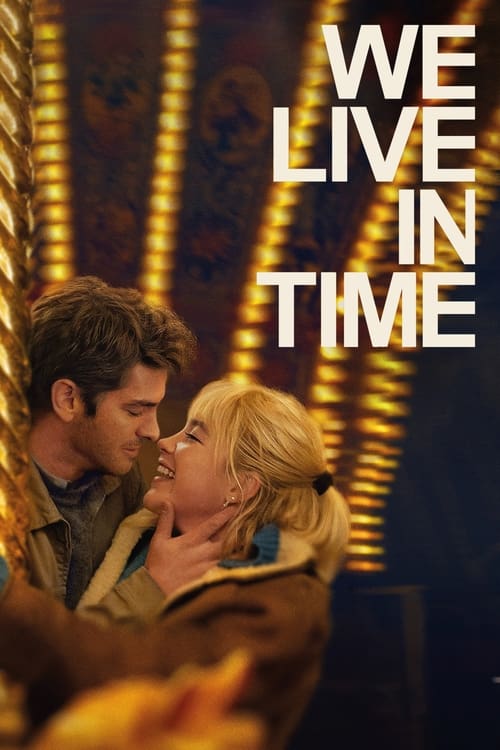
We Live in Time
2024 · John Crowley
When you need a good cry that earns it — a date-night or rainy-Sunday film for feeling everything at once. Bring tissues; leave the mascara.
What it's about
Almut, an ambitious chef, and Tobias, a gentle recent divorcé, collide by chance and build a life together — courtship, career, a child. The film shuffles a decade of that relationship out of order, braiding the giddy early days with the family years and with the hardest stretch, when Almut's illness forces them to decide what the time they have is actually for.
The experience
Openly, unapologetically a tearjerker, but the scrambled timeline keeps it from wallowing — joy and grief sit side by side in a way that feels like how you actually remember someone. Warm, sexy, funny in places, and quietly devastating by the end.
Performances
Florence Pugh and Andrew Garfield have lived-in, unforced chemistry — bickering, flirting, and grieving like a real couple — and Pugh in particular makes Almut's ambition as vivid as her illness, refusing to play a saint. Two of the best actors of their generation, given room to just be together on screen.
The craft
Nick Payne's screenplay dares to tell a familiar love story in fragments, trusting you to assemble the years yourself, and Crowley's direction keeps the time-hopping emotionally legible rather than tricksy. The kitchen scenes have real culinary texture, and the film finds big feeling in small domestic staging.
Why it matters
An A24 romance that became a word-of-mouth weepie hit and a showcase for the Pugh–Garfield pairing, proving there's still an audience hungry for grown-up love stories in theaters.
Snapshot
We Live in Time is a decade-spanning romance built on a deliberately fractured architecture: the story of Almut (Florence Pugh), a driven chef, and Tobias (Andrew Garfield), a gentle, recently divorced Weetabix employee, is told out of order, its three broad phases — the meet-cute, the building of a family, and Almut's terminal illness — braided together so the viewer experiences a relationship the way memory actually holds one, as simultaneity rather than sequence. Directed by John Crowley from an original screenplay by the playwright Nick Payne, the film belongs to the tradition of the terminal-illness weepie but tries to escape its clichés through structure and performance rather than plot. It premiered at the Toronto International Film Festival in September 2024 and was released by A24 in North America and StudioCanal internationally. It is a small-scale, actor-forward picture whose ambition lies almost entirely in its form and its two leads.
Industry & production
The film sits at the intersection of British and American independent financing. StudioCanal, the French-owned pan-European studio, was the principal backer and international distributor; A24 held North American rights, a pairing that positioned the film as prestige adult drama in a marketplace increasingly hostile to mid-budget romance for grown-ups. It is, in commercial terms, exactly the kind of film that has become rare: no franchise, no source-novel pre-sold audience, no spectacle, wagering instead on star chemistry and a well-known screenwriter's voice.
Its casting history is part of its production story. Andrew Garfield was attached across the project's development; the female lead reportedly passed through other names before Florence Pugh, and the finished film is in many ways engineered around Pugh's particular register of ferocity and vulnerability. Beyond distributor and lead casting, the granular production record — precise budget, shooting schedule, location breakdown, exact box-office totals — is thin in the authoritative sources available to me, and I will not manufacture figures. What is clear is the film's scale: intimate interiors, a handful of standout set-pieces, and a shoot organized around the logistical puzzle of a non-chronological narrative, which requires actors and department heads to track three distinct life-stages of the same characters, often within a single production day.
Technology
We Live in Time is, technologically, an unshowy contemporary production, and this modesty is itself a choice. It was made in the current digital-capture idiom; I do not have a reliable record of the specific camera system or lens package and will not guess at model names. The film's most interesting technical decision is a refusal of technology's usual crutches for signposting time. Where a lesser handling of a fractured timeline reaches for title cards, date stamps, or heavy color-grading shifts between eras, this film largely withholds them, trusting instead in-camera and profilmic cues — chiefly Pugh's changing hair, the presence or absence of the couple's daughter, and the progression of Almut's illness — to orient the audience. The "technology" that does the narrative work is therefore continuity craft and design rather than post-production apparatus. Digital intermediate grading is present, as in any modern release, but it is used to hold the three timelines within one coherent palette rather than to separate them, which places an unusual burden on hair, makeup, and costume as the primary temporal markers.
Technique
Cinematography
The photography favors warmth, proximity, and naturalistic light over stylization. The camera stays close to faces, framing the relationship in a shallow, tactile register that privileges skin, food, and small gestures. The domestic and culinary spaces — kitchens professional and home, a bathroom, a hospital — are shot for intimacy rather than grandeur. The most celebrated visual sequence is the birth of the couple's daughter in a petrol-station lavatory, staged and photographed as a single sustained crescendo of panic and tenderness; it is the film's set-piece precisely because it refuses prettiness, finding beauty in cramped fluorescent ugliness. The overall visual strategy is legibility in service of emotion: nothing in the frame competes with the actors. (I have seen Stuart Bird credited as cinematographer; where I am not fully certain of a below-the-line attribution I flag it rather than assert it.)
Editing
Editing is the film's true authorial instrument, because the screenplay's structure is fundamentally an editorial proposition. The cutting must perform two contradictory tasks at once: keep the viewer disoriented enough that the timelines rhyme and resonate, yet oriented enough that they never feel merely confused. The film works by juxtaposition — placing a scene of early joy hard against one of late grief so that each inflects the other, so that we watch the beginning already knowing the end and watch the end still able to feel the beginning. This is montage as thesis: the argument that a life is not a line but a simultaneity. The transitions tend to be associative — a match of gesture, object, or emotional key rather than a chronological cue — which is why the film rewards a second viewing, when the hidden logic of the sequencing becomes visible.
Mise-en-scène / staging
Domestic realism dominates the staging. The couple's home, Almut's restaurant kitchen, and the clinical spaces of illness are dressed with lived-in specificity, and food functions as a recurring staging motif — cooking as courtship, as identity, as legacy. Almut's professionalism is expressed spatially: she is most fully herself in the controlled aggression of a kitchen, and the film stages her ambition (a high-level culinary competition late in her illness) as an act of self-definition against death. The staging consistently sets intimacy against institution — the warmth of the home and the kitchen versus the cool geometry of the hospital.
Sound
The score is credited to Bryce Dessner, the composer and guitarist of The National, whose film work runs to restrained, textural, string- and piano-forward writing rather than sweeping melodrama. That sensibility suits a film wary of emotional manipulation: the music tends to underscore rather than dictate, leaving space for the performances. Sound design leans naturalistic, with the ambient particularity of kitchens — knives, pans, service — doing characterizing work. The film generally trusts silence and room tone in its heaviest scenes, a discretion consistent with its overall aversion to the weepie's usual cueing.
Performance
Performance is where the film lives or dies, and it largely lives. Florence Pugh plays Almut as fierce, funny, and unsentimental about her own dying, refusing the passive saintliness the terminal-heroine role usually imposes; her insistence on competing, on working, on not being reduced to a patient, gives the film its spine. Andrew Garfield's Tobias is the softer counterweight — open-faced, easily wounded, a man whose whole emotional life is legible on his face — and Garfield's particular gift for on-the-verge-of-tears sincerity is used deliberately. The two generate a lived-in chemistry that the fractured structure actually depends upon: because we meet them at all stages at once, the actors must make each stage instantly recognizable as the same couple, and it is the consistency of their rapport across the timelines that stitches the film together.
Narrative & dramatic mode
The film's dramatic mode is the non-linear memory-romance, and its form is inseparable from its meaning. By scrambling chronology, the screenplay converts suspense-of-plot into suspense-of-feeling: we are not asking "what happens?" — we largely know she will die — but "how did they get here, and how do the joy and the loss speak to each other?" This is a melodrama that has read its own genre and tries to outmaneuver it. The structure enacts the title: to live in time is to hold all of one's moments at once, so the film denies us the consolations of linear closure. The risk of the mode is preciousness — that structure becomes a gimmick — and critics divided precisely on whether the device deepens the emotion or merely decorates a conventional story. At its best the form earns itself: the ending lands differently because we have already lived the beginning beside it.
Genre & cycle
We Live in Time is a romantic drama in the terminal-illness tradition — the lineage of Love Story, Terms of Endearment, and, in the more recent YA-inflected cycle, The Fault in Our Stars. Against that cycle it defines itself by tone: adult rather than adolescent, wry rather than lachrymose, structurally adventurous rather than linear. It also belongs to a smaller, more interesting cycle of non-linear love stories — films and works that tell a relationship out of order to make an argument about time and memory, of which Eternal Sunshine of the Spotless Mind, Blue Valentine, and (500) Days of Summer are the obvious reference points, and to which one might add the temporal experiments of Nick Payne's own theater. The film's cultural moment placed it as counter-programming: a sincere, star-driven romance for adults in a market dominated by tentpoles.
Authorship & method
Authorship here is genuinely shared between director and writer. John Crowley is a director of literate, emotionally precise adaptations and dramas — Boy A, Brooklyn, The Goldfinch — with a career-long attentiveness to interiority, displacement, and the texture of ordinary feeling; Brooklyn in particular established his gift for restrained, deeply felt romance, and We Live in Time extends that sensibility while taking a formal risk he had not previously attempted. His method is actor-centric and unshowy, trusting performance and behavioral detail over directorial flourish.
Nick Payne, the screenwriter, is arguably the film's structural author. A playwright best known for Constellations — a two-hander that dramatizes a relationship across branching, repeating possibilities — Payne has made time, contingency, and the non-linear anatomy of love his signature subject. We Live in Time is legibly of a piece with that theatrical project: the scrambled chronology is not a directorial imposition but the screenplay's founding conceit.
Among collaborators, composer Bryce Dessner brings the restrained indie-classical idiom described above. The cinematography (Stuart Bird, per the credits I have seen) and the editing serve the writer-director's shared commitment to legibility-in-fragmentation. I do not have a confident record of the editor's name and decline to attribute it rather than risk error, though the editorial architecture is, as noted, central to the film's identity.
Movement / national cinema
The film is best understood within contemporary British prestige cinema — the StudioCanal / BBC Film / A24-adjacent ecosystem that produces literate, mid-budget, character-driven work for the international arthouse and awards circuit. It is not part of any formal movement; rather it reflects a durable strain of British screen realism inflected with theatrical craft, a tradition where playwrights migrate into film and bring their formal preoccupations with them. Its transatlantic distribution (A24 in the US) also marks the increasingly common hybrid: a British production consciously positioned for the American specialty market.
Era / period
Made and set in the present-day, the film is a 2020s artifact in both its industrial and emotional situation. Industrially it is a statement about the endangered mid-budget adult drama — a bet, at a moment of franchise dominance and streaming disruption, that audiences will still turn out for a two-hander about love and death. Emotionally it speaks to a post-pandemic sensibility acutely conscious of mortality, time, and the preciousness of ordinary domestic life. Its formal fracturing of time also resonates with a broader contemporary storytelling appetite for non-linear structure, familiar from prestige television as much as cinema.
Themes
The film's governing theme is time itself — how a life is measured, and whether it is best understood as a sequence or a totality. From this flow its other concerns: mortality and the refusal to be reduced to one's dying; ambition versus intimacy, dramatized in Almut's insistence on her work and identity even as illness closes in; parenthood and legacy, with the daughter as the couple's continuation; and food as love, memory, and self-expression. Beneath these is a quiet argument about grief and anticipatory loss — the film asks how one lives fully while already mourning, and its very structure is the answer, insisting that the joy and the grief are not separable phases but a single simultaneous fabric.
Reception, canon & influence
Critical reception was warm but divided along a predictable fault line. Admirers praised the central performances almost universally — Pugh and Garfield's chemistry was widely singled out as the film's greatest asset — and credited the non-linear structure with lending freshness and genuine feeling to well-worn material. Skeptics argued the reverse: that beneath the reshuffled chronology lies a conventional tearjerker, and that the structure is a sophisticated distraction from familiarity rather than a true reinvention. The petrol-station birth sequence was near-universally cited as a highlight. I do not have reliable aggregate scores or box-office totals to hand and will not invent them; the consensus impression is of a well-liked, well-acted film that critics respected more than they were overwhelmed by.
The influences on the film are clear: the terminal-illness melodrama tradition it both inherits and resists; the non-linear love story exemplified by Eternal Sunshine of the Spotless Mind and Blue Valentine; John Crowley's own Brooklyn as a template for restrained romance; and, most decisively, Nick Payne's theatrical preoccupation with time and contingency, above all Constellations.
Its legacy — the influence forward — is necessarily provisional so soon after release, and honesty requires saying the record is still being written. What can be said is that the film functioned as a significant showcase for Florence Pugh in a leading romantic-dramatic role and reaffirmed Andrew Garfield's standing as an actor of unusual emotional transparency. More broadly it stands as a data point in the ongoing argument for the viability of the adult romance in a franchise era — a modestly scaled but sincere assertion that there is still an audience for films about two people, love, and the shape of a life lived in time.
A Deleuzian reading
A petrol-station lavatory.
The full Deleuzian reading of We Live in Time →
Reception
Landed at TIFF 2024 as a well-liked but conventional tearjerker — then its own marketing swallowed it, and it's now remembered as much for the memes and the Garfield–Pugh press tour as for the movie itself. The film-fan defense that it's better than its 'A24 does Nicholas Sparks' reputation is already underway.
How We Live in Time was received, from release to now →
How to watch We Live in Time: what to notice on a first viewing
- Watch for the absence of a timestamp between scenes. The film cuts between the couple's decade with no title card, no year, no color shift, leaving only hair, the daughter's presence, and illness as your only clock. You're made to place yourself in time the way memory actually works, not the way plot usually hands it to you.
- Notice one scene answer another through a gesture, not a date. The cuts jump years by matching an object, a motion, or an emotional key rather than following a chronological thread from one moment to the next. The relationship between two scenes is left for you to supply, which is why a second viewing changes what you see.
- Watch the camera stay close on hands, food, and skin. The photography favors a shallow, tactile register throughout, privileging small physical detail over wide, composed rooms. Intimacy is built through proximity to the body, scene after scene, rather than through dialogue explaining the relationship.
- Watch the petrol-station birth play out in one unbroken scene. Crowley stages the delivery as a single sustained crescendo of panic and tenderness in a cramped, fluorescent-lit bathroom, without cutting away from the mess of it. The scene finds its power in refusing prettiness rather than in reaching for it.
- Listen for how little the score tells you to feel. Bryce Dessner's music stays restrained and textural throughout, underscoring quietly rather than swelling to cue the emotion a scene wants from you. The film trusts the performances to do the work music usually does instead.
The whole guide to watching We Live in Time, with the keys for a rewatch →
Influences: the films it descends from and the films it influenced
- Two for the Road (1967) — Pioneers the intercut-timeline marriage anatomy that Payne's screenplay inherits — sorting a relationship into simultaneous strata (different road trips / different cars-and-clothes) so the audience reconstructs chronology from behavioral and costume cues, exactly the 'withheld time cues' method We Live in Time uses.
- Hiroshima mon amour (1959) — Establishes the associative cut between present touch and remembered image as a grammar for love-and-time, the editing logic (memory triggered by sensation, then dissolved back) that underlies the film's associative transitions rather than mere flashback.
- Don't Look Now (1973) — The template for elliptical, match-on-object montage across time and grief — Roeg's fragmenting of a couple's timeline into associatively rhymed shots is the direct forerunner of Crowley's legibility-in-fragmentation editorial architecture.
- Annie Hall (1977) — Invents the modern fractured-chronology 'autopsy of a romance,' reshuffling a relationship out of linear order and cutting associatively between eras to diagnose why it ends — the structural project We Live in Time applies to a terminal-illness arc.
- Eternal Sunshine of the Spotless Mind (2004) — The named exemplar for the film's conceit: chronology reordered to follow emotional/mnemonic logic rather than clock time, so the reunion of a couple is felt through structure — the exact non-linear memory-romance grammar the dossier cites as an influence.
- 5x2 (2004) — Reverse-chronology dissection of a couple (five scenes run last-to-first) that weaponizes structure to make tender early moments ache with known outcomes — the withheld-outcome irony We Live in Time generates by cutting joy against illness.
- 21 Grams (2003) — Demonstrates shuffling a grief/illness drama into non-consecutive fragments so the viewer supplies causal order — the associative-assembly editing model Payne's fractured chronology adopts for a smaller, domestic register.
- Blue Valentine (2010) — The dossier's named ancestor: two intercut timelines (courtship vs. dissolution) sustained by naturalistic, close-in handheld cinematography and immersive actor-centric performance — the Pugh/Garfield chemistry-over-flourish method in embryo.
- Terms of Endearment (1983) — Master-class in the terminal-illness weepie's tonal engineering — earning the deathbed through accumulated domestic comedy and behavioral warmth — the tradition We Live in Time both inherits and tries to freshen via structure.
- Brooklyn (2015) — Crowley's own template for restrained, deeply-felt romance built on interiority and behavioral detail over directorial flourish; We Live in Time extends this actor-first sensibility while adding the formal risk of scrambled time.
- (500) Days of Summer (2009) — Popularizes the day-labeled non-linear romance whose associative jump-cuts between good and bad phases invite the viewer to reassemble the arc — a lighter precedent for the film's fragmented, cue-withholding chronology.
- Past Lives (2023) — Sibling in the revived adult-romance-as-prestige mode: restraint, contingency and 'the shape of a life in time' rendered through hushed indie-classical scoring and behavioral acting rather than melodramatic pitch.
- Aftersun (2022) — Extends the same craft of elliptical, associatively-edited memory with deliberately withheld temporal and factual cues, trusting fragments and naturalistic close framing to accrete into grief — a direct contemporary of the film's editorial ethos.
- The Souvenir (2019) — British prestige memory-romance built from naturalistic, observationally close scenes and gaps the viewer bridges — the domestic-realism-plus-ellipsis register We Live in Time works within.
- C'mon C'mon (2021) — Shares composer Bryce Dessner's restrained indie-classical idiom and a loosely associative, memory-inflected structure — the same sound-and-structure pairing that gives We Live in Time its emotional texture.
- Marriage Story (2019) — Sibling in actor-centric two-hander construction, staging the anatomy of a relationship through sustained performance and everyday domestic behavior rather than plot mechanics — the Pugh/Garfield chemistry model of drama.
Similar films
- Past Lives (2023) — influence & lineage · often watched together
- Drawing Closer (2024) — same viewing thread
- Even If This Love Disappears Tonight (2025) — same viewing thread
- All of Us Strangers (2023) — often watched together
- The Taste of Things (2023) — often watched together
- Falling in Love Like in Movies (2023) — often watched together
- Eternity (2025) — often watched together
- Portrait of a Lady on Fire (2019) — often watched together
All the films related to We Live in Time →
Watch it with: curated runs of related films
- Love on Borrowed Time — A run of romances where the calendar is the antagonist — watch these back to back when you want to be wrecked, gently, and don't mind seeing the same shape (limited days, remembered love) rhyme across four countries.