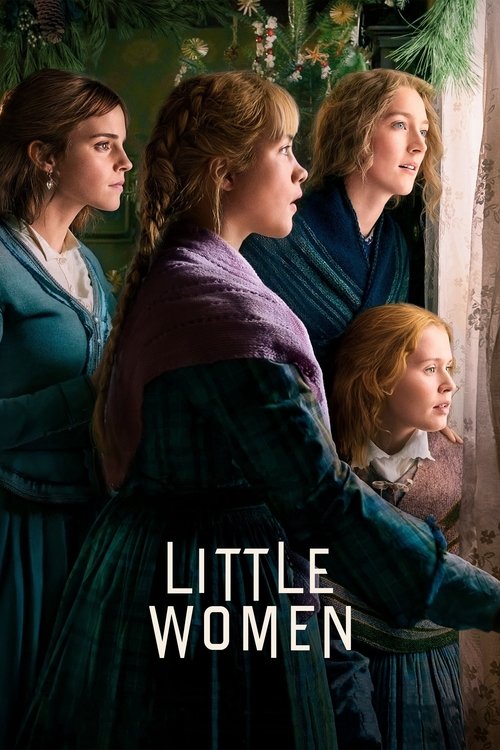
Little Women
2019 · Greta Gerwig
Went from mumblecore darling to billion-dollar Barbie director, triggering endless discourse about whether Barbie was feminist subversion or corporate co-optation, then her Best Director snub became an Oscars flashpoint. Her Narnia-for-Netflix deal keeps the "indie voice swallowed by IP" conversation running.
For a cozy night when you want to feel everything at once — comfort-movie warmth with a real brain and a real ache underneath. Ideal for holidays, heartbreak recovery, or watching with your family and crying anyway.
What it's about
The four March sisters — writer Jo, actress Meg, painter Amy, and gentle Beth — grow up poor and close-knit in Civil War–era Massachusetts, then scatter into adult lives that don't match their childhood dreams. The film cuts freely between the two eras, so every grown-up compromise sits right next to the girlhood promise it broke, and Jo's fight to write and live on her own terms becomes the spine of the whole thing.
The experience
Warm, fast, and alive — the sisters talk over each other like a real family, and the time-jumping structure keeps landing little emotional ambushes where a memory suddenly recolors the present. It's a film that makes you laugh, then catches you off guard with how much it hurts.
Performances
Saoirse Ronan's Jo burns with restless, productive frustration, and Florence Pugh is the film's secret weapon — she turns Amy, historically the story's least loved sister, into its sharpest and most sympathetic mind.
The craft
Greta Gerwig shatters the novel's chronology and lets color temperature narrate: childhood glows honeyed and golden, adulthood turns wintry blue-gray, so you always know where you are by feel. Yorick Le Saux's photography and the sumptuous period design reward a big screen, and the ending pulls off a witty, moving negotiation between what the market demanded of women's stories and what their authors actually wanted.
Why it matters
It proved a 150-year-old classic could be structurally reinvented rather than just re-dressed, cemented Gerwig as a major American director, and became the version of this story a generation now reaches for first.
The eighth screen adaptation of Louisa May Alcott's novel, and the first to solve it structurally. Greta Gerwig shatters the chronology, cutting between the March sisters' childhood and their scattered adult lives so that memory and present tense comment on each other — girlhood shot in honeyed warmth by Yorick Le Saux, adulthood in wintry blue-gray, the color temperature doing the work of narration. The device transforms a story about growing up into a story about looking back, and it lets Gerwig smuggle in Alcott herself: the film's ending negotiates openly, and wittily, between what the nineteenth-century market demanded of women's stories and what their authors wanted. Saoirse Ronan's Jo burns with productive frustration; Florence Pugh's Amy, long the adaptation problem child, becomes the film's secret weapon, given an economics-of-marriage speech that reframes the character entirely. With Alexandre Desplat's dancing score and dialogue that overlaps like a household actually talking, it confirmed Gerwig — two films into her solo directing career — as an American filmmaker of the first rank.
A Deleuzian reading
Four girls on the floor in front of a fire, talking over each other, the light the color of honey.
The full Deleuzian reading of Little Women →
Reception
No flop-to-classic arc needed — it landed six Oscar nominations (winning Costume Design) on release, but the discourse was dominated by Gerwig's Best Director snub, and in the years since it's settled into beloved comfort-classic status with an annual Christmas-rewatch ritual.
How Little Women was received, from release to now →
Influences: the films it descends from and the films it influenced
- Lady Bird (2017) — Gerwig's own prior film establishes her elliptical, montage-like coming-of-age editing and her use of Ronan as a spiky autobiographical surrogate, carried directly into Jo.
- Frances Ha (2012) — Gerwig co-wrote and starred in this template for her screwball overlapping-dialogue rhythm and the restless, apartment-bounding female artist figure she gives Jo.
- Little Women (1994) — The direct adaptation predecessor whose hearth-centered ensemble blocking — sisters clustered and overlapping around the fire — Gerwig restages, then breaks apart by cutting it against the future timeline.
- Little Women (1933) — Katharine Hepburn's striding, floor-sprawling tomboy Jo set the boyish physical-performance template — the un-ladylike gait and ink-stained sprawl — that Saoirse Ronan visibly extends.
- Atonement (2007) — Ronan plays a young writer whose fiction rewrites the story's ending; Gerwig lifts this metafictional writer-as-author device for Jo's negotiated, is-it-real marriage finale.
- The Hours (2002) — Braids separate timeframes together through the through-line of a woman author's act of writing, the crosscut-on-authorship structure Gerwig builds her whole film around.
- The Godfather Part II (1974) — The canonical parallel-timeline architecture where warm-amber past and cooler present are color-graded as distinct emotional registers, the exact temperature-as-narration logic Gerwig and Le Saux adopt.
- The Age of Innocence (1993) — Retrospective-narrated period literary adaptation in which material culture and social ritual are shot as a precise index of suppressed feeling, a mode Gerwig's drawing-room economics scenes inherit.
- Days of Heaven (1978) — Néstor Almendros's magic-hour natural light, where color temperature itself carries emotion, is the ancestor of Le Saux's golden, backlit girlhood scenes at Orchard House.
- Sense and Sensibility (1995) — A sisterhood-ensemble period adaptation that foregrounds the economics of marriage as plot engine — Marmee/Aunt March's 'marry rich' pragmatism descends from Emma Thompson's script.
- Barry Lyndon (1975) — Its available-light, painterly period cinematography established candlelit natural-light interiors as a formal organizing principle for the literary costume drama Le Saux works within.
- The Grand Budapest Hotel (2014) — Alexandre Desplat's rhythmic, nested-timeframe chamber scoring method — motifs that signal shifts between temporal frames — is the collaborator technique he brings to Little Women's dual timeline.
- Portrait of a Lady on Fire (2019) — A same-year meditation on women's authorship and the female gaze, structured as retrospective memory framed by an act of looking-back, a sibling in form and theme.
- Marriage Story (2019) — A sibling from the same Baumbach-Gerwig household using overlapping, naturalistically colliding domestic dialogue to stage the fine print of love and money.
Similar films
- Atonement (2007) — influence & lineage · often watched together
- Lady Bird (2017) — influence & lineage
- 20th Century Women (2016) — influence & lineage
- Sense and Sensibility (1995) — influence & lineage
- Hamnet (2025) — often watched together
- Carol (2015) — shared sensibility
- Our Little Sister (2015) — shared sensibility
- Emma. (2020) — shared sensibility
All the films related to Little Women →