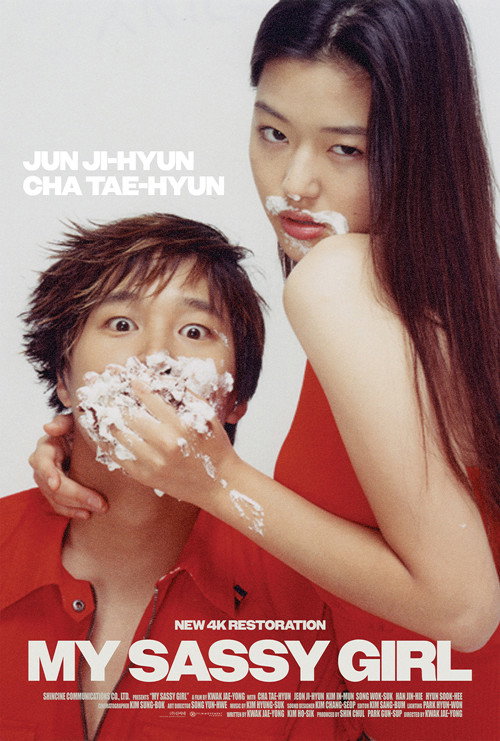
My Sassy Girl
2001 · Kwak Jae-yong
For a cozy night in when you want to laugh hard and then get unexpectedly misty — comfort viewing with a real emotional payload underneath.
What it's about
Gyeon-woo, a directionless Seoul engineering student, stops a drunk young woman from falling onto the subway tracks — and gets mistaken for her boyfriend before she passes out. What follows is a courtship conducted entirely on her terms: she's volatile, bossy, prone to elaborate emotional tests and the occasional slap, and he endures all of it with the baffled patience of a man slowly realizing he's fallen in love with a hurricane.
The experience
Riotously funny in a broad, physical way, then suddenly and sincerely tender — it swings between slapstick and ache without warning, and somehow both registers land. By the end it has snuck up on you completely.
Performances
Jun Ji-hyun became a superstar with this role, making a character who could easily be exhausting into someone magnetic and secretly heartbreaking; Cha Tae-hyun is the perfect foil, a comic everyman whose bewilderment reads as devotion.
The craft
Kwak Jae-yong's script, drawn from a true internet-serialized memoir, structures the romance as a series of escalating episodes and tonal reversals, trusting the audience to follow it from farce into melancholy. The pop soundtrack does heavy emotional lifting, and the film's timing — both comic and sentimental — is precision work disguised as chaos.
Why it matters
One of the biggest Korean films of its era and a pan-Asian phenomenon that helped launch the Korean Wave, it spawned remakes abroad and set the template for a generation of romantic comedies built on unruly heroines and tonal whiplash.
Snapshot
My Sassy Girl (엽기적인 그녀, Yeopgijeogin geunyeo — literally closer to "That Bizarre Girl") is a South Korean romantic comedy directed by Kwak Jae-yong and released in 2001. It follows Gyeon-woo (Cha Tae-hyun), a directionless engineering student, and an unnamed young woman (Jun Ji-hyun) he meets by chance on the Seoul subway when he stops her, drunk, from falling onto the tracks. What begins as an accidental entanglement becomes a courtship conducted almost entirely on her terms: she is volatile, domineering, prone to violence and elaborate emotional tests, and Gyeon-woo endures it all with the baffled patience of a comic everyman. The film's tonal signature is its abrupt oscillation between broad slapstick and disarming melancholy — a mode that, late in the story, reveals the Girl's aggression as displaced grief for a dead former boyfriend. Adapted from a widely circulated set of online postings and a subsequent novel by Kim Ho-sik, the film became one of the defining texts of the early-2000s Korean Wave, a pan-Asian sensation that made a star of Jun Ji-hyun and seeded a long chain of international remakes. It is best understood as a hinge work: a mainstream commercial romance arriving precisely as Korean cinema's domestic renaissance was translating into regional cultural power.
Industry & production
My Sassy Girl emerged from a specific and unusually fertile moment in Korean film history. The late 1990s had seen the loosening of censorship, the entry of conglomerate (chaebol) and later venture capital into production and multiplex exhibition, and a string of domestic blockbusters — Shiri (1999), Joint Security Area (2000) — that proved Korean films could out-draw Hollywood imports at home. Into this expanding commercial ecosystem the film arrived as a comparatively modest genre picture whose success outstripped all expectation.
Its most distinctive production fact is its source. The story originated as a series of comic, semi-confessional posts by Kim Ho-sik on the Korean internet in the late 1990s, recounting (or purporting to recount) his relationship with a strong-willed girlfriend. The postings became a phenomenon in their own right, were compiled into a bestselling two-volume novel, and only then were adapted for the screen — an early, striking instance of user-generated online writing feeding directly into mainstream cinema. How much of the material is genuinely autobiographical has always been uncertain, and the honest position is that the "true story" framing is part of the work's mythology rather than a verifiable claim.
The casting proved decisive. Jun Ji-hyun (later internationally billed as Gianna Jun) was a young model-turned-actress when she took the lead; the role's combination of glamour, physical comedy, and abrupt pathos made her one of Asia's most recognizable performers almost overnight. Cha Tae-hyun, already an established young actor, anchored the film as its narrator and audience surrogate. Beyond these headline facts, granular English-language documentation of the production — budget, shooting schedule, precise admissions figures — is comparatively thin, and I will not invent specifics; what is firmly established is that the film was a major domestic hit and traveled exceptionally well across East and Southeast Asia through theatrical release, television, and the era's vigorous informal (including pirated) distribution networks.
Technology
The film was produced on 35mm and exhibited photochemically, consistent with mainstream Korean feature practice at the turn of the millennium — a period just before digital intermediate workflows and digital projection became standard. Its technological interest lies less in any single tool than in the media environment it both depicts and exploits. This is a film acutely aware of the internet, mobile phones, email, and online writing as sites of intimacy and self-fashioning; its very existence testifies to broadband-era South Korea's status as one of the world's most connected societies. The narrative's transmission history — post to novel to film — is itself a technological story about how content moved through Korean digital culture. On screen, the paraphernalia of early-2000s connectivity (the pager/mobile call, the internet café milieu of student life) is treated as unremarkable texture, marking the film as a document of a wired urban modernity.
Technique
Cinematography
The visual style is bright, glossy, and legible in the manner of polished commercial romance rather than art-cinema experiment. Seoul is rendered as an attractive, navigable contemporary city — subway platforms, university corridors, cafés, an amusement park, a hilltop with a single tree that becomes the film's emotional landmark. The camera generally serves performance and story, favoring clean coverage that lets Jun Ji-hyun's physical comedy and Cha Tae-hyun's reactions read clearly, while reserving softer, more lyrical compositions for the melodramatic turns. I do not have reliable authoritative attribution for the director of photography in English-language sources, and rather than guess I flag that the cinematography credit is not something I can state with confidence.
Editing
Editing is where the film's design is most conspicuous. The story is organized into explicitly titled movements — a "first half" and "second half," followed by an "overtime" coda — a sporting-match conceit that frames the romance as a contest with rounds and extra time. Within this structure the film makes pointed use of repetition and variation: gags and situations are set up early and paid off later in altered form, and certain images recur with accumulating emotional weight. Cha Tae-hyun's voice-over narration is the connective tissue, and the cutting is paced to it, moving briskly through comic set pieces before slowing markedly for the reveal and reconciliation. As with the cinematography, I cannot confidently name the editor from memory and decline to fabricate the credit.
Mise-en-scène / staging
Staging privileges the two bodies in space and the comedy of power imbalance between them. Recurrent blocking motifs — the Girl commanding, striking, or issuing rules; Gyeon-woo cringing, complying, absorbing — externalize the relationship's dynamic. Costume participates in characterization: the Girl's poised, fashionable presentation is repeatedly undercut by her behavior, a deliberate friction between image and conduct. Emblematic objects and locations (a rose, a letter, a time capsule buried at the hilltop tree) are planted with care so that their return in the second half lands as both narrative payoff and visual rhyme.
Sound
The film's sonic identity is one of its most influential legacies, and it rests largely on pre-existing music. Pachelbel's Canon in D — in a widely recognized solo-piano treatment associated with George Winston's variations — recurs as the romance's leitmotif and became, through this film, indelibly linked to Korean screen romance. Contemporary Korean pop is woven throughout, most famously a ballad performed by Shin Seung-hun that the film helped make a lasting hit. Voice-over narration is the other defining sonic layer, giving the whole a confessional, retrospective intimacy. On the original underscore credit I will be candid: English-language documentation is limited, and the film's musical memory is carried above all by its curated use of the Canon and its pop selections rather than by a bespoke score I can reliably attribute.
Performance
Performance is the film's engine. Jun Ji-hyun's turn is a high-wire act of register-switching — imperious, childish, cruel, brittle, and finally sorrowful — that persuades an audience to reinterpret aggression as wounded grief. Cha Tae-hyun plays the classic reactive comic lead: his hangdog endurance and precisely timed exasperation make the Girl's excesses playable rather than merely abusive, and his narration lends warmth and hindsight. The chemistry between them, built on imbalance rather than symmetry, is what carries the tonal gearshifts.
Narrative & dramatic mode
Dramatically the film is a two-movement structure hinged on concealment and revelation. The comic first half establishes the relationship as a series of escalating trials; the melodramatic second half recontextualizes that behavior as mourning, converting laughter retroactively into pathos. Its governing devices are the frame of first-person retrospection, the sporting-match segmentation, and a strong reliance on fate and coincidence — the film openly embraces destiny (a buried time capsule, a promised future meeting, a chain of near-misses) as an organizing principle rather than a contrivance to be apologized for. This yields a dramatic mode that is at once episodic and tightly patterned: loosely strung comic vignettes that turn out to have been laying track for an emotionally engineered convergence.
Genre & cycle
The film sits squarely in the Korean romantic-comedy tradition while helping to redefine it. Its hybridity — the deliberate welding of broad "gag" comedy to full-throated melodrama, comedy in the first act and tears in the third — is characteristic of Korean commercial cinema's comfort with tonal mixing, and My Sassy Girl became a template for the "rom-com with a cry" that dominated Korean and pan-Asian screens in the following decade. Its central innovation within the cycle was the inversion of gendered courtship convention: the dominant, aggressive woman and the passive, accommodating man, a reversal that felt fresh and became widely imitated.
Authorship & method
Kwak Jae-yong is the film's decisive authorial presence, functioning as both director and adapter of Kim Ho-sik's material. His method here is one of tonal orchestration — trusting an audience to travel from farce to grief within a single work — and of building romances around fate, delayed revelation, and iconic musical motifs. He would rework this signature in Windstruck (2004), again with Jun Ji-hyun, a film widely regarded as a spiritual companion piece that shares its melancholic-romantic sensibility and its investment in destiny.
On collaborators I will hold to what can be responsibly stated. The source author, Kim Ho-sik, is central to the film's identity and its "true story" aura. The two lead performers, Jun Ji-hyun and Cha Tae-hyun, are effectively co-authors of the tone. For the below-the-line craft roles — cinematographer, editor, and original-score composer — I do not have confident, verifiable English-language attributions and will not manufacture names; the film's most legible "musical authorship" is really its curation of Pachelbel's Canon and its pop soundtrack.
Movement / national cinema
My Sassy Girl is a flagship of the Korean New Wave's commercial wing and, more consequentially, of Hallyu — the "Korean Wave" of cultural export that carried Korean film, television, and pop music across Asia in the early 2000s. Where prestige titles of the same years announced Korean cinema's artistic arrival at festivals, My Sassy Girl demonstrated its popular, cross-border reach: it was embraced in China, Japan, Hong Kong, Taiwan, and Southeast Asia, and it made Jun Ji-hyun a regional icon. It thus belongs to the story of how a national film industry, newly confident at home, became a regional entertainment powerhouse.
Era / period
The film is a precise artifact of turn-of-the-millennium urban South Korea: post-financial-crisis, rapidly digitizing, and culturally ascendant. Its student milieu, its internet-native origin story, and its glossy Seoul settings capture a society experiencing both economic recovery and a surge of soft-power self-confidence. Aesthetically it belongs to the last photochemical generation of Korean mainstream cinema, just before digital tools reshaped production and exhibition.
Themes
Its central theme is grief masquerading as love's difficulty: the Girl's "sassiness" is finally legible as the acting-out of unresolved mourning, making the film a study of how loss deforms intimacy and how patience and time can metabolize it. Around this sit interlocking concerns — the reversal and interrogation of gender roles in courtship; fate and destiny as forces that bind two people across time (the tree, the time capsule, the appointed future meeting); healing and second chances; and the romanticization of endurance. The film also quietly thematizes storytelling itself, foregrounding narration, letters, and writing as the means by which a relationship is understood only in retrospect — fitting for a work born from online confessional writing.
Reception, canon & influence
Critically and commercially, My Sassy Girl was a landmark: a domestic hit that became a genuine pan-Asian phenomenon and one of the most beloved Korean romantic comedies ever made, routinely cited as a foundational Hallyu text. (I avoid quoting specific admissions or box-office figures I cannot verify, but its status as a major regional success is not in dispute.) Contemporary reception celebrated Jun Ji-hyun's breakout performance and the film's audacious tonal blend, while some later criticism has revisited the romanticization of the Girl's controlling and violent behavior — a reading the film's own passage of time invites.
Its lines of influence run both backward and forward. Backward: it draws on the Korean commercial romance tradition and, in its self-aware narration and coincidence-driven plotting, on a broad romantic-comedy lineage, while its most audible inheritance is musical — the appropriation of Pachelbel's Canon into the grammar of screen romance. Forward, its legacy is expansive. It codified the "quirky, dominant girlfriend / long-suffering boyfriend" dynamic and the comedy-then-tears structure that saturated East Asian rom-coms through the 2000s. It generated an unusually long remake genealogy across borders — a Hollywood English-language version (My Sassy Girl, 2008), a Bollywood adaptation (Ugly Aur Pagli, 2008), a Japanese television drama, and other regional versions — a rare case of a Korean romantic comedy becoming globally franchisable source material. A Korean-Chinese follow-up, My New Sassy Girl (2016), extended the property directly. Above all, its elevation of Jun Ji-hyun and its demonstration that a Korean romance could conquer neighboring markets make it one of the essential connective works in the atlas of the Korean Wave.
Reception
A monster hit in Korea in 2001 that swept across Asia and became one of the Korean Wave's founding exports — and its legend only grew when the 2008 Hollywood remake landed with a thud, retroactively proving the original was lightning in a bottle.
How My Sassy Girl was received, from release to now →
How to watch My Sassy Girl: what to notice on a first viewing
- Notice the film label itself 'first half' and 'second half.' The story is explicitly framed with sporting-match titles, treating the romance like a contest with rounds. The structure tells you upfront that this love story is going to be scored, not just felt.
- Listen for Pachelbel's Canon returning across the film. A solo-piano treatment of Pachelbel's Canon in D recurs as the couple's musical signature, returning every time the romance between them resurfaces after a comic detour. One piece of music becomes the shorthand for everything between them that dialogue never quite says.
- Watch Cha Tae-hyun's face for exasperation, not anger. He plays the classic reactive comic lead, absorbing each of her demands with hangdog endurance and exasperation timed to the beat, rather than real hostility. His patience is what turns her behavior into comedy instead of something uglier.
The whole guide to watching My Sassy Girl, with the keys for a rewatch →
Influences: the films it descends from and the films it influenced
- Ordinary People (1980) — Cemented Pachelbel's Canon in Western screen grammar as a leitmotif of grief and loss — the exact cue My Sassy Girl re-appropriates and re-codes as the sound of destined romance.
- Annie Hall (1977) — Establishes the confessional male narrator who reconstructs a finished relationship out of chronological order, addressing the audience directly — the retrospective, self-aware framing device Kwak adopts for Gyeon-woo's voiceover.
- The Contact (1997) — The Korean commercial romance's internet-native template — courtship mediated by online chat — anchored by a single curated Western pop record ('A Lover's Concerto') as connective leitmotif, both devices MSG inherits directly.
- Chungking Express (1994) — Pairs a willful, rule-breaking female lead with a passive male one and loops a single pop song ('California Dreamin'') as an obsessive recurring motif — the quirky-girl/reactive-boy dynamic and pop-cue grammar MSG systematizes.
- Christmas in August (1998) — Korean New Wave's restrained-grief melodrama, where mortality is withheld beneath everyday surface — the buried-bereavement engine MSG hides under farce (grief masquerading as caprice).
- Sleepless in Seattle (1993) — Builds an entire romance from engineered fate and a destined-but-delayed meeting, planting setups whose predestined payoff arrives only at the finale — the coincidence architecture MSG mirrors in its hilltop time-capsule reunion.
- When Harry Met Sally... (1989) — Codifies antagonism-as-courtship and register-switching banter as the rom-com's central rhythm, the combative dynamic MSG inverts by handing dominance and aggression to the woman.
- Windstruck (2004) — Kwak's own companion piece, re-teaming with Jun Ji-hyun to rework the identical signature — a domineering heroine, a destiny-driven structure, and a late tonal plunge from farce to bereavement scored to swelling strings.
- 100 Days with Mr. Arrogant (2004) — Directly extends the dominant-partner / long-suffering-partner power dynamic MSG codified, foregrounding coercive control as the courtship's comic motor.
- He Was Cool (2004) — Adapts a Guiyeoni web-novel, extending MSG's internet-native-origin pipeline (online serialized fiction to screen) while gender-flipping the volatile-dominant-partner archetype back to a bad-boy male.
- A Millionaire's First Love (2006) — Runs the comedy-to-tears reversal on a concealed-terminal-illness reveal, deploying the concealment-and-revelation payoff structure MSG used to convert farce into mourning.
- My Sassy Girl (2008) — The direct English-language Hollywood remake, transposing the retrospective narration, sporting-match escalation of gags, and destined-reunion payoff wholesale into a New York setting.
- Ugly Aur Pagli (2008) — The Bollywood adaptation, porting the volatile-heroine/passive-hero dynamic and the setup-and-payoff coincidence plot into a song-and-dance idiom — proof of the property's cross-border franchisability.
- You Are the Apple of My Eye (2011) — Taiwanese first-person male retrospection anatomizing a formative, combative romance that curdles from slapstick to bittersweet, with curated pop and a long-delayed emotional payoff — the MSG narration-and-tone template exported to Sinophone youth cinema.
- My New Sassy Girl (2016) — The direct Korean-Chinese franchise continuation, reprising the character property, the reactive-boyfriend comedy, and the Canon-adjacent musical-destiny motif.
- 20th Century Girl (2022) — Codified the Korean romcom's screwball tonal whiplash — broad comic set-pieces snapping abruptly into weeping melodrama — the tempo and mood-shift grammar 20CG inherits wholesale.
- Man in Love (2021) — Set the East-Asian tonal blueprint of abrasive-comic courtship curdling into weepie, delivered through OST-driven montage — the ballad-bound emotional unit that an MV-trained director like Yin thinks in natively.
- Love Untangled (2025) — Codifies the Korean romcom's slapstick-capable, physically broad female lead who drives the comic misdirection instead of playing the passive love interest.
- Il Mare (2000) — Contemporaneous Korean romance built on fate, letters, and a strict setup-and-payoff of predestination across a temporal gap — the same coincidence-and-revelation engineering, minus the comic register.
- My Tutor Friend (2003) — Extends the comedy-then-tears Korean campus rom-com built on a physically combative male/female pairing, riding the exact tonal-hybrid formula MSG made bankable a year prior.
- 500 Days of Summer (2009) — A non-linear, retrospective male narrator dissects a relationship with an elusive, willful woman, shuttling between comic and mournful registers — the Western cousin of MSG's reconstructed, register-switching post-mortem on love.
- Castaway on the Moon (2009) — Defines the Korean New Wave tonal fusion — broad slapstick abruptly turning to sincere melodramatic ache — that governs Castaway's tragicomic register.
Similar films
- Chungking Express (1994) — influence & lineage
- Sunny (2011) — shared sensibility
- 20th Century Girl (2022) — shared sensibility
- The Way Home (2002) — shared sensibility
- Even If This Love Disappears Tonight (2025) — shared sensibility
- A Moment to Remember (2004) — shared sensibility
- Love Untangled (2025) — shared sensibility
- A Bittersweet Life (2005) — shared sensibility