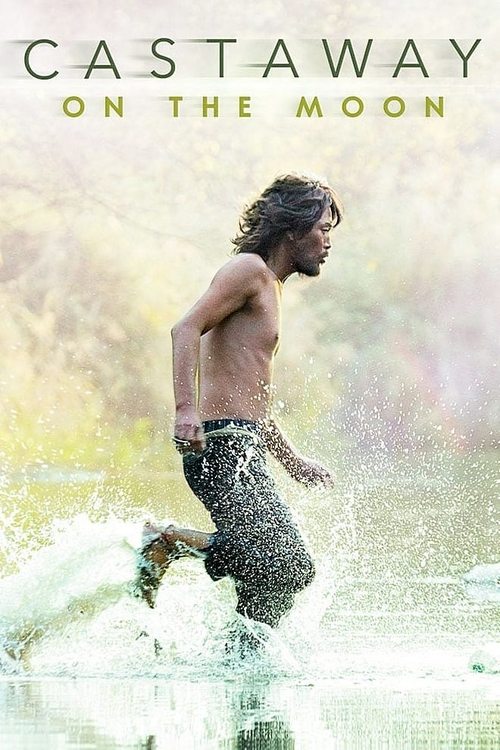
Castaway on the Moon
2009 · Lee Hae-jun
For when you're feeling burnt out or invisible and want a film that understands — a warm, odd, hopeful watch. Perfect for a solo night in when you need to believe small gestures can reach across a distance.
What it's about
Crushed by debt and dumped by his girlfriend, Mr. Kim jumps off a Seoul bridge into the Han River — and washes up alive on a tiny uninhabited island in the middle of the city, skyscrapers in plain view. Too ashamed to call for rescue, he decides to live as a castaway inside his own metropolis. Across the water, a reclusive young woman who hasn't left her apartment in years spots him through her camera's telephoto lens, and two of the loneliest people in Seoul begin the slowest of correspondences.
The experience
Deadpan-funny and quietly moving in equal measure — it wrings real comedy from survival absurdities, then blindsides you with tenderness. It's the rare film about despair that leaves you lighter than it found you.
Performances
Jung Jae-young commits totally to the castaway's scraggly, half-mad dignity, and Jung Ryeo-won makes a woman who barely leaves one room feel fully alive — two performances that connect while almost never sharing the frame.
The craft
The film mines its central visual joke — a desert-island movie shot in the shadow of high-rises — with wit and precision, cutting between the wild little island and the hermetic glow of an apartment. The storytelling turns tiny objects and rituals into suspense and romance, and the city-versus-island imagery plays beautifully on a big screen.
Why it matters
A modest performer on release that grew into a beloved cult favorite, it has become a go-to recommendation for Korean cinema's humane, genre-bending streak — and a film people press on friends who are going through it.
Snapshot
Castaway on the Moon (Korean title Kimssi pyoryugi / 김씨 표류기, literally "Mr. Kim's Drift" or "The Castaway of Kim") is a South Korean tragicomedy written and directed by Lee Hae-jun, released in 2009. Its premise is a deadpan paradox: a man attempts suicide by leaping from a Seoul bridge into the Han River, fails, and washes up not on a distant shore but on Bamseom (밤섬), a small uninhabited islet in the middle of the river, in full view of the city that has just discarded him. Unable to swim and too ashamed to signal for rescue, he elects to become a castaway inside his own metropolis. His counterpart is a young woman, a self-isolated recluse (a hikikomori-type shut-in) who has not left her high-rise apartment in years and who discovers him through the telephoto lens she otherwise trains on the moon. The film's governing conceit — Robinson Crusoe stranded within sight of a skyline of millions — makes it one of Korean cinema's sharpest fables about urban loneliness, and it has aged into a durable international cult title. Jung Jae-young plays Mr. Kim; Jung Ryeo-won plays the woman.
Industry & production
The film emerged from the mature, post-2000 Korean industry, in the years after the domestic box-office boom and the international arthouse breakthroughs of directors such as Park Chan-wook and Bong Joon-ho. It sits in the mid-budget "well-made commercial film with an auteur signature" bracket that Korean studios cultivated in the late 2000s — a character-driven concept picture rather than a franchise or blockbuster. Lee Hae-jun had come up as a screenwriter and co-director within that same system; Castaway on the Moon was mounted as a director-driven original, not an adaptation, which is notable given how much late-2000s Korean output leaned on novels, webtoons, and remakes.
The production's defining logistical fact is its location: Bamseom is an actual ecological preserve in the Han River, and the film had to reconstruct or stage a habitable "wilderness" a short distance from central Seoul. The result is a shoot that is at once a studio-scale drama and a quasi-survival production — the island must read as a genuine frontier while the city glitters unreachably behind it. On the specific financing, distributor, and box-office figures the reliable English-language record is thin, and I will not invent numbers; the film is generally understood to have been a modest domestic performer whose reputation grew substantially after release through festivals and home viewing abroad, particularly among cinephile audiences who championed it word-of-mouth.
Technology
Castaway on the Moon is a film of the standard late-2000s Korean production apparatus — 35mm-era, professional cinema-camera capture with polished digital post — but its more interesting technological dimension is diegetic. The narrative is built around consumer imaging and communication devices as instruments of both alienation and connection. The woman's world is mediated entirely through screens and lenses: a DSLR with a long telephoto used for lunar astrophotography, a computer through which she performs a curated false identity online, and the apartment window as a fixed frame separating her from the city. It is precisely her camera — a surveillance-adjacent tool of distance — that becomes the means of first contact when she spots the castaway. The film thus stages, without editorializing, the way early-smartphone-era imaging technology can substitute for lived experience and then, unexpectedly, restore it. On the island, technology inverts: the man scavenges the detritus of consumer society (a stranded phone with a dying battery, washed-up trash, a duck-shaped pedal boat) and must relearn a pre-technological competence, most famously by cultivating corn from scratch to manufacture his own jajangmyeon rather than order takeout he cannot receive.
Technique
Cinematography
The visual scheme is organized around a single, resonant spatial opposition: the wide, open, sunlit horizontality of the island versus the boxed, vertical, glass-and-concrete confinement of the woman's apartment. The camera exploits the extraordinary real-world irony of the setting — long lenses compress the castaway against the towering Seoul skyline so that solitude and density occupy the same frame. Point-of-view is thematically weaponized: much of the couple's early relationship is shot through the woman's telephoto, so the audience shares her voyeuristic, mediated distance before any true intimacy is possible. Over the film the palette warms and the island's greenery deepens as Mr. Kim's despair converts into purpose. I do not have a firmly attributable director-of-photography credit to cite with confidence, and I will not guess one; the cinematographic strategy, however, is legible and consistent regardless of attribution.
Editing
The film cross-cuts two parallel solitudes that for most of its length never physically meet, and the editing's central task is to build an emotional relationship out of geographic separation — a rhythm of glance, response, and delayed reply (messages written in sand, answered from a window) that functions like a courtship conducted across an unbridgeable gap. The cutting patiently withholds the payoff of contact, which lets the eventual convergence — engineered by a flood that scours the island and a civil-defense drill that empties the streets — land as a genuine release. Comic beats are timed with a dry, observational patience rather than punchline velocity.
Mise-en-scène / staging
Production design carries much of the film's meaning. The island shelter — improvised from urban castoffs, anchored by the beached duck-boat — is a witty emblem of a life rebuilt from garbage. Opposite it, the woman's room is a fortress of accumulated withdrawal: sealed, curated, defended, a physical diagram of the hikikomori condition. The corn plot, the sand-writing, the "HELLO" / "ALIEN" exchanges, and the fantasized bowl of black-bean noodles are all staged as concrete objects the characters can labor over, so that abstract states (despair, hunger, longing, hope) are always given tactile form.
Sound
The sound design draws a hard line between the ambient hush of the island — river, wind, birds, the man's isolated voice — and the sealed silence of the apartment, punctuated by the electronic sounds of the woman's mediated life. The score underlines the film's tonal tightrope, shading whimsy toward melancholy and back, and swelling for the late convergence. I cannot reliably attribute the composer by name here and will not fabricate a credit.
Performance
The film rests almost entirely on two performances delivered largely in isolation. Jung Jae-young, an actor with strong comedic and dramatic range, carries long solitary stretches through physical business and voice-over-adjacent self-address, modulating from suicidal defeat to absurd triumph (the near-religious ecstasy of the first bowl of self-made jajangmyeon) to earned tenderness. Jung Ryeo-won, cast against her more glamorous public image, plays the shut-in with a coiled, defended physicality that gradually, credibly loosens. Neither performance can lean on conventional two-hander chemistry, since the actors share almost no scenes until the finale — the connection is built through separate, complementary interior arcs.
Narrative & dramatic mode
Structurally the film is a dual-protagonist parallel narrative: two castaways, one literal and one figurative, whose stories rhyme before they intersect. Its dramatic mode is tragicomic and fabular — it opens on suicide and stays alert to real desolation, but processes that desolation through absurdist comedy and eventual romance. The screenplay (by Lee himself) is essentially a survival narrative rerouted into a metaphor: the "wilderness" skills Mr. Kim must acquire are really lessons in choosing to live, while the woman's parallel task is to survive the wilderness of her own room. The central irony — that the most complete alienation is possible in the most crowded place on earth, and that rescue must be refused before life can be rebuilt — is sustained without sermonizing.
Genre & cycle
The film is a hybrid of romantic comedy, drama, and survival/castaway adventure — a combination whose incongruity is the point. It belongs to a strain of late-2000s Korean cinema comfortable with radical tonal mixing, where broad comedy and genuine pathos coexist within a single scene without the seams being smoothed over. It can be read as a wry, one-person-on-an-island inversion of the desert-island survival picture, and as an entry in a small transnational cluster of films about modern hermits and shut-ins. Within Korean romantic comedy specifically, it is an outlier: the "meet-cute" is a telephoto sighting, and the lovers are two people society has functionally erased.
Authorship & method
Castaway on the Moon is a strong auteur statement by Lee Hae-jun as writer-director. Lee had built his reputation as a screenwriter within the Korean industry and came to solo direction after collaborative work — most notably co-directing the comedy Like a Virgin (2006) with Lee Hae-young. His signature, evident here and consistent with his later work, is high-concept premises pursued with emotional sincerity: absurd situations played for real feeling rather than mere quirk. His method on this film is essentially that of a screenwriter-director — the meaning is engineered at the script level, in the parallel structure and the chain of concrete metaphors (the corn, the noodles, the messages), then realized visually.
On the key below-the-line collaborators — cinematographer, editor, composer — the readily verifiable English-language record is genuinely thin, and I will not attach names I cannot confirm; the safest attribution is to the coherent authorial design that unites the film's writing and staging. The two lead performers, Jung Jae-young and Jung Ryeo-won, function as effective co-authors of the film's tone, since so much of it lives in solitary performance.
Movement / national cinema
The film is a product of the "Korean New Wave" broadly construed — the sustained wave of confident, internationally legible Korean filmmaking that followed the industry's late-1990s renaissance and the loosening of censorship. It shares that cinema's characteristic willingness to violate Hollywood tonal decorum, its interest in social precarity and downward mobility, and its fluent command of genre. Thematically it belongs to a specifically Korean preoccupation of the 2000s: the human cost of hyper-modernization — debt, unemployment, digital isolation, and the pressure of a relentlessly networked society — themes that the same national cinema would later dramatize on a far larger scale.
Era / period
Made in 2009, the film is legibly of its moment: post-financial-crisis anxiety about employment and personal debt, the early social-media era's performance of curated online selves, and a Seoul defined by vertical density and constant connectivity. It predates the smartphone's total saturation, which gives its technology — DSLR, desktop internet, feature phone — a slightly transitional, late-analog-into-digital texture. Its portrait of joblessness and the shut-in phenomenon reads as an early, humane diagnosis of conditions that would only intensify in the following decade.
Themes
The film's dominant theme is alienation within abundance — the paradox that total isolation is achievable amid millions. Around it cluster: the possibility of second chances and self-reinvention (survival as a metaphor for choosing life); authenticity versus performance, dramatized through the woman's fabricated online identity set against the man's stripped-down, unwatched existence; the critique of consumer society, literalized in a man who must grow his own food from society's garbage; communication and its failures, staged as messages sent across a gap that technology both widens and, finally, bridges; and connection as rescue — the idea that being seen, truly, by one other person is the only rescue that matters. The recurring jajangmyeon motif ties these together: a mass-produced convenience food becomes, when it must be made by hand from a single seed, an emblem of patience, labor, and the will to keep living.
Reception, canon & influence
Critically, Castaway on the Moon was well received as an original, tonally daring work, praised for balancing high-concept absurdity with real emotional weight and for its two central performances. Its commercial footprint at home was modest relative to its acclaim, and I will not cite figures I cannot verify; its reputation is best described as a slow-burn cult ascent, spreading through international festival exposure and home-video and streaming discovery, where it became a beloved word-of-mouth title among cinephiles well beyond Korea.
Influences on the film (backward): it stands in an old lineage of castaway and Robinson Crusoe narratives, which it deliberately relocates from the exotic frontier to the urban interior; it draws on the survival-picture's grammar of improvisation and self-sufficiency; and it responds to the very Korean and East Asian social phenomenon of the reclusive shut-in, giving cinematic form to a condition more often discussed than dramatized. Its tonal DNA — the fusion of broad comedy with sincere melancholy — is characteristic of the Korean New Wave that formed Lee.
Legacy (forward): the film's clearest downstream significance is as a benchmark reference point for the "urban loneliness fable" — a small, humane concept film about isolation in the connected city, a template later cinema and criticism repeatedly invoke. It consolidated Lee Hae-jun's standing as a distinctive writer-director working in high-concept-with-heart, and it burnished the range of its leads, particularly recasting Jung Ryeo-won in a de-glamorized dramatic mode. More diffusely, it has become a durable point of comparison whenever films or discussions take up digital isolation, the hikikomori figure, or the paradox of solitude in the crowd — a modest 2009 tragicomedy that has outlasted many bigger releases precisely because its central metaphor has only grown more resonant.
Reception
A flop in Korea on release in 2009 — roughly 700,000 admissions despite warm reviews — it slowly became one of world cinema's great word-of-mouth rescues, passed around via streaming and 'trust me' recommendations until it's now routinely called criminally underseen.
How Castaway on the Moon was received, from release to now →
How to watch Castaway on the Moon: what to notice on a first viewing
- Notice long lenses squeeze the island against the city skyline. The camera compresses the castaway and the towering skyline into the same shot, so solitude and a crowded city occupy one frame together. You see, in a single image, how someone can be surrounded by millions and still be alone.
- Watch early scenes of him filtered through her camera lens. Much of their early relationship is shown through her telephoto, so you share her distant, watching position before any real closeness is possible. You are made to watch him the way she does, at a distance, before you're let any closer.
- Notice the shelter built entirely from things the river washed up. Kim's improvised home is anchored by a beached duck-shaped pedal boat and pieced together from urban castoffs, a life built out of garbage. What he's thrown away by the city, he turns into what he needs to survive.
- Listen for the shift between river sound and total silence. The island carries river, wind, and birds, while the apartment holds a sealed silence broken only by the electronic sounds of her mediated life. Each space has its own soundtrack, and neither one includes another human voice.
- Notice the two leads almost never appear in the same shot. Jung Jae-young and Jung Ryeo-won build their connection almost entirely in separate scenes, each performance carrying the loneliness alone rather than playing off the other. The film builds a relationship out of two solitudes that barely share the screen.
The whole guide to watching Castaway on the Moon, with the keys for a rewatch →
Influences: the films it descends from and the films it influenced
- Cast Away (2000) — Establishes the solo-survivor performance grammar — improvised self-sufficiency and a talked-to inanimate confidant (Wilson) — that Lee reworks on a Han River islet, replacing the volleyball with the corn, the noodles, and the messages in the sand as objects the marooned man converses through.
- The Gold Rush (1925) — Model for the near-wordless survival pantomime that fuses slapstick with pathos (boiling and eating a boot), the same register in which Castaway wrings comedy and ache from coaxing a meal out of nothing.
- Rear Window (1954) — Source of the telephoto, lens-mediated voyeur structure — a housebound observer watching a distant stranger's life unfold in isolated framed windows — which Lee transplants into the shut-in woman photographing the castaway across the river.
- Robinson Crusoe (1954) — Carries the Crusoe grammar of methodical improvised self-sufficiency and the psychology of enforced solitude, which Castaway deliberately relocates from the tropical frontier to an urban river islet in sight of the city.
- The Truman Show (1998) — Precedent for telephoto-compressed, surveillance-mediated observation of a single unwitting life, and for the authenticity-versus-performance tension between a watched man and the apparatus framing him.
- Like a Virgin (2006) — Lee's own prior high-concept-with-heart comedy, where the writer-director method engineers an absurd premise for sincere feeling — the same script-level engineering he carries into solo direction here.
- 127 Hours (2010) — Sustains a single-location solitary-survival performance through improvised self-help and imagined others, the same one-body-and-a-camera challenge of holding a film on isolation.
- Her (2013) — Direct heir to the urban-loneliness fable of mediated connection — intimacy achieved through a screen or device across the isolated connected city that Castaway diagnosed first.
- The Martian (2015) — Extends the Crusoe survival-improvisation grammar of growing your own food (potatoes echoing Castaway's cornfield) and treating isolation as a procedural, problem-solving optimism.
- Swiss Army Man (2016) — Pushes the Cast Away/Castaway island-castaway grammar into full absurd tragicomedy, building a found-object companion out of a corpse to escape isolation and re-enter society.
- My Sassy Girl (2001) — Defines the Korean New Wave tonal fusion — broad slapstick abruptly turning to sincere melodramatic ache — that governs Castaway's tragicomic register.
- Save the Green Planet! (2003) — Shares the Korean high-concept-with-heart mode of tonal-whiplash absurdism grounded in real pathos, an absurd premise played for genuine emotion rather than quirk.
- Amélie (2001) — Parallel whimsical urban-solitude fable assembled from a chain of small concrete objects and gestures that connect two lonely strangers across a city.
- Lars and the Real Girl (2007) — Extends the sincere, never-mocking treatment of a socially withdrawn man's coping ritual, preserving the shut-in's dignity the way Lee refuses to ridicule his hikikomori heroine.
- WALL-E (2008) — Near-wordless solo protagonist who survives by scavenging found objects amid consumer-society detritus, sustaining full emotion with almost no dialogue — the same isolated-performance economy.
- All Is Lost (2013) — Strips survival cinema to a near-silent one-man physical craft-and-endurance study with almost no dialogue, the endpoint of the isolated-performance grammar Castaway works in.
Similar films
- Save the Green Planet! (2003) — influence & lineage
- My Sassy Girl (2001) — influence & lineage
- Microhabitat (2018) — shared sensibility
- Lost in Starlight (2025) — shared sensibility
- Love in the Big City (2024) — shared sensibility
- Soulmate (2023) — shared sensibility
- The Host (2006) — shared sensibility
- Even If This Love Disappears Tonight (2025) — shared sensibility