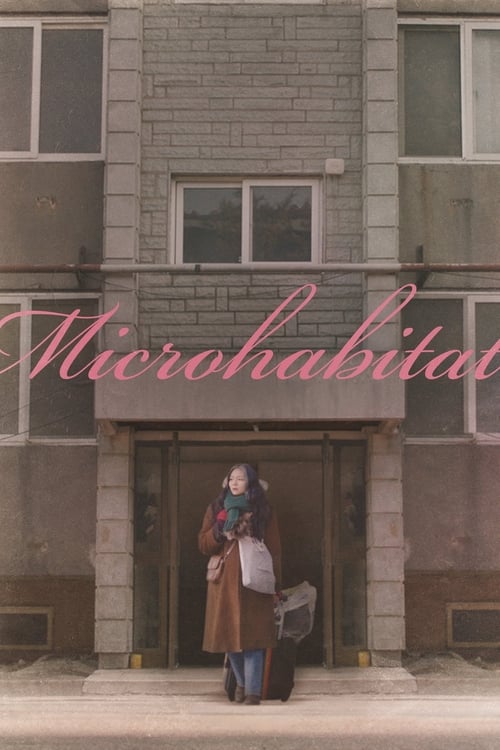
Microhabitat
2018 · Jeon Go-woon
For when you want something soft-spoken that still stings — a film to chew on for days about money, dignity, and small pleasures. Comfort on the surface, challenge underneath.
What it's about
Miso, a thirtysomething housekeeper in Seoul, has budgeted her life to the last won around three fixed pleasures: cigarettes, a nightly glass of whisky, and her boyfriend. When rent and tobacco prices jump, she does the math and gives up the apartment instead — spending a winter couch-surfing through the homes of her old college bandmates, each visit a snapshot of what her generation traded away for security.
The experience
Wry, light on its feet, and quietly devastating — it plays like a gentle comedy of visits while the arithmetic underneath keeps tightening. You laugh, then catch yourself doing your own math about what you'd refuse to give up.
Performances
Esom plays Miso with unshakable, serene stubbornness — never pitiable, never preachy — and makes a woman who owns almost nothing feel like the freest person in every room she enters.
The craft
Jeon Go-woon's debut structures itself as an episodic tour, each friend's home a compact short story with its own tone, and keeps the whole thing miraculously light — closer to a picaresque than a lament. The writing does the heavy lifting: an economic parable smuggled inside warm, funny visits.
Why it matters
A defining film of Korea's 2010s independent scene — Jeon co-founded the Gwanghwamun Cinema collective that revitalized it — and a touchstone for a generation's conversation about housing, precarity, and what a good life costs.
Jeon Go-woon's debut poses its economic parable as a deceptively simple question: when the price of everything rises, what do you refuse to give up? Miso, a thirtysomething housekeeper in Seoul, has budgeted her life down to the won around three fixed pleasures — cigarettes, a nightly glass of whisky, and her boyfriend — so when rent and tobacco prices jump, it's the apartment that goes. Her winter of couch-surfing becomes an episodic tour through the lives of her old college bandmates, each visit a compact portrait of what her generation traded for security: a loveless marriage, a corporate IV drip, a mortgage worn like a shackle. Jeon, a founding member of the Gwanghwamun Cinema collective that revitalized Korean independent film in the 2010s, keeps the tone miraculously light — closer to a picaresque than a lament — while the arithmetic underneath stays merciless. Esom's performance is the film's quiet marvel, serene without ever being naive, so that Miso reads not as a dropout but as the only person in the film who has done the math honestly.
Reception
It opened quietly in Korea in 2018 as a small indie from the Gwanghwamun Cinema collective, but festival wins (Busan's CGV Arthouse Award, Best New Director at the Grand Bell Awards) and years of streaming word-of-mouth turned it into an international cult favorite — now a go-to title in the 'broke millennial cinema' canon.
How Microhabitat was received, from release to now →
Influences: the films it descends from and the films it influenced
- Vagabond (1985) — Builds a portrait of a drifting, home-renouncing woman as a mosaic reconstructed from the households she passes through, the exact couch-hopping episodic architecture Microhabitat inherits — each host revealing more about the protagonist than she reveals about herself.
- City Lights (1931) — Codified the picaresque tramp who guards small dignities and pleasures against total economic ruin; Miso trading her apartment to keep cigarettes and whisky is a direct female-tramp variation on the Chaplinesque preservation of self over shelter.
- Umberto D. (1952) — Neorealist observational study of eviction and dignified poverty that stages precarity through mundane domestic gesture rather than melodrama — the template for rendering housing loss as quiet, undramatized routine.
- Tokyo Story (1953) — Structures narrative as a serial visit to former intimates one household at a time, each stop exposing that home's compromises through static, low-eye-level domestic framing — the visiting-device Microhabitat borrows for Miso's tour of ex-bandmates.
- The Match Factory Girl (1990) — Deadpan proletarian comedy-drama that holds austere, frontal compositions on a working woman's shrinking economic life, pairing minimalist framing with dry humor — the tonal register Microhabitat adopts to keep precarity from tipping into pity.
- Woman on the Beach (2006) — Established the Korean-independent grammar of low-budget episodic repetition, long static talk-scenes over cheap soju and cigarettes, and structural recurrence that Microhabitat's Gwanghwamun-collective milieu directly extends.
- Treeless Mountain (2008) — Korean minimalist-observational precarity told as a child shuttled between reluctant relatives' homes, using patient handheld intimacy and elliptical episodes — a diaspora-indie forerunner of Microhabitat's household-to-household drift.
- Nomadland (2020) — Extends the Vagabond-lineage itinerant-woman portrait into the gig economy, structuring the film as a road-strung series of encounters and stays that reconstruct a precarious life in motion — the same drift-as-structure Microhabitat practices at city scale.
- Wendy and Lucy (2008) — Pares an entire film down to one woman's arithmetic of survival at the economic edge, using restrained duration and withheld backstory to make a single act of loss carry the whole social critique — the same lean portrait method as Microhabitat.
- Frances Ha (2012) — Follows a broke young urban woman with no fixed address through a chaptered sequence of borrowed rooms, using each apartment as a station in a picaresque of downward mobility — a Western cousin to Miso's serial couch-surfing structure.
- The Florida Project (2017) — Renders housing insecurity as loosely episodic, buoyant vignettes that foreground small joys over misery, refusing the poverty-porn frame — the same tonal strategy Microhabitat uses to keep comedy and precarity in balance.
- House of Hummingbird (2018) — A female-authored Korean-independent debut of the same moment that builds meaning through accumulated quiet character-portrait episodes and generational disillusionment, sharing Microhabitat's staging of interior lives over plot.
- Little Forest (2018) — Korean indie of the same year whose heroine opts out of the hustle economy for a chosen austerity, dramatizing economic refusal as principled lifestyle — a direct thematic-craft companion to Miso's voluntary homelessness.
- Shoplifters (2018) — Observes an improvised economy of survival with warm, non-judgmental long takes on domestic space, treating makeshift arrangements as tender rather than pathetic — the humane observational register Microhabitat shares.
- Certain Women (2016) — Assembles a film from discrete portrait-episodes of women navigating constrained lives, letting the anthology structure itself become the argument — the same episodic-portrait form Microhabitat uses across Miso's hosts.
- Parasite (2019) — Renders class and housing hierarchy through the concrete staging of domestic space — who occupies which home — making architecture the vehicle of social critique, a spatial-craft sibling to Microhabitat's household-by-household map of Seoul's economic strata.
- Kim Ji-young: Born 1982 (2019) — Post-2015 Korean feminist social-realism centering a single woman's economic precarity with observational restraint and a refusal of sensational framing.
Similar films
- Little Forest (2018) — influence & lineage
- Shoplifters (2018) — influence & lineage
- Castaway on the Moon (2009) — shared sensibility
- House of Hummingbird (2019) — shared sensibility
- Poetry (2010) — shared sensibility
- Love in the Big City (2024) — shared sensibility
- Kim Ji-young: Born 1982 (2019) — shared sensibility
- One Million Yen Girl (2008) — shared sensibility