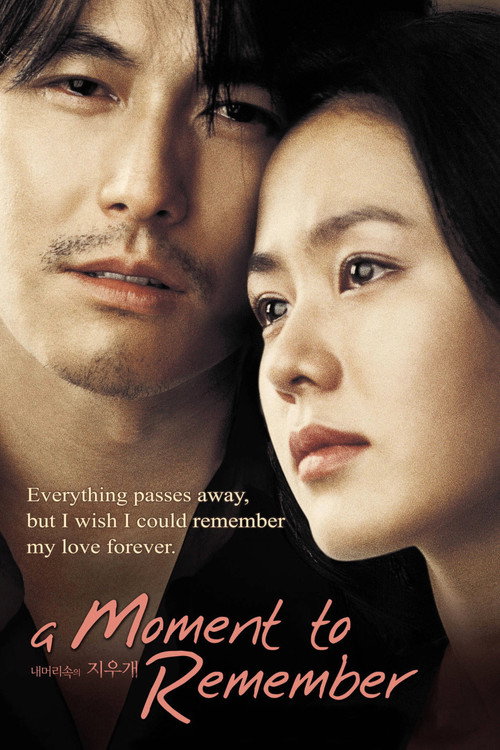
A Moment to Remember
2004 · John H. Lee
When you need a good cry and want to earn it — a film for a night when you're ready to feel everything about love, memory, and devotion. Comfort viewing in shape, devastating in effect.
What it's about
A construction engineer from a rough background and a young woman from a well-off family fall for each other, marry, and start building an ordinary life together. Then she is diagnosed with a rare early-onset form of Alzheimer's disease, and the marriage becomes a fight to hold on to each other while her memory — including her memory of him — begins to slip away.
The experience
A full-hearted tearjerker that spends its first act being light and swoony so the second half can quietly wreck you. It moves at a gentle pace and doesn't hide where it's going; the ache comes from watching two people love each other well while time runs out.
Performances
Son Ye-jin makes the heroine's fading feel physical and specific rather than saintly, and Jung Woo-sung plays the husband's steadiness with a gruff tenderness that keeps the melodrama honest. Their early chemistry is what makes the later scenes land so hard.
The craft
The film's power is in its patient structure: it builds the couple's daily rituals in warm, unhurried detail so that every small forgetting registers as a loss you can measure. Glossy, romantic imagery and a swelling score push the emotion openly — this is melodrama played without embarrassment, and played well.
Why it matters
One of the defining Korean 'sad romance' weepies of the 2000s, it became a touchstone tearjerker across East Asia and helped cement Son Ye-jin as the era's great melodrama star.
Snapshot
A Moment to Remember (Korean: 내 머리 속의 지우개, Nae meorisokui jiwoogae, literally "The Eraser in My Head") is a South Korean romantic melodrama directed by John H. Lee, starring Son Ye-jin as Kim Su-jin and Jung Woo-sung as Choi Chul-soo. Its narrative engine is a familiar one made freshly devastating: a young couple from unequal backgrounds fall in love, marry, and are then confronted by Su-jin's diagnosis of early-onset Alzheimer's disease, which erodes her memory — and eventually her recognition of the husband she loves — while he is left to hold the marriage together against an incurable, accelerating loss. The film is a canonical entry in the wave of "sad romance" weepies that dominated East Asian popular cinema in the early-to-mid 2000s, and it became one of the era's most emblematic tearjerkers, notable both as a domestic hit and as a landmark of the Korean Wave (Hallyu) in Japan. Where many terminal-illness romances kill the beloved, this one instead dramatizes a crueler premise — the beloved survives but forgets — making the disease itself the antagonist of memory, identity, and love's continuity.
Industry & production
The film was produced within the commercially confident South Korean film industry of the mid-2000s, a period in which domestic productions regularly outperformed Hollywood imports at the local box office and in which star-driven melodrama was a reliably bankable genre alongside the thrillers and gangster films for which Korean cinema was gaining international festival attention. A Moment to Remember is an adaptation: its source is the 2001 Japanese television drama Pure Soul (純粋 ~君が僕を忘れても~), and the transfer of a Japanese TV property into a Korean theatrical feature was itself characteristic of the intense creative traffic between the two national industries during this decade. Casting was central to the film's commercial architecture. Jung Woo-sung was already an established leading man with a "cool," often brooding screen image built through 1990s youth films; Son Ye-jin was an ascendant star increasingly identified with romantic and melodramatic roles. Pairing them signaled a prestige melodrama aimed squarely at a mainstream, cross-generational audience.
Commercially, the film was a substantial domestic success and, more strikingly, an exceptional performer in Japan, where it was released the following year and became one of the most successful Korean films yet to play in that market — a direct beneficiary of the Hallyu boom that Japanese audiences were then experiencing through Korean television dramas and stars. I should note plainly that precise, verified admission and gross figures for both territories are the kind of detail I cannot reproduce reliably from memory, and I will not invent them; the qualitative record — a strong home hit and a breakout Japanese success — is secure, but readers should confirm exact numbers against box-office databases.
Technology
The film was made and distributed as a conventional 35mm theatrical production of its period, before the wholesale shift to digital acquisition that would reshape Korean cinematography later in the decade. Its technological profile is unremarkable in the best sense: it deploys the standard tools of glossy mainstream melodrama — polished film stock, controlled lighting, and a lush, foregrounded music mix — rather than any novel apparatus. What is worth flagging is that the film's true "technology" is dramaturgical rather than mechanical: Alzheimer's disease functions as the story's central device, and the screenplay treats memory as something like a failing storage medium, staging its erasure through motifs (labeled objects, written notes, repeated questions) that externalize an internal, invisible pathology. Any claim beyond this general characterization — about specific cameras, lenses, or lab processes used on the shoot — would exceed what the reliable record supports, and I will not fabricate it.
Technique
Cinematography
The film works in the register typical of high-gloss Korean melodrama: warm, saturated interiors for the couple's domestic happiness, giving way to cooler, emptier compositions as Su-jin's illness advances. The visual grammar leans on the close-up — the genre's fundamental unit — to register the micro-expressions of confusion, fear, and grief on which the drama depends, and on shot/reverse-shot intimacy to build the couple's bond before the disease begins to sever it. Seasonal and weather imagery, a staple of the form, is used to externalize emotional states. I do not have a securely attributable credit for the director of photography to hand, and rather than guess I will note that the cinematographer's identity and specific stylistic signature are details a reader should verify; what can be said confidently is that the film's look is that of premium studio melodrama, prioritizing legibility of emotion over stylistic ostentation.
Editing
The editing serves the melodrama's two-part structure: an accelerated, buoyant courtship-and-marriage movement, then a decelerating, increasingly fragmented illness movement whose rhythm mimics memory's collapse. The film uses montage to compress the couple's happiness into a store of "moments" that the second half will systematically strip away — a structure in which editing itself enacts the title's promise and threat. Flashback and repetition are deployed so that images the audience has already lived with return, now emptied of Su-jin's recognition, weaponizing the viewer's own memory against them. As with the camera department, I will not assert a specific editor's name without confidence.
Mise-en-scène / staging
Class difference is written into the film's spaces and objects: Su-jin belongs to a more affluent, professional world, while Chul-soo is a working man — a carpenter/construction worker — whose labor and rougher milieu mark the couple as a deliberate mismatch that the romance must overcome. This class staging is central to the film's emotional design, positioning Chul-soo's steadfastness as a working-class virtue. As the disease progresses, the domestic set becomes a field of coping mechanisms — notes, labels, and reminders — turning the home itself into a losing battle against forgetting. The mise-en-scène thus moves from romantic idealization toward clinical fragility.
Sound
Sound in the film is dominated, per genre convention, by an emotive score and pop-ballad underscoring designed to cue and amplify the audience's tears — a defining feature of the Korean melodrama of the period, in which the musical theme often becomes as memorable as the images. The soundtrack's swelling strings and vocal ballads are integral to the film's affective machinery. I do not have a reliably verifiable composer credit to cite here and will not manufacture one; the reader should treat the specific attribution of the score as a detail to confirm, while the general observation — a lush, foregrounded, ballad-driven mix — is characteristic and secure.
Performance
The performances are the film's principal artistic achievement and the reason it endures in memory more than most of its cycle. Son Ye-jin's Su-jin traces a harrowing arc from radiant, slightly impulsive young woman to a person progressively unmoored from her own history, and the role is widely credited as a major step in consolidating her stature as one of Korean cinema's foremost melodrama actresses. Jung Woo-sung, cast somewhat against his established image of aloof glamour, plays Chul-soo with a banked, inarticulate tenderness — a man whose love is expressed through endurance rather than eloquence — and the pairing of his restraint with Son's expressive deterioration gives the film its emotional ballast. It is a two-hander in which the acting, more than any formal device, carries the tragedy.
Narrative & dramatic mode
The dramatic mode is pure melodrama in the classical sense: a mode of moral and emotional legibility in which a virtuous couple is subjected to an undeserved affliction, and in which suffering is made spectacular and cathartic. The screenplay follows a clear two-act emotional structure — the establishment of an idealized love, then its methodical dismantling by disease — and it withholds and delivers its tears with practiced timing. What distinguishes its dramaturgy from the death-of-the-beloved template is the substitution of forgetting for dying: the tragedy is not that Su-jin will be gone, but that she will remain while ceasing to know the person she loves, which inverts the usual grief (the survivor mourns not the dead but the living stranger). The narrative also foregrounds a subplot concerning Su-jin's romantic past that complicates the early courtship, adding a note of guilt and second chances to the film's moral texture. Throughout, the mode is unabashedly sentimental, unembarrassed by its own manipulation, and confident that emotional excess is the point rather than a flaw.
Genre & cycle
The film belongs to the early-2000s East Asian "pure love" (junai) and "sad romance" cycle — a wave of glossy, ballad-scored terminal-romance melodramas that swept Korean and Japanese popular culture. Its Korean kin include Kwak Jae-yong's The Classic (2003) and the broader lineage of romantic weepies descended from television dramas such as Autumn in My Heart and Winter Sonata; its Japanese cousins include the contemporaneous illness-romance boom exemplified by Crying Out Love, in the Center of the World (2004). This cycle itself descends from the much older shinpa melodramatic tradition — the Japanese-derived sentimental theatrical mode that shaped early Korean cinema — and A Moment to Remember can be read as a slick, contemporary refinement of that century-old form. Within the cycle, the film's specific innovation is its disease: by choosing Alzheimer's rather than the more common cancer or fatal accident, it swaps the countdown-to-death structure for a countdown-to-oblivion one, and this variation is much of why it is remembered as a standout rather than a mere type-specimen.
Authorship & method
John H. Lee is a director whose biography sits astride the Korea–US axis: born in South Korea and educated in the United States (in the New York film-school milieu), he brought a transnational sensibility to a very Korean genre. A Moment to Remember was his breakthrough, and his subsequent career confirms his comfort moving across national industries and modes — he would go on to direct the Korea-Japan production Sayonara Itsuka and the Korean War features 71: Into the Fire (2010) and Operation Chromite (2016), the latter an English-inflected international production. This trajectory suggests an authorship defined less by a fixed visual signature than by an ability to work fluently within genre frameworks and across the Korea-Japan cultural circuit — precisely the circuit that produced this film, adapted as it was from a Japanese teleplay.
On the key collaborators, honesty requires restraint: the film was adapted from the 2001 Japanese television drama Pure Soul, and the theatrical screenplay reworks that source, but I do not hold reliably verifiable individual credits for the screenwriter(s), cinematographer, composer, and editor, and I decline to invent names or attributions for them. This is a genuine thinness in what I can responsibly assert, and the reader should consult authoritative filmographic records for the full crew. What can be stated with confidence is the authorial center of gravity: a director working a well-defined melodramatic genre, two major stars anchoring the drama, and a Japanese televisual source transposed into Korean theatrical idiom.
Movement / national cinema
The film is a product of the "New Korean Cinema" era in its commercial, mainstream dimension. While that renaissance is often narrated through its auteur thrillers and genre-benders (the films of Park Chan-wook, Bong Joon-ho, and Kim Ki-duk that were then winning festival prizes), its commercial backbone was exactly this kind of star-driven popular melodrama, which financed the industry's confidence and reach. A Moment to Remember is also a key artifact of Hallyu — the Korean Wave — specifically its melodramatic export arm, which found enormous purchase in Japan. In that sense the film sits at the intersection of two movements: the domestic commercial vigor of 2000s Korean cinema and the transnational cultural export that made Korean romance a regional, then global, commodity.
Era / period
Released in 2004, the film is precisely of its moment: the high tide of the East Asian pure-love boom, the crest of Hallyu's penetration of Japan, and the pre-digital, pre-K-content-streaming media environment in which theatrical release and physical-media/TV afterlife still governed a film's reach. It captures a period when Korean and Japanese popular culture were in unusually intimate dialogue, when a Japanese TV drama could become a Korean blockbuster, and when the emotional maximalism of the ballad-scored weepie was culturally central rather than nostalgic. Watched now, it reads as a document of that specific mid-2000s sentimental sensibility.
Themes
The film's governing theme is memory as the substance of love: it proposes that a relationship is, in the end, an accumulation of shared moments, and it asks what remains of love when one partner can no longer hold those moments. From this flows a meditation on identity — Su-jin's loss of memory is a loss of self, and the film quietly asks whether she remains "herself" to those around her. Fidelity and endurance form a second axis: Chul-soo's love is tested not by rivalry or death but by the slow attrition of being forgotten, and the film valorizes a steadfastness that persists without reciprocation or recognition. Class and worthiness form a third: the union of an affluent woman and a working-class man frames love as something that levels social difference, with Chul-soo's constancy figured as a moral nobility independent of status. Underneath all of this runs the melodramatic conviction that suffering has meaning — that to love fully is to accept its potential for catastrophic loss, and that catharsis, not consolation, is the reward.
Reception, canon & influence
Critically, the film occupies the position typical of its genre: warmly received by audiences and often regarded by critics as an unusually well-made and affecting example of a formula that is easy to execute cynically and hard to execute movingly. Its performances, especially, were singled out, and it is generally credited as a career-consolidating film for Son Ye-jin within the melodrama tradition. In the popular canon of Korean romance, it stands as one of the defining tearjerkers of its decade — frequently cited, alongside titles like The Classic, when the "sad Korean romance" is invoked as a cultural type.
Looking backward, the film's influences are clear and multiple: the immediate source is the Japanese TV drama Pure Soul; the deeper lineage runs through the shinpa melodramatic tradition and the terminal-romance conventions codified in Korean television dramas of the preceding years. It synthesizes these into feature form. Looking forward, its most concrete legacy is as a high-water mark and reference point for the pure-love cycle and for Hallyu's melodramatic export to Japan, where its success helped confirm the commercial viability of Korean romance abroad. Its choice of Alzheimer's as a romantic-tragic device also anticipates a durable strain of memory-loss love stories across East Asian screen media. A specific, verifiable record of remakes, direct homages, or named filmmakers citing it as an influence is not something I can confidently enumerate, and I will not manufacture such a genealogy; what is secure is its standing as a representative, and unusually well-realized, specimen of one of the most culturally significant popular-film cycles of early-2000s East Asian cinema.
Reception
A solid hit in Korea in 2004, it became a phenomenon when it crossed to Japan in 2005 and out-grossed its home run — dismissed by some then as a shameless weepie, it's now filed as a canonical Korean melodrama and a Son Ye-jin essential.
How A Moment to Remember was received, from release to now →
Influences: the films it descends from and the films it influenced
- All That Heaven Allows (1955) — Establishes the women's-picture color melodrama grammar A Moment to Remember inherits — a class-crossed couple staged through saturated, temperature-shifting Technicolor and glass/reflection framing that externalizes emotional entrapment.
- Love Story (1970) — Codifies the terminal-illness weepie template: a class-crossed romance whose grief is metered by a single recurring musical love theme, the ballad-scoring logic AMTR runs on.
- Christmas in August (1998) — The New Korean Cinema template of the restrained dying-protagonist melodrama — static long takes and held close-ups that underplay terminal illness, a source of understatement AMTR heightens into full weepie.
- Love Letter (1995) — Sets the East Asian pure-love visual grammar AMTR's cycle draws on: memory-triggered flashback structure, a warm-to-cool snowbound palette, and orchestral-ballad scoring binding present grief to remembered past.
- Pure Soul (2001) — The direct source teleplay; AMTR transposes its Alzheimer's-as-tragic-device premise and serialized terminal-romance beats into a two-part Korean theatrical feature.
- A Millionaire's First Love (2006) — Continues the Korean pure-love terminal-illness cycle: a class-difference two-hander, warm palette, and ballad scoring extending AMTR's high-water-mark formula.
- Sayonara Itsuka (2010) — Same director extending his Korea–Japan melodrama method across the identical transnational cultural circuit that produced AMTR.
- A Werewolf Boy (2012) — Korean tearjerker in the AMTR mode: a present-day-return-into-extended-flashback two-part frame, with memory and the passage of time as the engine of loss.
- Architecture 101 (2012) — Extends the cycle's memory-structured melodrama with a strict two-timeline (student past / adult present) cutting pattern and class-difference first love recovered through recollection.
- Away From Her (2006) — Carries the Alzheimer's-as-love-device forward into a marital two-hander built on close-up performance and fidelity tested by forgetting — the identity-loss strain AMTR anticipates.
- Still Alice (2014) — Foregrounds identity-loss via Alzheimer's as the central dramatic engine, sustained by a single lead's close-up performance — the 'forgetting-not-dying' device pushed to awards-vehicle character study.
- Man in Love (2021) — Codified the Korean terminal-illness melodrama architecture — romance deliberately engineered toward a diagnosis-driven third act and punctuated by a recurring ballad motif — that the seed's redemptive-rogue plot bolts onto.
- Even If This Love Disappears Tonight (2025) — Codifies the Korean memory-loss weepie's grammar of dramatic-irony withholding — the audience grasps the coming erasure before the couple does — the exact information-management the adaptation localizes into high-school texture.
- Il Mare (2000) — Contemporary Korean romance built on a time-displaced letter device and a cool-blue-to-warm palette, sharing AMTR's structuring of longing through temporal gaps and epistolary memory.
- The Classic (2003) — The co-defining early-2000s Korean tearjerker: a two-timeline/two-part structure, warm rural-nostalgia cinematography, and a recurring ballad theme — the exact formal package critics cite alongside AMTR.
- Crying Out Love, in the Center of the World (2004) — Parallel Japanese pure-love terminal romance using the same past/present two-part structure and analog-recording (cassette) memory objects to reactivate the remembered beloved.
- Be With You (2004) — Japanese memory-and-mortality melodrama structured as a return-of-the-lost-spouse, ballad-scored and built on the same forgetting/remembering emotional mechanics as AMTR's Hallyu-Japan circuit.
- The Notebook (2004) — Western same-year counterpart: a dementia framing device wrapping a two-timeline, class-crossed romance, with a recurring musical theme — an almost point-for-point structural rhyme with AMTR.
- 50 First Dates (2004) — Same-year memory-loss (not dying) romance built on daily re-remembering and recorded-video memory aids — the 'forgetting-not-dying' device that AMTR treats tragically, here in comic register.
Similar films
- The Notebook (2004) — influence & lineage
- Christmas in August (1998) — influence & lineage
- Even If This Love Disappears Tonight (2025) — shared sensibility
- Miracle in Cell No. 7 (2013) — shared sensibility
- Memoir of a Murderer (2017) — shared sensibility
- Eternal Sunshine of the Spotless Mind (2004) — shared sensibility
- Soulmate (2023) — shared sensibility
- The Way Home (2002) — shared sensibility