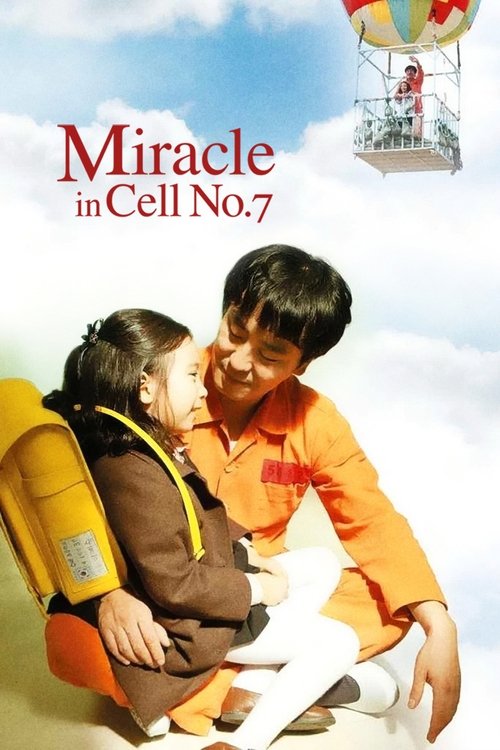
Miracle in Cell No. 7
2013 · Lee Hwan-kyung
For when you need a good cry and want the film to earn it with warmth rather than misery — a father-daughter story that hugs you hard even as it breaks your heart. Comfort viewing in the sense that it feels, deeply, and lets you feel along.
What it's about
Yong-gu, an intellectually disabled man with the mind of a child, is wrongfully convicted of a terrible crime against the daughter of a powerful official and torn away from his own six-year-old girl, Ye-sung. Inside prison, the hardened men of Cell No. 7 — moved by the gentle father in their midst — conspire to smuggle the little girl in to be with him. Years later, the grown Ye-sung fights to clear her father's name.
The experience
Openly, unapologetically sentimental — it swings from broad prison-cell comedy to full-hearted tearjerker and commits completely to both. You'll laugh at the cellmates' schemes and then get absolutely wrecked; bring tissues, it's not a fair fight.
The craft
The writing walks a high wire between farce and tragedy, using the comedy of the cellmates to open your defenses before the emotional blows land. Its structure — the grown daughter's fight for a retrial framing the prison story — turns a sentimental premise into an argument about justice for the powerless.
Why it matters
A defining commercial phenomenon of early-2010s Korean cinema and one of the biggest box-office hits in the country's history, it spawned remakes across multiple countries and proved the global reach of the Korean tearjerker.
Snapshot
Miracle in Cell No. 7 (Korean: 7번방의 선물, 7beonbang-ui Seonmul, literally "The Gift of Room 7") is a South Korean comedy-drama that became one of the defining commercial phenomena of early-2010s Korean cinema. Its premise is deliberately, almost provocatively, sentimental: Yong-gu, an intellectually disabled man with the mind of a child, is wrongfully convicted of raping and murdering the young daughter of a powerful police commissioner, sentenced to death, and separated from his own six-year-old daughter, Ye-sung. Inside the prison, the hardened men of Cell No. 7 conspire to smuggle the little girl in to be with her father — the "gift" of the title. A framing device set years later, in which the grown Ye-sung (now training in law) pursues a retrial to posthumously clear her father's name, turns the film into an explicit plea against judicial cruelty and the death penalty. The film pairs broad slapstick with unabashed tearjerking, and it is best understood not as art cinema but as a virtuoso example of Korean mainstream melodrama engineered for maximum emotional saturation. It drew an enormous domestic audience, entering the small club of Korean films to surpass roughly twelve million admissions, and its afterlife — a chain of officially licensed international remakes — is arguably more consequential than the original's critical standing.
Industry & production
The film was produced within the mature, vertically integrated South Korean film industry of the early 2010s, distributed by NEW (Next Entertainment World), a distributor then rapidly establishing itself as a challenger to the CJ and Lotte majors. It arrived at a moment of extraordinary confidence for domestic production: local films were routinely outperforming Hollywood imports at the Korean box office, and the "ten-million-admission" benchmark — a film seen by roughly one in five Koreans — had become the recognized marker of a blockbuster. Miracle in Cell No. 7 was a modestly budgeted drama rather than a spectacle-driven tentpole, which made its commercial performance especially striking; it returned a very large multiple on its production cost and became one of the year's biggest domestic successes. Precise figures beyond the widely reported admissions total should be treated cautiously in English-language sources, but the film's status as a sleeper hit that vastly outgrew its budget is well established. Its success is frequently cited as part of the run that established NEW as a serious force in Korean distribution.
Technology
The film was made with the standard digital production toolchain of Korean commercial features of its era; by 2013 digital capture and a digital-intermediate finishing pipeline were the industry norm for a mid-budget drama of this kind. English-language documentation of the specific camera systems, lenses, or post-production houses used is thin, and I will not invent those details. What can be said with confidence is that the film makes no ostentatious use of technology as spectacle: there is no reliance on visual effects, virtual sets, or technological novelty. Its craft is invested almost entirely in performance, staging, and editing rhythm rather than in any technical apparatus, which is consistent with its identity as a character-and-emotion-driven melodrama.
Technique
Cinematography
The visual approach is functional and warm rather than expressive or authorial. The prison — normally cinema's most oppressive interior — is deliberately softened: the cell is shot as a cramped but cozy communal space, lit to feel domestic rather than carceral, so that the arrival of a child reads as plausible warmth rather than incongruity. The camera favors clear, legible framing that keeps faces central, because the film's entire strategy depends on reading emotion in close-up. Compositions repeatedly isolate the physical scale difference between the towering, childlike Yong-gu and his tiny daughter, using the frame to underline their reversed, mutually protective relationship. This is populist visual storytelling: nothing is allowed to distract from the actors.
Editing
Structurally, the most important editorial decision is the frame narrative. The film opens and periodically returns to the adult Ye-sung's legal proceeding, and it cross-cuts between the retrial "present" and the prison "past," so that information about Yong-gu's innocence is withheld and released for maximum pathos. Within the prison sections, the cutting alternates deliberately between comic set pieces (the cellmates' schemes, the smuggling operation) and escalating melodrama, a tonal oscillation that the editing manages as a rhythm — buoyancy, then devastation. The climactic sequences are cut for sustained emotional crescendo rather than restraint, which is precisely the effect the film seeks.
Mise-en-scène / staging
The single cell is the film's principal stage, and much of the drama is blocked as ensemble theater: a fixed group of men in a confined room, their movements choreographed around the child who enters their space. Production design leans into contrast — the drabness of institutional prison against the color and softness the daughter brings. Props and costume carry meaning simply and directly (the Sailor Moon backpack that recurs as a token of the daughter, the prison uniforms that flatten the men into a group before the film individuates them). The staging is unembarrassed about sentiment, arranging bodies and objects to maximize legibility of feeling.
Sound
The score is used frankly and heavily to cue emotion, swelling under the film's turning points in the tradition of Korean melodrama. Music and diegetic sound are deployed to amplify rather than complicate; the film does not use sound ironically or for distanciation. I do not have reliable confirmation of the composer's identity in English-language sources and will not guess. What is clear is that the soundtrack is a primary instrument of the film's affective design.
Performance
Performance is the film's true medium. Ryu Seung-ryong, an actor otherwise associated with commanding or villainous roles, plays Yong-gu with a physically committed, deliberately childlike register — a high-risk performance that could easily have curdled into caricature but instead anchors the film's sincerity. The child actress Kal So-won, as the young Ye-sung, delivers the naturalistic, disarming presence on which the entire emotional gamble rests; her chemistry with Ryu is the film's engine. The ensemble of cellmates — including Oh Dal-su among the recognizable character actors — provides the comic texture that leavens the melodrama and makes the group's collective tenderness believable. Park Shin-hye appears as the adult Ye-sung in the framing sections. The performances are pitched broad but sincere, and their conviction is the reason audiences forgave the film its manipulations.
Narrative & dramatic mode
The dramatic mode is melodrama in its purest commercial form, structured around innocence persecuted by power. The narrative machinery is built to produce tears: an innocent who literally cannot comprehend the charge against him, a child who cannot save her father, a wrongful execution driven by a powerful man's grief and influence, and a retrospective vindication that arrives too late to undo the loss. The frame narrative is crucial to the mode — by revealing at the outset that Ye-sung is fighting to clear her father's name, the film converts the prison story into remembered tragedy, coloring even its comic scenes with dread. The comedy is not a counterweight to the drama so much as a setup for it; the warmth accumulated in the middle is deliberately spent in the devastation of the ending.
Genre & cycle
The film sits at the intersection of two durable Korean commercial genres: the broad ensemble comedy and the sinpa (신파) tearjerker — a term for heightened, sometimes derided sentimental melodrama with deep roots in Korean popular culture. It belongs to a recognizable cycle of Korean films that mix comedy and pathos around family, disability, and social injustice, and it draws on the prison-drama and courtroom-drama traditions without being primarily either. Its closest generic kin are populist "cry movies" designed for mass emotional catharsis. The deliberate genre-blending — starting as a group comedy and ending as a wrenching tragedy — is itself characteristic of Korean commercial cinema's willingness to swing tonal registers within a single film, a quality often noted as distinctive of the national industry.
Authorship & method
Miracle in Cell No. 7 was directed by Lee Hwan-kyung, for whom it was an early feature following his sentimental sports-family drama Champ (2011); his sensibility across these works is unabashedly emotional and populist rather than formalist or festival-oriented. Lee is credited among the film's writers, and the screenplay is generally attributed to a small writing team; I am not certain enough of the full writing credits in English-language records to name each collaborator, and will not fabricate them. This is emphatically director-as-craftsman rather than director-as-auteur: the film's "method" is the disciplined orchestration of tone — knowing exactly how much comedy to bank before cashing it in for grief — and the careful management of star performances. Below-the-line authorship (cinematographer, editor, composer) is not well documented in accessible English sources, and I flag that gap rather than invent attributions. The controlling authorial intelligence here is a commercial-melodrama sensibility exercised with genuine technical assurance.
Movement / national cinema
The film is a product of the post-2000 Korean cinema renaissance in its mainstream, box-office-dominant phase — the period when Korean audiences overwhelmingly chose domestic films and when a robust star-and-genre system could turn a mid-budget drama into a national event. It does not belong to the auteurist, festival-facing strand of Korean cinema associated with directors like Bong Joon-ho, Park Chan-wook, or Lee Chang-dong; rather, it exemplifies the commercial mainstream that coexists with, and financially underwrites, that art-cinema wing. Its unembarrassed embrace of sinpa connects it to a long lineage of Korean melodrama stretching back through the mid-century golden age, updated for a contemporary mass audience.
Era / period
Released in the early 2010s, the film is a document of a specific and confident moment: the boom years when Korean films regularly crossed ten million admissions and domestic productions dominated their own market. Its wrongful-conviction and death-penalty themes also resonate within a period of continued public reckoning over judicial fairness and state power in South Korea. The film's period identity is inseparable from the industrial context — it is a product of a national cinema at the height of its commercial self-assurance, when a story this sentimental could become one of the most-watched films of its year.
Themes
The film's central theme is paternal love as an absolute, unconditioned by the father's disability or the world's cruelty; the daughter's love for her father is mirrored back with equal totality. Around this core cluster several social concerns: the vulnerability of the intellectually disabled before institutions that cannot or will not understand them; the corruption of justice by class and power (the accuser is a well-connected official who bends the system toward a predetermined outcome); and a direct argument against capital punishment, dramatized as the irreversible execution of a demonstrably innocent man. The film also advances a theme of chosen family and communal redemption — the hardened criminals of Cell No. 7 are morally elevated by their care for a child — and, through its frame story, the theme of memory and vindication: the belated, insufficient effort of the living to restore an innocent's name. Innocence itself, both legal and childlike, is the film's recurring keyword.
Reception, canon & influence
Critically, the film generated the classic split that surrounds effective sinpa: it was enormously beloved by audiences and frequently faulted by critics for emotional manipulation and calculated sentimentality. That divide is central to its reputation — it is a film often defended on the grounds that it does exactly, and expertly, what it sets out to do. Domestically it earned major-award recognition and star-making acclaim, particularly for Ryu Seung-ryong's risky central performance and for the child actress Kal So-won; I do not have reliable confirmation of the specific award wins in English-language sources and will not enumerate them falsely.
Looking backward, the film's influences are the deep traditions it draws on rather than specific named precursors: the Korean melodramatic sinpa mode, the tradition of the wrongful-conviction courtroom drama, and the international lineage of "sentimental father" films (the comparison to Hollywood's I Am Sam has often been made, given the shared premise of an intellectually disabled father and a young daughter, though the resemblance is thematic rather than derivative).
Its forward legacy is unusual and substantial. Rather than shaping a school of imitators at home, Miracle in Cell No. 7 became a globally exported template through a remarkable chain of officially remade versions across national cinemas. The best-documented of these is the Turkish remake 7. Koğuştaki Mucize (2019), directed by Mehmet Ada Öztekin, which became a major streaming success and was selected as Turkey's submission for the international Academy Award. An Indonesian remake followed and likewise performed strongly in its home market, and additional remakes were mounted in other territories (including the Philippines and South Asian and Spanish-language versions), making the story one of the most frequently re-adapted Korean screenplays of its generation. This transnational remake phenomenon — a Korean melodrama proving so portable that it could be re-nationalized again and again — is the film's most significant contribution to film history, and a striking case study in how the Korean industry's commercial storytelling began circulating globally in the years just before the international "Korean wave" crested. On that count, whatever critics made of its sentimentality, Miracle in Cell No. 7 earned a durable place as one of the most influential export properties of contemporary Korean popular cinema.
Reception
A monster audience hit in Korea in 2013 — critics sniffed at the sentimentality, but it drew over 12 million admissions and became one of the country's most-watched films ever. Now many international viewers actually discover it backwards, through its famous remakes.
How Miracle in Cell No. 7 was received, from release to now →
Influences: the films it descends from and the films it influenced
- The Green Mile (1999) — Establishes the death-row single-block ensemble in which a gentle, wrongly-condemned innocent works quiet 'miracles' that soften his jailers into a surrogate family — the carceral-melodrama staging this film transplants to a Korean cell.
- Life Is Beautiful (1997) — Pioneers the device of a father converting imprisonment into clowning and play to shield a child, driving the comedy-banked-then-cashed-for-grief tonal oscillation that is Lee's core method.
- I Am Sam (2001) — Supplies the intellectually-disabled father / precociously bright daughter dyad litigated through a custody-court structure, with a childlike performance register anchoring the pathos.
- To Kill a Mockingbird (1962) — Models the wrongful-conviction courtroom injustice filtered through a child's moral point of view and framed by a grown child's retrospective narration.
- One Flew Over the Cuckoo's Nest (1975) — Codifies the single-institution ensemble of comic misfit inmates who rally around one outsider, mixing broad group comedy with an institutional-tragedy turn.
- A Coachman (Mabu) (1961) — Foundational Korean sinpa of the suffering, self-sacrificing father whose devotion to his children is the tear-engine — the melodramatic paternal-love template this film inherits.
- Champ (2011) — Lee's own prior sentimental sports-family weepie where he honed the populist orchestration of tone and underdog/disability pathos he brings to the cell.
- The Champ (1979) — The archetypal father-child death-weepie whose climactic child-at-the-deathbed staging codified the wrenching separation beat the film ultimately cashes in.
- 7. Koğuştaki Mucize (2019) — The officially licensed Turkish remake reproducing the daughter-lawyer frame, single-cell ensemble and comedy-to-grief architecture, re-nationalized to a rural Turkish setting.
- Miracle in Cell No. 7 (2019) — The Filipino official remake transplanting the screenplay's frame-story and tonal-oscillation blueprint intact into Tagalog melodrama.
- Miracle in Cell No. 7 (2022) — The Indonesian official remake — the most commercially successful of the export chain — preserving the daughter-lawyer framing device and prison-family beats wholesale.
- Harmony (2010) — Korean prison melodrama built on incarcerated outcasts and a parent-child separation, oscillating comic ensemble warmth with a death-sentence climax.
- Marathon (2005) — Set the Korean template for a humane, non-caricatured childlike-register performance of intellectual disability that Ryu Seung-ryong's risky central turn extends.
- Hope (Wish) (2013) — Same-year Korean sinpa centering a wounded child and a devoted father, using domestic close-up intimacy and a legal-aftermath structure to process injustice.
- Ode to My Father (2014) — Contemporaneous Korean commercial sinpa that wraps a father's sacrificial past in a present-day frame story to license unabashed audience weeping.
- Along with the Gods: The Two Worlds (2017) — CJ-mode blockbuster tearjerker structured as a trial — an afterlife court re-litigating a good man's life — pairing broad comic set-pieces with melodramatic revelation.
- Hope (2013) — Same-year Korean father-daughter tearjerker mining the same working-class-innocence-under-assault vein — a tonal sibling in the era's melodrama even as Hope stays more restrained.
Similar films
- Hope (2013) — shared sensibility
- Sunny (2011) — shared sensibility
- Memoir of a Murderer (2017) — shared sensibility
- The Way Home (2002) — shared sensibility
- Soulmate (2023) — shared sensibility
- A Moment to Remember (2004) — shared sensibility
- Tae Guk Gi: The Brotherhood of War (2004) — shared sensibility
- Forgotten (2017) — shared sensibility