Hope
2013 · Lee Joon-ik
For when you need a good, cleansing cry and want a film about healing rather than horror. Emotionally heavy, but it holds your hand through it — the challenge is the subject, not the telling.
What it's about
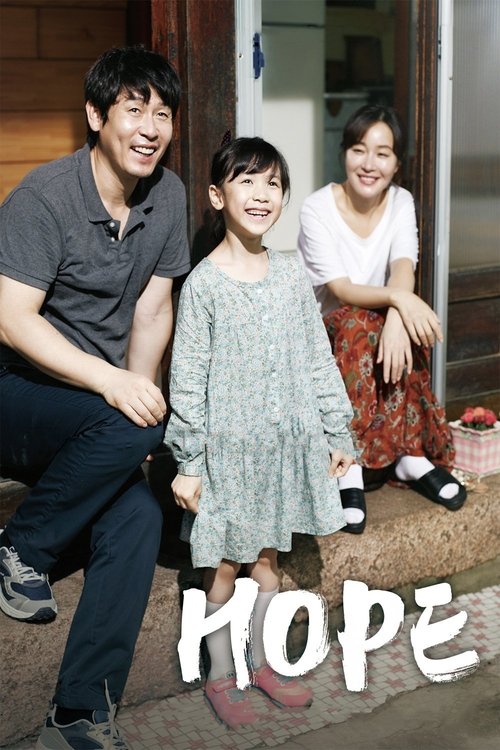
After eight-year-old So-won narrowly survives a brutal assault, her working-class family has to relearn how to live: a mother swallowing her own grief to project calm, and a father whose daughter can no longer bear the presence of men — and who searches for a way to be near her anyway. Drawn from a real 2008 case that convulsed South Korea, the film keeps the crime itself offscreen and gives everything to the aftermath.
The experience
Devastating but never exploitative — a film of small kindnesses, patience, and hard-won steps that earns every tear honestly. Expect to cry, and expect the crying to feel like relief rather than punishment.
Performances
Sol Kyung-gu is devastating in his restraint as the father — a man who expresses everything he can't say out loud through sheer stubborn presence, including waiting outside his daughter's school in a sweltering cartoon mascot costume.
The craft
Lee Joon-ik directs without a single lurid impulse: the pivotal crime stays offscreen, and the film trusts duration, routine, and small gestures to carry the weight. That restraint is the craft — it turns what could have been a lurid true-crime drama into a study of how a family absorbs the unabsorbable.
Why it matters
Korean audiences embraced it as an act of collective mourning over a case the whole country knew, and it stands among the most respected films of Lee Joon-ik's career.
Drawn from a real 2008 case that convulsed South Korea, Lee Joon-ik's drama begins with the unthinkable — the brutal assault of an eight-year-old girl — and then makes the compassionate, rigorous choice that defines it: the crime stays offscreen, and the film gives itself entirely to the aftermath. What follows is a study of a working-class family relearning how to live: a mother swallowing her grief to project calm, and a father, played with devastating restraint by Sol Kyung-gu, who discovers his daughter can no longer bear the presence of men — and finds a way to be near her anyway, inside a cartoon mascot costume, waiting outside her school in the heat. Lee, best known for the historical smash The King and the Clown, directs without a single lurid impulse, trusting duration and small kindnesses. Korean audiences embraced it as an act of collective mourning, and it won Best Film at the Blue Dragon Awards over the year's flashier titles. It is that rarest thing: a film about atrocity whose true subject is repair.
Reception
A wrenching sell in 2013 — a drama drawn from a real, notorious Korean criminal case — it stunned everyone by taking Best Film at the Blue Dragon Awards over Snowpiercer and Miracle in Cell No. 7; it has since traveled abroad via streaming and Letterboxd as one of Korean cinema's definitive tearjerkers.
How Hope was received, from release to now →
Influences: the films it descends from and the films it influenced
- Poetry (2010) — Keeps a schoolgirl's sexual assault entirely offscreen and dramatizes only its moral aftermath through an elderly guardian — the aftermath-focused, non-sensational treatment Hope inherits wholesale.
- Secret Sunshine (2007) — Builds a whole film from the parental grief that follows a child's abduction, using long-take restraint and a refusal of catharsis that Hope's mourning scenes directly echo.
- Oasis (2002) — Establishes the Korean realist ethic of treating a stigmatized victim with unsentimental tenderness and offscreen sexual violence from which Hope's handling of its child survivor descends.
- Silenced (2011) — The immediate Korean predecessor dramatizing child sexual abuse from a true case, but as courtroom exposé — Hope answers it by turning the camera from perpetrator and system to the survivor's domestic repair.
- Life Is Beautiful (1997) — The direct model for a father who constructs a protective game or fiction — literalized in Hope's mascot costume — to metabolize a child's trauma into something bearable.
- Still Walking (2008) — Koreeda's method of staging collective family mourning around meals and mundane routine in restrained long takes shapes Hope's domestic grief scenes.
- Nobody Knows (2004) — Model for eliciting unforced naturalistic child performance and letting scene duration carry a child's suffering without melodramatic underscoring.
- The Sweet Hereafter (1997) — Pioneers the community-in-mourning-after-harm-to-children structure, refusing to depict the catastrophe directly and dwelling instead on collective repair.
- In the Bedroom (2001) — Aftermath-of-a-crime family drama built on performative restraint and offscreen violence, its pressure held in silences the way Hope holds the parents' contained rage.
- Ordinary People (1980) — Template for the family slowly repairing itself through therapy and small reconciliations after trauma — the emotional architecture Hope's recovery arc follows.
- The King and the Clown (2005) — Lee Joon-ik's own recurring device of costume, clowning and performance as an emotional shield, which Hope literalizes in the father sweating inside a children's mascot suit.
- A Girl at My Door (2014) — Extends Hope's restrained adult-guardian-protecting-an-abused-child template, again keeping the violence offscreen and privileging quiet protective gestures over spectacle.
- Miss Baek (2018) — Inherits the working-class-guardian-and-traumatized-child dyad and the muted realist register Hope established for the Korean child-abuse aftermath drama.
- Han Gong-ju (2013) — Same-year survivor drama that opens after the assault and withholds the event, sharing Hope's aftermath structure and its performance of a girl painstakingly reassembling ordinary life.
- Miracle in Cell No. 7 (2013) — Same-year Korean father-daughter tearjerker mining the same working-class-innocence-under-assault vein — a tonal sibling in the era's melodrama even as Hope stays more restrained.
- Way Back Home (2013) — Contemporaneous true-events drama about a working-class family enduring a legal and social ordeal, sharing Hope's fidelity to a real case and its ordinary-family focus.
- Souleymane's Story (2024) — Lojkine's own prior migration film establishing his method: immersive vérité fieldwork with non-professional leads playing versions of their journeys, the sub-Saharan-to-Europe route rendered as intimate handheld ordeal.
Similar films
- Miracle in Cell No. 7 (2013) — influence & lineage
- Silenced (2011) — influence & lineage
- Nobody Knows (2004) — influence & lineage
- Hope (2026) — shared sensibility
- Mother (2009) — shared sensibility
- Blue Heron (2026) — shared sensibility
- Chithha (2023) — shared sensibility
- The Host (2006) — shared sensibility