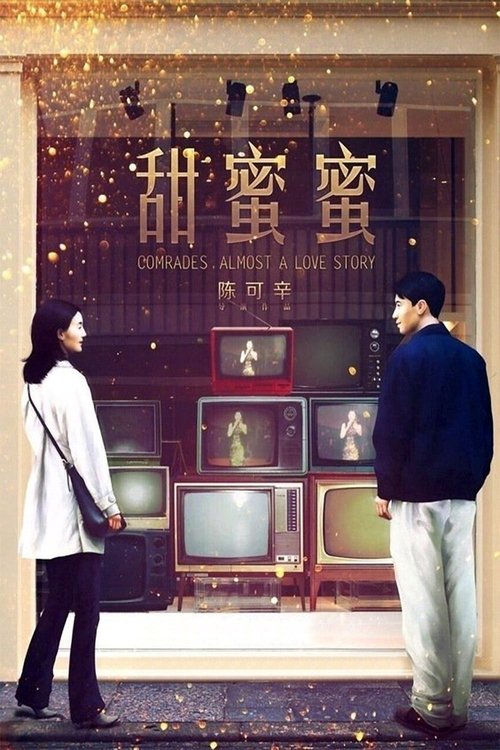
Comrades, Almost a Love Story
1996 · Peter Chan Ho-Sun
For a night when you want to fall in love and have your heart gently broken — the kind of film you reach for when you're feeling wistful about roads not taken. Bring tissues; it's a warm cry, not a cruel one.
What it's about
Xiaojun arrives in Hong Kong from mainland China in the mid-1980s, a sweet provincial innocent saving money to marry the fiancée he left back home. He befriends Qiao, a sharp, ambitious fellow migrant who passes herself off as a native Hong Konger and is determined to get rich. Over roughly a decade — through schemes, setbacks, other partners, and even other continents — their friendship keeps tipping into love, and their timing keeps being wrong.
The experience
Tender, funny, and quietly devastating — a romance built from small gestures, pop songs, and near-misses rather than grand declarations. It earns its emotions honestly, and the ache sneaks up on you.
Performances
Maggie Cheung gives one of the great romantic performances — Qiao's toughness and tenderness flickering across her face in the same instant — and Leon Lai's guileless sincerity makes the pairing work; a single late close-up of Cheung is reason enough to watch.
The craft
Peter Chan threads the whole romance on the songs of Teresa Teng, the Taiwanese singer beloved by mainlanders, so the music becomes the lovers' secret shared identity — the title itself comes from her song 'Tian Mi Mi.' The decade-spanning structure, hopping from Hong Kong's street markets to New York, turns a two-person love story into a portrait of an entire migrant generation.
Why it matters
Swept the Hong Kong Film Awards and is regularly ranked among the greatest Hong Kong films ever made — the definitive screen romance of the Chinese diaspora, released on the eve of the 1997 handover it quietly reflects.
Snapshot
Comrades, Almost a Love Story (Cantonese/Mandarin title Tian Mi Mi / 甜蜜蜜, "Sweet as Honey," borrowed from the Teresa Teng song) is a decade-spanning romance about two mainland Chinese migrants who meet, part, and repeatedly miss one another in Hong Kong and, finally, New York. Li Xiaojun (Leon Lai) arrives from the north around 1986, an earnest, provincial innocent saving to bring over the fiancée he left at home; Li Qiao (Maggie Cheung) is a Guangzhou transplant passing as a native Hong Konger, hungrier and shrewder, forever chasing the money that the territory seems to promise. Their friendship curdles into love and back again over roughly ten years, their timing perpetually wrong, their shared secret—that both are outsiders performing belonging—the thing that binds and dooms them. Directed by Peter Chan for the UFO collective at the peak of its influence, the film is the pre-eminent romantic drama of Hong Kong's handover decade: a melodrama of displacement scored to the ubiquitous ballads of Teresa Teng, and structured so that the singer's real death in May 1995 becomes the hinge of the lovers' reunion. It swept the Hong Kong Film Awards and is now routinely cited among the finest Chinese-language films of the 1990s.
Industry & production
The film is inseparable from UFO—United Filmmakers Organization—the boutique company Peter Chan co-founded in the early 1990s with collaborators including Eric Tsang and Lee Chi-ngai. UFO carved out a distinctive niche within a Hong Kong industry then dominated by action spectacle, Triad sagas, and slapstick: literate, urban, character-driven comedies and dramas aimed at a maturing middle-class audience (He's a Woman, She's a Man, Tom, Dick and Hairy, and others). Comrades is generally regarded as the studio's crowning achievement and the fullest expression of its house sensibility—commercial storytelling with an art-house attention to interior life.
The production arrived at a fraught commercial moment. The Hong Kong film industry, which had boomed through the late 1980s and early 1990s, was entering the contraction that would deepen after 1997, squeezed by video piracy, the rise of Hollywood imports, and the uncertainty surrounding the handover. Against that backdrop, a mid-budget romantic drama with no action hook and a downbeat, elliptical structure was a genuine gamble; its critical and popular success validated UFO's bet that adult drama still had a domestic market. Casting drew on the crossover between Cantopop stardom and film: Leon Lai was one of the "Four Heavenly Kings" of Cantopop, and Maggie Cheung was already a critically esteemed actress moving beyond her ingénue beginnings. Their pairing gave the film marquee appeal while allowing Chan to work against type—Lai's stiffness repurposed as Jun's guilelessness, Cheung's poise sharpened into Qiao's brittle ambition.
Technology
Technologically the film is unremarkable by design, which is worth stating plainly rather than dressing up: it was shot and finished on 35mm using the conventional means of mid-1990s Hong Kong production, with no notable innovation in format, optics, or post-production. Its achievements are entirely those of craft and performance rather than apparatus. What is significant technologically sits inside the story world—the film is acutely attuned to the material culture of migration and money in the period it depicts: cassette tapes and the pirated-record trade, ATMs and stock tickers, English-language classes, pagers and early telephones as instruments of connection and missed connection. The screenplay treats communications technology thematically, as the medium through which the lovers keep just failing to reach each other.
Technique
Cinematography
The photography, by Jingle Ma (Ma Chor-shing), favors a warm, naturalistic, largely unshowy palette that grounds the melodrama in observed reality—crowded flats, fast-food kitchens, night markets, cramped English classrooms. Ma modulates the look across the film's decade-long span, letting the imagery track the characters' rising and falling fortunes, and reserves his most lyrical compositions for the recurring motifs of bicycle, rain, and neon-lit street. The camera tends to hold on faces, trusting the actors, and stages the lovers within the density of the city so that intimacy is always negotiated against a hostile, moneyed backdrop.
Editing
The film's decade-spanning, elliptical structure is fundamentally an editorial achievement: it compresses roughly ten years into a series of chance meetings and partings, using time jumps and pointed matches to make the audience feel the ache of near-misses. The cutting withholds and delays, repeatedly bringing the two into the same frame or the same city only to separate them again, so that the eventual New York reunion lands as the release of tension the whole structure has been building. (Precise editorial attribution is less consistently documented in accessible English-language sources than the film's above-the-line credits, and I won't guess at a name.)
Mise-en-scène / staging
Chan stages the drama through the accumulating texture of everyday migrant life. The signature set piece—the two peddling Teresa Teng cassettes at a Chinese New Year night market—works entirely through staging: Qiao bets that Hong Kongers, embarrassed by their mainland roots, won't buy a mainland idol's records, and the flop that follows silently exposes both characters as the outsiders they've been hiding. Recurring props (the bicycle, Teng's music, Pao's Mickey Mouse tattoo) are placed and returned with a novelist's care, so that objects carry the memory of earlier scenes.
Sound
Sound design is dominated, deliberately, by Teresa Teng's recordings, which function less as soundtrack than as connective tissue—the shared cultural inheritance that marks Jun and Qiao as products of the same abandoned homeland. Chiu Tsang-Hei's original scoring works around and beneath these ballads rather than competing with them. The film's emotional grammar is built on the gap between the sweetness of Teng's voice and the hard economic reality on screen; the title song's promise of honeyed love plays as both wish and irony.
Performance
Maggie Cheung's Qiao is the film's engine and its most celebrated performance—a woman armored in ambition and pragmatism whose tenderness keeps breaking through against her will, aging convincingly across a decade of gains and losses. Leon Lai's Jun is the necessary counterweight: an actor sometimes faulted elsewhere for reserve, here using that very quality to render a decent, slow-to-understand man whose constancy is both his virtue and his limitation. Eric Tsang, as the good-hearted Triad figure Pao who loves Qiao, supplies a warmth and pathos that complicate the film's romantic geometry and deepen its sense that love and timing rarely align.
Narrative & dramatic mode
The dramatic mode is melodrama in its most disciplined form—the drama of the missed connection, of two people "meant for each other" whom circumstance, pride, and economics keep pulling apart. The narrative unfolds as a chronicle across a fixed span of years, punctuated by chance reunions that function as the film's structural beats. Crucially, Chan and screenwriter Ivy Ho refuse the easy consolations of the genre: obstacles are internal and material (money, ambition, prior commitments, self-deception) as much as they are the machinery of fate, and the film earns its emotion through observed social detail rather than contrivance. The framing device of Teresa Teng's death—announced on a shop-window television at the moment the lovers are again in the same city—gives the sprawling story a fatalistic shape without tipping into the supernatural.
Genre & cycle
The film sits at the intersection of two lineages: the Chinese-language romantic melodrama and the 1990s Hong Kong "handover cinema" preoccupied with migration, identity, and the anxieties of 1997. Within the first, it belongs to a tradition of grand, timing-driven love stories; within the second, it is a defining entry in the cycle of films about mainland-Hong Kong flux and diasporic dislocation. It also participates in a broader immigrant-melodrama tradition, following its characters from the mainland to Hong Kong to the United States. The film's self-conscious romanticism nods to the classical Hollywood weepie of separation and reunion, though I'd flag any one-to-one source claim as interpretive rather than documented.
Authorship & method
Peter Chan is the film's clear author, but its method is collaborative in the UFO manner. His approach here is one of restraint and precision—letting a tightly written screenplay and trusted performers carry emotion, resisting stylistic flamboyance in favor of accumulated feeling. The screenplay by Ivy Ho is central to the achievement: its decade-spanning architecture, its interweaving of the personal and the socioeconomic, and its refusal of sentimentality mark it as one of the outstanding Hong Kong scripts of the period, and it established Ho (later a writer-director in her own right) as a major screenwriting voice. Cinematographer Jingle Ma supplied the warm naturalism; composer Chiu Tsang-Hei provided the original score woven around Teresa Teng's catalog; Eric Tsang, beyond his supporting role, was part of the UFO nucleus behind the production. The film exemplifies Chan's career-long interest in ordinary people caught in large historical currents—an interest he would later scale up to epic dimensions.
Movement / national cinema
Comrades is a landmark of Hong Kong cinema in its late-golden-age, pre-handover phase—a moment when the territory's filmmakers were increasingly turning inward to examine what Hong Kong identity meant on the eve of its return to Chinese sovereignty. It stands somewhat apart from the flashier auteur strands of the era (the martial-arts fantasias, John Woo's heroic bloodshed, Wong Kar-wai's stylized reveries), representing instead a humanist, socially grounded tendency. Its subject—mainlanders remaking themselves in Hong Kong—makes it a bellwether for the growing entanglement of mainland and Hong Kong cinema that would define the decades to follow.
Era / period
The film both depicts and speaks from a specific historical window. Its story runs from the mid-1980s through 1995, tracing the waves of mainland migration into Hong Kong and the pull of further emigration to North America that intensified as 1997 approached. Produced in 1996—one year before the handover—it is saturated with the era's ambient anxiety about belonging, money, and where "home" would finally be. Teresa Teng, a mainland-born idol beloved across the Chinese-speaking world and a figure of cross-strait and cross-border longing, is the perfect period emblem; her 1995 death, folded into the narrative, dates and elegizes the whole enterprise.
Themes
The governing themes are displacement and the performance of belonging: both protagonists disguise their mainland origins, and the film's deepest insight is that their shared act of concealment is also their deepest bond. Money and the ideology of Hong Kong success run throughout—love repeatedly deferred or deformed by economic ambition. Timing and fate form the melodramatic spine: the sense that the right people can meet endlessly and still keep missing the moment. Teresa Teng's music threads through as an emblem of cultural memory and homesickness, the sweetness of the remembered homeland set against the hardness of the migrant present. Underneath sits a quiet meditation on diaspora itself—the way a generation of Chinese people scattered across Hong Kong and the West carried the same songs, the same nostalgia, the same unfinished love.
Reception, canon & influence
Critically the film was a triumph. It dominated its year at the Hong Kong Film Awards, taking the top prizes—Best Film, Best Director, and Best Actress for Maggie Cheung among them—in one of the most decisive award sweeps of the decade (I'd rather not commit to an exact tally I can't verify, but the haul was widely reported as near-total). It also drew strong notices abroad following an international and US release, and appeared on retrospective lists of the best Hong Kong films; it is frequently named among the great Chinese-language romances.
Looking backward, the film draws on the deep well of Chinese-language melodrama and on the classical romance of separation and reunion, refracted through UFO's realist, character-first sensibility; most concretely, it draws on the real cultural saturation of Teresa Teng's music across the Chinese diaspora, which the film treats as found emotional material.
Looking forward, its legacy is substantial. It cemented Maggie Cheung's standing as one of the finest screen actresses of her generation and reframed Leon Lai's dramatic range. For Peter Chan it was a launching point: he was recruited to Hollywood soon after (the 1999 romance The Love Letter) before returning to Chinese-language cinema and scaling his interest in individuals swept up by history into large-canvas works such as Perhaps Love, The Warlords, American Dreams in China, and Dearest. More broadly, Comrades helped legitimize the intimate, socially observant migration drama as prestige Hong Kong cinema, and it remains a touchstone for later Chinese-language films about people who cross borders in search of a better life and find their loves rearranged by the crossing. Its enduring reputation rests on a rare balance—a popular tearjerker that is also a clear-eyed social document of Hong Kong at the edge of a historical threshold.
A Deleuzian reading
A folding table at a Chinese New Year night market.
The full Deleuzian reading of Comrades, Almost a Love Story →
Reception
An instant triumph at home — it swept the 1997 Hong Kong Film Awards with nine wins including Best Picture — but for years it was frustratingly hard to see in the West; it's since climbed into 'greatest Chinese-language romances' conversations as new audiences finally catch up.
How Comrades, Almost a Love Story was received, from release to now →
How to watch Comrades, Almost a Love Story: what to notice on a first viewing
- Track the bicycle as it reappears across the years. The same bicycle recurs in Jun and Qiao's story at different points, returned to and referenced long after its first appearance. A single object carries the memory of earlier scenes forward without anyone needing to mention it.
- Listen for the same singer's voice returning throughout. Teresa Teng's recordings thread through the film as connective tissue rather than ordinary soundtrack, tying scenes set years apart to the same cultural memory. The music becomes shorthand for everything both characters left behind when they came to Hong Kong.
- Watch them try to sell cassettes at a crowded market stall. Qiao bets on how Hong Kongers will react to a mainland singer's records, and the staging plays the whole gamble out through a single busy scene. A simple sales flop quietly exposes both of them as outsiders performing a belonging they don't actually feel.
- Notice how ordinary the flats and kitchens look. Jingle Ma's photography stays warm and largely unshowy, grounding the story in crowded flats, fast-food kitchens, and night markets rather than glamorous settings. The romance is kept inside a recognizably hard, working world instead of an idealized one.
- Notice how abruptly the film jumps forward in time. The editing compresses roughly ten years into a series of chance meetings and partings, using time jumps rather than a steady chronological march. You feel the years passing as a string of near-misses rather than as a continuous story.
The whole guide to watching Comrades, Almost a Love Story, with the keys for a rewatch →
Influences: the films it descends from and the films it influenced
- Spring in a Small Town (1948) — Established the Chinese-melodrama grammar of repressed longing conveyed through withheld glance, economy of gesture and unconsummated missed connection rather than declaration — the restraint Ivy Ho's script and Chan's staging inherit.
- An Autumn's Tale (1987) — The working-class Hong Kong-immigrant-in-New-York romance whose lovers are kept apart by the economics of survival — the direct structural template for Comrades' immigrant melodrama and its overseas-Chinatown coda.
- Rouge (1987) — Pioneered treating period Chinese popular song as diegetic emotional material and nostalgia engine, the exact device Comrades applies to Teresa Teng's catalog.
- Days of Being Wild (1990) — Built romance from elliptical time jumps, mood and period pop around a minimalist Maggie Cheung — the withheld-longing-across-time editing grammar Comrades adopts.
- Song of the Exile (1990) — Anchored a diasporic memory-and-displacement drama on Maggie Cheung's naturalist interiority, modeling the socially observant émigré identity film Comrades extends.
- Full Moon in New York (1990) — The ensemble of mainland/HK/Taiwan diaspora women negotiating New York displacement — the clear-eyed social-document register beneath Comrades' romance.
- Center Stage (1991) — Forged Maggie Cheung's interiorized, minimalist star performance style that Comrades leverages as its emotional load-bearing wall.
- In the Mood for Love (2000) — Reuses Maggie Cheung in a period romance of missed connection and repressed desire scored by diegetic era ballads and elliptical time — a direct continuation of Comrades' longing-through-ellipsis.
- Durian Durian (2000) — Renders the mainland migrant's material struggle inside Hong Kong in socially observant naturalism, extending Comrades' migration-material-culture realism.
- Perhaps Love (2005) — Chan scales his individuals-swept-by-history romance into large-canvas musical form, growing Comrades' memory-and-migration arc to epic dimensions.
- Claustrophobia (2008) — Ho's own directorial debut extends her Comrades architecture — elliptical, reverse-ordered chronology and understated emotional withholding — into a workplace romance.
- American Dreams in China (2013) — Chan's continued study of border-crossing strivers chasing a better life abroad, directly scaling Comrades' aspirational-migration narrative to a three-decade canvas.
- Us and Them (2018) — Establishes the mainland-migrant-lovers template Us and Them runs on — two economic drifters who fall together in hardship, part, and are structurally reunited years later, the whole romance measured against the passage of time and money.
- Dear Ex (2018) — Chan threads a recurring pop song (Teresa Teng) through his melodrama as an emotional leitmotif, the model for Dear Ex's use of 'Bali Song' as a recurring theme-song motif.
- C'est la vie, mon chéri (1993) — The UFO-era prestige tearjerker built on restrained naturalism and accumulated feeling over melodramatic spectacle — the same house style of earned tears.
- He's a Woman, She's a Man (1994) — Chan/UFO's character-first romance method using the Cantopop music industry as a diegetic world, the craft workshop immediately preceding Comrades.
- July Rhapsody (2002) — Written by Ivy Ho, it carries forward her signature screenwriting method: understated, socioeconomically grounded melodrama structured across time without sentimentality.
- The World (2004) — Documents internal-migrant workers whose loves are rearranged by the crossing, the same clear-eyed social-document treatment of displacement Comrades pioneered as prestige cinema.
- Swallowtail Butterfly (1996) — Mainland migrants hustling in a city that won't have them, structured around one pop standard (Teresa Teng) that keeps crossing from radio-in-the-scene into score — the exact motif architecture Iwai builds for 'My Way'.
Similar films
- In the Mood for Love (2000) — influence & lineage · same viewing thread
- Days of Being Wild (1990) — influence & lineage · same viewing thread
- Farewell My Concubine (1993) — same viewing thread
- Happy Together (1997) — same viewing thread
- Saving Face (2004) — same viewing thread
- The Wedding Banquet (1993) — same viewing thread
- Chungking Express (1994) — shared sensibility
- Taipei Story (1985) — shared sensibility
All the films related to Comrades, Almost a Love Story →
Watch it with: curated runs of related films
- Love Against the Grain — A run of films where desire refuses the shape its world demands — opera stages, drought-struck Taipei, an honor-bound Lahore household, drenched Buenos Aires — and burns brighter, and more dangerously, for the refusal.