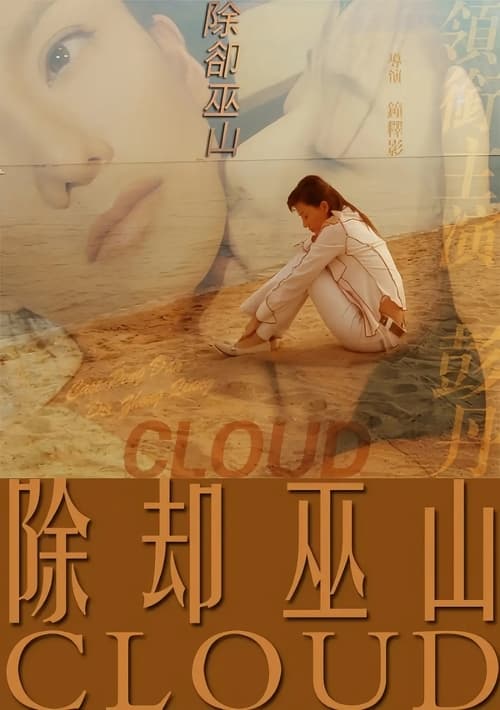
Cloud
2007
For when you want a tender, bittersweet love story rather than a tidy one — a low-key evening watch for the curious, especially if you're drawn to rare and hard-to-find queer cinema.
What it's about
A young woman writer, Liu Yin, falls into a tangled, on-and-off romance with a female university student in 2000s China. Their relationship weathers separations and returns, the pull between them never quite letting go. It's a love story told from inside a country and moment where a romance between two women had almost no place on official screens.
The experience
Quiet and melancholy, moving at the drifting pace of a relationship that keeps circling back on itself. It feels intimate and a little fragile — less about big dramatic scenes than about longing that has nowhere to go.
The craft
A small, sparsely documented production carried by its two leads, Peng Dan and Deng Jiajia, rather than by spectacle. Its interest lies less in polish than in what it attempts: putting an intimate relationship between two women at the center of a Chinese-language drama.
Why it matters
It belongs to the small, scattered wave of 2000s Chinese-language films that made love between women their central subject — work made largely outside sanctioned distribution, and valuable today partly because so little of it survives in the record.
Snapshot
Cloud is a Chinese-language romantic drama from 2007 centered on the relationship between a young woman writer, Liu Yin (played by Peng Dan), and a female university student (Deng Jiajia). On the evidence of its synopsis, it belongs to the small body of Chinese-language films of the 2000s that took a love story between two women as their central subject — a subject that, in mainland China during this period, sat outside the bounds of officially sanctioned distribution. The documentary record on this particular title is genuinely thin: a verifiable director is not attached to the available metadata, production credits beyond the two lead actresses are sparse, and there is no reliable account of its financing, festival history, or critical reception. What follows therefore distinguishes carefully between the few things the record supports and the broader historical conditions that a film of this description, made in this place and year, would almost certainly have shared. Where this dossier reconstructs context, it does so explicitly as context, not as established fact about Cloud itself.
The honest summary is that Cloud is a marginal, poorly documented work whose interest lies less in any confirmed artistic achievement — which cannot be assessed from the surviving record — than in what its very existence and obscurity reveal about queer filmmaking in China in the middle of the last decade.
Industry & production
No reliable production information survives in the accessible record beyond the year, the two principal performers, and the genre designation. The director is unknown; producers, financing, and distributor are unrecorded. This absence is itself the most telling fact about the film, and it is consistent with a particular industrial reality.
In 2007, mainland Chinese cinema operated under a centralized regulatory regime administered by the State Administration of Radio, Film and Television (SARFT). All theatrically released films required SARFT approval, and the censorship apparatus had no rating system; a single standard of acceptability applied to all audiences. Homosexuality, while decriminalized in 1997 and removed from the official catalog of mental disorders in 2001, remained effectively unrepresentable in approved feature films. A drama foregrounding a romance between two women would not have passed into the official distribution channel in this period. Films of this kind were therefore typically made outside the studio-and-quota system entirely — financed privately or on negligible budgets, shot on consumer or prosumer digital video, and circulated through film festivals abroad, underground screenings, pirate VCD/DVD, and increasingly the internet.
It is plausible, though not confirmed, that Cloud belongs to this off-the-books sphere. The general truthful claim is that any Chinese feature with this subject and this date would have existed in the gap between the official industry and the gray-market and online economies. Without firmer documentation, the specifics of Cloud's production — where it was shot, on what, with whose money, and for what audience — cannot be stated.
Technology
The technological circumstances of Cloud cannot be confirmed, but the period context is well established. The defining technological development for independent and underground Chinese filmmaking from the late 1990s onward was lightweight digital video. The arrival of affordable MiniDV cameras, and later HDV and DSLR-adjacent formats, collapsed the cost of feature production and put filmmaking within reach of people with no access to film stock, studio facilities, or state backing. This "DV movement" was the technological precondition for almost the entire body of Chinese independent and queer cinema of the 2000s.
If Cloud was made in the low-budget, unofficial register its subject implies, it was in all likelihood shot on digital video and finished on desktop nonlinear editing software, with the attendant look of the form: available-light interiors, handheld or lightly supported camerawork, and direct-to-disc distribution. This is a reasoned inference from the era and the genre, not a documented property of the film, and it should be read as such.
Technique
Cinematography
No verified description of the film's visual style is available, and it would be irresponsible to fabricate one. What can be said is conditional. Films made in the Chinese DV idiom of the period tended toward an unadorned naturalism dictated as much by means as by aesthetics — natural and practical lighting, real locations (apartments, campuses, streets), long-ish takes, and a handheld or minimally stabilized camera. Whether Cloud adopts or departs from these conventions cannot be determined from the record. Any account of its framing, lens choices, or color would be invention.
Editing
The editing of Cloud is undocumented. A two-hander love story of "ups and downs" would conventionally be structured as a chronological or lightly elliptical chronicle of a relationship's phases, but the synopsis is too schematic to support claims about cutting rhythm, scene construction, or temporal organization. No editor is credited in the available record.
Mise-en-scène / staging
Here too the record is silent. The synopsis locates the story in a recognizable contemporary milieu — a writer and a college student — which implies domestic and campus settings rendered in a realist key, the default of low-budget contemporary-set Chinese drama. Beyond that reasonable expectation, nothing about the film's design, blocking, or use of space can be verified.
Sound
No information survives regarding the film's sound design, music, or whether it used direct or post-synchronized sound. Low-budget DV productions of the period frequently relied on location sound with all its imperfections, and on sparing, sometimes informally sourced music. Whether this describes Cloud is unknown.
Performance
The two performances at the film's center are credited to Peng Dan, as the writer Liu Yin, and Deng Jiajia, as the student. These are the most solidly attested facts in the entire record. Neither performer is associated, on the available evidence, with a prominent body of subsequent mainstream work that would allow their contribution here to be read backward through a known career. The synopsis frames the film as an intimate two-character study, which would place the entire dramatic weight on these two actresses; in such a configuration the performances are effectively the film. But no critical assessment of those performances exists to be drawn upon, and this dossier will not manufacture one.
Narrative & dramatic mode
The available synopsis describes Cloud as the story of the "ups and downs and lingering love" between Liu Yin and the student — that is, a relationship melodrama in the most classical sense: a narrative organized around the emotional vicissitudes of a romantic bond rather than around external plot machinery. The phrase "lingering love" suggests a register of longing, attenuation, and possibly loss or non-fulfillment rather than romantic comedy or consummated triumph.
This places the film, on its own description, within the durable tradition of the romantic melodrama of impossible or socially constrained love — a mode in which the obstacle to the lovers' union is as much the structuring subject as the union itself. In a Chinese same-sex context of 2007, the obstacles implicit in such a story would be legible without needing to be named: familial expectation, the pressure toward heterosexual marriage, social invisibility, and the absence of any public framework within which the relationship could be acknowledged. The dramatic mode, in other words, is one in which private feeling is set against an unaccommodating world — though the precise shape of that conflict in Cloud cannot be reconstructed from the synopsis alone.
Genre & cycle
Cloud is identified as drama and romance, and its content places it specifically within lesbian-themed, or more broadly LGBT-themed, cinema. In the Chinese-language sphere, queer film by 2007 was a recognizable if marginal cycle. On the mainland it was overwhelmingly an underground and festival phenomenon; in the freer regulatory environments of Hong Kong and Taiwan it had achieved a measure of above-ground visibility. The defining mainland works of the preceding decade — most prominently Zhang Yuan's East Palace, West Palace (1996), the first Chinese film to take homosexuality as its explicit subject — had established the template of the censored, internationally circulated, domestically suppressed queer feature.
Lesbian-centered films were rarer than gay-male-centered ones across this cycle. Stanley Kwan's Hong Kong production Hold You Tight (1998) and Yan Yan Mak's Butterfly (2004) are among the better-known Chinese-language films to foreground female same-sex desire in this era, both made in Hong Kong's comparatively permissive industry. A mainland or unofficially produced lesbian romance from 2007 such as Cloud would sit at the most marginal edge of this already marginal cycle — which helps explain the scantness of its paper trail. The film should be understood as a minor entry in this cycle; the record does not support stronger claims about its standing within it.
Authorship & method
The authorship of Cloud cannot be established. The director is not identified in the available metadata, and no cinematographer, composer, editor, or screenwriter is reliably credited. This is an unusual and significant gap: for most films one can at least name the director, and the inability to do so here marks Cloud as a genuinely obscure work, possibly one made by a first-time or non-professional filmmaker, possibly one whose credits have simply been lost from the databases that now constitute its only trace.
In the absence of an attributable author, the only "method" that can be discussed is the collective, conditions-driven method of the milieu the film likely came from: small crews or near-solo production, improvisatory working practices, and a reliance on available people and places. To attach these practices specifically to Cloud, or to name any individual as its author, would be to invent. The responsible statement is that the film's authorship is, on the present record, unknown.
Movement / national cinema
Cloud belongs, by language and subject, to Chinese-language cinema, and most likely to its independent/underground stratum rather than its commercial mainstream. The relevant movement context is the Chinese independent film wave that grew out of the DV revolution of the late 1990s and 2000s — a loose, non-programmatic body of work, much of it documentary, defined by its operation outside SARFT approval and by its engagement with social realities the official cinema avoided. Queer cinema was one important current within this stratum, sustained by venues such as the Beijing Queer Film Festival (founded 2001), which itself operated under constant threat of closure.
If Cloud circulated at all, it most plausibly did so through this ecosystem of underground festivals, activist networks, and online distribution rather than through theaters. The film cannot be assigned to any named school or manifesto-driven movement; its affiliation is to the broad, decentralized fact of Chinese independent filmmaking, and that affiliation is inferred from its profile rather than documented.
Era / period
The film dates from 2007, a specific and consequential moment. This was the period just before the 2008 Beijing Olympics, during which the Chinese state's attention to image control was heightened, and several years before the partial commercial mainstreaming of certain queer narratives elsewhere in East Asia. Digital video had by now thoroughly democratized production, and the internet was rapidly emerging as the primary distribution channel for content that could not be shown publicly — a shift that would, within a few years, give rise to a substantial body of web-distributed Chinese lesbian (often called "lala") short films and series. Cloud, made in 2007, sits at the cusp of that transition: late enough to benefit from cheap digital production, early enough to predate the more organized online lala-media culture that followed. Its period identity is that of a transitional, pre-streaming moment in Chinese queer media.
Themes
The thematic content of Cloud can be addressed only at the level its synopsis permits. Its evident subject is love between two women across what the synopsis frames as a series of emotional reversals — a story of desire, attachment, and the difficulty of sustaining a bond. Read against its context, themes that such a story would characteristically engage include the conflict between private feeling and social constraint; the invisibility of same-sex relationships within a society organized around heterosexual marriage and family continuity; and the particular precariousness of young women's autonomy. The pairing of a writer with a student also gestures, potentially, at themes of self-expression, age and experience differentials, and the relationship between art and life — though the synopsis is too brief to confirm that any of these are actually developed. These are the themes the premise invites; which of them the finished film actually pursues is not recoverable from the record.
Reception, canon & influence
There is no documented critical reception of Cloud to report. The film does not figure in the standard critical literature on Chinese queer cinema, carries no recorded festival awards or notable reviews in the accessible record, and has left only the faintest metadata trace. It cannot be said to occupy any position in an established canon; on the contrary, its near-total obscurity is its most concrete characteristic.
On influence, the same candor is required. There is no evidence that Cloud influenced subsequent films, and no body of identifiable sources can be shown to have shaped it — beyond the general observation that any Chinese lesbian-themed film of 2007 worked in a landscape already marked out by earlier Chinese-language queer cinema (the Zhang Yuan, Stanley Kwan, and Yan Yan Mak lineage noted above) and by the broader DV-independent ethos. To claim specific backward influences on Cloud, or to credit it with shaping anything that came after, would exceed what the record supports.
The most honest conclusion is that Cloud is best understood not as an individually consequential film but as one barely surviving instance of a larger phenomenon: the many small, under-resourced, and now poorly documented works through which queer lives found their way onto Chinese screens in the years when the official cinema would not have them. Its value to an atlas of influence is chiefly as a marker of that condition — a film whose obscurity is itself the historical evidence.
A Deleuzian reading
Start with what isn't there.
The full Deleuzian reading of Cloud →
Reception
How Cloud was received, from release to now →
Influences: the films it descends from and the films it influenced
- East Palace, West Palace (1996) — The explicit template: a chamber two-hander built on confessional interrogation, queer desire dramatized through talk in a single confined setting rather than action.
- Fish and Elephant (2001) — First mainland lesbian feature shot on DV with nonprofessional leads, establishing the available-light, realist-domestic two-hander grammar Cloud reuses.
- Lan Yu (2001) — Beijing queer melodrama that stages private feeling against social constraint in restrained domestic interiors, the emotional register Cloud inherits.
- Suzhou River (2000) — Handheld, available-light urban naturalism that proved digital-era Chinese independents could carry intimate melodrama without studio polish.
- Xiao Wu (1997) — Codified the independent method Cloud works in — on-location naturalist shooting, nonprofessional performers, available light, observational long takes.
- Beijing Bastards (1993) — Pioneered the underground DIY production ethos — small crew, no official sanction, improvisatory shooting — that makes an anonymous film like Cloud possible.
- Mama (1990) — The first film made wholly outside the studio system, founding the self-financed, near-solo independent model Cloud descends from.
- Happy Together (1997) — Queer two-hander of constrained, obstacle-bound love rendered through handheld, available-light intimacy in cramped rooms.
- Vive L'Amour (1994) — Minimalist long-take domestic staging of unspoken queer longing, where empty apartments and silence do the dramatic work.
- Drifting Flowers (2008) — Lesbian melodrama assembled from naturalist domestic chamber pieces, extending the low-budget two-hander into linked vignettes.
- Spring Fever (2009) — Guerrilla queer melodrama shot covertly on consumer cameras under a filmmaking ban — the post-Olympics endpoint of Cloud's clandestine DV mode.
- Soundless Wind Chime (2009) — Queer diasporic intimacy built on DV available-light naturalism and nonlinear editing across timelines.
- All About Love (2010) — Lesbian romance foregrounding the collision of private feeling and social/familial constraint, the melodramatic engine Cloud runs on.
- Blue Gate Crossing (2002) — Campus-set constrained queer first love shot in soft naturalist daylight, sharing Cloud's realist-domestic-campus staging.
- Spider Lilies (2007) — Contemporaneous lesbian romance whose narrative is organized around webcam/internet mediation, paralleling Cloud's internet-distribution moment.
- Saving Face (2004) — Lesbian romance structured as a constrained-love-obstacle melodrama against family and social expectation, a diaspora cousin to Cloud's two-hander.
Similar films
- Saving Face (2004) — influence & lineage
- Happy Together (1997) — influence & lineage
- Us and Them (2018) — shared sensibility
- Xiu Xiu: The Sent-Down Girl (1998) — shared sensibility
- The Wayward Cloud (2005) — shared sensibility
- In the Mood for Love (2000) — shared sensibility
- Decision to Leave (2022) — shared sensibility
- Lust, Caution (2007) — shared sensibility