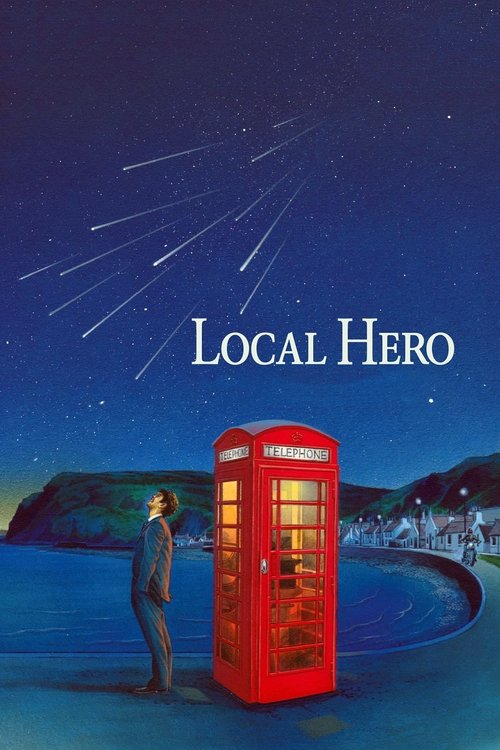
Local Hero
1983 · Bill Forsyth
For a cozy night when you want wit without cruelty and a film that makes you homesick for a place you've never been — pure comfort with a bittersweet finish.
What it's about
A Houston oil company dispatches a young executive to a tiny Scottish seaside village with orders to buy the whole place — beach, harbor, houses — for a refinery. The twist is in the temperaments: the villagers cheerfully scheme to get rich off the deal, while the company man, undone by the light on the water and the rhythm of village life, starts falling for the very place he's meant to erase. Only one stubborn beachcomber, who happens to own the beach, stands in the way.
The experience
Gentle, sly, and quietly magical — the comedy comes from sideways glances and perfectly held pauses rather than jokes, and it accumulates into something unexpectedly moving. It ends on a note of longing that stays with you for days.
Performances
Peter Riegert underplays beautifully as the executive coming quietly unmoored, and Burt Lancaster brings unexpected soul to the sky-gazing oil tycoon back in Houston — a mogul more interested in comets than crude.
The craft
Forsyth's script inverts every culture-clash cliché with a light touch, and the film drinks in the Scottish coast — beaches, aurora-lit skies, one red phone box — while Mark Knopfler's wistful guitar score became famous in its own right. It's a film of small perfect details that rewards patience.
Why it matters
Bill Forsyth's most beloved film and a cornerstone of Scottish cinema, its blend of deadpan whimsy and melancholy shaped decades of gentle fish-out-of-water stories about small towns enchanting big-city visitors.
Snapshot
Local Hero is a comedy about acquisition that ends up being a film about attention. Bill Forsyth's third feature sends Mac MacIntyre (Peter Riegert), a Houston oil executive of Hungarian extraction who has been mistaken for a Scot on the strength of his surname, to the fictional coastal village of Ferness to buy the entire place — beach, houses, harbor, the lot — so that Knox Oil and Gas can build a refinery. The joke the film builds and then quietly dismantles is that everyone's motives are inverted: the villagers are delighted at the prospect of becoming rich and negotiate with cheerful ruthlessness, while the corporate emissary falls in love with the light on the water and starts trying, in a muddled and inarticulate way, to stop the deal he was sent to close. The one genuine obstacle is Ben Knox (Fulton Mackay), a beachcomber whose family has held the strand for generations and who cannot be bought because he does not want anything.
Produced by David Puttnam for Goldcrest and released by Warner Bros. in the United States, the film arrived at the high-water mark of a brief British production boom and became the work by which Forsyth is most widely known internationally. It is also the film that made Mark Knopfler a screen composer. Its reputation has proved unusually durable: it is routinely cited among the finest Scottish films and among the best British comedies, and it has become a reference point — sometimes an over-invoked one — for a whole strain of small-town screen storytelling in which an outsider arrives to extract something and is changed instead. What keeps it from sentimentality is its refusal to make the villagers innocent, and its willingness to let its emotional climax happen offscreen, in a phone box, in the wrong hemisphere.
Industry & production
The film belongs to a specific and short-lived moment in British cinema. David Puttnam had produced Chariots of Fire (1981), whose Academy Award for Best Picture briefly persuaded the industry and its financiers that a British production sector could be rebuilt on quality features with international reach. Goldcrest Films, under Jake Eberts, was the principal engine of that optimism, and Local Hero was among the projects that followed in the immediate wake of Chariots. Warner Bros. distributed in the US, giving a modestly budgeted Scottish comedy a studio release — the kind of access that Goldcrest's brief prestige made possible and that would become much harder to obtain after the company's collapse in the mid-1980s.
Forsyth came to it with two features behind him, both made outside the London industry. That Sinking Feeling (1979) was assembled on a shoestring in Glasgow with performers associated with the Glasgow Youth Theatre; Gregory's Girl (1981) was made for a small budget in Cumbernauld and became a substantial and slightly surprising commercial success, which is what brought Forsyth to Puttnam's attention and made a larger film possible. The step up in resources for Local Hero is visible — location shooting on two Scottish coasts, a Texas unit, a recognizable American star in Burt Lancaster — but the sensibility did not scale up with the budget, which is much of the point.
Casting followed the film's own logic of displacement. Lancaster, playing Knox, the company's astronomy-obsessed chairman, is the film's one piece of star wattage, deployed sparingly and against type: an emblem of American corporate power rendered as a lonely, courteous man who would rather look at the sky than at a balance sheet. Peter Riegert, then best known from National Lampoon's Animal House (1978), plays Mac with a deliberate blankness that some viewers initially read as underplaying and that time has vindicated. The Scottish roles drew on a deep bench of stage and television performers — Denis Lawson as Gordon Urquhart, the hotelier-accountant who is effectively the village's negotiator, and Fulton Mackay, then very widely known in Britain from television, as Ben.
Production used composite geography: the village exterior and harbor were shot on the west coast at Pennan, in Aberdeenshire on the northeast coast for the seafront and the celebrated telephone box, and the long beach — which the story requires to be adjacent to the village — was found on the west coast at Camusdarach, near Arisaig. The two locations are on opposite sides of Scotland, stitched together in the edit into a single coherent place. (The phone box at Pennan has since become a minor pilgrimage site; the on-screen box was a production fixture rather than the working one, a distinction often blurred in popular accounts.) The Houston material, including Knox's tower and the aversion-therapy consultant, was shot in Texas, giving the film's opening and closing movements a genuine sense of continental scale against which Ferness registers as a rumor.
Technology
Technologically the film is unassuming, and deliberately so. It was shot on 35mm color negative in anamorphic widescreen, and the choice of a wide frame for a story about a small place is its single most consequential technical decision: the scope ratio lets Forsyth and cinematographer Chris Menges hold village, harbor, beach and sky in one image, so that the human negotiation is always sited within a landscape that dwarfs it.
The more interesting technological content is diegetic rather than industrial. Local Hero is a film about communications infrastructure, and it knows it. The telephone box is the hinge of the plot and the emotional instrument of the ending; the running gag of Mac's calls to Houston — expensive, badly timed across the hours of difference, increasingly unable to carry what he actually wants to say — turns a piece of rural utility into the film's central metaphor. Against it the film sets Knox's telescope and his private obsession with the aurora and with comets, and the visiting Russian trawler captain Victor, who moves across the border between blocs with more ease than Mac moves across the gap between his job and his feelings. Marine research, satellite-age astronomy, offshore extraction and a coin-operated phone all occupy the same coastline. The film's technological argument, insofar as it makes one, is that instruments for looking at things (telescope, aurora, the beach itself) are set against instruments for taking things (the refinery, the acquisition), and the plot resolves when a man who owns an oil company decides he would rather have an observatory.
Technique
Cinematography
Chris Menges shot the film, and his presence is a large part of why it does not look like a comedy. Menges had built a reputation in documentary and in socially engaged British filmmaking — long association with Ken Loach among others — and would go on to win Academy Awards for cinematography on The Killing Fields (1984) and The Mission (1986), both Puttnam productions. His work here is observational rather than decorative: available and available-seeming light, a preference for wide compositions that place figures small against sea and sky, and an unusual patience with the northern light itself.
That light is the film's real subject at the level of image. Scotland's high-latitude summer gives long, low, protracted golden hours, and Menges builds the middle of the film out of them: skies that stay luminous late, water that holds color, a quality of illumination that is beautiful without being warm. The aurora sequence — the villagers and Mac watching the northern lights — is the pivot, and it is staged as an event to be witnessed rather than a special effect to be admired. Menges also shoots the Houston material differently: glass, verticality, reflective surfaces, a colder and more enclosed palette, so that the cut to Scotland registers as a change of medium as much as of location. The camera rarely calls attention to itself; the film's most extravagant gesture is simply to hold on a landscape a beat longer than a comedy normally would.
Editing
Michael Bradsell edited. The film's rhythm is its most underrated technical achievement: it is cut slowly for a comedy, with gags allowed to arrive at conversational speed and frequently permitted to pass without a reaction shot to underline them. Jokes are set up early and paid off much later — the injured rabbit, the punk couple, the motorcyclist who periodically thunders through the village, the recurring failure of Mac and Danny to notice what is in front of them. Bradsell's cutting trusts the audience to remember, which is why the film rewards revisiting.
The two-location geography is an editing achievement as well: Pennan and Camusdarach are joined into one place by a consistent set of screen directions and by the confidence never to draw a map. The final movement is a masterclass in restraint. The return to Houston is abrupt; the last shot — the phone ringing in the empty village box, unanswered — is held long enough to become the film's whole meaning, and the decision to end there rather than on a reunion is the single edit that converts a charming comedy into something that aches.
Mise-en-scène / staging
Forsyth stages in medium and long shot, keeping ensembles in frame together and letting business happen at the edges. Ferness is built as a functioning social system: the hotel that is also the accountancy practice, the church with its African minister, the shop, the harbor, the beach. Gordon Urquhart's dual role — innkeeper and accountant, host and adversary — is the film's structural joke made physical, and it is staged in a single space where hospitality and negotiation are the same activity.
The recurring visual argument is scale. Human figures are consistently placed small within the frame against beach, sea, and sky; the refinery is never built, but the film keeps showing you what it would occupy. Against this, Houston is composed vertically and in glass. Knox's office, with its telescope and its planetarium-like preoccupations, is the one American space that opens upward rather than closing in. Small props carry a great deal: the shells and rubbish Mac begins to collect, Ben's hut, Marina's webbed hands — which the film shows and declines to explain, a piece of folkloric possibility left deliberately unresolved.
Sound
Mark Knopfler's score is inseparable from the film's reputation. Then at the height of Dire Straits' success, Knopfler wrote his first film score here, and the result established the guitar-and-air idiom that would define his screen work. The main theme, "Going Home," has long outlived the film's own circulation — it became a standing feature of Knopfler's live performance and, in Britain, a piece of ambient cultural furniture attached to sporting broadcast and public occasion. Its function within the film is precise: it withholds itself for long stretches, so that when it arrives, at the return to Houston and over the closing images, it supplies the emotion the characters cannot say aloud.
Just as important is the film's use of ambient sound and silence. Wind, surf, gulls and the small mechanical noises of a working harbor carry much of the middle section; the aurora sequence is largely given over to weather and wonder. Diegetic music matters too — the ceilidh, the village's own playing — establishing that Ferness has a musical life that is not the score. And the telephone is a sound object: ring tone, coins, the transatlantic delay. The last thing the film gives you is a sound with nobody to receive it.
Performance
The performance register is uniformly underplayed, and the film's comedy depends on it. Riegert's Mac is a study in a man who does not know what is happening to him; the choice to play him flat rather than charming means the change registers only in accumulated small details — the sneakers, the beach, the reluctance to mention the deal. Lancaster gives Knox an old star's stillness, courtly and slightly absent, playing a titan of extraction as a man whose real life is elsewhere; the astronomy is not a quirk but the character.
Denis Lawson's Gordon is the film's most quietly complex creation: genial, hospitable, and entirely willing to sell his neighbors' village at the best available price. Fulton Mackay's Ben supplies the moral center without a moral speech; his refusal is not principled resistance to capitalism so much as a total absence of appetite, which is far harder to argue with. Peter Capaldi, in his screen debut as Danny Oldsen, plays enthusiasm as a form of innocence, and Jenny Seagrove's Marina is written and performed as something not quite accounted for. The Scottish ensemble's collective effect is to make Ferness feel inhabited rather than populated.
Narrative & dramatic mode
The screenplay operates by systematic inversion of a familiar structure. The template — corporate agent sent to a small community, community resists, agent converts, deal collapses — is announced and then dismantled piece by piece. The villagers want the money and are shrewd about getting it. The company man converts, but too late and without authority. The resistance comes from a single man with no economic stake at all. And the deal is resolved not by struggle but by a whim from the top: Knox arrives, meets Ben, looks at the sky, and decides to build a research institute and observatory instead. The victory is real and entirely contingent, which is a far more unsettling proposition than a triumph of the people.
Tonally the film runs on drift rather than drive. Scenes are structured as encounters rather than as beats in an escalating plan; subplots (the rabbit, the punks, the motorcyclist, the minister, the Russian) accumulate without being resolved into theme. Forsyth's comedy is one of ellipsis and deadpan: the funny thing is often not shown, or is shown without emphasis, or happens to someone at the back of the frame. The dramatic mode might be called melancholic comedy — closer to Ealing's later, stranger films and to European art comedy than to the joke-per-page discipline of the mainstream.
The ending is the film's defining formal choice. Mac returns to a Houston apartment with a view of nothing, empties his pockets of shells, pins up his photographs of Ferness, and the film cuts to the village at night with the phone box ringing. Nobody answers. The film ends on an unconsummated connection, and refuses to tell us whether Mac ever gets back — a withholding that has kept it alive for four decades.
Genre & cycle
Formally it is a comedy of manners crossed with a fish-out-of-water tale, but it sits within a longer tradition of British films about outsiders and remote communities. The Ealing comedies are the obvious ancestors — Whisky Galore! (1949) and The Maggie (1954), both Alexander Mackendrick films set in the Scottish islands and coast, both concerned with canny locals outmanoeuvring outsiders. Forsyth inherits the shape and complicates the politics: his villagers are not preserving a way of life, they are trying to monetize one, and the film declines to grant them the innocence Ealing might have.
Behind Ealing lies Powell and Pressburger's I Know Where I'm Going! (1945), the film Local Hero most resembles in spirit: a determined outsider arrives in the Hebrides on business, is delayed by weather, and is changed by place and by the pull of something older than commerce. The mystical undertow — the aurora, Marina's possible selkie nature, Ben's unbudgeable presence — is closer to Powell than to Ealing.
Within its own moment the film belongs to the early-1980s British revival: Chariots of Fire, Gregory's Girl, The Draughtsman's Contract (1982), a run of pictures that briefly persuaded international audiences to take British features seriously again. It also stands at the head of a durable cycle of eccentric-community comedies — the strain that runs through Waking Ned Devine (1998), Saving Grace (2000) and a long tail of British and Irish pictures, and through the television series Northern Exposure (1990–95), whose debt is frequently noted, if not formally documented.
Authorship & method
Forsyth wrote and directed, as he did on all his early features, and his method was famously unforced. He built his films around observation, allowed performers room, and structured by accumulation rather than by plot mechanics. The comic voice is consistent across That Sinking Feeling, Gregory's Girl, Local Hero and Comfort and Joy (1984): gentle, oblique, attentive to inarticulate people, generous towards the ridiculous. His subsequent career — Housekeeping (1987), the difficult American production Being Human (1994), and the belated Gregory's Two Girls (1999) — was more troubled, and the standard critical view is that the industrial conditions that allowed Local Hero to exist did not survive the decade.
His key collaborators here are essential to the result. Chris Menges brought a documentary-trained eye that gave the comedy a weight of place it would not otherwise have had. Michael Bradsell, a very experienced British editor, supplied the unhurried rhythm and the courage of the final cut. Mark Knopfler, writing his first score, produced music that has arguably become better known than the film. David Puttnam as producer is the enabling figure — the person who could put Lancaster and a Warner Bros. release around a Scottish comedy, and who connected Forsyth with Menges. It is a film made by a director with an unmistakable voice who happened, at exactly the right moment, to be surrounded by first-rate people.
Movement / national cinema
Local Hero is a foundational text of modern Scottish cinema, and a complicated one. Before Forsyth, Scotland on screen was largely the property of others: the Kailyard sentimentalism of the couthy village, the Tartanry of romantic highlandism, and outsiders' fantasies of which Brigadoon (1954) is the standing example. Forsyth works with those inherited images knowingly. Ferness has the shape of a Kailyard village, but its inhabitants are calculating, connected and unromantic about their own picturesqueness. The film's Scotland has a Russian trawler in the bay, an African minister in the pulpit, marine biologists, punks and a motorcyclist — a place inside modernity rather than preserved outside it.
Critical debate about the film has centered exactly here: whether it subverts the Kailyard and Tartanry traditions or refurbishes them for an international audience. The scholarship on Scottish cinema — the line of argument running from Colin McArthur's Scotch Reels (1982) forward — has kept this question open, and the film is regularly used as its test case. What is not in dispute is that Local Hero helped establish that Scottish stories, in Scottish voices, could reach the world, and that the subsequent flowering of the 1990s (Shallow Grave, Trainspotting, the growth of a Scottish production infrastructure) had this film in its prehistory.
Era / period
The film is precisely dated to the North Sea oil era. By 1983 Scotland had lived through a decade of the oil boom: Aberdeen transformed, coastal communities reshaped by the industry, and a national argument about whose oil it was that ran directly into the constitutional politics of the period — the 1979 devolution referendum had failed only four years before. Knox Oil and Gas arriving to buy a village is not fantasy; it is a comic distillation of what the industry had been doing to the northeast coast.
It is equally a Reagan-and-Thatcher-era film about acquisition, made in the early years of a political settlement that treated market exchange as the natural resolution to most questions. Its irony is that the villagers have thoroughly internalized that logic while the American executive is losing his grip on it. The Cold War sits lightly in the frame — Victor the Soviet captain has a share in the local co-operative and is on friendly terms with everyone — and the film's cheerful indifference to bloc politics is itself a period marker. Technologically it is pre-mobile and pre-internet in a way that is now load-bearing: the entire ending depends on there being exactly one telephone, in a fixed place, that anyone can ring and nobody may answer.
Themes
The governing theme is the collision between price and value. Everything in Ferness has a price, and the villagers are eager to establish it; the film's argument is not that this is wrong but that the pricing mechanism has no way of registering what Mac starts to notice — the light, the sky, the beach at four in the morning. Ben, holding the strand, is the point at which the mechanism fails, and the film is careful that his refusal is not framed as heroism.
Related and equally strong is displacement and belonging. Mac is a man with a Scottish-sounding name and no connection to the place, sent because of a clerical assumption about his ancestry; he finds a home he cannot keep. Danny falls for a woman who may not be entirely human. The minister is African, the trawler captain Russian, the village both more cosmopolitan and more rooted than the Houston executives who want to erase it. Nobody in the film is quite from where they appear to be.
Beneath both runs a theme of attention as a moral faculty. The characters who look — Knox at the stars, Mac at the aurora, Ben at the beach he has watched all his life — are the ones capable of changing their minds. And running through the whole is a rueful account of communication: transatlantic calls that cost too much and say too little, a man who cannot tell anyone what he wants, and a final ringing phone that stands for everything the film's characters fail to say to each other in time.
Reception, canon & influence
Critical reception was strong and has strengthened. Reviewers in Britain and the United States responded to the film's tonal control and its refusal of easy sentiment, and it won the BAFTA for Best Direction; Forsyth's writing was likewise honored by the British academy in the same cycle. Its commercial performance was respectable rather than spectacular — a specialized success rather than a hit on the scale of Chariots of Fire — but its afterlife has been unusual. It appears consistently in surveys of the best British films and near the top of most rankings of Scottish cinema, and its locations remain a working tourist itinerary, which is a form of canonization the film's own plot would have found funny.
Its backward influences are legible. The Ealing Scottish comedies of Alexander Mackendrick, Whisky Galore! and The Maggie, supply the structure of the canny community and the outmatched outsider. Powell and Pressburger's I Know Where I'm Going! supplies the weather, the delay, and the sense that place has agency. Forsyth's own Gregory's Girl supplies the comic method — the deadpan, the ensemble drift, the tenderness towards the socially inept. Beyond British cinema, the film's relaxed structure and melancholy sit closer to European art comedy than to Hollywood, and Forsyth's reputation as a genuine screen humorist rests substantially on this.
Forward, its legacy operates on several levels. Most directly, it helped establish a template for the outsider-in-a-small-community comedy that British and Irish cinema returned to repeatedly through the 1990s and 2000s. Northern Exposure is widely regarded as its most conspicuous television descendant — the transplanted urban professional stranded among eccentrics in a remote community, with a similar mixture of comedy and mysticism — though the connection is one of evident kinship rather than documented derivation. It also shaped how Scotland could be filmed: as a real, modern, economically implicated place that happens to be beautiful, rather than as a heritage backdrop, an inheritance visible in the Scottish production culture that emerged in the following decade.
Knopfler's score had a life of its own, effectively launching a parallel career in film music and giving the film an audience among people who had never seen it. And in 2019 Local Hero returned as a stage musical, with Knopfler writing new songs alongside his original themes, premiering at the Royal Lyceum Theatre in Edinburgh — a rare case of a film's music being the vector by which the film itself was revived. Four decades on, the reason the film persists is not its plot but its ending: a phone ringing in an empty street, in a village nobody bought, for a man who is not there.
A Deleuzian reading
A man sent to buy a beach starts picking things up off it.
The full Deleuzian reading of Local Hero →
Reception
A critical darling on release — Forsyth won the BAFTA for Best Direction — but only a modest box-office performer, it has since climbed to national-treasure status, routinely topping polls of the best Scottish films ever made.
How Local Hero was received, from release to now →
How to watch Local Hero: what to notice on a first viewing
- Watch how small the people look against the beach and sky. Forsyth and Menges keep figures small within wide shots of sea and sky, human negotiation always sited inside a landscape that dwarfs it. The scale keeps reminding you that whatever gets decided here, the place itself does not care.
- Notice how long the golden evening light gets held. Scotland's high-latitude summer gives long, low light, and Menges lets scenes sit inside it a beat longer than a comedy usually would. The light is doing as much persuading of Mac as anyone's dialogue.
- Watch Gordon run the hotel and the accountancy from one room. The same innkeeper is also the village's accountant, so hospitality and hard-nosed negotiation happen in the same space, sometimes the same breath. One posture, one room, makes an entire social relation visible at once.
- Watch Mac's face for what it doesn't show you. Riegert plays him flat rather than charming, so the change happening to him registers only in small accumulated details, not in any speech. His face holds a feeling that never turns into a stated decision.
- Notice which jokes get no reaction shot to confirm them. Gags are set up early and paid off much later, and the film often lets them pass without underlining that a joke has happened. The film trusts you to remember, which is exactly why it rewards a second viewing.
The whole guide to watching Local Hero, with the keys for a rewatch →
Influences: the films it descends from and the films it influenced
- Whisky Galore! (1949) — Mackendrick's Ealing structure of the community as collective protagonist, defeating an outside authority not by confrontation but by a chain of polite non-refusals, misdirections and logistical delays — the exact mechanism by which Ferness wears Mac down.
- The Maggie (1954) — The template of the American businessman ground down by a Scottish crew, with comedy generated by attrition and schedule slippage rather than gags; Forsyth borrows the machine and inverts the ending so the outsider converts instead of merely losing.
- I Know Where I'm Going! (1945) — Establishes weather and tide as active narrative agents that strand the goal-driven outsider, and the staging of figures scaled tiny against Hebridean coast so that place, not plot, dictates the delay.
- Monsieur Hulot's Holiday (1953) — Seaside comedy in which the joke lives in the depth of the wide frame and in ambient sound — surf, doors, a distant loudspeaker — rather than in dialogue; the model for Forsyth's background-event staging and coastal atmosphere track.
- Kes (1969) — Chris Menges' long-lens observational coverage in available light, holding actors at documentary distance so performance registers as behavior — the grammar he carries into anamorphic here, giving a comedy the weight of a location film.
- Days of Heaven (1978) — Almendros and Wexler's magic-hour discipline — building the shooting schedule around a narrow golden window and letting sky rather than units light the frame — which Menges adapts to northern latitudes where that window runs for hours.
- Sweet Smell of Success (1957) — Mackendrick casts Burt Lancaster against his athletic-hero persona, redirecting his physical authority inward through stillness and spectacles; Forsyth runs the same trick on the same actor, pointed at melancholy instead of menace.
- Gregory's Girl (1981) — Forsyth's own comic method arrives fully formed: deadpan underplaying, ensemble drift, punchlines placed at the edge of the frame, and structure built by accumulation of observed incident rather than plot mechanics.
- Chariots of Fire (1981) — David Puttnam's producing template — a British director given room, pre-sold international finance, and a contemporary non-orchestral composer whose theme sells the film independently of it; Vangelis to Knopfler is the same play.
- Northern Exposure (1990) — Its most conspicuous descendant transposes the inverted premise to television and adopts the ensemble drift, the deadpan mysticism (aurora, shamans, radio monologue) and the refusal of tidy episode-end resolution.
- Doc Hollywood (1991) — A near-structural restatement of the inverted premise: an urban professional detained in a small town by a mechanical delay, gradually annexed by its economy and eccentrics, with the departure-and-return coda intact.
- Waking Ned Devine (1998) — Reruns the coastal-village conspiracy against a distant institution in anamorphic widescreen, with the same golden-hour headland compositions holding figures small against sea and sky as the community operates as one protagonist.
- Ratcatcher (1999) — Inherits the license Local Hero created for shooting Scotland as a real, economically implicated modern place rendered in lyric golden-hour light, rather than as heritage picturesque or social-realist gray.
- Seducing Doctor Lewis (2003) — Inverts the inversion — the remote coastal village now performs a fake version of itself to trap the visiting professional — while keeping the deadpan collective-conspiracy comedy and the community-wide gag economy intact.
- Lost in Translation (2003) — Builds on the withheld-payoff ending: a romance and a resolution both structurally denied, with the final beat carried by absence and sound rather than by a scene — the ringing phone box logic applied to a whisper.
- The Station Agent (2003) — Forsyth's template — an outsider lands in a fixed small place and is slowly absorbed by an eccentric community — supplies the gentle tonal blend of melancholy and dry comedy McCarthy builds the depot around.
- The Ballad of Wallis Island (2025) — The direct template for the coastal-outsider comedy in which a visitor is slowly converted by a stubborn remote community, with the melancholy-under-whimsy tone and location-as-character staging that Wallis Island openly inherits.
- Gary (2026) — Forsyth's corporate errand dissolving into drift supplies the displacement picaresque: the assignment is never abandoned, only quietly outlasted, which is how an episodic road structure keeps a work spine underneath it.
- Comfort and Joy (1984) — Forsyth's immediate follow-up reuses Knopfler and the same withholding architecture: a becalmed professional adrift in a comic city, scored by guitar motifs that refuse a full statement until the film is nearly over.
- The Killing Fields (1984) — Menges scales the identical method — handheld, available light, documentary distance — to widescreen on another Puttnam production the following year, proving the technique was a portable authorial signature and not a one-film adaptation.
- Cal (1984) — Knopfler's next score extends the Local Hero device of a solo-guitar motif standing in for both landscape and a character's inarticulacy, deliberately fragmented and withheld across the running time.
- The Gods Must Be Crazy (1980) — Stages the gentle culture-clash fable of consumer-capitalist modernity meeting a 'pure' remote community, the deadpan comic anthropology of civilization-encounters-innocence Uys runs in parallel.
- Basic Sanitation, the Movie (2007) — Shares the deadpan communal comedy of a rural village negotiating with outside money, weighing what a place needs against what it can be paid to become.
Similar films
- I Know Where I'm Going! (1945) — influence & lineage
- The Ballad of Wallis Island (2025) — shared sensibility
- Le Havre (2011) — shared sensibility
- How Green Was My Valley (1941) — shared sensibility
- Rose of Nevada (2026) — shared sensibility
- The Princess Bride (1987) — shared sensibility
- Where Is The Friend's House? (1987) — shared sensibility
- Braveheart (1995) — shared sensibility