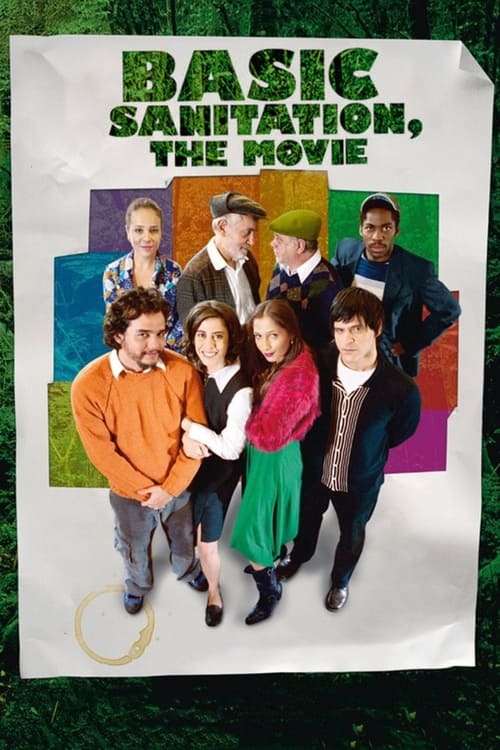
Basic Sanitation, the Movie
2007 · Jorge Furtado
For a feel-good night when you want to laugh at something clever rather than dumb — comfort viewing with a satirical bite. Great with company; it's the kind of comedy you quote afterward.
What it's about
A small village in the hills of southern Brazil desperately needs a septic tank, but the only public money available is a federal grant for making a video. So the villagers, led by a formidably practical woman and her game but bewildered neighbors, decide to shoot a science-fiction movie about a monster that lives in the septic-tank construction pit — and use the budget to dig the hole. Amateur filmmaking, small-town politics, and raw sewage collide.
The experience
Warm, quick-witted, and genuinely funny — a comedy that gets its laughs from watching ordinary people improvise their way through absurd bureaucracy. It's light on its feet but sneakily sharp, and you come out grinning.
Performances
Fernanda Torres is a comic force as the village's no-nonsense driving spirit, and Wagner Moura is a delight opposite her — two of Brazil's finest actors having visible fun with material worthy of them.
The craft
Jorge Furtado's script is a precision-built satirical machine: every gag about grants, genres, and DIY moviemaking doubles as a wry commentary on how films get funded and why they get made. The movie-within-the-movie is staged with real affection for amateur cinema's charms and catastrophes.
Why it matters
A beloved fixture of modern Brazilian comedy, it sharpened Furtado's reputation as the country's wittiest chronicler of the gap between public promises and everyday life.
Snapshot
Saneamento Básico, O Filme is a Brazilian comedy written and directed by Jorge Furtado, one of the country's most literate and reflexive filmmakers, working out of the Casa de Cinema de Porto Alegre. Its premise is a small, exact satirical machine: a rural hamlet in the Serra Gaúcha — the Italian-descended highlands of Rio Grande do Sul — cannot secure public money to dig the septic pit its houses urgently need, but discovers that an unspent federal grant of R$10,000 is available to produce a "video." So the villagers resolve to make a movie in order to fund a sewer, and, since the only genre that seems to justify a budget is science fiction, they set out to shoot a monster picture about a creature that emerges from the hole where the tank is being dug. The film stars Fernanda Torres and Wagner Moura — two of the era's defining Brazilian screen actors — and belongs to a strain of gentle, ideas-driven comedy that uses the act of amateur filmmaking to think about art, bureaucracy, community, and what a society is willing to pay for. It is, in the plainest sense, a movie about people making a movie, and a comedy about the perverse arithmetic of cultural policy.
Industry & production
The film is a product of the Casa de Cinema de Porto Alegre, the production house Furtado co-founded in 1987 with collaborators including Giba Assis Brasil, Ana Luiza Azevedo, Carlos Gerbase, and Nora Goulart. That collective is central to understanding the picture's economy: rather than the Rio–São Paulo axis that dominates Brazilian cinema, the Casa built a durable, regionally rooted, author-driven model in the far south, sustaining a repertory company of writers, technicians, and performers across features, shorts, and television. Furtado's own career straddled cinema and Rede Globo, for which he wrote acclaimed miniseries and telenovela material; that television income and craft base underwrote the kind of modest, articulate feature Saneamento represents.
Brazilian feature production in this period ran substantially on tax-incentive and public-fund mechanisms — the very apparatus the film satirizes. It is worth stating plainly that the movie's plot is a joke told from inside the system that financed it: a comedy about villagers gaming an audiovisual grant, made by filmmakers who themselves depend on audiovisual grants. I do not have reliable, verifiable figures for the film's budget or its box-office gross and will not invent them; contemporary Brazilian mid-budget comedies of this scale were released theatrically at home with limited international exposure, and Saneamento traveled the festival circuit more than it did the international commercial market.
Technology
The picture sits at a hinge moment in image-making technology, and it knows it. Its dramatic engine is the arrival of accessible consumer and prosumer video in the mid-2000s: the premise only works because "making a video" has become something ordinary people can plausibly attempt with a small camera and a computer. Within the story, the characters shoot on the kind of lightweight digital camcorder that had, by 2007, put motion-picture production within reach of a farming community — the democratization of the moving image is not merely a theme but the plot's precondition.
The feature that contains this story was made with professional cinema tools; I do not have a firmly documented capture format to cite and will not guess between 35mm and a digital origination. What matters more is the deliberate two-tier texture the film cultivates: the polished "outer" film we watch versus the crude, hand-made "inner" film the villagers produce. That contrast — clean professional coverage framing deliberately rough amateur monster-movie footage — is itself a statement about the gulf and the kinship between the equipment of the industry and the equipment now in anyone's hands.
Technique
Cinematography
The visual grammar serves clarity and landscape rather than showmanship. The Serra Gaúcha setting — vineyard hills, modest houses, the raw brown gash of the septic excavation — gives the film a specific, unglamorous rural palette that grounds the fable. The camera is generally observational and legible, favoring the group compositions a communal comedy needs so that ensemble reactions read cleanly. I am not able to confirm the director of photography's name with certainty and will not attribute the credit falsely; the Casa de Cinema worked with a stable roster of southern-Brazilian cinematographers, and the film's look is consistent with that house style of unfussy, warm, character-forward framing.
Editing
Editing is the domain where Furtado's signature is unmistakable. He came to features from the short Ilha das Flores (1989), an internationally celebrated essay-film built entirely on montage, voiceover, and the collision of images and data. That montage sensibility — brisk, associative, willing to cut for wit — informs his comedy. The film's most pointed structural device is the juxtaposition of two registers of footage: the "real" story of the villagers and the "movie" they are shooting, edited against each other so that the seams of construction become the joke. Giba Assis Brasil is the Casa de Cinema's principal editor and a longtime Furtado collaborator; the film's cutting reflects that studio's editorial tradition, though I flag that I cannot verify the exact editing credit for this specific title.
Mise-en-scène / staging
Staging is built around the village as a collective protagonist. Furtado blocks scenes as town meetings, kitchen-table conferences, and improvised film sets, so that decisions are dramatized as group negotiation — the recurring image is people crowded into a room arguing about how, and whether, to proceed. The excavation pit is the film's central set piece and its governing metaphor, a literal hole in the ground around which the fiction of the monster is erected. The homemade monster costume, the makeshift lighting, the props scavenged from farm life — the mise-en-scène of the film-within-the-film is designed to look lovingly, comically inadequate, aligning the audience with the amateurs' ingenuity rather than mocking it.
Sound
I do not have verifiable details about the film's music credits or sound design and will not invent a composer or score description. In general terms, the film relies on dialogue-forward sound typical of ensemble comedy, where overlapping talk and reaction carry the humor, and on the diegetic sounds of construction and rural life that anchor the setting. Any confident account of the musical score would require documentation I don't have.
Performance
Performance is the film's richest resource. Fernanda Torres — a comedienne and dramatic actor of the first rank in Brazil, with deep theatrical and television grounding — brings intelligence and comic timing to the role of the villager who becomes the project's driving creative force. Wagner Moura, who by 2007 was emerging as one of Brazil's most magnetic screen presences, plays with a looser, warmer register than the intensity he would become internationally known for. The surrounding ensemble draws on Brazil's strong repertory of screen actors, and the film's pleasures are substantially those of a well-cast troupe playing recognizable rural types without condescension. The acting style is naturalistic and affectionate; the comedy comes from character and situation rather than caricature.
Narrative & dramatic mode
The film's mode is metafiction played as folk comedy. Its deep structure is the "let's put on a show" tradition — the community that bands together to produce something against the odds — refunctioned so that the show is a movie and the reward is a sewer. This lets Furtado run two stories in parallel: the practical caper of extracting money from a fund, and the accidental education of a group of people who discover, in the making, what filmmaking actually is. The dramatic irony is structural and sustained: the audience always knows that the "real" goal (sanitation) and the "cover" goal (art) have quietly changed places, that the pretext is becoming the point. It is a comedy of unintended consequences and of process — the plot is the production, and the climax is a screening.
Genre & cycle
Formally the film is a comedy, but it braids several traditions. It is a metacinema — a movie about movie-making, kin to the international lineage of Day for Night and, more pointedly, to affectionate portraits of no-budget filmmaking such as Tim Burton's Ed Wood, where sincerity redeems ineptitude. It is a rural or "hinterland" comedy in a specifically Brazilian key, and it is a satire of cultural bureaucracy. The film-within-the-film is a deliberate B-movie creature feature, and the picture mines the gap between the villagers' sci-fi ambitions and their farmyard means. Within Furtado's own filmography it belongs to a cycle of talky, intertextual, idea-rich features — alongside The Man Who Copied (2003) and My Uncle Killed a Guy (2004) — that treat ordinary people as sophisticated reasoners about their own predicaments.
Authorship & method
Furtado is the film's clear author: he wrote and directed it, and his method is legible throughout. His authorial fingerprints — established in Ilha das Flores and carried through his features and television work — include a fascination with how meaning is constructed, a taste for reflexivity and quotation, a montagist's instinct for juxtaposition, and a humane, essayistic curiosity that treats comedy as a vehicle for argument. His deepest collaboration is institutional: the Casa de Cinema de Porto Alegre supplies the continuity of craft, with figures such as editor Giba Assis Brasil and a recurring pool of cast and crew forming a de facto authorial collective. I attribute the screenplay and direction to Furtado with confidence; for the cinematography and music credits, as noted above, I lack verifiable documentation and decline to assign names I cannot confirm.
Movement / national cinema
The film is a distinctive product of cinema gaúcho — the cinema of Rio Grande do Sul — and of the broader "retomada" and post-retomada landscape of Brazilian film that followed the industry's 1990s revival. Against the dominance of Rio and São Paulo, and against the international image of Brazilian cinema fixed by the favela dramas of City of God (2002), the southern cinema associated with the Casa de Cinema offered a different mode: literate, regional, comedic, middle-scale, invested in the immigrant cultures and small towns of the south rather than the metropolis. Saneamento is a near-programmatic statement of that alternative — its very subject is a peripheral community that the national funding apparatus barely registers.
Era / period
2007 places the film squarely in the digital transition and in a mature phase of Brazil's incentive-funded production system. The joke about the audiovisual grant is period-specific: it reflects a moment when public and tax-incentive money for "culture" and "video" had become a defining, sometimes absurd feature of how Brazilian films got made, and when digital tools had newly made "making a video" a genuinely popular possibility. The film reads, from within its moment, as a wry insider's commentary on both facts at once — the bureaucratic supply of culture money and the technological democratization of the image.
Themes
The controlling theme is the collision of basic needs and culture — the pointed absurdity of a state that will fund a monster movie but not a sewer. Around that sits a cluster of concerns: bureaucracy and the perverse incentives it creates; the dignity and ingenuity of ordinary rural people; community as the true engine of creation; and, self-reflexively, the nature of cinema itself — what it costs, what it's worth, and how the mere act of making it transforms the people who attempt it. There is a tender argument buried in the comedy: that art is not opposed to material necessity but tangled up with it, and that the "waste" of making a film for a village can turn out to be its own kind of infrastructure. The title's deadpan phrase, basic sanitation, becomes ironic — the film asks what else, besides plumbing, is basic to a community's life.
Reception, canon & influence
Backward — influences on the film: The picture stands on Furtado's own foundational short Ilha das Flores, which established his reflexive, montage-driven, argumentative style; on the international metacinema tradition of films about filmmaking; and on the affectionate B-movie homage exemplified by Ed Wood. Institutionally it grows out of two decades of Casa de Cinema de Porto Alegre practice and out of Furtado's parallel career in Globo television storytelling.
Reception: The film was received at home as a characteristically intelligent, warm Furtado comedy and traveled internationally through festivals more than through commercial distribution. I do not have verifiable specifics on individual awards, critical rankings, or box-office performance and will not fabricate them; a responsible account has to mark that part of the record as, from my vantage, thin. What can be said with confidence is that it consolidated Furtado's reputation as a leading voice of Brazil's southern cinema and paired two major stars in a register unusual for both.
Forward — legacy: The film's most durable significance is emblematic. It has become a convenient reference point for the very paradox it dramatizes — the culture-funding-versus-basic-needs debate in Brazil — and a touchstone within cinema gaúcho and Brazilian metacinema. Its influence is felt less as a template that spawned imitators than as a crystallizing statement: a comedy that anticipated, and made permanently quotable, the tension between public art money and public infrastructure that would only grow more charged in Brazilian cultural politics in the years that followed.
Reception
A warmly reviewed crowd-pleaser in Brazil in 2007, it stayed a mostly domestic treasure for nearly two decades — then Fernanda Torres's 2025 Golden Globe and Wagner Moura's Cannes Best Actor win sent international viewers digging into their back catalogs, and this little comedy where they play a married couple became a full-blown Letterboxd rediscovery, even returning to Brazilian cinemas in a 2025 re-release.
How Basic Sanitation, the Movie was received, from release to now →
How to watch Basic Sanitation, the Movie: what to notice on a first viewing
- Watch how many scenes happen as a full town meeting. Furtado blocks the village's decisions as group negotiation: kitchen tables, crowded rooms, everyone arguing over how and whether to proceed with the plan. The village itself acts as the film's main character, deciding everything together instead of through one hero.
- Notice how often the camera returns to the excavation pit. The hole being dug for the septic tank sits at the center of the village, the literal ground the monster movie and the real sewer project both grow out of. One hole in the ground carries the plot, the joke, and the actual point of the whole scheme.
- Watch the film cut between real life and the shoot. Furtado edits the villagers' actual planning against footage of the sci-fi movie they are making, so the seams between the two registers become the joke. You are always aware you're watching a movie about making a movie, on purpose.
- Watch how Fernanda Torres steers every group scene she's in. Torres plays the villager who becomes the project's driving creative force, bringing sharp comic timing to a character who keeps nudging the group's chaotic plan forward. Her energy is what turns a bureaucratic accident into an actual production.
The whole guide to watching Basic Sanitation, the Movie, with the keys for a rewatch →
Influences: the films it descends from and the films it influenced
- Ilha das Flores (1989) — Furtado's own short established the argumentative-montage essay engine — ironic voiceover chaining disparate images into a socioeconomic proof — that Basic Sanitation reworks into fiction.
- Man with a Movie Camera (1929) — Originates the self-reflexive cut that foregrounds the apparatus, filming the act of filming so editing itself becomes the film's argument — the montagist instinct behind Furtado's juxtaposed registers.
- 8½ (1963) — Codifies the film-about-a-stalled-production as metafictional structure, letting a movie be built out of the anxieties and improvisations of making a movie.
- Day for Night (1973) — Model for the affectionate ensemble portrait of a crew, treating the chaos and craft-problems of a shoot — fake effects, amateur logistics — as the story's warm center.
- Ed Wood (1994) — The template for tender homage to amateur, no-budget monster filmmaking, staging DIY special effects and rubber-suit ingenuity as heroism rather than ridicule.
- Bride of the Monster (1955) — Supplies the actual rubber-creature, seams-showing B-movie aesthetic that the villagers imitate when they shoot their own monster picture.
- The Purple Rose of Cairo (1985) — Metacinema comedy that collides cinema's manufactured fictions with material poverty, using the movies-as-escape premise to sharpen an economic point.
- Passport to Pimlico (1949) — Ealing blueprint for the community-as-collective-protagonist scheming against bureaucracy — a whole locality, not an individual, drives the plot to game officialdom.
- Whisky Galore! (1949) — Small-community-outwits-the-state comedy built on a naturalistic ensemble and a scarce resource, the tonal ancestor of the village's funding hustle.
- Bye Bye Brasil (1980) — Itinerant entertainers carrying cheap spectacle into the Brazilian interior dramatize the culture-versus-basic-needs tension that is Furtado's explicit subject.
- Local Hero (1983) — Shares the deadpan communal comedy of a rural village negotiating with outside money, weighing what a place needs against what it can be paid to become.
- The Full Monty (1997) — Same engine of an economically desperate community mounting an improbable amateur production as the literal solution to its material shortfall.
- Waking Ned Devine (1998) — An entire village conspiring in a benign collective fraud to capture a windfall — the village-as-single-schemer staging that Basic Sanitation runs on.
- Living in Oblivion (1995) — Comedy that mines the mishaps of low-budget production itself — failed takes, jury-rigged effects — turning the shoot into farce, as the villagers' amateur crew does.
- O Homem que Copiava (2003) — Built by the same Casa de Cinema team and editor Giba Assis Brasil, it deploys Furtado's reflexive first-person narration and montage-driven digressions within a Cinema Gaúcho ensemble.
- American Movie (1999) — Documentary counterpart on the DIY genre filmmaker improvising financing and effects to finish a monster movie, the real-world echo of the villagers' amateur creature-feature.
Similar films
- The Man Who Copied (2003) — influence & lineage
- Rotting in the Sun (2023) — shared sensibility
- Bacurau (2019) — shared sensibility
- Chuck Billy and The Marvelous Guava Tree (2025) — shared sensibility
- Estômago: A Gastronomic Story (2008) — shared sensibility
- I'm Still Here (2024) — shared sensibility
- Mango Yellow (2002) — shared sensibility
- Elite Squad (2007) — shared sensibility