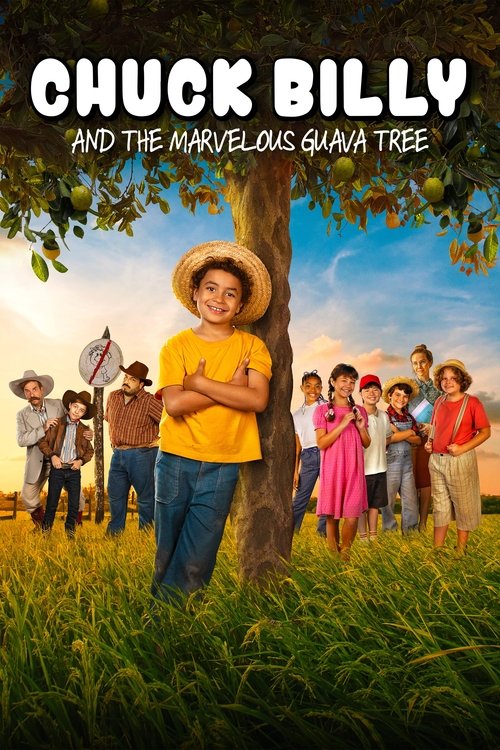
Chuck Billy and The Marvelous Guava Tree
2025 · Fernando Fraiha
For family movie night or when you want something warm and uncomplicated that still has something to say about the places we come from. Pure comfort viewing.
What it's about
Chuck Billy is a country boy whose whole world revolves around his village, his friends, and the marvelous guava tree he's been climbing and picking from all his life. When a developer's new road threatens to cut the tree down, Chuck and his gang mount a full kids-versus-grownups campaign to save it. A live-action family adventure drawn from one of Brazil's most beloved comic characters.
The experience
Sunny, silly, and big-hearted, with a real streak of affection for rural life underneath the slapstick. It moves at kid-adventure pace and lands its laughs broadly — the whole family can watch without anyone checking their phone.
The craft
The film takes visible delight in translating a comics icon to live action, down to reproducing the character's phonetic country dialect right in its deliberately misspelled Portuguese title. The green, sun-drenched farm setting gives it a storybook glow.
Why it matters
The first live-action feature for Chico Bento, a character beloved in Brazil since 1961, extending one of the country's most popular family film franchises built from the Monica's Gang comics.
Snapshot
Released in Brazil on 9 January 2025 as Chico Bento e a Goiabeira Maraviósa, this live-action family adventure is a spin-off of the enormously popular film franchise built from Maurício de Sousa's Turma da Mônica (Monica's Gang) comics. "Chuck Billy" is the long-standing English localization of Chico Bento, a caipira (rural interior) boy Maurício created in 1961; the film gives that character his first live-action feature. The deliberately misspelled Portuguese title — "Maraviósa" rather than "Maravilhosa" — is itself a signal of method, reproducing on the marquee the phonetic, dialect-based lettering that has always rendered Chico Bento's country speech in print. Directed by Fernando Fraiha from a screenplay he co-wrote with Elena Altheman and Raul Chequer, the picture runs roughly 90 minutes and was distributed theatrically by Paris Filmes before moving to Prime Video in March 2025. Its plot is a compact ecological fable: Chico's beloved guava tree, on old Nhô Lau's (Jed's) land, stands in the path of a road that the developer Dotô Agripino intends to build, and the children mobilize to save it. It is best understood not as a stand-alone auteur work but as the third theatrical entry in a coordinated, professionally mounted Brazilian children's-cinema project, and as one of its more thematically ambitious.
Industry & production
The film sits inside one of the most successful sustained ventures in modern Brazilian commercial cinema: the live-action adaptation program of Mauricio de Sousa Produções (MSP), which began with Turma da Mônica: Laços (2019) and Turma da Mônica: Lições (2021). Those two films were directed by Daniel Rezende, who here moves into a producer role — a meaningful continuity, since it places the franchise's established creative steward behind the spin-off rather than at its helm. Production is credited to Biônica Filmes together with MSP, with Bianca Villar, Daniel Rezende, Fernando Fraiha, and Karen Castanho as producers. Distribution and financing sit with the Paris Filmes / Paris Entretenimento apparatus, with Paramount Pictures also attached — a configuration typical of Brazil's larger family releases, which pair a domestic distributor's exhibition reach with a major's marketing and platform muscle. Brazilian reporting associated the release with brand backing (the insurer Brasilprev was cited as a presenting sponsor), consistent with the franchise's practice of financing family tentpoles partly through corporate partnership. Trade and box-office trackers reported a domestic theatrical gross on the order of R$17 million; as with all such figures the precise number should be treated as reported rather than audited here. What is not in doubt is the commercial logic: a proven IP, a January family-holiday release window, and rapid transactional-to-streaming migration on Prime Video.
Technology
The public record on the film's specific capture and finishing technology is thin, and I will not invent camera, lens, or workflow credits that are not documented. What can be stated responsibly is contextual. A 2025 Brazilian studio family feature at this budget tier is, by prevailing industry standard, shot digitally in a large-sensor workflow and finished through a full digital-intermediate color pipeline. The material demands of the story — a real guava tree, rural exteriors, weather, and a large ensemble of child performers — point to substantial location work rather than stage-bound production, and Brazilian coverage repeatedly emphasized "authentic locations." Where the franchise's animated-to-live-action lineage would most plausibly invite digital tooling is in preserving the comics' graphic identity: costume, color, and set design that read as heightened and cartoon-true on camera, supported by unobtrusive visual-effects cleanup rather than spectacle VFX. Absent documented credits, the honest summary is that this is a conventionally, competently resourced live-action production whose technological interest lies in translation — turning flat, saturated comic-book iconography into photographable space — rather than in any novel apparatus.
Technique
Cinematography
The director of photography is not reliably documented in the sources available, and I will not attribute the work to a named cinematographer without confirmation. On the evidence of the finished film's reception, the visual approach favors bright, legible, sunlit compositions keyed to the countryside setting — the palette of a rural idyll, greens and earth tones organized around the totemic tree. Brazilian critics singled out the photography as a strength, describing it as surprising and carefully composed. Stylistically this is storybook realism: the camera serves clarity and warmth, framing children at their own scale and treating landscape as a character (the goiabeira as the film's literal and figurative center of gravity) rather than pursuing an authorial visual signature.
Editing
The film was cut by Daniel Weber. The editorial task in a children's adventure of this kind is rhythmic legibility — sustaining momentum across an episodic quest structure, balancing comic beats against the escalating jeopardy to the tree, and keeping a large young ensemble spatially coherent. Reviews describing a well-paced, emotionally modulated experience suggest the cutting successfully alternates lightness and stakes without losing younger viewers.
Mise-en-scène / staging
Staging is the film's most consequential craft problem, because its whole project is fidelity: making a beloved two-dimensional world stand up in three dimensions. The comics' Vila Abobrinha universe has a fixed iconography — Chico's patched clothes and straw hat, the rural schoolhouse, the fishing hole, the guava tree — and the production design's job is to render these as at once real and recognizably "Chico Bento." Critics' emphasis on faithfulness indicates the staging leans into that recognizability, dressing authentic rural locations into a lightly heightened, comic-true storybook space.
Sound
The score is by Fabio Góes. Brazilian critics described the music as an effective blend of lightness and dramatic weight, scaling up under the film's more earnest ecological turns. In a family film pitched to both children and accompanying adults, this dual register — playful for the adventure, swelling for the stakes — is a deliberate structural tool, and reviewers credited it with reinforcing individual scenes rather than merely decorating them. Documentation on the broader sound design and mix is thin.
Performance
The film is carried by a child cast led by Isaac Amendoim as Chico Bento (Chuck Billy), with Pedro Dantas as his cousin Zé Lelé, Anna Júlia Dias as Rosinha, and Lorena de Oliveira as Tábata. Amendoim's performance drew the warmest notices, praised as spontaneous and natural — the central risk of any live-action Chico Bento being that his stylized caipira dialect can curdle into caricature; reviewers felt the young lead instead made it feel lived-in. The adult ensemble anchors the fable's moral architecture: Augusto Madeira as the antagonist Dotô Agripino, Luis Lobianco as Nhô Lau (Jed), and Débora Falabella among the featured adults, with Taís Araújo also noted in Brazilian coverage as appearing. The register throughout is broad but sincere — pantomime-adjacent comedy grounded by an earnest emotional core.
Narrative & dramatic mode
The dramatic mode is the children's ecological quest: a small band of kids versus an adult-world threat to a cherished natural object, resolved through ingenuity, solidarity, and moral suasion rather than force. Its structure is classical and episodic — an inciting threat (the road, the felling of the tree), a mobilization of friends, escalating obstacles, and a values-driven climax — a shape shared with a long tradition of family adventure from The Goonies lineage down to eco-minded animation. What distinguishes it within its own franchise, critics noted, is that the stakes reach past the series' usual theme of friendship toward a genuine argument about development and preservation. The film addresses, in terms a child can hold, the "anything goes for the sake of progress" impulse and its cost — pitched as, in one reviewer's phrase, a real lesson for adults as much as children.
Genre & cycle
The film belongs to two overlapping cycles. The first is Brazilian family/children's cinema, a commercially vital but critically under-canonized sector in which MSP's Turma da Mônica adaptations have been the dominant recent success story. The second is the transnational cycle of live-action adaptations of animation/comics IP — the strategy of converting a proven children's brand into recurring theatrical events. Within genre terms it is a family adventure-comedy with a pastoral, ecological inflection, closer in spirit to the gentle rural fable than to effects-driven adventure. Its release as a spin-off — extending the shared universe to a single character rather than the core Monica's Gang — mirrors the franchise-building playbook of larger cinematic universes, adapted to a Brazilian, child-audience scale.
Authorship & method
Authorship here is corporate-collaborative before it is auteurist. The controlling creative sensibility is Maurício de Sousa's, whose characters, world, and tone the film is bound to honor. Director Fernando Fraiha — a Brazilian filmmaker whose prior work spans feature and series direction — functions as the adapter, and also co-wrote the screenplay with Elena Altheman and Raul Chequer, a writing team charged with expanding short comic-strip material into a 90-minute dramatic arc while preserving the caipira idiom. The most telling authorial fact is the presence of Daniel Rezende as producer: the acclaimed editor (of City of God and other landmarks) who directed the first two live-action Turma da Mônica films, and whose move to a producing role signals a franchise deliberately handing directing duties to a new voice while retaining institutional continuity. Key collaborators are composer Fabio Góes and editor Daniel Weber; the cinematographer is not reliably credited in the available record, which I flag rather than fill. The method, in sum, is stewardship: a defined house style, a returning production apparatus, and a new director working within tightly established parameters.
Movement / national cinema
The film is a product of Brazilian commercial cinema's family sector and, more specifically, of the São Paulo–centered Turma da Mônica industrial ecosystem. It also participates in a distinctly Brazilian cultural register: caipira identity, the rural interior culture of São Paulo state that Maurício de Sousa — himself from the interior — drew on in creating Chico Bento. That regionalism is not incidental; the character's dialect, dress, and pastoral setting make the film a mainstream, affectionate representation of interior Brazil for a national audience, at a moment when Brazilian cinema's international profile skews toward auteur and social-realist work. Within national cinema debates it sits on the commercial, IP-driven pole — evidence that Brazil sustains not only festival cinema but a functioning popular-genre and family-film industry.
Era / period
As a 2025 release the film is fully a product of the post-pandemic, streaming-integrated theatrical landscape. Its economics — brand sponsorship, a major-studio distribution partner, a rapid ten-week window to Prime Video — are characteristic of how mid-budget family films now recoup: theatrical as event and marketing engine, streaming as the durable afterlife. It also reflects the current maturity of the franchise era in Brazilian popular cinema, in which a domestic IP can support a multi-film shared universe with spin-offs, a model imported from Hollywood and localized. Thematically, its foregrounding of environmental preservation places it squarely in a period when ecological anxiety has become a default moral vocabulary of children's media worldwide.
Themes
The central theme is the conflict between "progress" and nature — development, embodied by Dotô Agripino's road, set against the guava tree as an emblem of the living, rooted world. Around it cluster the franchise's constants: friendship, collective action, and the moral competence of children confronting an adult problem. A quieter, potent theme is childhood itself — reviewers described the film as a reminder of the goodness of being a child, trading in innocence, imagination, and wonder. Underneath runs a theme of cultural rootedness: the caipira world, its speech and rhythms, presented not as a joke but as something worth defending — so that saving the tree and honoring a regional way of life become, subtly, the same act.
Reception, canon & influence
Critical reception. Brazilian critical response was warm. Reviewers praised the faithfulness of the adaptation, the naturalness of Isaac Amendoim's lead performance, the supporting adult cast, the photography, and a score that balanced levity with feeling. The recurring critical note is that the film's ecological message gives it more substance than a friendship parable, making it, for several writers, a genuine "lesson" pitched at adults as well as children. Brazilian coverage also reported the film being honored as Best Children's Feature at the country's principal film-academy awards (the Grande Otelo), which — reported here as such — indicates institutional as well as popular validation. Full aggregated or international critical data is limited, as befits a recent, primarily domestic release.
Influences ON the film (backward). The film inherits, first, six decades of Maurício de Sousa's comics and the fixed iconography of Chico Bento; second, the concrete precedent of MSP's own Laços (2019) and Lições (2021), which established the visual grammar, tone, and commercial model this spin-off extends; and third, the broad tradition of the children's ecological adventure, in which a group of kids defends nature against adult greed. Its caipira roots also connect it to a longer lineage of rural Brazilian storytelling and regional identity in popular culture.
Legacy / what it shaped (forward). As a recent release its forward influence is still forming, but its structural significance is legible: it is proof-of-concept that the Turma da Mônica live-action universe can support single-character spin-offs, widening the franchise's expansion path beyond the core ensemble. Its comparatively strong thematic reach — pushing a mainstream children's film toward an environmental argument — offers a template for how the franchise, and Brazilian family cinema more broadly, might carry heavier ideas without sacrificing accessibility. Any larger legacy will depend on whether the spin-off model it validates continues; on the present record, its clearest achievement is demonstrating that a beloved, dialect-inflected regional character can headline a successful, critically respected national release.
Sources: Wikipedia (EN), Wikipedia (PT), Cinematório review, AdoroCinema, Biônica Filmes
Reception
Landed in January 2025 as a modest-budget kids' film and became one of the feel-good Brazilian cinema stories of the year — critics and audiences agreed almost immediately, so its arc is less reappraisal than instant embrace, crossing 1 million admissions in two months.
How Chuck Billy and The Marvelous Guava Tree was received, from release to now →
Influences: the films it descends from and the films it influenced
- Turma da Mônica: Laços (2019) — Established the MSP live-action grammar this spin-off inherits wholesale — casting children to match de Sousa's fixed panel iconography and blocking scenes as legible comic-strip compositions.
- Turma da Mônica: Lições (2021) — Refined the two-film tonal-and-commercial template and the child-ensemble melodrama pacing that the spin-off extends, while Rezende's shift to producer hands the same house style to a new director.
- Cine Gibi: O Filme (2004) — First big-screen translation of MSP's fixed comic iconography, codifying how the strip's flat character designs and gag rhythms move as motion pictures.
- Menino Maluquinho: O Filme (1995) — The Brazilian precedent for adapting a canonical children's comic (Ziraldo) into live action, translating strip iconography and a child's-play episodic tone to feature length.
- Jeca Tatu (1959) — The caipira performance tradition — rural dialect, slow country manners, and interior-vs-city comedy — that Chico Bento's speech and staging directly descend from.
- Tainá: An Amazon Adventure (2000) — The Brazilian children's-eco-adventure blueprint: a rural/native child guardian defending threatened nature from extractive adults, structured as a location-driven quest.
- The Goonies (1985) — The kid-gang quest engine — episodic treasure-hunt set-pieces with children outrunning greedy adults — that the film's own influence tag names explicitly.
- E.T. the Extra-Terrestrial (1982) — The low, child-height camera and naturalistic direction of non-professional child leads that lets a young actor carry the emotional register unforced.
- Free Willy (1993) — The child-guardian-versus-corporate-greed rescue structure that fuses an ecological argument with accessible family melodrama and a triumphant liberation climax.
- Days of Heaven (1978) — The magic-hour pastoral cinematography that codified the golden, storybook-realist rural image — idealized fields and low sun — this film's photography quotes.
- Paddington (2014) — The gold-standard for warm, faithful IP adaptation: a storybook-realist world and a dual-register score/tone that runs comic set-pieces and genuine tenderness on the same track.
- Astérix & Obélix: Mission Cléopâtre (2002) — A live-action comics adaptation that preserves the source's panel gags and character silhouettes while expanding thin strip material into a sustained feature arc.
- FernGully: The Last Rainforest (1992) — The eco-fable plot device of nature's small defenders versus a resource-devouring machine, pitched at children as a moral quest rather than abstract message.
- Detetives do Prédio Azul: O Filme (2017) — A contemporary Brazilian children's-IP theatrical release built on the same TV/streaming-integrated franchise model — pre-sold characters, family-matinee scale — that Chuck Billy operates within.
Similar films
- Monica's Gang in an Adventure in Time (2007) — shared sensibility
- My Sweet Orange Tree (2012) — shared sensibility
- A Dog's Will (2000) — shared sensibility
- My Mom Is a Character 3 (2019) — shared sensibility
- Bacurau (2019) — shared sensibility
- Basic Sanitation, the Movie (2007) — shared sensibility
- The Super Mario Bros. Movie (2023) — shared sensibility
- Boy & the World (2014) — shared sensibility
All the films related to Chuck Billy and The Marvelous Guava Tree →