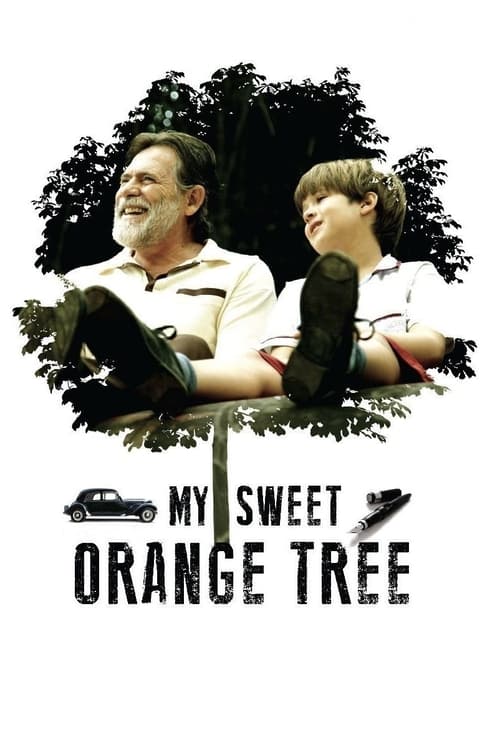
My Sweet Orange Tree
2012 · Marcos Bernstein
For a soft, sincere evening when you want a film about childhood that earns its tears — comfort viewing with a lump in the throat, good for watching with family or when you need to feel something uncomplicated and true.
What it's about
In a poor working-class suburb of Rio de Janeiro, an eight-year-old boy named Zezé gets through a hard childhood — an unemployed father, a house short on money and patience — by pouring his imagination into long conversations with the little orange tree in his backyard. He's a troublemaker with a tender heart, and his loneliness eases when he strikes up an unlikely friendship with Portuga, an older Portuguese man who treats him with the kindness his family can't spare. It's adapted from one of Brazil's most beloved novels, a semi-autobiographical story generations of Brazilians grew up reading.
The experience
Gentle and warm on the surface with a real ache underneath — it moves at a child's pace, finding wonder in small things, but it never pretends poverty and neglect don't hurt. Expect to be charmed for an hour and quietly wrecked by the feeling of it.
The craft
Director Marcos Bernstein, a screenwriter by trade, keeps the adaptation modest and faithful, trusting the child's-eye view rather than dressing it up. The film stays close to Zezé's imagination — the whispered confidences to the tree, the small rituals of a boy inventing tenderness where there isn't much — and lets the working-class Rio setting feel lived-in rather than picturesque.
Why it matters
It stands as the most prominent screen version in decades of a novel that is a fixture of Brazilian school reading lists — for many viewers it's the face of a story their whole culture knows by heart.
Snapshot
My Sweet Orange Tree (Meu Pé de Laranja Lima) is a Brazilian family drama adapted from José Mauro de Vasconcelos's beloved 1968 semi-autobiographical novel of the same name. It follows Zezé, a bright, mischievous, poverty-pinched boy of around eight in a working-class Rio de Janeiro suburb, whose interior life unfolds in confidences whispered to a young orange tree and whose loneliness finds a fragile refuge in his friendship with an older Portuguese man he calls Portuga. The novel is one of the most widely read books in modern Brazilian culture — a fixture of school reading lists for generations — and the 2012 film arrives as the most prominent screen version in decades of a story already worn smooth by familiarity. Directed by Marcos Bernstein, better known before this as a screenwriter, the film is a modest, sincerely mounted period adaptation whose ambitions are fidelity and feeling rather than formal innovation. It belongs to a durable strand of Brazilian cinema devoted to childhood, poverty, and the sentimental education of a sensitive boy narrator.
Industry & production
The film was produced within Brazil's mid-2000s-to-2010s system of state-supported feature production, in which incentive laws (chiefly the Lei do Audiovisual and, from the 2000s, the funds later consolidated under ANCINE and the Fundo Setorial do Audiovisual) underwrote a steady output of literary adaptations and heritage dramas. A canonical novel with guaranteed name recognition is precisely the kind of property that fits this financing logic: pre-sold cultural legitimacy, an audience of readers, and obvious pedagogical and broadcast afterlife. Beyond that structural context, the granular production record for this particular title — budget figures, precise financing partners, shooting schedule, and box-office returns — is thin in the widely available English-language literature, and I will not invent numbers. What can be said with confidence is that it was mounted as a period reconstruction, requiring the recreation of a modest mid-century suburban Brazilian setting, and that it was positioned as a mainstream, all-ages release rather than a festival-forward art film.
Technology
The film was made in the era of Brazilian digital feature production and shows no signs of being a technological showcase; its means are conventional for a 2012 mid-budget drama. The visible craft priorities are period reconstruction and performance capture rather than any distinctive imaging or post-production technique. Specific data on camera systems, capture format (digital vs. photochemical), and finishing workflow are not reliably documented in accessible sources, so I flag that as a genuine gap rather than guess. What the film's look communicates — warm, softened, slightly nostalgic imagery — is achievable through standard means of the period and should be read as an aesthetic choice about memory and childhood, not as evidence of any particular hardware.
Technique
Cinematography
The film's visual strategy is organized around a child's scale and a memory's warmth. Framing tends to keep Zezé central and to render the adult world partly from below or at his eye level, so that the film's sympathies are locked to his vantage. The palette leans warm and burnished — sunlit yellows, dusty earth tones, the green of the titular tree — the standard grammar of remembered childhood in period cinema. This is a film that wants beauty to soften hardship rather than to indict it: the poverty is real within the story but the images are gentle. I do not have a reliably attributed director of photography credit to name here, and rather than misattribute the work I note that the cinematographic authorship should be verified against the film's official credits.
Editing
Editorially the film follows a linear, episodic progression faithful to the novel's structure, which is itself a chain of vignettes — small transgressions, punishments, discoveries, and tender exchanges. The cutting favors legibility and emotional dwell time over compression or rhythmic experiment: scenes are allowed to settle so that the audience registers Zezé's reactions. The dramatic architecture builds toward a late rupture and grief, and the editing reserves its most patient handling for those passages. As with the camera credit, I will not assign the editing to a named figure without a verified source.
Mise-en-scène / staging
The staging is the film's most deliberate craft dimension, because the entire project rests on convincing period reconstruction of a poor suburban household and its surrounding streets. Production design carries the weight of establishing time and class: the sparse home, the marks of a father's long unemployment, the schoolyard, the street where Portuga's car appears. The orange tree is the governing spatial motif — a private zone at the edge of the domestic world where Zezé's imaginative life is licensed to speak aloud. Staging repeatedly isolates the boy in his own pocket of space, dramatizing loneliness spatially before the dialogue names it.
Sound
The soundtrack works in the register of gentle sentiment, using score to underline emotional beats and to signal the shift between Zezé's harsh outer circumstances and his tender inner life. Music is a load-bearing element in a film of this kind, cueing the audience toward warmth and, later, sorrow. I do not have a securely attributed composer credit to state and decline to invent one; the score's authorship should be checked against the official credits.
Performance
Performance is where the film lives or dies, and its central demand is a child lead capable of carrying nearly every scene while balancing mischief and pathos. The young actor playing Zezé must be at once a plausible troublemaker and a wounded, precociously feeling child — the double register that made the novel's narrator so enduring. The counterweight is Portuga, the older man whose gruff kindness becomes the boy's emotional anchor; the film's central relationship depends on a warmth and restraint that keeps sentiment from curdling. Publicly circulated casting attributions for the 2012 film should be confirmed against the credits before being repeated as fact; I flag this rather than assert names I cannot fully verify.
Narrative & dramatic mode
The dramatic mode is intimate domestic realism inflected by a child's fantasy. Zezé's conversations with the orange tree externalize his inner monologue — the tree functions as confidant, alter ego, and imaginary friend — so the film oscillates between observed social reality (a household ground down by unemployment) and the interior, animistic world a lonely, imaginative child builds to survive it. Narratively the film is episodic and cumulative rather than tightly plotted: it accretes small incidents of naughtiness, punishment, humiliation, and grace until the friendship with Portuga gives Zezé his first experience of being truly seen. The mode is fundamentally elegiac. It is a story about the end of childhood illusions and the first encounter with loss, and its emotional design moves deliberately from warmth toward grief.
Genre & cycle
The film sits squarely in the coming-of-age family drama, and more specifically in the sentimental-realist tradition of stories about poor, sensitive boys. Its natural companions are literary-adaptation heritage dramas and the broad international cycle of "a child and his older mentor" films. Within Brazilian screen culture the material also belongs to a very particular cycle: Meu Pé de Laranja Lima has been adapted repeatedly across film and television since the 1970s, making the 2012 feature less a fresh discovery than a new entry in a long adaptation lineage — a remake in spirit of a national touchstone. It thus doubles as a heritage/nostalgia property, aimed partly at readers who carry the book as a formative memory.
Authorship & method
Marcos Bernstein's most significant prior credential is as a screenwriter, notably as a co-writer of Walter Salles's Central Station (Central do Brasil, 1998) — one of the landmark Brazilian films of the Retomada, and itself a story of an unlikely bond between an older figure and a child crossing hard social terrain. That lineage is the most illuminating fact about Bernstein's approach here: he comes to My Sweet Orange Tree as a writer attuned to intergenerational tenderness against a backdrop of Brazilian hardship, and the film reads as an author returning to a kindred emotional territory in a more classical, less road-movie key. His method on this project is fidelity-driven adaptation — honoring a canonical text and trusting its emotional architecture rather than radically reinterpreting it. The other key authorial contributions — cinematographer, composer, editor, and any co-writers — are collaborators whose specific credits I have chosen not to state without verification, precisely because the reliable secondary record on this film's below-the-line authorship is thin; those names should be drawn from the official credits.
Movement / national cinema
The film belongs to post-Retomada Brazilian cinema — the mature, institutionalized phase that followed the 1990s revival, when state incentive mechanisms produced a steady stream of features including many literary adaptations and heritage dramas alongside the harder-edged social cinema (City of God and its descendants) that dominated Brazil's international profile. My Sweet Orange Tree represents the gentler, more domestic and pedagogical wing of that national cinema: films that address a home audience's cultural memory rather than chasing festival transgression. It is worth situating it against the more famous export image of 2000s Brazilian film, all favela violence and kinetic energy; this is a deliberately quieter register, closer to the sentimental humanism of Central Station than to the brutal realism of the crime cycle.
Era / period
Two time frames matter. The film's diegetic period is the mid-twentieth-century Brazil of the novel — a world of long paternal unemployment, streetcars and early automobiles, and rigid domestic discipline — reconstructed as a nostalgic past. Its production era is early-2010s Brazil, a moment of relative economic optimism and a well-funded audiovisual sector, in which mining the national literary canon for warm, exportable-yet-domestic drama was a natural strategy. The gap between the two — a 2012 film looking back on a mid-century childhood through a book that generations read as children — is itself part of the work's meaning: it is nostalgia layered on nostalgia.
Themes
The film's central themes are poverty and dignity; the loneliness of a sensitive child in a family too overwhelmed to nurture him; imagination as survival, embodied in the talking tree; and the redemptive power of being seen by one adult who takes the child seriously. Running beneath these is the theme of premature loss — the film is fundamentally about the moment childhood's magic is broken by grief, the passage from an enchanted world (where trees speak) to a disenchanted one. Cruelty and tenderness are held in tension: Zezé absorbs real harshness at home, and the friendship with Portuga is precious precisely because it is the exception. Class, family, and the education of feeling are the load-bearing concerns.
Reception, canon & influence
On the backward axis, the film's decisive influence is its literary source: Vasconcelos's 1968 novel is a genuine phenomenon of Brazilian letters, semi-autobiographical, tearful, and canonized through decades of school curricula, and the film is unthinkable apart from that text's cultural weight. A secondary influence is the pre-existing chain of Brazilian film and television adaptations of the same novel stretching back to the 1970s, which established a template of reverent, sentimental treatment that the 2012 version largely honors. Bernstein's own background on Central Station forms a third, personal line of influence — the same tender-hardship register carried from writing into directing.
On critical reception, I flag a real limitation: comprehensive, reliably sourced critical and commercial data for this specific film is not abundant in accessible English-language scholarship, and I will not manufacture reviews, ratings, or box-office figures to fill the gap. What can be said responsibly is that the film was received as a faithful, respectful adaptation of a cherished book — the kind of production whose reception is inseparable from audiences' prior attachment to the source, and which is valued more for sincerity and cultural fidelity than for cinematic reinvention.
On the forward axis, the film's legacy is best understood as custodial rather than generative. Its function has been to keep a foundational national story in circulation for new audiences — a screen companion to a set text — rather than to launch a stylistic movement or reshape Brazilian cinema. Its influence, such as it is, lies in reaffirming the enduring adaptability and emotional durability of Meu Pé de Laranja Lima as a property, and in demonstrating that the post-Retomada industry could deliver the canon back to its readers in earnest, unironic form. For a fuller account of the film's specific critical standing and box office, the primary Brazilian-language press and the film's official credits would need to be consulted directly; the honest scholarly position is that the detailed record here is thinner than the novel's fame might lead one to expect.
Reception
It arrived in 2012 carrying the weight of one of Brazil's most beloved novels and was received warmly but quietly — and that's roughly where it still sits, a well-liked adaptation forever in the shadow of its source.
How My Sweet Orange Tree was received, from release to now →
How to watch My Sweet Orange Tree: what to notice on a first viewing
- Watch scenes framed low, at Zezé's own eye level. The camera keeps the adult world shot from below or at the boy's height, locking the film's sympathy to his vantage throughout. Seeing adults from a child's height keeps you inside his scale of the world the whole time.
- Notice the warm, sunlit color washing the poorer scenes. Sunlit yellows and dusty earth tones color even the household's hardship, a warm palette laid over a family strained by unemployment. The warmth softens the poverty visually without pretending the hardship in the story is not real.
- Watch Zezé retreat to the same orange tree repeatedly. The tree at the edge of the yard becomes his fixed private space, the one place he is allowed to speak his mind out loud. The tree is where his inner life gets to exist, since nowhere else in the house makes room for it.
- Notice the story move in small, separate incidents. The film accumulates vignettes, small mischief, punishment, tenderness, rather than building toward one central event, following the shape of the novel it adapts. Each small incident adds up to a portrait of how this boy learns to survive his house.
- Watch how alone Zezé is staged even in crowded rooms. Blocking repeatedly isolates him in his own pocket of space at home, dramatizing his loneliness physically before any line of dialogue names it. His isolation is visible in the staging well before the story explains why he is alone.
The whole guide to watching My Sweet Orange Tree, with the keys for a rewatch →
Influences: the films it descends from and the films it influenced
- Central Station (1998) — Bernstein co-wrote this Retomada landmark, and he carries its exact screenwriting architecture — an unlikely older-figure/child bond structured as tender emotional escalation against Brazilian hardship — directly into his direction here.
- O Meu Pé de Laranja Lima (1970) — The first Brazilian screen adaptation of Vasconcelos's novel established the reverent, sentimental fidelity template — treating the source's episodic chapters as sacrosanct emotional beats — that Bernstein's 2012 version deliberately honors rather than reinvents.
- Bicycle Thieves (1948) — De Sica's neorealist device of anchoring adult economic humiliation to a non-actor child's silent witnessing gaze supplies the film's child's-eye method of registering poverty through a boy's reactions rather than expository framing.
- Forbidden Games (1952) — Clément's model of a child metabolizing death through a private invented ritual is the direct ancestor of the film's imagination-as-survival mechanism, where make-believe becomes the child's structural defense against loss.
- The 400 Blows (1959) — Truffaut's subjective, unsentimentalized child-narrator framing — camera pinned to the boy's height and the boy's misreadings of the adult world — is the formal template for the film's cinematography/childs-eye-view.
- Pather Panchali (1955) — Ray's method of building a poverty narrative from loosely-strung rural vignettes that accumulate toward a premature death gives the film its episodic-vignette structure and its elegiac register of dignity amid want.
- The Spirit of the Beehive (1973) — Erice's fusion of warm, honey-lit period reconstruction with a spatially isolated child whose inner fantasy life outstrips her surroundings prefigures the film's nostalgic palette married to a lonely, imagining child protagonist.
- My Life as a Dog (1985) — Hallström's warm, retrospective child-narrator voice — a boy narrating his own coping strategies for loss with rueful humor and consolation — is a close ancestor of the film's elegiac first-person interiority.
- Cinema Paradiso (1988) — Tornatore's central device — an intergenerational friendship between a boy and a lonely older man, staged in golden mid-century period reconstruction and mourned elegiacally — is the direct structural cousin of Zezé and Portuga's bond.
- To Kill a Mockingbird (1962) — Mulligan's canonical-novel adaptation method — trusting a beloved text's emotional architecture and filtering a period social world through a child's moral perception — models the fidelity-driven adaptation approach Bernstein adopts.
- Behind the Sun (2001) — Salles's sibling film shares the Bernstein-adjacent register of a child narrator rendering rural Brazilian hardship in elegiac, near-mythic terms, where a boy's imaginative interiority softens a landscape of loss.
- The Year My Parents Went on Vacation (2006) — A sibling in post-Retomada child-led cinema, it reconstructs a specific mid-century Brazilian moment entirely through a solitary boy's-eye perspective, using warm period detail to frame a child's confrontation with abandonment.
Similar films
- My Life as a Zucchini (2016) — shared sensibility
- Chuck Billy and The Marvelous Guava Tree (2025) — shared sensibility
- The Way He Looks (2014) — shared sensibility
- Pixote (1980) — shared sensibility
- Boy & the World (2014) — shared sensibility
- House of Hummingbird (2019) — shared sensibility
- Aniki-Bóbó (1942) — shared sensibility
- Mars One (2022) — shared sensibility