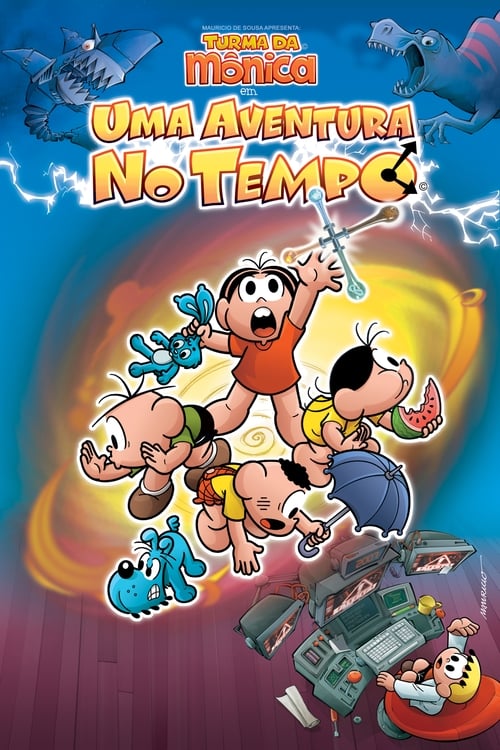
Monica's Gang in an Adventure in Time
2007 · Mauricio de Sousa
For a cozy family afternoon, or when you want the specific warmth of the cartoons you grew up on. All comfort, zero challenge — nostalgia you can share with a kid.
What it's about
The Earth is freezing over, and the only fix is scattered across history: the essences of the four elements. Mônica, her rabbit Sansão, and the rest of the neighborhood gang are flung through time to recover them — landing in the prehistoric world of the caveman Piteco, the jungle of forest sprite Papa-Capim, and outer space alongside the Astronaut, where pirates are waiting. It's a grand crossover of Mauricio de Sousa's comics universe, with the kids even bumping into their own baby selves along the way.
The experience
Bright, bouncy, and warm-hearted, moving at a kid-adventure clip with a gentle save-the-world urgency underneath. For Brazilians it lands as pure comfort — a whole childhood on one screen; for newcomers it's a cheerful window into another country's beloved cartoon world.
The craft
The animation is modest, but the construction is the fun of it: a shared-universe adventure that threads decades of comic strips — cavemen, forest spirits, philosophical astronauts — into one quest, long before big-budget franchises made crossovers routine. The four-elements structure gives each corner of the universe its own look and flavor.
Why it matters
Turma da Mônica is the closest thing Brazil has to a national comics mythology — on school notebooks and snack packaging for generations — and this feature brought that whole universe to the big screen as one story.
When the Earth faces a deep freeze, the children of Limoeiro — bossy, buck-toothed Mônica and her rabbit Sansão among them — are scattered across time to recover the essences of the four elements, crossing into the prehistoric, jungle and outer-space corners of their creator's universe. Mauricio de Sousa has drawn Turma da Mônica since 1959, building the closest thing Brazil has to a national comics mythology: his characters adorn school notebooks, snack packaging and the childhoods of several generations. This theatrical feature works as a grand crossover, threading the flagship gang through de Sousa's satellite strips — caveman Piteco, forest sprite Papa-Capim, the philosophical Astronaut — decades before American franchises made such universe-weaving routine. As animation it is modest; as cultural object it is enormous, which is why Brazil's famously fervent film-logging community lifted it into global visibility. The affection is the point: a country's shared childhood compressed into ninety minutes of time travel, drawn in the round, cheerful lines Brazilians recognize the way others recognize a flag.
Reception
A genuine hit at home on release in February 2007 — over 600,000 Brazilians saw it in cinemas, critics called it one of Mauricio de Sousa's best and proof the country's animation industry was maturing — and today it survives mainly as a warm childhood memory for Brazilians who grew up in the 2000s.
How Monica's Gang in an Adventure in Time was received, from release to now →
Influences: the films it descends from and the films it influenced
- As Aventuras da Turma da Mônica (1982) — The studio's first theatrical cel feature, which codified the rounded, four-fingered model sheets, primary-color palette, and gag-strip cutting rhythm carried unchanged into this film's animation pipeline.
- A Boy Named Charlie Brown (1969) — Established the template for stretching a daily newspaper strip to feature length while keeping the flat minimal linework and casting real children as the voice ensemble — the exact adaptation grammar Maurício reuses.
- The Twelve Tasks of Asterix (1976) — Its chain-of-discrete-challenges quest architecture, drawn from a national comic institution and rendered in flat cel color, is the episodic scaffolding this time-hopping adventure imitates.
- Tintin and the Temple of the Sun (1969) — Belvision's method of animating ligne-claire comics — uniform-weight outlines and flat unshaded fills that keep the panel look intact — is the same clear-line-to-cel technique underpinning this adaptation.
- Lucky Luke: Daisy Town (1971) — Showed how a Franco-Belgian gag comic's deadpan panel-timing survives the jump to feature animation for a franchise lead, a comedic-beat translation Maurício applies to Cebolinha and Cascão.
- Doraemon: Nobita's Dinosaur (1980) — Founded the annual children's-comic feature built entirely around a time-travel quest with a fixed child ensemble — the precise commercial-narrative formula this film localizes for Brazil.
- Cassiopeia (1996) — A pioneering wholly-Brazilian feature that asserted a national animation-production identity, the industrial precedent Maurício's studio extends by staging its story inside Brazil's own founding history.
- The Peanuts Movie (2015) — Re-renders a legacy newspaper-strip cast in CGI while deliberately preserving 2D strip conventions (flat expressions, hand-drawn motion lines) — the same heritage-preservation problem this film solved in cel.
- Turma da Mônica Jovem (2008) — Restyles the identical character stable in a manga/shōnen idiom with screentone and speed-lines, a franchise-continuity reboot enabled by the same shared-universe casting this film relies on.
- Turma da Mônica: Laços (2019) — Transfers the comic's fixed character designs and shared-universe ensemble into live action, continuing the franchise's model of moving one cast across media while keeping crossover continuity intact.
- Turma da Mônica: Lições (2021) — A direct sequel that further formalizes the multi-film shared-universe crossover apparatus this 2007 feature helped establish as a franchise precursor.
- Doraemon: Nobita and the Birth of Japan (1989) — Uses time travel into the nation's mythic prehistory as the engine for teaching a national origin story, mirroring this film's guided tour through Brazil's indigenous and colonial founding moments.
- The Twelve Tasks of Asterix / Asterix and Cleopatra (1968) — Its period-tourism device — dropping cartoon regulars into meticulously caricatured historical settings for comedy and pageantry — parallels this film's use of eras as staging backdrops.
- Cine Gibi: O Filme (2004) — A contemporaneous Turma da Mônica feature from the same cel pipeline and voice cast, sharing the anthology-of-comic-strips construction that this film stretches into a single continuous quest.
- Rio (2011) — Brazilian-authored animation that foregrounds national iconography for a children's audience, extending the same national-identity-as-spectacle impulse into CGI rather than cel.
- Detective Conan: The Time-Bombed Skyscraper (1997) — Represents the same manga-franchise-to-annual-feature economy, where a beloved comic ensemble is repackaged as a self-contained theatrical adventure driven by a high-concept genre hook.
Similar films
- Chuck Billy and The Marvelous Guava Tree (2025) — shared sensibility
- Boy & the World (2014) — shared sensibility
- Time Masters (1982) — shared sensibility
- Time Bandits (1981) — shared sensibility
- Rio 2096: A Story of Love and Fury (2013) — shared sensibility
- Ó Paí, Ó: Look at This (2007) — shared sensibility
- Minions & Monsters (2026) — shared sensibility
- Mars One (2022) — shared sensibility
All the films related to Monica's Gang in an Adventure in Time →