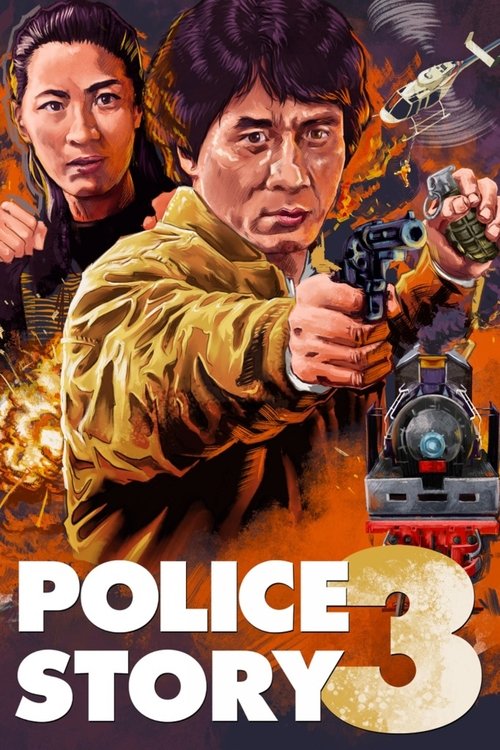
Police Story 3: Super Cop
1992 · Stanley Tong Gwai-Lai
For when you want spectacle that's actually real — a crowd-pleaser for a rowdy night in, best watched with friends who will yell at the screen. Zero homework, maximum payoff.
What it's about
Hong Kong supercop Chan Ka-Kui goes undercover in mainland China to infiltrate a drug lord's network, partnered with a by-the-book mainland officer who turns out to be at least his equal. The operation escalates from a prison break through Thailand and Malaysia to a finale tearing across Kuala Lumpur by helicopter, motorcycle, and moving train.
The experience
Pure adrenaline with a grin — comedy and jaw-dropping stunt work in constant alternation, building to a last half hour that has you involuntarily saying 'that's really them' out loud. It moves fast and never gets grim.
Performances
Jackie Chan does his signature real-risk physical comedy, but the revelation is Michelle Yeoh, who matches him stunt for stunt — including a motorcycle jump onto a moving train she performed herself — and steals the film outright.
The craft
Stanley Tong stages the action with the unfaked physical exposure that was Hong Kong's calling card: real bodies, real vehicles, real altitude, no digital safety net. The Kuala Lumpur finale is one of the great sustained action sequences — see it big and loud, and stay for the outtakes over the credits.
Why it matters
This is the film that pushed Hong Kong action from local genre to global export, opening international doors for both Chan and Yeoh.
Snapshot
Police Story 3: Super Cop is the point at which the Hong Kong action film stopped being a local genre and became an international export commodity — not because it changed its methods, but because it pushed them to a scale that could no longer be ignored. Jackie Chan returns as Chan Ka-Kui (Kevin Chan), the Royal Hong Kong Police officer whose career has been a running argument between duty and property damage; this time he goes undercover into mainland China to infiltrate a drug-trafficking network, partnered with a Public Security Bureau officer, Inspector Yang Chien-Hua, played by Michelle Yeoh. The film ends with an extended chase across Kuala Lumpur involving a helicopter, a moving train, and a motorcycle, staged with the unfaked physical exposure that was Chan's signature and his liability.
Two things distinguish it inside Chan's filmography. The first is Stanley Tong, who replaced Chan himself as director (Chan had directed the first two Police Story films) and brought a heavier, more spectacle-forward sensibility — bigger set pieces, more location travel, less of the first film's shopping-mall claustrophobia. The second is Yeoh, returning to screen acting after a retirement following her marriage to producer Dickson Poon, and doing her own stunts at a level that made the film hers as much as Chan's. Her motorcycle jump onto a moving train is the most-cited image in the picture, and it is the reason many viewers who came for Chan left talking about her.
The film's afterlife was unusually complicated. Released in Hong Kong in 1992 as Ging chaat goo si III: Chiu kap ging chaat, it circulated in the West through import video and repertory screenings before Dimension Films (Miramax's genre arm) released a re-edited, English-dubbed version in the United States in 1996 as Supercop — with a new soundtrack, a shortened running time, and the Police Story framing largely stripped away. That version, arriving in the wake of Rumble in the Bronx, was for many Americans their second Jackie Chan film and their first Michelle Yeoh film. It also demonstrated, in a way distributors could count, that the Hong Kong action idiom would travel.
Industry & production
Super Cop was produced by Golden Harvest, the studio that had built its identity around Bruce Lee and then rebuilt it around Jackie Chan, at a moment when the Hong Kong industry was at a commercial and creative peak. The early 1990s were the boom years: production volume was high, Hong Kong films dominated their home market and much of Southeast Asia, and the territory's stars carried genuine regional bankability. The film sits inside that boom rather than at its edges — a franchise sequel from the biggest star at the biggest action studio.
The most consequential production decision was handing the director's chair to Stanley Tong. Chan had directed Police Story (1985) and Police Story 2 (1988) himself, and both bear his authorial fingerprints: the escalating comic-mechanical set pieces, the density of gag-to-gag construction, the willingness to let a sequence run past the point of comfort. Tong came from a stunt background and had directed Stone Age Warriors (1991) before this. His contribution was scale and geography — a film that moves from Hong Kong to mainland China to Malaysia, and that treats each location as a platform for a distinct kind of spectacle. The collaboration was productive enough that Tong went on to direct Chan in Rumble in the Bronx (1995), First Strike (1996, the fourth Police Story) and later CZ12 / Chinese Zodiac (2012) and Rush Hour-era projects; he became, in effect, Chan's principal outside director of the 1990s.
Michelle Yeoh's casting was the other decisive move. Yeoh had made her name in the mid-1980s women-with-guns cycle at D&B Films — Yes, Madam! (1985) opposite Cynthia Rothrock, Royal Warriors (1986), Magnificent Warriors (1987) — before stepping away from performing. Super Cop was her return, and the film is structured to make that return an event: Yang is introduced as Chan's superior in rank and at least his equal in capability, and the script keeps finding occasions to prove it. The casting also carried a political dimension that the film treats lightly but unmistakably: a Royal Hong Kong Police officer and a mainland PSB officer working as partners, five years before the 1997 handover.
The Malaysian production block — Kuala Lumpur locations, including the sequences built around the helicopter and the train — reflected both the story's trajectory and the practical realities of large-scale stunt work: airspace, rail access, and cooperative authorities are easier to secure outside a dense city like Hong Kong. Yeoh, born in Ipoh, was returning to her home country to shoot the sequences that would define her comeback.
The Dimension release in 1996 is a separate industrial story. Miramax's genre label acquired Hong Kong action titles in the mid-1990s and reworked them for American audiences: English dubbing, a replaced score (the Supercop cut carries a new soundtrack featuring Western artists), trimmed running time, and retitling that severed the film from its series. This was standard practice for the period and was widely criticized by critics and Hong Kong cinema advocates, even as it undeniably widened the audience. The original Cantonese version remains the reference text; the Dimension cut is a historical artifact of how the American market absorbed the material.
Technology
Super Cop is not a technologically innovative film in the sense of introducing new tools. It is, rather, a demonstration of what conventional film technology could deliver when the primary "effect" is a real body in real space. The film was shot on 35mm with largely conventional camera packages, and its spectacle is achieved through stunt engineering, rigging, and camera placement rather than optical or digital manipulation.
What is worth noting is the near-total absence of digital effects at a moment when Hollywood was pivoting hard toward them — Terminator 2: Judgment Day had appeared in 1991, Jurassic Park would follow in 1993. The Hong Kong action film of this era took the opposite path: rather than synthesizing impossible images, it organized production around capturing dangerous real ones. The helicopter sequence, the train work, the vehicle stunts — these are problems of aviation coordination, safety rigging (or its insufficiency), timing, and multi-camera coverage.
That approach carried a documented human cost, and the Police Story films are among the clearest cases. Chan's stunt team, the Jackie Chan Stunt Team, worked under a system in which performers took real impacts and injuries were routine; Chan's own catalog of injuries across his career is well documented and was, by the 1990s, part of his public persona. Super Cop follows the series convention of running outtakes and injury footage over the end credits — a device Chan had used since the early 1980s, which functions simultaneously as comedy, as authentication (proving nothing was faked), and, read less generously, as a display of the labor and risk that produced the film.
The film's other technological dimension is prosaic but real: the logistics of shooting across three territories with different infrastructure, and of achieving continuity between them. This is production management as technology.
Technique
Cinematography
The camerawork follows the governing principle of Hong Kong action shooting: the frame exists to make the physical action legible and to certify that it happened. Wide and medium-wide setups dominate the action sequences, holding the performer's full body in frame so that the audience can see there is no cut, no double, no substitution. When the camera moves in, it is usually to register impact or reaction, not to disguise.
Tong's staging is more expansive than Chan's own directorial work in the earlier films. Where Police Story (1985) built its most famous sequence inside a shopping mall — a confined, vertically stacked space full of breakable glass — Super Cop opens outward: rooftops, roads, open air, the vertical drop beneath a hanging rope ladder. The helicopter material exploits altitude and negative space; the frame is largely empty, and the emptiness is the point, because it is what the body would fall through.
There is also a documentary-adjacent quality to some of the location work — real streets, real crowds at the edges of frame, real rail lines. This is partly economics and partly aesthetic: the Hong Kong action film of this period frequently derives tension from the collision of controlled choreography with uncontrolled environments.
Editing
Chan-style action editing is often misunderstood as fast cutting. It is better described as rhythmic cutting: shots are held long enough to establish that a movement is continuous and real, then cut on impact, frequently with a brief overlap or a repeated beat from a second angle to extend the sensation of a blow. The result is a cadence — set, execute, register — rather than the fragmentation typical of contemporaneous Hollywood action.
Super Cop applies this to a wider palette of material: hand-to-hand exchanges, vehicle work, and large-scale aerial spectacle each demand different cutting logic. The climactic sequence has to solve a problem of geography — a helicopter, a moving train, a city below, and two protagonists in separate predicaments — and it does so through clear spatial anchoring: establish the relative positions, then cut between them without violating the audience's mental map.
The end-credit outtake reel deserves mention as an editorial strategy. By showing failed takes, injuries, and the crew's reactions, the film retroactively re-frames everything preceding it, converting spectacle into testimony.
Mise-en-scène / staging
The film's staging logic is Chan's inheritance from Peking opera training and from silent comedy: the environment is the co-star. Objects, architecture, and vehicles are not backdrop but apparatus — things to swing from, be struck by, and improvise with. Tong scales this up. The mall becomes a city; the ladder becomes a helicopter's rope ladder over Kuala Lumpur; the props become a train.
Costume and setting also do narrative work. The undercover premise moves Chan through a series of disguises and registers — the comic embarrassment of impersonation is one of the film's steady sources of humor — while the mainland sequences (a labor camp, a prison break) give the film a visual texture distinct from the Hong Kong material.
Crucially, the staging distributes spectacle between two performers rather than concentrating it in one. Yeoh's set pieces are designed as her set pieces, not as assists to Chan's. That structural choice is why the film reads, thirty years on, as a two-hander.
Sound
The original Cantonese version carries a conventional Hong Kong action score and the dense, percussive foley that the genre uses to sell impact — the exaggerated hit sounds that make a pulled punch land. Post-synchronized dialogue was standard practice in Hong Kong production of this era, with films frequently dubbed into Cantonese and Mandarin versions; the loose relationship between voice and image that Western viewers sometimes read as a flaw is in fact an industrial norm.
The Supercop release complicates any account of the film's sound design, because Dimension replaced the score entirely and dubbed the dialogue into English. Viewers whose experience of the film is that version have heard a substantially different film. Any serious discussion of the soundtrack should specify which cut is under discussion.
Performance
Chan's performance is built on a comic persona he had refined over a decade: competent but perpetually put-upon, physically extraordinary but emotionally sheepish, more likely to flee a confrontation than start one. The undercover premise is well suited to this, since it requires him to perform incompetence and endure indignity. He is also, in the Police Story films specifically, allowed flashes of genuine anger — the series periodically lets the comedy drop away, and the resulting tonal shifts are part of its texture.
Yeoh's performance is the film's discovery. She plays Yang with a controlled, unsmiling authority that refuses to soften into either romantic subordination or comic foil. Her physical work is exact rather than flamboyant, and the fact that she performed her own stunts — including the motorcycle-onto-train material — is not incidental to how the character reads. Yeoh's background is in dance rather than martial arts, and that training shows in her line and timing.
Maggie Cheung returns as May, Chan's girlfriend, in a role the series has always used awkwardly — as comic obstacle and as the person who gets endangered. Cheung's own history with the franchise includes a serious head injury sustained during production of Police Story 2, a fact frequently cited in accounts of the human costs of this filmmaking method.
Narrative & dramatic mode
The screenplay is functional in the way action-film screenplays of this tradition typically are: a delivery system for set pieces, structured as an undercover-infiltration plot with a rescue at its center and a chase at its end. Chan goes under, gains the trust of a criminal organization, breaks a boss out of a labor camp, follows the network to Malaysia, is exposed, and escapes with Yang in the extended climax.
What gives the film its shape is the partnership. The narrative repeatedly places Chan in a position of relative helplessness so that Yang can be competent, and the running joke — that the "super cop" of the title might be either of them — is doing real structural work. The film is a buddy movie in which the buddy dynamic is organized around a woman who outranks the hero.
Tonally it moves between broad comedy, procedural, and sincere danger, sometimes within a single sequence. Western viewers unfamiliar with Hong Kong commercial cinema often read this as inconsistency; within the tradition it is a convention, and the Police Story films handle the modulation more deftly than most.
Its political subtext is present but unforced. A colonial Hong Kong policeman and a mainland state security officer cooperate across a border that, in 1992, everyone in the audience knew was about to dissolve. The film does not editorialize; it simply stages the collaboration as workable, which was itself a position.
Genre & cycle
Super Cop belongs to the Hong Kong police-action cycle that Chan's own Police Story (1985) had substantially defined — a hybrid of the kung fu film's choreographic values, the Hollywood cop movie's institutional framework, and the stunt-comedy lineage Chan had developed since Drunken Master (1978) and Project A (1983). Its immediate genre context includes the "heroic bloodshed" films of John Woo and Ringo Lam, which had reshaped Hong Kong crime cinema in the late 1980s toward gunplay and melodrama. Chan's series is distinguishable from that current: it privileges the body over the gun and comedy over tragic fatalism.
It also participates in a second cycle — the women-warriors strand that had run through Hong Kong action since the 1960s wuxia films of King Hu (with Cheng Pei-pei) and through the 1980s D&B productions that launched Yeoh. Super Cop imports that tradition into the Chan vehicle, and the graft holds.
Within the franchise, it is the third of a series that would continue with First Strike (1996) and New Police Story (2004), and it is generally regarded as the point at which the series exchanged the tight, escalating construction of the first film for larger international spectacle.
Authorship & method
The authorship question here is genuinely divided, and it is more interesting for being so. Stanley Tong directed and is credited as an action director on the film, and the picture bears his preferences: geographic expansion, vehicular and aerial spectacle, a cleaner and more conventionally "big" sense of scale. But Jackie Chan is the film's dominant creative force by any practical measure — the star, the franchise's originating director, the head of the stunt team, and the person whose established method (choreograph on set, iterate through repeated takes, escalate until the sequence is exhausted) governs how the action was made. Hong Kong action credits of this era are frequently fluid, with action directors, stunt coordinators, and stars sharing responsibility for what ends up on screen; attributing individual sequences to a single author is often not possible from the public record.
Michelle Yeoh should be counted as a third author of the film's physical text. Performers in this tradition are co-creators of choreography, and Yeoh's sequences reflect her specific capacities.
Below the line, the record available in general reference sources is thinner than for comparable Western productions, and I will not guess at individual credits. What can be said with confidence is that the film was made within the Golden Harvest production system and the Jackie Chan Stunt Team's working method — a durable, well-documented apparatus in which the same core group of performers and technicians moved from picture to picture, developing an institutional expertise in physical action that had few equivalents anywhere in world cinema.
The end-credit outtakes are, in authorship terms, a signature: they are Chan's device, carried over from his earlier work, and they explicitly claim the film's danger as authorial.
Movement / national cinema
The film is a product of Hong Kong cinema at its commercial zenith and on the eve of its greatest uncertainty. The Sino-British Joint Declaration of 1984 had set the 1997 handover in motion, and the decade that followed produced both an extraordinary creative boom and a persistent undercurrent of anxiety across Hong Kong film — visible in the fatalism of Woo's crime films, the temporal dislocation of Wong Kar-wai's work, and the emigration of talent to Hollywood and Canada.
Super Cop engages that context in the most direct way available to a mainstream entertainment: it makes the mainland partner a hero. Yang is capable, honorable, and entirely un-caricatured, and the film's mainland sequences are shot on location in the PRC. Whether one reads this as diplomacy, optimism, or commercial calculation about a future market, it is a legible position in a national cinema that spent the 1990s working out its relationship to Beijing.
The film also stands at the threshold of Hong Kong cinema's export moment. Within a few years, Woo, Tsui Hark, Ringo Lam, Chow Yun-fat, Yeoh, and Chan himself would all be working in or with Hollywood. Super Cop, in its American release, was one of the vehicles that made that traffic possible.
Era / period
1992 sits at the crest. Hong Kong's production output and box office were near their peak; Chan was among the most bankable stars in Asia; and the industry's technical confidence in physical action was total. Within roughly five years, the picture would change: the handover, the 1997 Asian financial crisis, rampant video piracy, and the departure of key talent all contributed to a sharp contraction.
Globally, 1992 was the last moment before digital effects reorganized the action film. Super Cop's method — real bodies, real altitude, real trains — was already becoming an anomaly, which is part of why it retains its force. It reads now as a document of a production culture that no longer exists in that form, and that mainstream cinema would not, for insurance and labor reasons among others, reconstruct.
Themes
Competence as the measure of worth. The film's moral universe is meritocratic in a narrow but sincere way: characters are judged by what they can do. This is what makes the Chan/Yeoh partnership work — the film never asks whether a woman can do the job, only whether this officer can, and answers yes repeatedly.
Duty against personal cost. Inherited from the first Police Story, the series' recurring tension is between the officer's obligations and the wreckage those obligations leave in his personal life. The May subplot, however clumsily handled, is the vestige of that theme.
The border. Undercover work, false identity, and cross-jurisdictional cooperation all thematize a boundary the film is quietly imagining the dissolution of. Chan and Yang must trust each other across a political line neither controls.
Authenticity and the body. More than any narrative theme, Super Cop's deepest subject is the reality of what it shows. The outtakes make this explicit. The film's argument is that the value of the image lies in its having actually occurred — a proposition the subsequent three decades of cinema have largely abandoned.
Reception, canon & influence
Critical reception. In Hong Kong, the film was a commercial success and was received as a strong entry in an established franchise, and Yeoh's return was widely noted. In the West, the film's critical history is bifurcated. Through the early 1990s it circulated among cinephiles via imported video, subtitled tapes, and festival and repertory screenings, where the Hong Kong action film had an enthusiastic, self-organizing following. The 1996 Dimension release brought mainstream American reviews, which were broadly positive about the action and frequently critical of the re-editing, dubbing, and replaced score. Yeoh's performance drew particular praise; a common note in the American coverage was surprise that a Jackie Chan film had been co-opted by someone else. I would not attribute specific quotations or box-office figures here without verification — the numbers reported for the American release vary across sources, and the Hong Kong figures are inconsistently recorded.
Influences on the film (backward). The lineage runs through Chan's own prior work — Project A (1983), Police Story (1985), Police Story 2 (1988) — and behind that to the silent comedians whom Chan has repeatedly named as models, especially Buster Keaton and Harold Lloyd, whose fusion of comedy with genuine physical peril is the direct ancestor of Chan's method. The Peking opera training Chan received at the China Drama Academy under Yu Jim-yuen, alongside Sammo Hung and Yuen Biao, is the foundational technical inheritance: acrobatics, precision timing, and ensemble choreography. The police-procedural framework borrows from Hollywood cop cinema. Yeoh's side of the film descends from the wuxia heroines of King Hu and the 1980s Hong Kong women-in-action cycle.
Legacy (forward). Three strands are traceable.
First, and most consequentially, the film made Michelle Yeoh an international proposition. Her subsequent career — Tomorrow Never Dies (1997), Crouching Tiger, Hidden Dragon (2000), and a trajectory that eventually produced an Academy Award for Best Actress for Everything Everywhere All at Once (2022) — has its modern origin point here. A spin-off vehicle, Supercop 2 (also known as Once a Cop, 1993), built a film around her character.
Second, it was part of the mid-1990s wave that carried the Hong Kong action idiom into American mainstream cinema, alongside Rumble in the Bronx. Chan's American career, the Rush Hour franchise, and the broader migration of Hong Kong action directors and choreographers into Hollywood — most visibly Yuen Woo-ping's work on The Matrix (1999) — belong to a transfer that films like this one made commercially legible.
Third, its method became a reference standard. The argument for practical, legible, full-body action staging — sustained since by filmmakers working in the John Wick and Mission: Impossible traditions, and articulated by countless video essays on Chan's technique — repeatedly returns to this period of his work as its exemplar. The helicopter-and-train climax is regularly cited in surveys of the greatest action sequences ever filmed.
The film's canonical position is secure but slightly unusual: it is rarely argued to be the best of the Police Story films — that honor generally goes to the 1985 original — yet it is frequently the one people have seen, and it is unambiguously the most historically consequential, because of what it did for Michelle Yeoh and for the westward passage of Hong Kong action cinema.
A Deleuzian reading
Michelle Yeoh rides a motorcycle off the road and lands it on the roof of a moving train.
The full Deleuzian reading of Police Story 3: Super Cop →
Reception
A hit in Hong Kong in 1992, it reached most Western viewers via the dubbed, re-scored 1996 Dimension release 'Supercop' riding the Rumble in the Bronx wave — and has since climbed from 'fun import' to routine placement on greatest-action-films-ever lists, its stock rising again with Michelle Yeoh's Oscar-era renaissance.
How Police Story 3: Super Cop was received, from release to now →
How to watch Police Story 3: Super Cop: what to notice on a first viewing
- Notice the wide shots holding a stunt performer's full body. Tong keeps the camera wide during the action, no cutaway, no double implied, so you can see the stunt happen in one continuous take. The wide frame is the film's proof that what you are watching actually occurred.
- Watch shots held until impact, then cut. Chan-style editing lets a movement establish itself as continuous and real before cutting on the hit, sometimes repeating the blow from a second angle. The cadence of set, execute, register makes the action legible instead of fragmenting it into speed.
- Track what Chan swings from, climbs, or is struck by. Rooftops, ropes, vehicles, and architecture are treated as apparatus rather than backdrop, an inheritance from opera training and silent comedy. The environment becomes a co-star instead of scenery, and the danger is real because the objects are real.
- Watch Yeoh's unsmiling, controlled authority. She plays Yang without softening into romantic subordination or comic relief, and her set pieces are staged as her own, not as support for Chan. The reading calls this a gest, a posture that states her rank over him without a line of dialogue.
- Watch Chan act incompetent on purpose while undercover. Every scene of his fumbling reads two ways at once, as a criminal failing and as a cop performing a role, and the film never tells you which to see first. The reading calls this an index of equivocity, one gesture belonging to two situations that you have to hold together.
The whole guide to watching Police Story 3: Super Cop, with the keys for a rewatch →
Influences: the films it descends from and the films it influenced
- Sherlock Jr. (1924) — Keaton's handlebar ride on a driverless motorcycle — the gag built by putting the unprotected performer on a real machine in real traffic and holding the wide shot so the audience can verify it — is the direct formal template for the motorcycle-onto-moving-train leap.
- Safety Last! (1923) — Lloyd's clock-face hang establishes the rule Chan inherits: peril is only readable if the star's whole body and the real drop are in the same uncut frame, which is exactly how the helicopter rope-ladder dangle over Kuala Lumpur is shot.
- The General (1926) — Keaton treats the moving locomotive as choreographic terrain — performer traversing roof, coupling and cowcatcher while the camera tracks laterally alongside — the same environment-as-apparatus logic that governs the train-roof climax here.
- Come Drink With Me (1966) — Hu built the armed female combatant as a figure of opera-derived precision, cueing her strikes to percussion and cutting on the beat rather than the blow — the performance grammar Yeoh's inspector inherits and converts to unarmed contemporary staging.
- Project A (1983) — The China Drama Academy ensemble method (Chan, Hung, Yuen Biao rehearsing as an opera troupe) plus the clock-tower fall shown from three angles, and the invention of the blooper reel over end credits as proof-of-authenticity — all three devices are reused wholesale.
- Wheels on Meals (1984) — The Chan–Benny Urquidez duel codified full-body wide framing at a fixed distance with no cutaway to a stunt double, the framing discipline that lets the Yeoh and Chan fights here be read as continuous physical fact.
- Police Story (1985) — Source of the series' editing signature — the impact repeated across two or three angles with a hard cut precisely on contact, plus percussive foley layered over post-synchronized dialogue — and of the pole-slide/glass-shatter template of staking one uninsurable stunt per picture.
- Armor of God (1986) — Chan's first genuinely globe-trotting production, which moved his location shooting out of Hong Kong streets into foreign terrain and ended on aerial hardware; Tong scales that geography-plus-aircraft finale up rather than inventing it.
- Yes, Madam! (1985) — Yeoh's debut established her working method — a dancer-trained performer doing her own falls and glass work without a double — and the women-in-action cycle whose stunt expectations she carries into this film's van-roof and bike work.
- Supercop 2 (1993) — Built the entire picture around Yeoh's Inspector Yang, transplanting the undercover-infiltration structure and her stunt-forward performance into a vehicle where she, not Chan, absorbs the physical punishment.
- Tomorrow Never Dies (1997) — Imports the Supercop motorcycle idiom directly — Yeoh handcuffed to Brosnan on a bike, performing her own riding in wide framing — grafting Hong Kong practical-stunt staging onto a Bond unit that normally cut around its stars.
- Crouching Tiger, Hidden Dragon (2000) — Cast Yeoh on the strength of the physical literacy this film exported, then let Yuen Woo-ping choreograph her armory duel in long takes that depend on her actually executing the weapon changes rather than on cutting.
- Ong-Bak (2003) — Adopts the full Chan authentication package — no wires, no doubles, impacts covered from multiple angles and replayed, and a closing reel of failed takes and injuries — as its explicit marketing and formal argument.
- The Raid (2011) — Evans holds the camera back to full-body distance and cuts on contact rather than mid-move, preserving the spatial anchoring that lets a viewer track who is where in a corridor — the legibility principle this film's fights model.
- John Wick (2014) — Stahelski, a stuntman turned director, rebuilt American action around actor-executed gun-fu framed head-to-toe in sustained takes, explicitly against the shaky close-cut style, citing Chan-era Hong Kong staging as the benchmark.
- Mission: Impossible – Fallout (2018) — The helicopter climax — star hanging from a real cargo rope beneath a real aircraft, shot wide enough to keep face and ground in frame simultaneously — is the same verification strategy as the rope-ladder sequence, scaled by budget rather than rethought.
- Drunken Master II (1994) — Contemporaneous Chan production running the identical post-production grammar — cut-on-impact coverage, percussive foley mixed over looped dialogue, outtakes of injuries under the credits — but applied to Lau's classical southern-style choreography instead of vehicular spectacle.
- Rumble in the Bronx (1995) — Tong repeats his own procedure here — build the finale around a single large piece of real machinery (hovercraft for helicopter), stage the star against it in wide masters, shoot on foreign location — and it was this pair of films that carried the method to American distribution.
Similar films
- Police Story (1985) — influence & lineage
- Ong-Bak (2003) — influence & lineage
- Come Drink with Me (1966) — influence & lineage
- Hard Boiled (1992) — shared sensibility
- A Better Tomorrow (1986) — shared sensibility
- Infernal Affairs II (2003) — shared sensibility
- Infernal Affairs (2002) — shared sensibility
- Once Upon a Time in China (1991) — shared sensibility