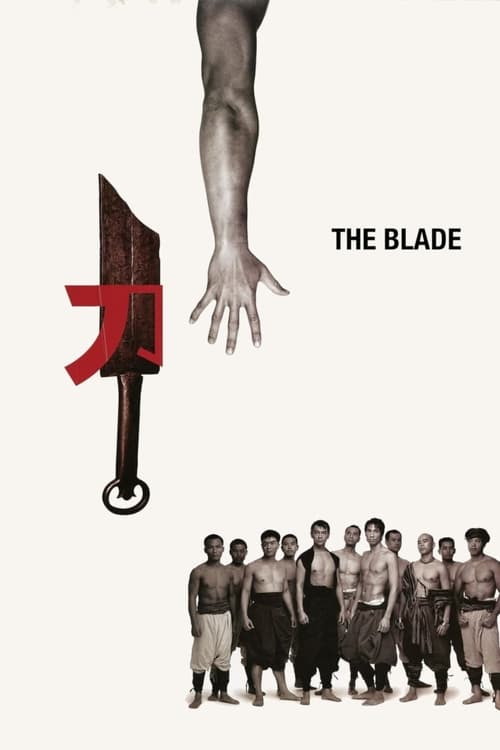
The Blade
1995 · Tsui Hark
For when you want pure adrenaline with an edge of madness — the martial-arts film to reach for when polished action feels too safe. Definitely challenge over comfort: raw, brutal, and unforgettable.
What it's about
A young man raised by a swordsmith learns his real father was murdered by a feared bandit and sets out for revenge — only to lose his right arm to desert cutthroats before he ever reaches his target. Nursed back to health in the wilderness, he teaches himself to fight again with a broken sword and half a burnt training manual, then returns to settle the account. It's a martial-arts revenge story stripped of all glamour and set in a scorched, lawless nowhere.
The experience
Ferocious and disorienting — handheld, mud-caked, and cut so fast the fights feel like being caught inside them. It's an assault of a movie, thrilling and exhausting in equal measure, closer to delirium than choreography.
The craft
Tsui Hark, the director who defined 1990s martial-arts elegance, here demolishes his own style: no silk, no graceful flight, just frenzied camerawork, sun-scorched landscapes, and editing pushed to the edge of legibility. The final duel is one of the most kinetic action sequences ever put on film. It rewards a big screen and a strong stomach.
Why it matters
A box-office failure that became a fierce cult favorite, now widely regarded as one of the greatest and most extreme martial-arts films ever made — the dark endpoint of the genre's 1990s golden age.
Snapshot
The Blade (刀, Dao) is the film in which Hong Kong's most restless commercial visionary turned on his own creation. Between 1990 and 1994, Tsui Hark had directed and produced the pictures that resurrected wuxia as a mass form — the Swordsman films, Once Upon a Time in China, New Dragon Gate Inn, Green Snake — and codified an idiom of weightless flight, silk in motion, and wire-assisted grace. The Blade, arriving as that cycle collapsed at the box office, is a violent repudiation of it. Taking Chang Cheh's One-Armed Swordsman (1967) as its armature, Tsui strips the story of chivalric consolation and re-shoots it as a fever: handheld, mud-caked, sun-scorched, cut to the edge of legibility, set in a nameless place and an unnamed dynasty. Its hero learns to fight from half a burnt manual with half a sword and one arm — an image of mastery achieved through mutilation that governs the whole film. It failed commercially, was received coolly at home, and has since become one of the most fiercely defended films in Tsui's filmography: an anti-wuxia wuxia, and one of the two great deconstructions of the genre produced in Hong Kong in the 1990s, the other being Wong Kar-wai's Ashes of Time (1994).
Industry & production
The Blade was produced by Film Workshop, the company Tsui founded with Nansun Shi in 1984 and through which he had functioned less as an auteur than as a one-man studio — developing, producing, rewriting, re-editing, and frequently seizing the direction of other people's films. By 1995 the environment that had sustained that operation was disintegrating. Hong Kong's domestic box office was contracting sharply, local production volumes were falling from their late-1980s peak, VCD piracy was gutting the ancillary market, Hollywood imports were taking a larger share of screens, and the industry's most bankable talent was looking abroad in the run-up to the 1997 handover. John Woo and Chow Yun-fat had already gone; Tsui himself would follow within two years, directing Double Team (1997) and Knock Off (1998) for Hollywood before returning with Time and Tide (2000).
The Blade was made squarely inside that contraction, and it shows in the film's economy of means: a small principal cast, a handful of recurring locations (the forge, the road, the wasteland, the brothel), no star of the magnitude of Jet Li or Brigitte Lin, and a physical production oriented toward dirt, weather, and constructed grime rather than spectacle. The film performed poorly on release. Precise figures are inconsistently reported and I will not invent them, but the commercial failure is not disputed — it was among the disappointments that effectively closed the wuxia revival Tsui had opened five years earlier.
The lead was Zhao Wen-zhuo (also billed as Chiu Man-cheuk and later Vincent Zhao), a mainland Chinese wushu competitor whom Tsui had installed as Wong Fei-hung in the fourth and fifth Once Upon a Time in China films after Jet Li's departure. Xiong Xin-xin (Hung Yan-yan), the acrobatic Clubfoot of the same series, plays the bandit Fei Lung. Both casting choices are legible as production strategy: real martial artists whose bodies could carry action that wires would not be doing for them.
Technology
The film's technological argument is subtractive. Tsui was, by 1995, Hong Kong's most aggressive adopter of optical and early digital effects — he had established the effects house Cinefex Workshop in 1986, and Zu: Warriors from the Magic Mountain (1983) and the Chinese Ghost Story and Swordsman films had made composite trickery central to the new wuxia's appeal. The Blade deliberately withdraws from all of it. There is no significant effects work, no supernatural augmentation, and wire assistance is used sparingly and, where present, disguised rather than displayed.
What replaces it is photochemical and mechanical: shutter and speed manipulation (undercranking to strobe and smear the violence, occasional ramping), heavy use of practical smoke, dust and firelight, and an aggressively grainy, high-contrast image that reads as degraded on purpose. The film was shot on 35mm in the conventional Hong Kong manner of the period, with dialogue post-synchronised in the studio — standard practice in an industry that routinely produced Cantonese and Mandarin tracks and shot without usable sync sound. Its intended projection ratio is one of several technical details muddled by decades of poor video transfers; for years The Blade circulated internationally only in mediocre editions, and its reputation was built largely on prints that flattened the very texture the film was engineered around.
Technique
Cinematography
The camera is close, low, mobile and frequently obstructed. Where Chang Cheh's Shaw Brothers wuxia and Tsui's own early-90s work favoured the clean, frontal, full-figure framing that lets a viewer read a body's line, The Blade shoots martial combat the way a war correspondent shoots a riot — inside it, jostled, missing things. Whip pans hand off between combatants; foreground bodies, timber, hanging cloth and smoke wipe across the lens; the frame is repeatedly too tight to contain the action it is nominally covering. The palette is a narrow band of ochre, rust, ash and sun-bleached bone, punctuated by forge-orange, with skin registering as leather. Light is hard and directional, often single-source, and the interiors are murky enough that figures resolve out of darkness rather than being presented within it.
Editing
The Blade has an extraordinarily short average shot length even by the standards of 1990s Hong Kong action, and its cutting is deliberately counter-classical. David Bordwell's account of Hong Kong action in Planet Hong Kong (2000) describes an idiom built on legibility — pause, burst, pause; constructive editing that assembles a clear geography of blows. The Blade is the systematic negation of that contract. Impacts arrive as fragments; consequences are frequently registered on faces or wounds rather than shown; whole exchanges pass in a blur from which the viewer extracts sensation but not choreography. This has always divided its audience, and the charge that the action is simply incoherent is a fair reading of the film's intent, not a misreading of its execution: Tsui is trading spatial mastery for somatic overwhelm.
Mise-en-scène / staging
The film's controlling environment is the forge — a smoke-blackened workshop of furnaces, hammers, quenching troughs and racked steel, where blades are labor before they are romance. Everything in the film's moral universe is measured against it. Outside lies a wasteland with no toponyms and no dynasty: a road, a brothel opposite the forge, bandit country, and a desert where the film's cruelties are staged with a bluntness rare in the genre — the opening sequence's torture of a monk establishes early that no chivalric code operates here. Costume is rag, hide and sweat rather than silk. Fei Lung's heavily tattooed body makes the film's recurring point that flesh in The Blade is a surface to be written on: branded, scarred, flayed, severed.
Sound
The mix is percussive and industrial, built on metal — hammer on anvil, blade on blade, the hiss of quenching — with foley pushed forward until the sound design functions as a second score. The music itself fuses drums and Chinese percussion with distorted, rock-derived textures, aligning the film with the harshness of its images rather than the lyricism the genre expected. Siu Ling's voiceover runs over and through this din, a calm retrospective voice laid across chaos.
Performance
Zhao Wen-zhuo plays On as near-mute physical fact; his performance is carried by posture, endurance and a training-montage arc in which the body must be rebuilt from its own damage. Xiong Xin-xin's Fei Lung is feral, whip-fast, and closer to an animal principle than a character. Song Lei's Siu Ling — the swordsmith's daughter, and the film's narrator — supplies its only interiority, and her performance in voiceover is arguably the film's true lead.
Narrative & dramatic mode
The revenge plot is skeletal and near-mythic: a foundling raised in a forge learns his father was killed by the bandit Fei Lung, leaves, is mutilated and left for dead, is nursed back by a peasant girl, teaches himself a new style, and returns. What Tsui does with that armature is anti-classical. The film is fragmented, elliptical, and filtered through Siu Ling's retrospective narration, which frames the entire story as remembered — nostalgic, partial, and openly desiring. She wants both On and his forge-brother Iron Head, and the film's violence is bracketed by a woman's memory of men who destroyed themselves in front of her.
The film's most concentrated invention is its training premise: On learns to fight one-armed from a scorched, incomplete manual, using a broken sword. His technique is not a mastery recovered but a mastery improvised out of two mutilations. Where the classical wuxia training sequence promises restoration — the hero returns whole — The Blade insists that what returns is something else, cruder and less human. The ending withholds the catharsis the genre is built to deliver.
Genre & cycle
The Blade sits at the terminus of the Hong Kong new wuxia cycle that Tsui himself detonated with Swordsman (1990) and Once Upon a Time in China (1991), and which ran through New Dragon Gate Inn (1992), Swordsman II (1992), The Bride with White Hair (1993), Iron Monkey (1993), Green Snake (1993) and The East Is Red (1993) before exhausting itself commercially around 1994–95. By that point the cycle had been thoroughly parodied, feminised, queered and abstracted; The Blade takes the remaining step of brutalizing it.
It belongs simultaneously to a narrower lineage: the maimed-hero subgenre inaugurated by Chang Cheh's One-Armed Swordsman (1967) with Jimmy Wang Yu, extended through Return of the One-Armed Swordsman (1969), The New One-Armed Swordsman (1971), Wang Yu's own One-Armed Boxer (1972) and Master of the Flying Guillotine (1976), and Chang's Crippled Avengers (1978). Tsui's relation to this material is not homage but argument: he retains the amputation and discards the yanggang (staunch masculine) heroism that Chang built on it.
Authorship & method
Tsui Hark — born in Saigon in 1950, film-trained in Texas, radicalized by community media work in New York's Chinatown, returned to Hong Kong television in 1977, and one of the founding figures of the Hong Kong New Wave alongside Ann Hui, Patrick Tam and Allen Fong — had by 1995 spent nearly two decades working at a velocity that made stable authorship hard to locate. His method is well documented and consistent: continuous rewriting during production, multiple units, heavy intervention in the edit, and a producer's habit of overriding directors (the fractured production of Swordsman, from which King Hu departed, is the notorious case). The Blade is one of the films where that method and the material coincide — a picture assembled at speed, in fragments, about incompleteness.
Tsui has consistently framed the film in interviews as a corrective to the weightless, wire-borne martial arts he had helped make dominant, and a return to the heavier, more punishing kung fu of the films he grew up with. That account matches the evidence on screen.
On collaborators, a caveat is warranted: Hong Kong crew credits from this period are inconsistently recorded across prints, territories and reference databases, and several of The Blade's technical attributions vary by source. The credits most commonly given are cinematography by Keung Kwok-Man, editing by Marco Mak, music by Wu Wai-Lap, action direction by Yuen Bun (with Xiong Xin-xin contributing from inside the cast), and a screenplay credited to Tsui with co-writers; Nansun Shi's producing role at Film Workshop is not in doubt. Readers wanting certainty on the individual technical credits should consult the film's own titles rather than secondary listings.
Movement / national cinema
The Blade is a late Hong Kong New Wave film in temperament and a handover film in substance. Its refusal to name a dynasty, a province or a city is the most-discussed feature of its design, and it invites the reading Ackbar Abbas formalized in Hong Kong: Culture and the Politics of Disappearance (1997): a culture apprehending itself in the moment of its vanishing, unable to locate a usable past or a legible future. The film's wasteland is a place without history, populated by people improvising survival out of damaged inheritances — a broken sword, half a manual, a father who is only a rumor. Stephen Teo's work on Tsui and on the wuxia tradition (Hong Kong Cinema: The Extra Dimensions, 1997; Chinese Martial Arts Cinema, 2009) situates the same gesture within the genre's long negotiation of Chinese identity from a colonial vantage.
Era / period
1995 was the hinge year. Jackie Chan broke through in North America with Rumble in the Bronx; the local industry that had produced him was shrinking; the handover was two years out; and the wuxia boom had become a glut. The Blade reads as a film made with full awareness that the party was over — which is part of why its bleakness lands as diagnosis rather than pose.
Themes
Mutilation as the precondition of mastery is the film's spine, and it radiates outward. Inheritance is figured through metal: a forge that makes weapons it cannot wield, a broken blade standing in for an absent father, a manual that survives only in part. Civilization and barbarism are staged as a short walk — the ordered labor of the workshop against a road on which rape, torture and predation are unremarkable — and the film denies that the jianghu has any code at all. Desire is displaced onto a female narrator whose account is nostalgic and unreliable, extending Tsui's long preoccupation with unstable and non-normative desire across Peking Opera Blues (1986), Swordsman II and Green Snake. And throughout, the body is treated as inscribed surface — tattooed, branded, flayed, severed — the film's most literal statement that in this world meaning is written on flesh.
Reception, canon & influence
Contemporary reception was poor to mixed. The film underperformed at the Hong Kong box office and its stylistic extremity — particularly the illegibility of the action — drew criticism from viewers and reviewers who read it as botched rather than intentional. Its reputation was rebuilt slowly and largely outside Hong Kong, through festival screenings, video circulation in indifferent transfers, and sustained advocacy from critics writing on Hong Kong cinema in the late 1990s and 2000s. It is now routinely cited among Tsui's strongest films and among the essential wuxia of the decade; better editions have improved access in recent years, though its home-video history remains uneven.
Backward, the film's debts are explicit: Chang Cheh's One-Armed Swordsman and the Shaw Brothers maimed-hero cycle for plot and iconography; King Hu's wuxia for the genre's grammar, which Tsui had already absorbed and here dismantles; and Tsui's own 1990–94 output as the direct object of critique. Ashes of Time is a sibling rather than a source — two 1990s films arriving independently at the conclusion that the genre's romanticism was no longer available.
Forward, the influence is real but should be described carefully. The Blade did not launch a school. Its clearest legatee is Tsui's own Seven Swords (2005), which reprises the argument for weight, dirt and physical consequence at greater length. Its aesthetic of fragmented, sensation-first action anticipates by several years the disorienting handheld style that became international default after the Bourne films, but there is no evidence of a causal line and none should be asserted; The Blade is better understood as an early independent arrival at the same idea. The broader turn toward de-mystified, materially grounded martial arts in later Chinese-language cinema — Xu Haofeng's The Sword Identity (2011) and The Final Master (2015), Peter Chan's Dragon/Wu Xia (2011) — occupies territory The Blade mapped first, whatever each filmmaker's individual route to it. Its most durable legacy may simply be as proof of concept: that the genre could be turned against itself by the person who had most recently perfected it, and that the resulting film would outlast the cycle it helped to end.
A Deleuzian reading
A man sits with a burnt book.
The full Deleuzian reading of The Blade →
Reception
A box-office flop in 1995 Hong Kong — audiences wanted heroic Tsui Hark, not this feral, nihilistic thing — and for years it was nearly impossible to see outside gray-market copies. It's since been reappraised as one of the greatest wuxia films ever made, arguably Tsui's masterpiece.
How The Blade was received, from release to now →
How to watch The Blade: what to notice on a first viewing
- Watch the color: ochre, rust, ash, forge-orange, skin like leather. Tsui and his cinematographer keep the palette narrow and hard-lit throughout, so the whole film reads as scorched, sunbaked, and without polish. The look strips away wuxia's usual glamour, so violence reads as filthy and real, not beautiful.
- Count how many blows you actually see land clearly. Tsui cuts to fragments during combat: a whip pan, smoke or cloth wiping across the lens, a face or wound instead of the strike itself. You leave each fight with your pulse up and no clear picture of what happened, which is deliberate.
- Listen for hammer on anvil and the hiss of quenching. The forge's industrial noises are pushed forward in the mix until they work as a second score, running under nearly every scene. It keeps tying the story back to labor and metal, the film's real inheritance plot.
- Notice the forge's order against the lawless road just outside it. Interiors are furnaces, hammers, and racked steel; a short walk away lies an unnamed wasteland with no toponyms and no code of conduct. The forge measures everything in this world; step outside it and no code applies at all.
- Watch On's face stay nearly blank while his body absorbs damage. Zhao Wen-zhuo plays On through posture and endurance, not expression, in a training arc where the body must be rebuilt from its own ruin. His mastery comes from what the damage left him, not from any restored, whole self.
The whole guide to watching The Blade, with the keys for a rewatch →
Influences: the films it descends from and the films it influenced
- One-Armed Swordsman (1967) — Chang's plot engine — arm severed, half a burnt manual recovered, a broken blade, a left-handed style improvised from the fragment — is lifted almost intact, along with his rule that the body must be ruined before the technique can be earned.
- The New One-Armed Swordsman (1971) — Extends Chang's yang gang choreography of bodily punishment to self-mutilation as an act of will inside a long-deferred revenge structure; The Blade inherits the deferral and then refuses the cathartic payoff Chang always delivered.
- Crippled Avengers (1978) — The maimed-hero logic pushed to its formal limit — each specific amputation dictates a specialized prosthetic technique — which is the mutilation-as-mastery grammar The Blade compresses into a single fighter learning from a half-legible manual.
- Dragon Inn (1967) — Hu's inn-as-arena spatial economy — dust, wind, sightlines threaded through beams, lintels and doorframes — supplies the obstructed framing Tsui adopts, minus the clarifying vantage Hu eventually granted the viewer.
- A Touch of Zen (1971) — Hu built combat from single-gesture shots cut on impact, action legible as rhythm rather than continuity; Tsui keeps the fragmentary scheme and the very short average shot length while deliberately withholding Hu's orienting wide.
- The Butterfly Murders (1979) — Tsui's own debut established the claustrophobic, over-cut, spatially illegible wuxia — combat as a barrage of partial views inside enclosed architecture — the mode The Blade returns to after fifteen years of hard-won clarity.
- The Sword (1980) — The Hong Kong New Wave's first stripping of wuxia to grime, elliptical cutting and unglamorous exhaustion; Tam's refusal of the swordsman's mythic composure is the local precedent for Tsui's demolition.
- Once Upon a Time in China (1991) — The wire-and-trampoline, undercranked, gravity-optional idiom Tsui perfected here is the explicit object of The Blade's critique — the later film retains the undercranking but reattaches it to weight, dirt and physical consequence.
- Swordsman II (1992) — Ching's weightless wire ballet, made under Tsui's production, is precisely what The Blade withdraws: the same rigs and speed ramps, but effects pared back until only impact, recoil and audible metal remain.
- Seven Swords (2005) — Tsui restates the argument at length: each sword defined by what it specifically does to a body, wire largely withdrawn, palette pushed into dust and iron, combat weighted by fatigue and terrain.
- Dragon (Wu Xia) (2011) — Takes the de-mystification forensic — blows anatomised as nerve, tendon and pressure point — and closes on the hero severing his own arm, reactivating the One-Armed Swordsman citation The Blade had already put back in play.
- The Sword Identity (2011) — Builds duels from reach, weapon geometry and correct technique rather than spectacle: no wires, no flourish, the fight as a solvable technical problem — the demystified ground The Blade mapped first.
- The Final Master (2015) — Extends the same premise into school politics and blade-length-specific choreography, treating martial arts as a trade with tools, costs and consequences rather than a metaphysics.
- The Assassin (2015) — The purest later working of The Blade's withheld catharsis — encounters cut away from before resolution, the genre's payoff structurally denied — reached by the opposite formal route, the long take instead of the fragment.
- Ashes of Time (1994) — An independent arrival at the same conclusion — combat smeared into abstraction (Doyle's step-printing where Tsui uses undercranking), an ochre desert palette, and fractured voiceover carrying the story the images refuse to stage.
- Burning Paradise (1994) — A Film Workshop production running the same experiment on the Shaolin film a year earlier: mud, blood, industrial traps and martial arts staged as grinding physical labor rather than display.
- Drunken Master II (1994) — Lau's contemporaneous counter-argument to wire-fu — real contact, sustained takes, full-body legibility — shares The Blade's materialist objection while inverting the solution, legibility against illegibility.
- The Bourne Supremacy (2004) — Reaches the same sensation-first grammar independently — sub-second shot lengths, handheld inside the strike zone, spatial coherence traded for felt impact — with no causal line to Tsui; the kinship is formal, not genealogical.
Similar films
- Once Upon a Time in China (1991) — influence & lineage
- Dragon Inn (1967) — influence & lineage
- The Assassin (2015) — influence & lineage
- Ashes of Time (1994) — influence & lineage
- Duel to the Death (1983) — shared sensibility
- Hard Boiled (1992) — shared sensibility
- The 36th Chamber of Shaolin (1978) — shared sensibility
- The Furious (2026) — shared sensibility