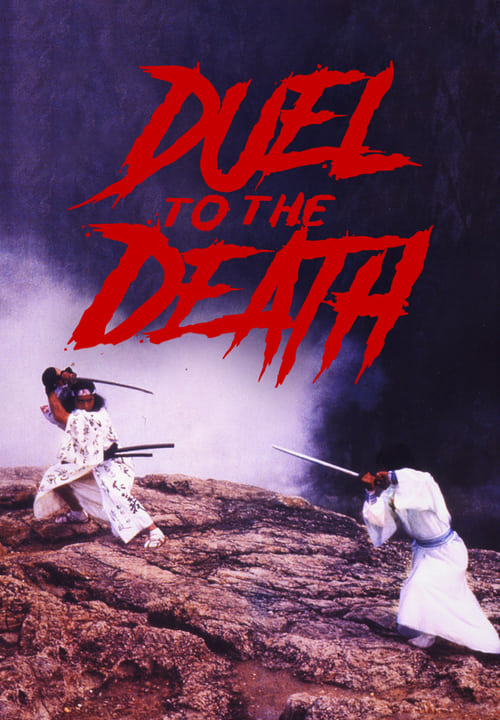
Duel to the Death
1983 · Tony Ching Siu-Tung
For a night when you want martial-arts action turned all the way up — wild, inventive, jaw-dropping — but with an unexpected ache underneath. Reach for it when pure spectacle alone isn't quite enough and you want the fireworks to mean something.
What it's about
Every ten years, the finest swordsman of Ming China meets the finest swordsman of Japan in a ritual duel to the death, fought for national honor. As the next contest approaches, the two champions — China's Bo Ching-Wan and Japan's Miyamoto — discover that forces on both sides are conspiring to rig the fight, turning a sacred rite into something rotten. Two men trained their whole lives for this moment must decide what honor is actually worth.
The experience
It swings between solemn, almost mournful gravity and some of the most deliriously unhinged action of its era — swordsmen launched skyward, ninjas materializing out of nowhere, fights that shred the laws of physics. Underneath the spectacle runs a real melancholy about duty and the emptiness of the glory these men are dying for.
The craft
This is the directing debut of Ching Siu-Tung, one of the most influential action choreographers in Chinese-language cinema, and it plays like a manifesto: wirework, airborne swordplay, and staging ideas he would spend decades refining. The action design is the star — kinetic, gravity-defying, endlessly inventive — and it rewards a big screen where the sheer scale of the set pieces can land.
Why it matters
It marks the hinge between the earthbound studio wuxia of the 1970s and the airborne fantasy cinema that swept Hong Kong in the late 1980s, and it launched the career of an action designer whose style shaped the genre for a generation.
Snapshot
Duel to the Death (生死決, Sang Sei Kuet) is the directorial debut of Ching Siu-Tung, one of the most consequential action designers in Chinese-language cinema, and it announces almost every obsession he would spend the next two decades refining. Framed as a decennial ritual combat between the finest swordsman of Ming China and the finest of Japan — a contest fought "for national honor" — the film uses that solemn premise as a launch pad for some of the most unhinged, gravity-defying action of its era, and then, remarkably, folds the spectacle back into a genuinely melancholy meditation on the vanity of the honor that motivates it. It sits at the hinge between the studio-bound wuxia of the 1970s and the airborne fantasy cinema that would dominate Hong Kong in the late 1980s, and it is best understood as a bridge film: classical in its themes of chivalry and mutual respect, radically modern in its willingness to make ninjas fly, split apart, and detonate. Its reputation has only grown; it is now widely regarded as a cult landmark and one of the purest early statements of the "new-style" Hong Kong sword film.
Industry & production
The film was produced within the orbit of Golden Harvest, the studio that by the early 1980s had displaced the older Shaw Brothers model as the dominant force in Hong Kong commercial cinema. Ching Siu-Tung came to the director's chair not as an outsider but as an industry insider: the son of filmmaker Ching Gong, Peking-opera trained, and already a working martial-arts choreographer through the 1970s. Duel to the Death is thus a choreographer's film in the most literal sense — a technician handed the whole apparatus and using it to externalize an action philosophy he had been developing from the fight-arranging trenches.
Its production sits in a pivotal year. 1983 also produced Tsui Hark's Zu: Warriors from the Magic Mountain, the effects-driven fantasy that is usually cited as the detonation point for modern Hong Kong wire-and-optical spectacle. Duel to the Death is properly read as a companion to Zu rather than an imitation: where Tsui pursued a maximalist, effects-saturated cosmology, Ching pursued kinetic invention grounded (however loosely) in bodies, blades, and wires. Precise budget and box-office figures for the film are not something I can attest to reliably, and I will not invent them; the durable historical fact is qualitative — that the film was recognized, then and since, as unusually ambitious and unusually strange for a swordplay picture of its moment.
Technology
The film is a showcase for the pre-digital Hong Kong toolkit at its most inventive. Its effects vocabulary is built from wirework (fighters and ninjas hauled through the air on cables), trampolines and springboards for vertical launches, undercranking to accelerate motion, and practical pyrotechnics and squibs for the film's many exploding bodies. Optical work and in-camera trickery extend the illusions further — most notoriously in the set-pieces where ninjas merge into a single towering composite figure or disassemble in mid-air. There is no digital compositing here; every impossibility is achieved through physical rigging, editing, and optical printing, which is precisely why the film retains a tactile, hand-made quality that later CGI-heavy fantasies often lose. The technology is not incidental decoration — it is the film's argument that the wuxia body could be liberated entirely from physical law.
Technique
Cinematography
The camerawork is mobile and aggressive, matching the choreography's verticality with craning, swooping movement and low angles that let combatants launch out of frame. The film favors dynamic framing over the static, proscenium-style compositions of an earlier generation of studio wuxia; the camera participates in the fights rather than merely recording them. I do not have a reliably confirmed director-of-photography credit to attribute here, and rather than guess I will simply note that the film's visual signature — high contrast, atmospheric coastal and forest exteriors, and a willingness to shoot against sky to sell the airborne action — is inseparable from Ching's staging.
Editing
Editing is where much of the film's magic is actually manufactured. Cuts conceal the wire launches and landings, accelerate impacts, and stitch together the composite-ninja illusions; the rhythm is percussive, built around the snap of a blade meeting flesh or the sudden verticality of a leap. The cutting is fast without becoming incoherent — an early instance of the tightly managed Hong Kong action grammar that would become internationally influential.
Mise-en-scène / staging
This is the film's crown. Ching stages action as invention rather than as demonstration of technique: a fight is an occasion to unveil something the audience has not seen. The ninjas are the great vehicle for this — they burrow underground, cling to surfaces, glide on kites and cables, assemble into a giant and dissolve back into individuals, and, in the film's most infamous image, one is stripped to reveal a woman using nudity as a weapon of distraction. The two duels that bookend and climax the story are staged on windswept cliffs and open ground, isolating the combatants against sky and sea so that the choreography reads with total clarity. The staging philosophy — clarity of space, escalation of impossibility, emotional stakes embedded in physical movement — is the seed of everything Ching would later do.
Sound
Like most Hong Kong productions of the period, the film was made in the post-synchronized tradition: dialogue and effects laid in during post-production rather than recorded live, with the film circulating in dubbed Cantonese and Mandarin versions. The sound design leans on the exaggerated whooshes, blade-rings, and impact hits characteristic of the genre. I am not able to confirm the composer with confidence, so I will not attribute the score; what can be said is that the music works in the conventional register of the form — swelling for combat, plaintive for the film's quieter passages of doomed camaraderie.
Performance
The performances are pitched between stoic gravity and physical extremity. Damian Lau, as the Chinese champion Ching Wan, brings a scholarly, restrained melancholy — a swordsman weary of the ritual he is asked to embody. Norman Tsui (Norman Chu), as the Japanese champion, gives the film its most complex figure: proud, honorable, and increasingly disillusioned, a man whose loyalty to his nation's cause curdles as he grasps how thoroughly it has been corrupted. Flora Cheung supplies the film's volatile energy as the woman who moves between the two men and the intrigue around them. The central dynamic — two enemies who recognize each other as the only equals in a debased world — depends on the leads playing respect and regret as convincingly as they play combat, and they do.
Narrative & dramatic mode
The dramatic mode is tragedy dressed as spectacle. The premise is a formal contest of national honor, but the plot's engine is a conspiracy — a scheme to rig the duel and, more broadly, to plunder Chinese martial secrets — that hollows out the ideals the duel is supposed to celebrate. This is the film's structural irony: the two men fated to kill each other are the only characters who behave honorably, while the institutions demanding their sacrifice are riddled with treachery. The narrative accelerates from courtly ritual toward violent chaos, and it refuses the reconciliatory ending the genre conventionally offers. The famous climax is one of mutual destruction rather than triumph — a downbeat, almost nihilistic resolution in which victory is meaningless and the cost is total. That bleakness is unusual and deliberate; it is what elevates the film above its own gonzo pleasures.
Genre & cycle
The film is a wuxia swordplay picture inflected heavily with fantasy and with the ninja craze that ran through early-1980s Asian and international genre cinema. It belongs to the transitional cycle that reinvented Hong Kong martial arts filmmaking away from the ground-bound, technique-focused kung fu of the 1970s toward airborne, effects-forward fantasy. Within that cycle it is a founding text: alongside Zu it demonstrates what wire-fu could become when unshackled from realism, and it anticipates the supernatural-swordsman wave that Ching himself would help define later in the decade with A Chinese Ghost Story (1987, which he choreographed and co-directed for Tsui Hark) and the Swordsman films.
Authorship & method
As author, Ching Siu-Tung is best understood as a choreographer-director whose signature is spatial imagination rather than a verbal or thematic style. His method — visible fully formed in this debut — is to conceive action as escalating revelation, to prioritize the poetry of bodies in impossible motion, and to anchor that spectacle to a strong emotional through-line, usually of doomed love or doomed honor. He works through rigging, editing, and optical craft rather than realism, treating physical law as a constraint to be theatrically suspended.
On the key collaborators, honesty requires restraint. The most secure authorial fact is Ching's own dual role as director and de facto action architect. Screenwriting, cinematography, and music credits for the film are areas where I do not have reliable, verifiable attributions at hand, and I will not manufacture names; readers seeking definitive crew credits should consult the film's authoritative filmographic records. What can be stated firmly is that the film reads as a unified directorial vision in which staging, cutting, and effects are subordinated to a single kinetic sensibility.
Movement / national cinema
The film is a product of Hong Kong cinema at the moment the territory's "new wave" energies were spilling into commercial genre filmmaking. It is not an art-house new-wave work, but it is a beneficiary of the same creative loosening — a period when younger filmmakers, many trained in television or as technicians, remade popular forms with new visual ambition. Its treatment of Japan is worth noting within that national-cinema frame: rather than the flat villainy that Sino-Japanese conflict often received in Chinese-language genre film, Duel to the Death grants its Japanese champion dignity and tragic depth, making the corruption of honor a shared human failing rather than a national one. That relative even-handedness is part of what gives the film its lasting moral weight.
Era / period
Set in the sixteenth century during the Ming dynasty, the film uses its historical frame loosely and expressively rather than for documentary accuracy. The period functions to license a world of clan academies, ritual codes, and roving ninjas, and to frame the duel as an ancient, ossified institution ripe for exposure as hollow. The naming of the Japanese champion in the Miyamoto/Musashi register evokes Japan's own legendary swordsman lore, folding the historical mystique of the master duelist into the film's mythology. The Ming setting is atmosphere and moral stage, not chronicle.
Themes
The film's governing theme is the emptiness of institutionalized honor — the way codes meant to ennoble men become instruments of manipulation and waste. Around that core cluster its other concerns: the recognition between true equals across enemy lines; the tension between personal integrity and national duty; the futility of a violence that can only end in mutual annihilation. There is a persistent elegiac undertone, a sense that the very excellence the two swordsmen embody dooms them, because a corrupt world has no use for their ideals except as a spectacle to be exploited. The fantastical action, far from trivializing these ideas, heightens them: the more superhuman the combat becomes, the more clearly its human cost registers as absurd and tragic.
Reception, canon & influence
Critically, Duel to the Death has ascended over time from a striking genre entry to a bona fide cult classic, frequently named among the most inventive and emotionally serious Hong Kong sword films of its era; its combination of berserk spectacle and downbeat gravity is the quality most consistently praised. I will not attach specific contemporaneous review quotations or box-office figures to that reputation, as I cannot verify them, but the trajectory of its standing — steadily rising esteem, especially among Western cult and martial-arts cinephiles — is well established.
Looking backward, the film draws on the wuxia literary and cinematic tradition of chivalric swordsmen and ritual combat, on the early-1980s ninja vogue, and on the Japanese legend of the master duelist. Looking forward, its influence is substantial and travels through its maker: Ching Siu-Tung carried this debut's vocabulary of airborne, wire-driven, emotionally charged action directly into the defining Hong Kong fantasies of the late 1980s and 1990s and, eventually, into the internationally visible wave of wire-fu that reshaped global action cinema — his later choreography for Zhang Yimou's Hero and House of Flying Daggers being the most prominent inheritance. Duel to the Death is, in that light, less a one-off curiosity than a manifesto: the first full articulation of an action poetics that would eventually become one of Hong Kong cinema's most influential exports.
Reception
A cult item rather than a hit in its day, it's since been reclaimed by Hong Kong action devotees as a landmark of wire-fu excess — the movie people point to when explaining where the delirious flying-swordsman style of the late-'80s wuxia boom came from.
How Duel to the Death was received, from release to now →
Influences: the films it descends from and the films it influenced
- A Touch of Zen (1971) — Hu's bamboo-forest ambush pioneered the trampoline-launched leap stitched together with fragmentary cuts so swordsmen seem to hang and vault impossibly — the exact leap-and-edit grammar Ching escalates into full airborne wirework.
- Come Drink with Me (1966) — Imported Peking-opera dance rhythm and posture into swordplay blocking, establishing combat as choreographed performance rather than brawl — the presentational, rhythm-first staging Ching inherits.
- Dragon Inn (1967) — Codified the single-location standoff where rival duelists circle and probe before eruption, the escalating-tension architecture Ching structures his climactic duels around.
- The One-Armed Swordsman (1967) — Chang's Shaw template of the maimed, stoically melancholic hero whose tragedy is staged as bloody spectacle is the emotional-through-line-plus-carnage formula Ching anchors his kinetics to.
- Five Element Ninjas (1982) — Its gimmick-ninja acrobatics — camouflage, gore, trampoline stunts and prop-driven trickery — directly feed Duel's berserk ninja set-pieces of splitting bodies and kite-borne assassins.
- Harakiri (1962) — Kobayashi choreographs formal ritual combat specifically to expose the hollowness of an institutionalized honor code, the same use of the duel-as-indictment that drives Duel's downbeat gravity.
- Lone Wolf and Cub: Sword of Vengeance (1972) — Established the undercranked slash punctuated by geysering arterial spray as a percussive beat, the accelerated-then-punctuated violence rhythm Ching adopts for his sword impacts.
- A Chinese Ghost Story (1987) — Ching carries Duel's vocabulary of doomed love welded to weightless, wire-driven airborne motion directly into supernatural fantasy, extending action-as-escalating-revelation into billowing-cloth spectacle.
- Swordsman II (1992) — Pushes Ching's escalating-revelation choreography to its extreme — each exchange out-inventing the last with palm-energy blasts and impossible flight — the mature form of Duel's build-by-astonishment method.
- The Bride with White Hair (1993) — Extends Ching's model of wire-assisted combat fused to a tragic doomed-romance through-line, treating balletic flight as an expression of emotional fatalism rather than mere athleticism.
- Once Upon a Time in China (1991) — Systematizes the undercranked, wire-assisted swordless-and-swordplay set-piece into a signature Hong Kong export style, industrializing the trampoline-and-optical toolkit Duel prototyped.
- Crouching Tiger, Hidden Dragon (2000) — Its treetop bamboo wire-ballet globalizes the leap-and-hover swordplay lineage, presenting the once-B-movie wirework as arthouse lyricism for international audiences.
- Hero (2002) — Ching Siu-Tung's own choreography here retells his action-as-escalating-revelation principle as color-coded, replayed duel chapters — the direct authorial inheritance from his debut.
- House of Flying Daggers (2004) — Ching stages combat as expanding sensory revelation — the echo-game drum duel and airborne bamboo ambush — refining the wire-and-editing revelation grammar he first articulated in Duel.
- The Matrix (1999) — Imports Hong Kong wire-fu wholesale via a Yuen Woo-ping rig-and-harness workflow, exporting the suspended-in-air, physics-defied fight aesthetic that Duel helped codify as a Hong Kong technology.
- Zu Warriors from the Magic Mountain (1983) — Same-year Hong Kong New Wave experiment that fused optical-printing effects with wire-flight to break physical law onscreen — the parallel technical leap that defined the transitional wire-fu cycle Duel belongs to.
Similar films
- Once Upon a Time in China (1991) — influence & lineage
- Dragon Inn (1967) — influence & lineage
- Come Drink with Me (1966) — influence & lineage
- Crouching Tiger, Hidden Dragon (2000) — influence & lineage
- House of Flying Daggers (2004) — influence & lineage
- Hero (2002) — influence & lineage
- A Touch of Zen (1970) — shared sensibility
- The Blade (1995) — shared sensibility