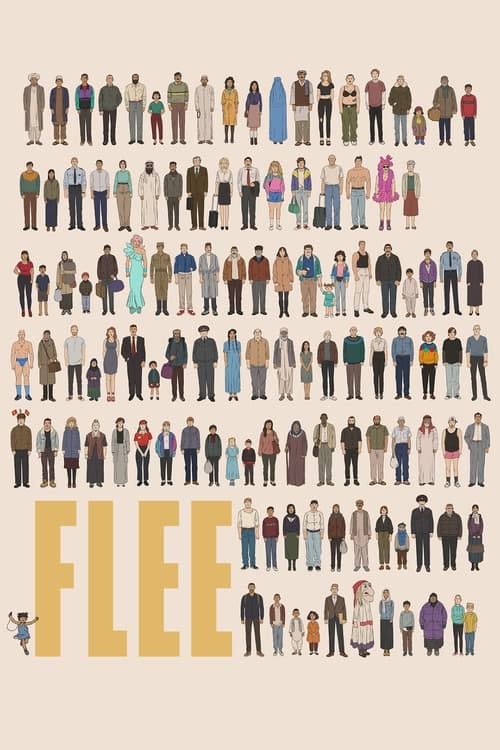
Flee
2021 · Jonas Poher Rasmussen
For when you want a film to chew on for days — a true story that opens your heart rather than lectures you. Emotionally demanding but deeply rewarding; bring someone to talk it over with.
What it's about
A man the film calls Amin — a pseudonym, to protect him — sits down with a director he's known since they were teenagers and tells, for the first time in full, how he fled Afghanistan as a child, survived years of clandestine limbo in Russia, and reached Denmark alone. His testimony is rendered in animation to shield his identity, with bursts of real archival footage as reminders that all of it happened. Now settled and about to marry his partner, he's still carrying a secret he's held for twenty years.
The experience
Intimate and quietly devastating — it feels like being trusted with a confession, and the animation somehow makes the fear and longing more vivid, not less. It's tense in stretches, tender throughout, and stays with you long after.
The craft
The animated-documentary form is the masterstroke: animation protects a real man's identity while giving his memories — including the ones too painful or fragmentary for cameras — a visual life, and the cuts to archival footage keep snapping you back to reality. The interview framing, built on a decades-long friendship, gives the storytelling rare trust and candor.
Why it matters
It made history as the first film nominated for Best Documentary, Best Animated Feature, and Best International Feature at the same Academy Awards, and it became a defining work of the animated-documentary form and of refugee storytelling on screen.
Snapshot
Flee is a Danish-led animated documentary in which a man the film calls Amin Nawabi — a pseudonym adopted to shield his identity — recounts, for the first time in full, how he fled Afghanistan as a child, survived years of clandestine limbo in post-Soviet Russia, and eventually reached Denmark alone as a teenager. Directed by Jonas Poher Rasmussen, who has known Amin since they were teenagers themselves, the film renders the bulk of its testimony in animation, reserving live archival footage for punctuating reminders that the events were real. It premiered at the 2021 Sundance Film Festival, where it won the World Cinema Grand Jury Prize for Documentary, and went on to a singular distinction: at the 94th Academy Awards it became the first film ever nominated simultaneously for Best Documentary Feature, Best Animated Feature, and Best International Feature Film. That triple nomination is the clearest measure of what the film accomplishes — it collapses categories that the industry usually keeps apart, using the "unreal" register of drawing to tell one of the most concretely real stories imaginable. Its subject is not only exile but the private cost of secrecy: Amin is gay, and the film braids the concealment of his refugee history with the long concealment of his sexuality, treating both as burdens of a life spent managing what could and could not be said.
Industry & production
Flee was produced by Final Cut for Real, the Copenhagen documentary house run by Signe Byrge Sørensen and Monica Hellström, the same company behind Joshua Oppenheimer's The Act of Killing and The Look of Silence. That lineage matters: Final Cut for Real specializes in formally daring, ethically fraught nonfiction, and Flee extends its house style of using cinematic artifice to approach truths that direct documentation cannot reach. The film was a multi-country European co-production, with Danish, French, Swedish, and Norwegian partners, financed through the customary Northern European public-funding architecture — the Danish Film Institute and public broadcasters among the backers — that sustains long-gestating documentary work. Rasmussen developed the project over several years, recording Amin's testimony in extended audio interview sessions before any images existed, so that the animation could be built to the voice rather than the reverse.
The film's international profile was amplified by a slate of executive producers who championed it after completion; the actor Riz Ahmed and the actor Nikolaj Coster-Waldau were among the prominent names attached in that capacity, lending visibility to a small documentary well outside the usual awards conversation. In the United States the film was distributed by Neon, which had a strong record of shepherding difficult international and nonfiction titles toward the Oscars. The English-language voice edition, produced to widen the film's reach, carried Ahmed and Coster-Waldau as narrating voices for the framing interviewer and other roles; the original-language version remains in Danish and Dari, spoken by Amin and Rasmussen themselves. Denmark selected Flee as its submission for the international feature Oscar, and it swept a substantial share of the year's documentary and animation prizes across the European festival and awards circuit.
Technology
The core technical proposition of Flee is that animation can serve as a documentary apparatus — not an illustration of testimony but the primary medium in which testimony is delivered. The film was made principally in 2D digital animation, produced with the Copenhagen studio Sun Creature under animation director Kenneth Ladekjær. Its dominant look is a relatively clean, hand-drawn character animation with flat, muted color fields — a deliberately readable style that keeps faces legible and expressive while stopping short of photorealism. Crucially, that stylization is what makes the ethics possible: because the film could not show Amin's real face, or the faces of others still at risk, without endangering people, animation is not a stylistic flourish here but the enabling condition of the film's existence. Interwoven with the drawn material is genuine archival footage — news images of Afghanistan and of the collapsing Soviet sphere, footage of refugees, of Moscow — which grounds the animated recollection in a documented historical reality and periodically reminds the viewer that this is nonfiction. The seam between the two registers is one of the film's most productive technical tensions.
Technique
Cinematography
Because Flee is composed largely of animation, it has no conventional cinematographer in the sense of a camera operator lighting live scenes, and the record on any live-action photographic credit is comparatively thin. What the film does have is a strong sense of framing and virtual camera in the animated passages — compositions that alternate between intimate close framing on faces during interview recollection and wider, colder framing for scenes of transit, detention, and border-crossing. The archival inserts bring their own documentary photographic texture, grainy and time-stamped, deliberately contrasted against the smoother animated surfaces. The visual authorship of the film is therefore better located in its production design and animation direction than in a single director of photography.
Editing
Editing is arguably the film's most decisive technical achievement, because Flee is fundamentally an interview shaped into narrative — the animation follows the cut of the testimony. The veteran Danish editor Janus Billeskov Jansen, a long-standing collaborator in Danish cinema and on Final Cut for Real's earlier work, is credited with the film's construction. The editing performs two simultaneous jobs: it sequences a life told out of order, layering the present-day frame (Amin as an adult, settling into a home and a relationship) against the excavated past, and it modulates the film's registers, deciding when to hand a memory over to abstraction, when to cut to archive, and when to hold on stillness. The rhythm is patient and confessional, allowing silences and hesitations to remain, so that the act of remembering — and of resisting memory — is itself dramatized in the cut.
Mise-en-scène / staging
The film's staging operates on two planes. In the present tense, Amin literally lies down to be interviewed, reclined on the floor with eyes often closed — a posture that unmistakably evokes the analyst's couch and frames the whole film as a kind of therapeutic excavation. Against this deliberately still, controlled present, the animated past is staged with far more incident: crowded apartments, smugglers' rooms, the hold of a boat, the interiors of detention. The most distinctive staging choice concerns trauma. At the film's hardest moments of fear and dissociation, the animation abandons its legible character style for a smeared, sketch-like, near-monochrome mode in which figures dissolve into moving charcoal-like shapes. This visual break stages the limits of memory itself — where recollection cannot resolve into clear images, the film refuses to draw clear images.
Sound
Sound anchors the film's claim to being documentary. The bedrock is Amin's own recorded voice, its grain, breath, and pauses carried intact, so that even fully animated scenes are tethered to an audibly real act of testimony. The score, by the Swedish composer Uno Helmersson — a frequent collaborator of Final Cut for Real — works in restrained, melancholic textures that support rather than dictate emotion. Diegetic sound design and period-specific needle-drops locate the past in time, most memorably through pop music of Amin's youth that ties personal memory to a particular cultural moment. The interplay of intimate voice, sparse score, and archival audio sustains the film's double identity as both crafted animation and recorded truth.
Performance
Performance in Flee is unusual: its central "performance" is a documentary vocal one, Amin narrating his own life, with the animated figure serving as his avatar. The emotional force therefore lives in vocal nuance — hesitation, the tightening of the voice, the moments where he stops. Rasmussen's own voice, as the gentle offscreen interviewer and lifelong friend, is part of the performance texture, and the trust between the two men is audible. In the English-language edition, professional actors lend their voices, but the original version's power derives precisely from its non-professional authenticity — a man speaking, not acting.
Narrative & dramatic mode
The film's dramatic mode is confessional and retrospective, structured as the belated telling of a secret. Its present-tense frame — Amin, now an academic, preparing to buy a house and build a settled life with his partner Kasper — supplies the stability from which the past can finally be spoken, and also the stakes: a secure future can only be fully inhabited once the concealed history is voiced. Within that frame the narrative is a memory-quest that repeatedly complicates its own reliability. A central turn is the revelation that the story Amin has told for two decades — the official account of his family's fate — is itself a protective fiction, so that the film becomes partly about the necessity and cost of the lies refugees must construct to survive asylum systems. The dramatic engine is thus not "what happened" alone but "what could not be said," making disclosure itself the film's climactic action.
Genre & cycle
Flee belongs to the still-young but increasingly defined cycle of the animated documentary, and it is best understood in direct dialogue with its landmark predecessors. Ari Folman's Waltz with Bashir (2008) established the mode's power to render traumatic and repressed memory through animation, and Marjane Satrapi and Vincent Paronnaud's Persepolis (2007) demonstrated animation's capacity to carry autobiographical exile and political history. Flee extends this lineage while adding a specifically ethical rationale — animation as anonymity — that sharpens the mode's justification beyond aesthetics. It also sits within the broader genres of the refugee narrative and queer coming-of-age/coming-out story, fusing them so that flight across borders and the private navigation of sexuality become versions of the same problem of belonging. Its Oscar triple-nomination confirmed that it could not be filed under any single genre heading.
Authorship & method
The film is authored first through relationship. Rasmussen's method was rooted in the fact that he and Amin have been friends since adolescence, when Amin arrived in Denmark; the director spent years earning the trust required for Amin to tell the full story, and the interview-first process — record the voice, then build images to it — is the signature of that method. This is documentary as long collaboration rather than extraction. Around Rasmussen, the authorship is genuinely collective: animation director Kenneth Ladekjær and the Sun Creature studio translated testimony into the visual language; editor Janus Billeskov Jansen shaped the excavation's structure and tone; composer Uno Helmersson supplied the film's emotional undertow; and producers Signe Byrge Sørensen and Monica Hellström at Final Cut for Real provided the institutional space for a formally risky, ethically careful project to mature. The screenplay credit belongs to Rasmussen (with development collaboration), but "writing" here means the architecture of a told life more than invented dialogue.
Movement / national cinema
Flee is a product of the exceptionally strong Danish documentary tradition, one of the most internationally respected small-nation nonfiction cultures, sustained by robust public funding through the Danish Film Institute and by production houses like Final Cut for Real that have made ambitious, world-facing documentary a national specialty. The film also reflects the collaborative Nordic and pan-European co-production model, drawing Swedish, French, and Norwegian resources into a single work. Within that context, Flee represents Danish documentary's continued push beyond observational realism toward hybrid and reconstructive forms — the same experimental impulse that produced Oppenheimer's Indonesia films here turned toward animation and personal memoir.
Era / period
The film occupies two time frames. Its story reaches back to the late 1980s and 1990s — Amin's childhood in Kabul under the shadow of war, the family's flight after the Soviet withdrawal and the ensuing collapse, and years spent in a precarious, semi-legal existence in post-Soviet Moscow before the passage to Scandinavia. This historical setting makes the film a document of a specific refugee experience shaped by the end of the Cold War order. Its production and release, meanwhile, belong to the early 2020s, and the film arrived into a moment of acute global attention to migration and asylum — its 2021 premiere and 2022 awards run coincided with renewed international focus on Afghanistan, which lent the decades-old story an unmistakable contemporary charge.
Themes
The film's governing theme is the story we tell to survive — the idea that displaced people must often construct and maintain fictions, to authorities and to themselves, and that these protective narratives exact a lasting private toll. From this flow its other concerns: home and belonging, and the question of whether "home" can ever be recovered or only rebuilt; the doubled closet, in which concealing one's flight and concealing one's sexuality become entangled forms of hiding; trauma and memory, dramatized formally through the film's dissolving animation; family, both its protection and its fractures under the pressure of escape; and the ethics of witness, since the film is finally about the conditions under which a person can be seen and heard without being endangered. That last theme is inseparable from the film's form: anonymity is not only a subject but a made object here.
Reception, canon & influence
Flee was received with near-unanimous critical acclaim from its Sundance premiere onward, widely praised for the emotional and ethical intelligence with which it married animation to documentary testimony. It accumulated a broad sweep of honors across the documentary and animation circuits — including major European and international documentary awards — before its historic triple Academy Award nomination sealed its status as a landmark of the animated-documentary form. Denmark's submission as its international feature, it competed and was celebrated simultaneously as documentary and as animation, a duality no earlier film had carried so far.
Its influences run backward to the animated-documentary lineage of Waltz with Bashir and Persepolis, and to Final Cut for Real's own tradition of using cinematic construction to reach documentary truth; the interview-driven method also draws on a long confessional strain in personal documentary. Its forward influence is best understood as consolidating and legitimating the animated documentary as a serious, award-worthy mode capable of carrying first-person testimony about trauma, migration, and identity — demonstrating to funders, festivals, and academies that a drawn film can be received as rigorous nonfiction. As a relatively recent work, its full downstream impact is still emerging and any specific claim about films it directly inspired would be premature; what is already clear is that Flee stands as a reference point for how animation can protect a subject while amplifying, rather than diluting, the reality of what that subject has lived.
Reception
No reappraisal needed — it landed fully formed, winning the World Cinema Documentary Grand Jury Prize at Sundance 2021 and riding near-universal acclaim all the way to the Oscars. If anything has shifted since, it's that the awards-season buzz has settled into quiet consensus: this one's a keeper.
How Flee was received, from release to now →
Influences: the films it descends from and the films it influenced
- Waltz with Bashir (2008) — Establishes Flee's core method of animating recorded first-person interview audio to reconstruct suppressed traumatic memory, using drawn imagery precisely where the mind's record fails and archive cannot follow.
- Persepolis (2007) — Models the autobiographical exile testimony rendered in high-contrast, near-monochrome graphic flatness, letting stylized 2D animation carry a first-person account of displacement and coming-of-age under threat.
- The Thin Blue Line (1988) — Pioneers the interview-first documentary where recorded testimony drives the edit and non-realist staged imagery visualizes competing versions of an event, licensing Flee's protective-fiction narration.
- La Jetée (1962) — Prototype for reconstructing memory as a voiceover-led montage of fixed images, where sound testimony rather than continuous live action becomes the load-bearing record of a remembered past.
- Waking Life (2001) — Advances the technique of animating pre-recorded real conversation, using drawn instability of line and surface to render subjective, dissociative states over documentary speech.
- Ryan (2004) — Directly precedes Flee's use of animation to visualize psychological damage—distorting the drawn body and space to externalize a real interview subject's trauma while the recorded voice stays intact.
- Tarnation (2003) — Sets the confessional-retrospective template of a filmmaker excavating a close subject's life across years, weaving personal archive and period needle-drops into a first-person account of identity and survival.
- Tower (2016) — Rotoscopes reenacted survivor testimony synced to recorded voices, using animation to protect and re-embody witnesses while integrating real archival footage at moments of documentary rupture—Flee's exact hybrid.
- The Breadwinner (2017) — Extends the animated recent-history testimony: an Afghan refugee's memory told in shifting drawing styles, naturalistic frame giving way to abstracted trauma.
- Little Amélie or the Character of Rain (2025) — Carries the artisanal-animated literary memoir forward, proving hand-crafted animation can carry a first-person autobiographical voice through trauma and displacement for adult audiences.
- Ethel & Ernest (2016) — Extends the animation-as-memoir mode, building an intimate personal chronicle out of domestic recollection and reinforcing hand-drawn animation as a vehicle for serious autobiographical history.
- Rio 2096: A Story of Love and Fury (2013) — Extends the voiceover-guided animated-memory form — first-person testimony reckoning with displacement and a nation's violent history through stylized 2D.
- The Act of Killing (2012) — Shares Flee's Final Cut for Real house method (producer Signe Byrge Sørensen) of using deliberate cinematic construction and staged form, rather than observational realism, to reach a documentary truth the subject cannot state plainly.
- The Look of Silence (2014) — Extends the same Final Cut for Real practice of a long-trust relationship with a testifying subject, building formal apparatus around confrontation with buried memory rather than extracting it in a single sitting.
- The Missing Picture (2013) — Uses handmade figures against archival footage to supply the images that no camera recorded, the same substitution logic by which Flee animates the un-filmable stretches of a refugee's clandestine passage.
- Crulic – The Path to Beyond (2011) — Builds an animated documentary around a single migrant's recorded/reconstructed first-person narration, mixing drawing styles and archival material to trace a life across borders and detention.
- Chris the Swiss (2018) — Interleaves animation with live archive to investigate a personally-connected subject, using the drawn passages specifically for the unverifiable, interior, or unrecorded portions of the testimony.
- Another Day of Life (2018) — Alternates stylized animation with documentary footage and interviews to convey a war-zone eyewitness account, deploying drawn sequences for subjective dread that reportage footage can't capture.
- Josep (2020) — Carries the animated refugee-testimony form with a sketched, charcoal-adjacent line, using hand-drawn aesthetics to render displacement, internment, and a coming-out of buried history.
- In Waves (2026) — Contemporary animated memoir drawn from the real subject's recorded testimony, extending the ethical documentary-reconstruction method into festival-circuit adult animation about loss.
- The Summit of the Gods (2021) — Same-year adult animated feature reconstructing a life from testimony with documentary restraint, part of the shared argument that 2D can carry research-grounded, interior nonfiction-style drama.
- I Lost My Body (2019) — Uses hybrid animation to crosscut layered memory timelines toward a withheld personal reveal, and its triple-Oscar-nominee streaming run extended I Lost My Body's proof that adult animation competes at the top of the awards field.
Similar films
- Waltz with Bashir (2008) — influence & lineage
- In Waves (2026) — shared sensibility
- Flow (2024) — shared sensibility
- Nimona (2023) — shared sensibility
- The Breadwinner (2017) — shared sensibility
- Close (2022) — shared sensibility
- Marona's Fantastic Tale (2020) — shared sensibility
- The Boy and the Heron (2023) — shared sensibility