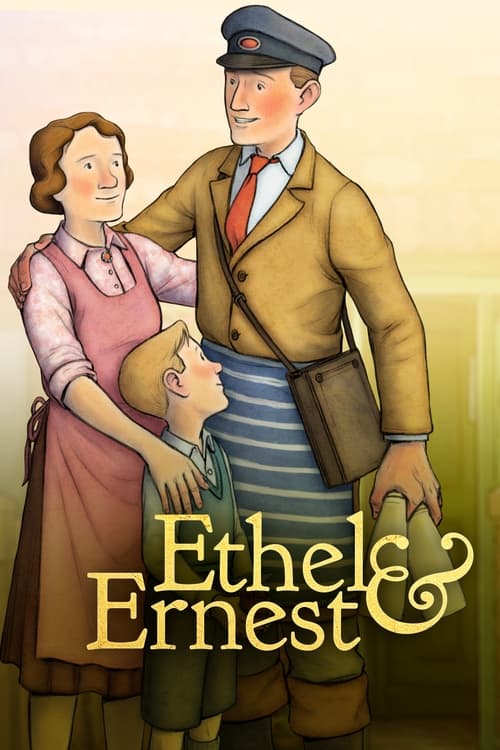
Ethel & Ernest
2016 · Roger Mainwood
For a tender night in when you want to feel the weight of ordinary life — comfort viewing that will still leave you misty about your own parents or grandparents.
What it's about
A hand-drawn animated portrait of Raymond Briggs's parents: Ernest, a cheerful London milkman, and Ethel, a former lady's maid, from their courtship in the late 1920s to their deaths in 1971. Nothing extraordinary happens to them — instead, the extraordinary twentieth century happens around them: the Blitz, the welfare state, television, a son who becomes an artist. It's a whole marriage, and a whole era, in ninety-odd minutes.
The experience
Gentle, funny, and quietly heartbreaking — the tone of a son lovingly teasing his parents while grieving them. It sneaks up on you; the small domestic moments do the emotional damage.
Performances
Jim Broadbent and Brenda Blethyn voice Ernest and Ethel with such lived-in affection — his optimism, her propriety, their bickering warmth — that you forget you're listening to actors at all.
The craft
The animation faithfully translates Briggs's soft watercolour comic-strip style into movement, and the period reconstruction of working-class London across five decades is lovely and exact. Roger Mainwood, a veteran of Britain's hand-drawn tradition, made this his feature debut — and it's a testament to what that craft can carry emotionally.
Why it matters
A late flowering of British hand-drawn animation and the definitive screen version of one of Briggs's most personal books, proving adult animation could be domestic, historical, and quietly profound.
Snapshot
Ethel & Ernest is a hand-drawn animated feature adapting Raymond Briggs's 1998 graphic memoir of the same name, a chronicle of his parents' marriage from their meeting in the late 1920s to their deaths within months of each other in 1971. It was the feature directorial debut of Roger Mainwood, a British animator long associated with the studio traditions behind The Snowman, and it channels Briggs's watercolour comic-strip aesthetic into a modest, emotionally exacting family chronicle. Ernest, a Belfast-born—no: London milkman, and Ethel, a former lady's maid, are voiced by Jim Broadbent and Brenda Blethyn. The film's ambition is deliberately small in scale and large in reach: to hold two entirely ordinary lives up against the transformations of the twentieth century — the Blitz, the welfare state, suburbanisation, the arrival of the telephone, car, and television — and to let the private and the historical illuminate each other. It is a British art-house and television production rather than a mass-market animated feature, and it belongs to a distinct lineage of grown-up, melancholic British animation aimed as much at adults as at children.
Industry & production
The film was produced primarily by Lupus Films, the London studio run by Camilla Deakin and Ruth Fielding, which has specialized in literary and heritage animation (including later Briggs-adjacent and Snowman-universe projects). It was mounted as an international co-production, a now-standard structure for feature animation of this budget class, drawing partners across the UK and continental Europe — Lupus Films with Melusine Productions of Luxembourg among the co-producing entities, and support from public-service and lottery-funded bodies including the BBC and the British Film Institute, with Welsh involvement through the Cardiff animation sector. (The precise roster of co-financiers and the exact budget are not something I can state with confidence, and I will not invent figures.)
Crucially, Ethel & Ernest was conceived with television as a primary destination as much as cinema. It received a limited theatrical release in the UK in late 2016 and was broadcast on the BBC over the 2016 Christmas period — the same seasonal, hearthside slot that had long carried The Snowman and its successors. This dual life as a modest cinema release and a prestige broadcast event is characteristic of British animation economics, where public broadcasters underwrite work that the commercial feature market would not sustain. The graphic novel's own prestige — Briggs's Ethel & Ernest was widely honored on publication, winning illustrated-book recognition in the British book awards of the period — gave the adaptation an established cultural standing and a built-in readership.
Technology
The film is essentially a traditional 2D production executed with contemporary digital tooling. Its surface deliberately preserves the look of hand-drawn line and colored wash — the aesthetic of Briggs's original pencil-and-watercolour pages — rather than adopting the flat vector or CG pipelines that dominate commercial animation. In practice this means hand-drawn key and in-between drawing combined with digital compositing, color, and camera moves, a hybrid workflow now standard for studios preserving a "drawn" look. The film frames its animation with live-action material: Raymond Briggs himself appears in a documentary-style prologue, situating the animated story as a son's act of remembrance. This live-action-to-animation threshold is itself a technological and rhetorical device, marking the passage from the real, aged author into the reconstructed world of his parents. I would not overstate any technical innovation here; the film's achievement is one of fidelity and restraint rather than pipeline novelty.
Technique
Cinematography
Because this is drawn animation, "cinematography" means the design of a virtual camera and the staging of image within the frame. The film's visual grammar is intimate and largely domestic: interiors of the small Wimbledon Park house recur as the fixed stage of the marriage, and the "camera" tends toward stable, unhurried framings that match Briggs's panel compositions. The palette shifts with era and mood — soft, warm domestic tones giving way to the desaturated grays and searchlight-cut skies of the wartime sequences. Compositions frequently isolate the couple within their home against the churn of history glimpsed through windows, doorways, and the radio; the framing repeatedly returns to the house as anchor, using consistency of place to measure the passage of decades.
Editing
The film's structure is episodic and chronological, moving in vignettes across roughly four decades. Editing works by ellipsis: years are dropped between scenes, and the audience is asked to register change through accumulated small differences — a new appliance, a grown child, a grayer head. Historical time is often compressed via montage and via the couple's reactions to offscreen events (news of war, of the moon landing, of social change) rather than through spectacle. The cutting rhythm is gentle and additive rather than propulsive, consistent with a memoir's logic of remembered moments rather than plotted incident.
Mise-en-scène / staging
This is the film's richest expressive register. Period detail — furnishings, clothing, the objects of a working-class then lower-middle-class English home — carries much of the narrative and thematic weight. The gradual modernization of the house (the arrival of the telephone, the motorcar, the television set) is staged as visible social history. Class is written into the décor and into the couple's differing attitudes toward respectability and aspiration. The staging honors the theatrical intimacy of two people in domestic space, with the drama emerging from ordinary tasks and conversations rather than dramatic confrontation.
Sound
The score is by Carl Davis, a composer long identified with British film and television and celebrated for his silent-film accompaniments; his idiom of warm, tonal orchestral writing suits the film's affectionate, elegiac tone. The film is also notable for an original song contributed by Paul McCartney, "In the Blink of an Eye," used in association with the film — a significant marker of the production's cultural profile. Diegetic sound is period-specific and evocative: the radio in particular functions as the household's window onto national events. Voice performance (below) is central to the soundtrack's emotional texture.
Performance
Vocal performance carries the film. Jim Broadbent as Ernest and Brenda Blethyn as Ethel deliver naturalistic, lived-in readings that avoid caricature; much of the film's pathos derives from the ordinariness and warmth of their exchanges. Broadbent's Ernest is genial, curious, politically hopeful (a Labor-leaning optimist about the postwar settlement), while Blethyn's Ethel is more anxious about status and propriety. Animation performance — the drawing of gesture, posture, and small facial change over the aging bodies — is calibrated to support rather than exaggerate the vocal work.
Narrative & dramatic mode
The film is a biographical domestic chronicle in the memoir mode: intimate, retrospective, and elegiac. Its dramatic engine is not conflict but the passage of time and the tension between private continuity and public upheaval. There is no villain and no plot in the conventional sense; instead the film accrues meaning through the patient depiction of a marriage across changing circumstances — courtship, the birth and rearing of their only son (Raymond himself), the disruptions of war and evacuation, postwar recovery, and finally illness, aging, and death. The narrative stance is that of the son looking back with love and a degree of guilt, and the film's emotional arc bends inexorably toward mortality, closing on the near-simultaneous deaths of both parents.
Genre & cycle
Nominally classed as animation, drama, war, and history, Ethel & Ernest sits most comfortably in a British tradition of adult-oriented, socially observant animation. It belongs to a small cycle of Briggs adaptations — most obviously The Snowman (1982) and When the Wind Blows (1986), the latter also a somber, adult work about ordinary people (indeed an elderly couple much like Ethel and Ernest) facing catastrophe. The film thus participates in a niche cycle where animation is used not for fantasy or comedy but for realist, emotionally serious storytelling about English domestic life and twentieth-century history.
Authorship & method
Authorship here is doubled. The originating author is Raymond Briggs, whose graphic memoir supplies the story, the visual style, and the moral perspective; the film is faithful to his drawings and to his mixture of tenderness and unsentimental candor, and his on-screen presence in the framing device foregrounds his authorship. The film's director, Roger Mainwood, brought decades of experience in British animation (including work within the studio culture that produced The Snowman) to this, his feature debut; he also wrote the screen adaptation. Mainwood died in 2018, making Ethel & Ernest effectively his signature and valedictory work as a feature director.
Among key collaborators, composer Carl Davis provides the orchestral score, and Paul McCartney contributes an original song. The producing partnership of Camilla Deakin and Ruth Fielding at Lupus Films is central to the film's realization and to its place within a continuing British heritage-animation practice. The voice cast — Jim Broadbent and Brenda Blethyn — should be counted among the principal authors of the film's tone. I do not have reliable, specific attributions for the individual heads of the animation, art, and editing departments and will not fabricate names.
Movement / national cinema
The film is emphatically a work of British national cinema, and specifically of the British public-service-funded, heritage-inflected sector. It draws on the long British tradition of realist attention to class and everyday life — a sensibility with roots in social-realist filmmaking and in the documentary impulse — transposed into animation. Its co-production financing situates it within the European art-animation ecosystem, where small national studios pool resources to make culturally specific features. Unlike the American feature-animation industry, this is a tradition in which animation is understood as a medium open to memoir, history, and adult melancholy.
Era / period
Two time-frames matter. The film's setting spans roughly 1928 to 1971, and it is meticulously a period piece across that arc — the interwar years, the Second World War and the Home Front, the founding of the welfare state and the National Health Service, postwar affluence and technological modernization, and the social change of the 1960s. Its moment of production, 2016, is equally significant: it arrives as a work of national memory at a time of renewed British reflection on the twentieth century and the wartime generation, offering a portrait of an ordinary couple whose lifetimes bracket the century's defining transformations.
Themes
The film's central theme is the dignity and texture of ordinary life — the insistence that two unremarkable Londoners are worthy subjects for serious art. Interwoven with this are: class and social mobility, dramatized through the couple's differing aspirations and, poignantly, through their son's movement into the educated middle class and the arts, which subtly estranges him from his parents' world; technological and social modernity, made visible in the changing household; history experienced from below, especially the Home Front and the Blitz; and, finally, love, aging, and mortality. Underlying all of it is the elegiac theme of memory itself — the film as a son's tender, imperfect reconstruction of the people who made him.
Reception, canon & influence
Ethel & Ernest was received warmly by British critics as a moving, understated, and beautifully crafted adaptation, praised particularly for its fidelity to Briggs's spirit and for the vocal performances of Broadbent and Blethyn; its 2016 Christmas BBC broadcast confirmed its place in the seasonal tradition of Briggs animation. (I will not cite specific review quotations, scores, or viewing/box-office figures I cannot verify.)
Looking backward, the film's influences are clear and acknowledged: Raymond Briggs's own body of work, above all the graphic novel it adapts and the tonal precedent of When the Wind Blows, which had already shown that Briggs adaptations could address adult mortality with animation; and the broader British realist tradition's attention to class and domestic life. The studio lineage of The Snowman — its hand-drawn, watercolour warmth — is the film's most direct stylistic ancestor.
Looking forward, its influence is best understood as consolidating rather than founding a tradition: it stands as a notable modern example of animation used for adult memoir and social history, reinforcing the case that hand-drawn feature animation remains a viable vehicle for serious, small-scale human stories in an era dominated by CG spectacle. As Roger Mainwood's final feature and a late high point of Briggs adaptation, it also functions as a memorial object twice over — for the author's parents and, in retrospect, for two of the artists (Mainwood, and later Briggs himself) who brought their story to the screen. Its longer-term canonical standing is still settling, but it is securely established as a touchstone of contemporary British adult animation.
Reception
It slipped out quietly — a London Film Festival premiere and a BBC One slot between Christmas and New Year 2016 — and has since become a word-of-mouth treasure, passed around by animation fans as one of the decade's great underseen tearjerkers, with renewed attention after Raymond Briggs died in 2022.
How Ethel & Ernest was received, from release to now →
How to watch Ethel & Ernest: what to notice on a first viewing
- Notice how often scenes happen inside the same house interior. The Wimbledon Park front room and kitchen recur as the fixed stage for the whole marriage, while news of war, politics, and social change arrives from outside its windows and doorways. The house stays fixed while the country changes around it, so the decades register through what enters the house, not through the house itself.
- Notice how the color palette shifts between peacetime and wartime scenes. Warm domestic tones give way to desaturated grays and searchlight-cut skies whenever the Blitz or wartime anxiety enters the story, then warm again once the danger passes. Color alone tells you how safe or frightened the household feels before a single line of dialogue does.
- Track each new object that arrives in the house over the years. A telephone, a motorcar, then a television set arrive one by one, each staged as a small event that Ernest and Ethel react to differently. Each new object marks a decade passing and quietly measures the couple's rising class and comfort.
- Listen for what the radio announces before anyone reacts to it. National events, war, politics, the moon landing, reach the household first through the radio, and the film often shows the couple simply listening rather than dramatizing the event itself. History arrives in this house as something overheard, not something the couple ever gets to shape.
- Notice how plainly Broadbent and Blethyn deliver even the biggest news. Ernest and Ethel receive courtship, war, and loss in the same conversational, understated tone they use for tea and small talk, with no raised voices. The ordinariness of the delivery is the point: two average people are treated as worth this much attention.
The whole guide to watching Ethel & Ernest, with the keys for a rewatch →
Influences: the films it descends from and the films it influenced
- The Snowman (1982) — Established the crayon-textured, watercolour-soft hand-drawn house style and the Raymond Briggs live-action framing device (author introducing his own tale) that Ethel & Ernest directly emulates.
- When the Wind Blows (1986) — The proximate precedent: a Briggs adaptation that renders an ordinary elderly couple's domestic routine and mortality by animating flat 2D figures against dimensional set-like backgrounds, proving Briggs animation could carry adult grief.
- Father Christmas (1991) — Continued the craft of translating Briggs's grumbling working-class Everyman and his panel-to-frame drawing style into feature animation, sustaining the tonal register Mainwood inherited.
- Watership Down (1978) — Founded the British tradition of feature-length hand-drawn animation for serious adult subject matter, using naturalistic English landscape watercolour backgrounds rather than cartoon abstraction.
- Grave of the Fireflies (1988) — Pioneered charting twentieth-century social history through elliptical hand-drawn vignettes of one family's ordinary domestic intimacies, dignifying small private lives against a national historical backdrop.
- Persepolis (2007) — Model for adapting an autobiographical graphic-novel memoir while preserving the author's own drawn line, using animation to compress decades of family history against political upheaval.
- Yellow Submarine (1968) — Precedent for anchoring a British hand-drawn feature with an original Paul McCartney musical contribution, the same collaborative device Ethel & Ernest reprises with McCartney's end-credits song.
- Flee (2021) — Extends the animation-as-memoir mode, building an intimate personal chronicle out of domestic recollection and reinforcing hand-drawn animation as a vehicle for serious autobiographical history.
- The Breadwinner (2017) — Cartoon Saloon hand-drawn feature deploying social-realist period detail and a domestic family chronicle to render ordinary life under historical pressure.
- Chico & Rita (2010) — Uses 2D hand-drawn animation, dense period production design, and a wall-to-wall musical score to trace a couple's relationship across mid-century decades — the same memoir-across-time architecture.
- Wrinkles (Arrugas) (2011) — Adult hand-drawn feature adapted from a graphic novel that finds tenderness and dignity in the unspectacular lives of the elderly, refusing caricature in favour of naturalistic observation.
- The Illusionist (2010) — An elegiac, near-wordless 2D feature that rejects spectacle for naturalistic domestic staging and period melancholy, carried by delicate character animation of quiet aging figures.
- Waltz with Bashir (2008) — Advanced animation as adult autobiographical memoir and social-historical document, reconstructing lived personal history in a form live action could not stage.
- Song of the Sea (2014) — A European art-animation coproduction sustaining hand-drawn 2D feature-making as a vehicle for intimate family stories, deliberately positioned against CG spectacle.
- Ernest & Celestine (2012) — A watercolour-line European coproduction whose loose painterly backgrounds and tender, unhurried domestic register share Ethel & Ernest's hand-drawn-digital hybrid warmth.
- The Wind Rises (2013) — A hand-drawn biographical chronicle spanning early-twentieth-century history through a life's private moments, dignifying ordinary daily existence within a sweep of national change.
- We're Going on a Bear Hunt (2016) — Produced by the same Lupus Films partnership (Deakin & Fielding) in the same year, continuing hand-drawn British literary adaptation with watercolour, virtual-camera domestic framing.
Similar films
- Ernest & Celestine (2012) — influence & lineage · same viewing thread
- When the Wind Blows (1986) — influence & lineage
- Grave of the Fireflies (1988) — influence & lineage
- Watership Down (1978) — influence & lineage
- Little Amélie or the Character of Rain (2025) — same viewing thread
- Loving Vincent (2017) — same viewing thread
- My Life as a Zucchini (2016) — same viewing thread
- In This Corner of the World (2016) — shared sensibility
All the films related to Ethel & Ernest →
Watch it with: curated runs of related films
- Handmade Animation's Dark Wonder — A run of painstakingly handcrafted animation — painted, stop-motion, watercolor — where childhood wonder keeps brushing up against loss and the adult dark.