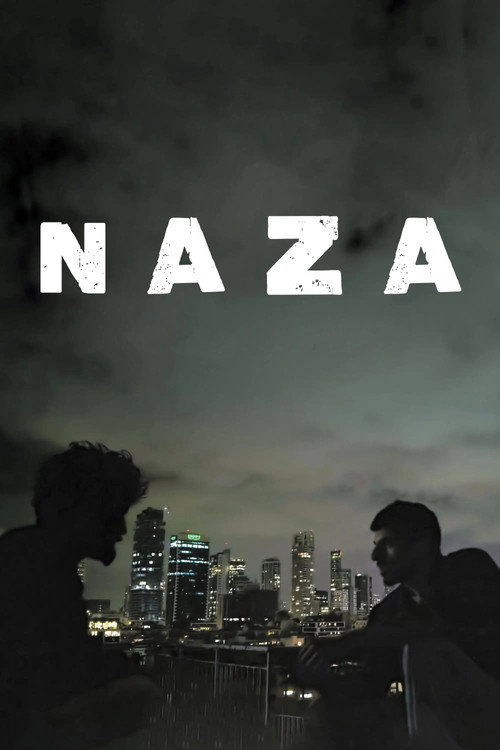
NAZA
2026 · Yuval Abraham
For when you want to be confronted, not comforted — a serious, demanding watch for a night when you're ready to sit with hard testimony about a war still in the news. Not background viewing; it asks your full attention and will stay with you for days.
What it's about
On night-time rooftops in Tel Aviv, investigative journalist Yuval Abraham interviews Israeli soldiers and military-intelligence personnel — faces hidden, voices altered — about how civilian deaths in Gaza were calculated, authorised, and partly automated after October 2023. The title is a military acronym for the expected civilian toll of a planned strike, and the film is built from roughly two dozen of these anonymous testimonies gathered over three years. Below the rooftops, the city carries on its ordinary evening life while the speakers describe the machinery of targeting operating sixty kilometres away.
The experience
Quiet, dark, and deliberately unhurried — it plays less like a news report than a series of confessions overheard at night, and the tension comes from listening to calm voices explain procedures for permitted killing. The darkness and the altered voices keep you leaning in, and the weight accumulates until it's genuinely hard to shake.
The craft
Rachel Szor's low-light cinematography turns a security necessity into the film's visual language: silhouettes against the lit skyline, residents glimpsed through apartment windows, almost nothing shown in full light. The soldiers sketch the targeting systems in marker on paper, which makes complex procedures legible without a single military graphic, and the sound design — processed voices, the squeak of a pen, long pointed silences — does much of the emotional work. It rewards a dark room and good speakers far more than a glance on a laptop.
Why it matters
It premiered in Competition at Venice in 2026 to a record ovation and won the Special Jury Prize, arriving as both a film and a news event: produced by the Guardian, executive-produced by Jonathan Glazer, met with fierce political backlash in Israel, and planned to stream free worldwide after its theatrical run. For Abraham and Szor, co-directors of the Oscar-winning No Other Land, it confirmed a new model of investigative journalism made as cinema.
Snapshot
NAZA is an 80-minute investigative documentary directed by Yuval Abraham and Rachel Szor. Most of it is made of night-time conversations on Tel Aviv rooftops, where Abraham interviews Israeli soldiers and military-intelligence personnel whose faces are hidden and whose voices are digitally altered. Reviewers report that 24 people testified on camera, recorded over about three years, out of a wider investigation that reportedly drew on more than a hundred sources. They describe how civilian deaths were calculated, authorised and partly automated during Israel's war in Gaza after 7 October 2023. The title comes from a Hebrew military-intelligence acronym for the expected number of civilians killed in a planned strike, usually rendered in English as "collateral damage."
The film premiered in Competition at the 83rd Venice International Film Festival on 10 September 2026 and won the Special Jury Prize. It was produced by the Guardian and James Wilson's JW Films, with Jonathan Glazer as executive producer. It is the second feature from Abraham and Szor, who were two of the four co-directors of the Oscar-winning No Other Land (2024). It works as both a film and a piece of journalism. It extends the reporting Abraham published in +972 Magazine and Local Call about AI-assisted targeting systems, and turns that reporting into a sustained cinematic study of perpetrator testimony.
Industry & production
The production model is unusual for a festival-competition feature. The lead producer is the Guardian, a newspaper rather than a film company, working with JW Films. James Wilson produced Glazer's Under the Skin (2013) and The Zone of Interest (2023), and Glazer serves as executive producer. That lineage matters. Glazer's Academy Award acceptance speech for The Zone of Interest in March 2024 addressed the war in Gaza directly, and his name links NAZA to the most widely discussed recent fiction film about perpetrators and atrocity.
The Guardian's role also shaped distribution. According to reporting in The National, the film secured theatrical release in 56 territories, with MK2 handling international sales. Italy got a 500-screen, three-day event release from 23 September 2026. In the US it opened at the IFC Center in New York on 30 September and expanded from 9 October. After the theatrical window, the film is planned to stream free worldwide on the Guardian's website, which is close to the model of investigative journalism. Production countries and the full budget are not documented in the sources available here.
The production was shaped by legal and physical risk. The testifiers are serving or former soldiers and intelligence officers talking about classified operations, so anonymity was a precondition for the film existing at all, not an aesthetic choice made afterwards.
Technology
The film's subject is military technology: the targeting systems Abraham first described in print. Reviewers report that the testimonies cover "Lavender" (an AI-assisted system that generates lists of suspected militants), "The Gospel" (Habsora, which generates building targets) and "Where's Daddy?" (which tracks targets to their family homes). Abraham's +972/Local Call investigations in November 2023 and April 2024 brought these systems into public view. The film gives faces, in a veiled way, and voices to the people who operated them. One review says the testimony includes an admitted error rate for Lavender. Error rates quoted in different accounts vary, so this dossier does not settle on a figure.
On the filmmaking side, the main technical tools are low-light digital cinematography and digital anonymisation of faces and voices. No published source available here names the camera system, grading pipeline or voice-processing method.
Technique
Cinematography
Szor is credited in press reporting with filming the rooftop interviews. The defining choice is darkness. Little White Lies notes that for roughly the first 75 minutes the film stays deliberately dim: faces are obscured, figures are silhouetted against the lit city, and the image refuses the "almost blinding clarity" of No Other Land. In interviews, Szor has described the night rooftops as a contemplative setting that helped people speak more freely. Critics have taken this as a production constraint turned into a visual language.
The camera often looks outward as well as at the speakers. The International Cinephile Society (ICS) review describes cityscape shots of Tel Aviv residents seen through lit windows, filmed through glass and obstructions. These faceless domestic figures create a parallel the film never states aloud: people being turned into data points on one side of the border, and ordinary life continuing on the other. The glass-and-steel skyline becomes the backdrop for testimony about systematic destruction about 60 km to the south.
Editing
The film is built from a set of interviews, punctuated by inserts. Reviewers single out several deliberate juxtapositions. Archival footage of Benjamin Netanyahu defining terrorism is set against soldiers describing comparable acts. A cinema marquee advertising a Claude Lanzmann retrospective appears as Holocaust analogies surface in the testimony. Archival material about Tel Aviv's own founding and history is also included. Little White Lies praises the "pointed silence" after these moments. The ICS review, while largely positive, finds the historical footage somewhat disconnected from the main investigation. No editor credit appears in the sources consulted here.
The overall shape withholds and then releases. Only in the final minutes does the film show the devastation in Gaza that it has kept offscreen until then.
Mise-en-scène / staging
The rooftop is the film's single stage: high, exposed, nocturnal, overlooking a functioning city. In Review Online says the setup "plays like a voyeuristic thriller." Within that staging, the testifiers explain the systems with pen-and-paper sketches drawn in marker on white paper. These diagrams are a modest visual device that makes the procedures understandable without using military graphics or reconstructions.
Sound
Sound carries much of the film. Voices are digitally altered, so the spoken word arrives already processed, at a distance from any individual. Little White Lies draws attention to ambient detail, including the squeak of wet marker tips on paper.
Accounts of the score disagree. Little White Lies describes the film as essentially without music. In Review Online refers to a "hypnotic drone score by Mica Levi," who scored Glazer's Under the Skin and The Zone of Interest. On the record available here, the most that can be said is that any music is sparse and drone-based enough for one critic to perceive none. Levi's involvement should be checked against the film's official credits before it is treated as established.
Performance
There are no performers in the conventional sense. The film's "performances" are testimony delivered under anonymity. Without faces, viewers attend to cadence, hesitation, rationalisation and the occasional moment of candour. Abraham's interviewing is described as patient, with little directorial intervention. He lets the speakers explain procedures in their own terms rather than confronting them dramatically. This restraint is a method of its own, and it is familiar from the strongest perpetrator-testimony documentaries.
Narrative & dramatic mode
NAZA is an expository-investigative documentary carried by an interview-based, participatory structure. Abraham is present as questioner but not as a protagonist on screen in the way he was in No Other Land. Its drama is one of accumulating knowledge rather than events. Each testimony adds a layer to a picture of a bureaucratic, increasingly automated system for authorising civilian death:
- Thresholds: the acronym itself, permitted civilian tolls, and strikes reported in reviews to have been authorised with tolls of more than 200 people.
- Targeting: systems that generate and track targets.
- Surveillance: practices that include monitoring phones.
- Information war: reviewers also mention testimony about a propaganda or influence apparatus, though the ICS critic felt this strand was underdeveloped.
The withheld images of Gaza at the end act as the film's dramatic and ethical climax. They turn the abstraction of the numbers into a visible aftermath.
Genre & cycle
The film belongs to several overlapping traditions:
- Perpetrator-testimony documentary: a line running from Lanzmann's Shoah (1985) through Rithy Panh's S21: The Khmer Rouge Killing Machine (2003) and Joshua Oppenheimer's The Act of Killing (2012).
- Investigative and whistleblower documentary: Laura Poitras's Citizenfour (2014), also tied to Guardian reporting. Little White Lies invokes Poitras's idea of "journalism plus."
- Israeli soldier-testimony films: most pointedly Avi Mograbi's Z32 (2008), which also used digital masking to protect a veteran describing a killing. This is an analytical comparison; none of the sources consulted cites Z32 as a direct influence.
The film is also part of the wave of documentary work about the Gaza war since October 2023, much of it made by Palestinian filmmakers from inside Gaza. NAZA is distinctive within that cycle because it looks from the side of the people who carry out the violence, documenting the system rather than the ground-level experience of its targets.
Authorship & method
Yuval Abraham is an Israeli investigative journalist. His reporting for +972 Magazine and Local Call on "The Gospel" and "Lavender" was among the most cited journalism of the war. He came to international attention as a co-director of No Other Land, alongside Basel Adra, Hamdan Ballal and Rachel Szor. NAZA applies the same source-protection habits found in his print work, including anonymity, corroboration across multiple sources and a focus on procedure, to cinema.
Rachel Szor is an Israeli filmmaker and cinematographer, also a co-director of No Other Land. Press accounts credit her with shooting the rooftop interviews, and her statements about the night setting suggest she was responsible for much of the film's visual concept.
Key collaborators:
- Producers: the Guardian and James Wilson (JW Films).
- Executive producer: Jonathan Glazer. Critics have repeatedly linked the film's sensibility, especially its insistence on keeping victims present while they are off screen, to The Zone of Interest.
- Composer: possibly Mica Levi, per one review, but this is disputed above.
- Editor and writing credits: not documented in the sources available here.
Movement / national cinema
NAZA belongs to a dissenting strand of Israeli documentary that turns the camera on the state's own military conduct. Precedents include Mograbi's films and Ari Folman's animated Waltz with Bashir (2008), as well as the testimony-gathering work of the veterans' organisation Breaking the Silence. Its financing and distribution are mostly British and international, not Israeli. That reflects the domestic climate: according to The National, Prime Minister Netanyahu called for the directors' citizenship to be revoked and proposed legislation against those who "smear" soldiers. The filmmakers reportedly received death threats, and more than 1,500 Israeli filmmakers and 43 human-rights organisations issued statements of solidarity. The film is Israeli by authorship and international by industry, and its place in Israeli national cinema is currently contested.
Era / period
The film was made over about three years and released in 2026. It comes out of the war that followed the Hamas-led attacks of 7 October 2023, and from a period in which algorithmic and AI-assisted targeting became a central concern in international law, human-rights reporting and public debate. It also reflects the 2020s convergence of investigative journalism and documentary cinema, where news organisations act as film producers and films act as publication events. And it continues the period's preoccupation, seen in The Zone of Interest among other works, with the ordinariness of the people who administer mass violence.
Themes
- The bureaucratisation of killing. The title points to the core concern: how a civilian life becomes a permitted number on an authorisation form.
- Automation and moral distance. The testimony shows how AI-assisted systems redistribute responsibility, and the film asks what judgment remains when targets are machine-generated.
- Seeing and not seeing. Darkness, obscured faces, and Gaza kept offscreen until the end make the spectator's own distance part of the subject.
- Two cities. Lit Tel Aviv apartments are set against unseen destruction 60 km away. The ICS review also notes the film's attention to erased Palestinian history within Tel Aviv itself.
- Testimony and complicity. As with Shoah, the film asks what it means to listen to people who carried out atrocities, and what their willingness to speak reveals.
- Historical analogy. The Lanzmann marquee and the Holocaust comparisons raised in the testimony put the hardest question of historical memory in front of the audience without resolving it.
Reception, canon & influence
Critical reception. The Venice premiere was reported as receiving a record-breaking 25-minute ovation, and the film won the Special Jury Prize (Ahram Online; The National). Critical response was strongly positive:
- Little White Lies called it "one of 2026's most vital film releases" and "a harrowing portrait of a race towards moral bankruptcy."
- In Review Online went further, calling it "one of the most important documentaries in the history of the moving image."
- The International Cinephile Society gave it a high rating while noting weaker passages in the archival material and the propaganda strand.
- NPR reviewed it on its US release.
The film's reception cannot be separated from the political backlash in Israel described above. Within weeks of its premiere, it was both a critical event and a political one.
Influences (backward). Critics consistently name:
- Lanzmann's Shoah: testimony as the main material, refusing archival "illustration."
- Glazer's The Zone of Interest: violence kept offscreen but always present, and the domestic ordinariness of perpetrators.
- Poitras's whistleblower cinema: "journalism plus."
Abraham's own print investigations are the film's direct source text. Z32 and The Act of Killing are useful analytical comparisons, but no source cited here documents them as acknowledged influences.
Legacy (forward). It is too early to assess the film's long-term influence; at this point, about six weeks after its premiere, the record is thin. What can be said is that NAZA establishes a model for the anonymised perpetrator documentary in the age of algorithmic warfare, and a model of a newspaper producing a festival-competition film with free global streaming after theatrical release. Its canonical position will depend on its awards trajectory, its long-term availability and how the history of the war it documents is eventually written.
Reception
NAZA stormed Venice with a 25-minute standing ovation, breaking the record set days earlier by The Voice of Hind Rajab, and took the Special Jury Prize before adding San Sebastian's Audience Award for Best European Film. A Guardian and MK2 self-distributed rollout, opening at New York's IFC Center and widening to 85 North American locations, has carried it to $7.6 million worldwide on a perfect 100% Rotten Tomatoes score across 66 reviews.
How NAZA was received, from release to now →
Influences: the films it descends from and the films it influenced
- Shoah (1985) — Builds a whole film out of present-tense testimony and refuses archival footage of atrocity. NAZA follows that principle in withholding Gaza imagery and letting the perpetrators' words do the work.
- Night and Fog (1956) — Cuts between the quiet present of a site and archival records of how killing was administered. This is the model for NAZA's archival juxtaposition against its calm rooftop present.
- The Specialist (1999) — Re-edits the Eichmann trial footage to show a functionary describing killing as procedure. This Israeli dissident precedent anticipates NAZA's theme of killing turned into bureaucracy, told through perpetrator speech.
- S21: The Khmer Rouge Killing Machine (2003) — Has perpetrators reconstruct the prison's paperwork and routines at the site itself. NAZA's hand-drawn diagrams of targeting workflow continue this procedural method.
- Z32 (2008) — An IDF soldier confesses to a killing while a digital mask and processing hide his identity. This is the direct Israeli formal precedent for NAZA's anonymised testimony and altered voices, though it is an analytical comparison, not a documented influence.
- Waltz with Bashir (2008) — Draws out veterans' memories through patient, non-accusatory interviews and holds back the real atrocity footage until the very end. Both devices carry over into NAZA's restrained interviewing and withheld imagery.
- Standard Operating Procedure (2008) — Questions low-ranking perpetrators about the rules and routines behind abuse. It sets the template for treating atrocity as a question of procedure and chain of command rather than individual monstrosity.
- The Gatekeepers (2012) — Interviews Israeli security insiders who describe targeted-killing decisions in technocratic language. NAZA moves this insider-testimony form down the ranks to the operators of AI-assisted targeting.
- The Act of Killing (2012) — Shows how perpetrators describe their own methods unprompted and without remorse. NAZA's portrait of ordinary operators is the counter-model: it keeps the testimony austere and uses no re-enactment.
- Images of the World and the Inscription of War (1988) — Farocki's essay on aerial reconnaissance and 'operational images' supplies the analytic frame for showing machine-vision targeting without showing what it destroys.
- Citizenfour (2014) — Poitras's 'journalism-plus' method films source-protected disclosure in one confined location, here a hotel room. NAZA's single rooftop and newspaper co-production with the Guardian extend that method.
- National Bird (2016) — Uses partly anonymised testimony from drone-program insiders about remote, data-driven killing. It is the nearest precedent for perpetrator testimony about algorithmic warfare.
- The Voice of Hind Rajab (2025) — Builds a Gaza film around real recorded voice instead of images of the dead. It is a contemporary parallel to NAZA's deliberate refusal to show Gaza imagery.
- Duch, Master of the Forges of Hell (2011) — Gives a whole film to one administrator of killing explaining his system, with diagrams and documents. Panh's sustained, uninterrupted perpetrator self-explanation runs parallel to NAZA's accumulating testimony.
Similar films
- No Other Land (2024) — influence & lineage · same viewing thread
- The Voice of Hind Rajab (2025) — influence & lineage
- The Zone of Interest (2023) — influence & lineage
- Shoah (1985) — influence & lineage
- Waltz with Bashir (2008) — influence & lineage
- Yes (2025) — same viewing thread
- Tatami (2024) — same viewing thread
- Quo Vadis, Aida? (2021) — same viewing thread
All the films related to NAZA →
Watch it with: curated runs of related films
- Bearing Witness — Watch these when you want cinema as testimony — ordinary people caught between armies, borders, prisons, and markets, filmed close to the ground and close to documentary.
- No Way to Say No — Watch these when you want to see individuals forced to perform for a state, an army, or a corporation — they rhyme on the impossible arithmetic of complicity and defiance.