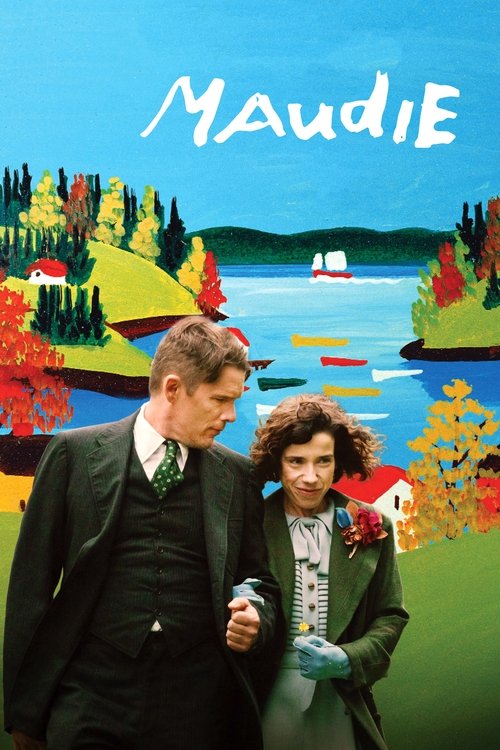
Maudie
2016 · Aisling Walsh
For a quiet night when you want to feel something true — a gentle, restorative watch about art and love growing in hard soil. Good for when you need hope without syrup, and yes, keep tissues nearby.
What it's about
In rural Nova Scotia, Maud — a small woman with severe arthritis and a stubborn spark — answers an ad to keep house for Everett Lewis, a gruff, near-illiterate fish peddler living in a one-room shack. She stays, she marries him, and she paints: flowers and cats and sleighs on every card, board, and wall she can reach, until strangers start pulling off the road to buy them. It's the true story of folk artist Maud Lewis and a thorny, decades-long companionship that becomes, in its crooked way, a love story.
The experience
Tender and unhurried, with real grit under the sweetness — it doesn't sand off Everett's harshness or Maud's hardships, which makes the warmth, when it comes, feel earned. You leave it moved and a little lighter.
Performances
Sally Hawkins is extraordinary — she builds Maud from the body outward, all bent posture and sly half-smiles, radiating will without a shred of self-pity. Ethan Hawke matches her by underplaying, letting Everett's tenderness surface in grudging inches.
The craft
Aisling Walsh shoots the Newfoundland-standing-in-for-Nova-Scotia landscape with painterly patience, and the tiny hand-painted house becomes the film's visual heart — a life's work you watch accumulate on the walls. Sherry White's screenplay trusts silence and small gestures over speeches.
Why it matters
A festival favorite from Telluride onward, it became a word-of-mouth success that introduced Maud Lewis's work to audiences far beyond Canada and stands among the most affecting artist biopics of its decade.
Snapshot
Maudie is a biographical drama about the Nova Scotia folk painter Maud Lewis (1901/1903–1970), who, despite a lifetime of debilitating rheumatoid arthritis and rural poverty, became one of Canada's most beloved naïve artists. Directed by the Irish filmmaker Aisling Walsh from a screenplay by the Newfoundland writer Sherry White, the film traces Maud's move into the tiny one-room house of a gruff, near-illiterate fish peddler, Everett Lewis, first as a live-in housekeeper and then as his wife, and the slow, thorny, decades-long companionship that grows between them as her brightly painted cards and boards find a small public. Sally Hawkins plays Maud and Ethan Hawke plays Everett. A Canadian–Irish co-production shot in Newfoundland, the film premiered at the Telluride Film Festival in September 2016 and went on to a broad festival run and a critically warm theatrical release in 2017. Its reputation rests overwhelmingly on Hawkins's performance and on the film's restraint: it is a period biopic that resists uplift, treating disability, marriage, and artmaking with an unusual plainness.
Industry & production
Maudie is a modestly budgeted international co-production assembled across two national funding systems. The Canadian side, anchored in the Atlantic provinces, and Irish partners combined Telefilm Canada and provincial funding with Irish film-board support and broadcaster money, the standard architecture for a picture of this scale that could not have been financed in either country alone. Producers included Mary Young Leckie, Bob Cooper, Mary Sexton, and Susan Mullen, with production companies drawn from both nations (Rink Rat Productions and Painted House Films on the Canadian side, and Irish partners such as Parallel Films / Mongrel-affiliated distribution channels). Sony Pictures Classics acquired U.S. rights, which secured the film a specialty-arthouse release in North America; distribution elsewhere was handled through the co-producers' regional partners. I do not have a reliable production budget or box-office figure to cite, and rather than invent one I will simply note that the film performed as a well-received specialty release rather than a wide commercial title.
The most consequential production decision was geographic. The historical Maud Lewis lived in Marshalltown, in Digby County, Nova Scotia; the film was shot instead in Newfoundland, largely around the Trinity Bay area and Bonavista Peninsula, whose weathered coastal landscapes and clapboard vernacular stood in for mid-century rural Nova Scotia. The production built a replica of the Lewis house — the real one, painted inside and out by Maud, is preserved as a gallery installation at the Art Gallery of Nova Scotia in Halifax — allowing the filmmakers to control and progressively "paint" the set as Maud's decoration accumulates over the story's years.
Technology
Maudie was made with conventional mid-2010s digital cinema tools; it is not a technically experimental film, and its craft ambitions lie in texture rather than novelty. It was shot digitally in a naturalistic register that privileges available and available-seeming light, soft interiors, and the muted palette of the North Atlantic coast. The film's most interesting "technology," in a broad sense, is practical and art-departmental: the incremental physical transformation of the single-room set, whose walls, window, stove, and household objects are painted over the course of the shoot so that the house itself becomes a growing canvas and a visible index of time passing. The reproduction of Maud's artworks — the cards, boards, and painted surfaces — was executed by the art department and scenic painters rather than generated optically, keeping the objects tactile on camera.
Technique
Cinematography
The cinematography is by Guy Godfree, whose work on the film was among its most decorated craft elements (it was recognized at the Canadian Screen Awards). Godfree's approach is patient and largely unshowy, built around natural-looking sources, a restrained handheld and locked-off mix, and close attention to the human face in confined space. Because so much of the drama unfolds inside one cramped room, the camera does a great deal of work modulating a tiny volume — finding fresh angles on the same corner, the same window, the same two bodies — so that the house feels neither monotonous nor artificially opened up. Exteriors exploit the low, changeable Atlantic light and the flattened, wintry colors of the coast, providing a chill counterweight to the warming interior. The film uses landscape sparingly but pointedly: the vastness outside sharpens the smallness of the life within.
Editing
The editing serves a deliberately unhurried, elliptical chronicle. Maudie covers many years of a marriage, and it advances through compression — jumping across seasons and phases of the relationship, letting the accreting paint on the walls and the deepening of Maud's physical frailty register the passage of time as much as any dated marker. The cutting favors held moments, particularly in the two-handed scenes between Hawkins and Hawke, allowing performance and silence to carry beats that a more conventional biopic would underline. Montage-like passages of Maud painting punctuate the drama without turning into a triumphal "artist at work" convention.
Mise-en-scène / staging
Staging is the film's central formal problem and its central achievement. The great majority of the action is confined to the Lewises' single room, and the production design turns that constraint into meaning: the space is at once prison, refuge, workshop, and, increasingly, artwork. Blocking has to negotiate a bed, a stove, a table, a window, and a staircase in claustrophobic proximity, and the film choreographs Everett and Maud around each other with a physical logic that expresses their prickly, negotiated intimacy. The progressive decoration of the walls and objects functions as visual dramaturgy — the room brightens as Maud's inner life and art asserts themselves against poverty and Everett's austerity. Costume and makeup track Maud's arthritis realistically, avoiding glamorization.
Sound
The score is by Michael Timmins, guitarist and principal songwriter of the Cowboy Junkies, and it carries the folk-inflected, hushed idiom one might expect from that lineage: spare, acoustic, unsentimental. The sound design leans on the ambient reality of the coast and the house — wind, stove, birds, the small domestic noises of a confined life — so that music enters selectively rather than continuously. This restraint keeps the film from sliding into the swelling emotional cueing typical of the inspirational biopic.
Performance
Performance is the film's reason for being. Sally Hawkins's Maud is a study in physical constraint and interior brightness: she renders the progressive deformation and pain of rheumatoid arthritis with committed, unpitying specificity — a hunched carriage, curling hands, a shuffling gait — while keeping Maud's wit, stubbornness, and appetite for beauty fully alive, so that the disability never becomes the whole character. It is a performance built on withheld self-pity. Ethan Hawke's Everett is its necessary counterweight: taciturn, blunt, sometimes harsh, a man of almost no social vocabulary whose capacity for tenderness surfaces slowly and grudgingly. The two-hander at the film's core depends on the friction and eventual accommodation between these registers, and much of the picture's power comes from watching affection assemble itself out of unpromising materials.
Narrative & dramatic mode
Maudie is a chronological life-story told in a minor key. It adopts the biopic's long-arc structure — the artist's emergence, the partnership that both constrains and enables her, growing recognition, decline, death — but strips out the genre's usual triumphalism. There is no montage of galleries and acclaim, no scene of vindication before a crowd; Maud's fame arrives in small, almost incidental increments (a customer, a newspaper notice, a request from beyond the county). The dramatic mode is domestic and relational rather than event-driven: the "plot" is essentially the slow evolution of a marriage and the quiet persistence of an artistic vocation under adverse conditions. Conflict is low-key and recurrent — money, dependency, Everett's temper, Maud's health, a painful thread concerning a lost child in her past — rather than escalating toward a single climax. This gives the film an accretive, life-shaped rhythm.
Genre & cycle
The film sits at the intersection of the artist biopic, the period romance, and the "regional" or landscape-rooted drama. Within the artist-biopic tradition it belongs to a strain that deglamorizes the creative life — closer to intimate, poverty-bound portraits of makers than to the grand-canvas biographies of famous painters. As a disability narrative it is notable for centering a disabled woman's agency and desire rather than framing her as an object of inspiration or tragedy, though, like much of the genre, it casts a non-disabled star in the role, a choice that is part of its critical conversation. It also participates in a small but real cycle of Atlantic-Canadian and rural Irish/British films preoccupied with harsh coastal environments, taciturn characters, and the dignity of constrained lives.
Authorship & method
The film is the product of a genuinely transnational authorship. Director Aisling Walsh is an Irish filmmaker with a substantial background in television and feature drama (her earlier work includes the acclaimed Song for a Raggy Boy); her sensibility — attentive to institutional and domestic cruelty, to endurance, and to performance — is legible throughout Maudie's patient, actor-centered method. Screenwriter Sherry White, a Newfoundland writer, supplied the script; the Atlantic-Canadian sensibility she brings is central to the film's texture, even as production relocated to Newfoundland. Cinematographer Guy Godfree shaped the film's naturalistic, single-room visual grammar and was recognized for it. Composer Michael Timmins of the Cowboy Junkies provided the spare folk score. The editing (by Stephen O'Connell, working in the elliptical chronicle mode described above) governs the film's handling of time. The collaboration's defining method is compression and restraint: a large span of life told in a small space, with the heavy lifting handed to two actors and to a set that slowly becomes a painting.
Movement / national cinema
Maudie does not belong to a self-conscious movement; it is best understood as a work of contemporary Canadian and Irish national cinema operating through co-production. On the Canadian side it is an Atlantic-Canadian film in subject and origin — rooted in Nova Scotia's cultural memory even though shot in Newfoundland — and part of a broader English-Canadian tradition of understated, character-driven realism. On the Irish side, Walsh's direction connects it to a lineage of Irish and British social drama concerned with hardship, faith, family, and survival. The film's identity is genuinely hybrid: an Irish director and a Canadian writer telling a distinctly Nova Scotian story, financed and crewed across both countries.
Era / period
The film is set from roughly the 1930s–1940s through 1970, spanning the decades of Maud Lewis's adult life and marriage in mid-century rural Nova Scotia. Its period world is one of pre-affluence Atlantic Canada: subsistence economies, itinerant peddling, hard winters, minimal medicine, and social isolation. The production renders this without nostalgic gloss — the poverty is real and cold, and the modernizing world reaches Marshalltown only faintly, through the occasional car, radio, or outside visitor. Produced and released in 2016–2017, the film also reflects its own moment's appetite for reconsidering overlooked women artists and for disability narratives told with greater sensitivity, even as it retains an old-fashioned faith in intimate, humanist storytelling.
Themes
Several themes interlock. First, art as survival and assertion: for Maud, painting is not a career but a way of insisting on beauty and selfhood against pain, poverty, and a husband's austerity — the transformation of the house is the theme made physical. Second, love between the unlovely and the wounded: the film examines how two damaged, socially marginal people build a real, imperfect intimacy, refusing both sentimentality and cynicism about their bond. Third, disability, dependency, and autonomy: Maud's arthritis makes her physically dependent, yet the film insists on her creative and emotional agency, and it is candid about the power imbalances and cruelties within the marriage. Fourth, class and rural isolation: the harshness of the environment and economy is not backdrop but pressure. And running beneath all of it, loss — most acutely the buried grief concerning a child taken from Maud in her youth, which the film handles as a quiet, aching undertow rather than melodrama.
Reception, canon & influence
Critical reception was warm and, in places, effusive, with near-unanimous praise for Sally Hawkins's performance and strong notices for Ethan Hawke and for the film's understated craft; the recurring reservation among critics was that the biopic frame is fairly conventional and the film occasionally tender to the point of softness. It was a significant awards presence in Canada — recognized at the Canadian Screen Awards across major categories including picture, direction, lead actress, and cinematography (I am confident it was a leading nominee and multiple winner there, though I won't enumerate every specific prize from memory). Its festival trajectory (Telluride, and a wide international festival circuit) and its Sony Pictures Classics release gave it an art-house afterlife and a durable reputation as a showcase for Hawkins.
The influences on the film are twofold: the documented life and folk art of Maud Lewis herself, whose surviving works and painted house are the primary source and the film's aesthetic touchstone; and the tradition of restrained, humanist biographical and regional drama that shapes its method. Its legacy forward is harder to measure definitively and is still recent. Its most concrete effect has been cultural rather than cinematic: the film markedly raised international awareness of Maud Lewis, drawing new attention to her work and to the preserved Lewis house in Halifax, and it stands as a reference point in ongoing discussions about how disabled artists are portrayed on screen and about the deglamorized artist biopic. Within Atlantic-Canadian and Irish co-production cinema it is frequently cited as a model of an intimate, internationally financed film that traveled well on the strength of performance and craft. Any claim to a broader stylistic school descending from Maudie would be overstated; its influence is best described as reputational and cultural rather than that of a formal template.
Reception
A warm festival debut (Telluride/TIFF 2016) that turned into a word-of-mouth sleeper in 2017, playing for months in Canadian and Irish cinemas; now it's mostly remembered as the Sally Hawkins showcase that landed right before The Shape of Water made her an Oscar nominee.
How Maudie was received, from release to now →
Influences: the films it descends from and the films it influenced
- My Left Foot (1989) — Established the Irish deglamorized-disability-artist template Walsh inherits: an actor's full-body physical transformation into a disabled painter (Day-Lewis's contorted control mirrored in Hawkins's arthritic gait and gripped brush) carrying the film rather than plot.
- Séraphine (2008) — The direct formal model — a self-taught rural woman folk painter observed through patient domestic labor and available light, refusing the triumphal art-world arc for daily endurance and the slow accumulation of naïve canvases.
- Song for a Raggy Boy (2003) — Walsh's own prior feature, sourcing her actor-centered method: institutional/domestic cruelty rendered through endurance and restrained performance rather than melodrama, the sensibility she brings intact to Maud's marriage.
- Iris (2001) — Supplies the elliptical two-hander structure — a creative woman's life compressed and cross-cut with her carer-partner, illness handled through intimate confined-face close-ups rather than expository scope.
- Camille Claudel (1988) — The tactile female-maker biopic: hands-in-material process and a woman artist's agency staged against a suffocating partnership, foregrounding physical craft over biographical milestones.
- The Diving Bell and the Butterfly (2007) — Models art-as-survival generated from inside a radically confined, disabled body — creativity as the one freedom available within physical constraint, the theme Maudie translates into painting from a single room.
- Pollock (2000) — The studio-process painter biopic anchored to a volatile marriage two-hander, letting the act of making paint on surface and the domestic power struggle, not career narrative, structure the film.
- Final Portrait (2017) — Extends the confined-studio, durational two-hander: the physical, repetitive labor of making a single portrait staged almost entirely in one room as a relationship between artist and sitter.
- At Eternity's Gate (2018) — Continues the deglamorized, subjective painter biopic in naturalistic available light, privileging the sensory experience of making and seeing over the triumphal-recognition narrative.
- The Shape of Water (2017) — Hawkins carries the disability-agency baton — a non-verbal woman whose interiority and desire are conveyed through face, gesture and craft, extending Maud's deglamorized-tenderness performance mode.
- Sound of Metal (2019) — Advances the disability-agency method through naturalistic sensory design: a body adapting to constraint rendered from the inside, endurance and self-determination replacing cure-narrative uplift.
- Mr. Turner (2014) — Parallel anti-triumphalist painter portrait: a physically embodied, grunting, unheroic artist shot in painterly naturalistic light where process and temperament replace the biopic's rise-and-recognition beats.
- Amour (2012) — The single-dwelling confined two-hander of care and endurance — an entire late-life relationship staged within four walls, decline registered through faces and restraint, no coverage of the outside world.
- Away from Her (2006) — Canadian restrained marriage-and-illness two-hander using naturalistic light and elliptical time to render a long partnership through small domestic gestures rather than dramatic climaxes.
- The Sweet Hereafter (1997) — Atlantic/rural-Canadian elliptical chronicle: cold coastal restraint and fractured time governing emotional accumulation, the regional-realist register and editing mode Maudie shares.
- Happy-Go-Lucky (2008) — Sources Hawkins's signature performance method — an improvisation-built, unsinkable optimist whose warmth reads as agency, the same actorly instrument Walsh hands the film.
Similar films
- The Shape of Water (2017) — influence & lineage
- Amour (2012) — influence & lineage
- Train Dreams (2025) — same viewing thread
- The Ballad of Wallis Island (2025) — shared sensibility
- Certain Women (2016) — shared sensibility
- Memoir of a Snail (2024) — shared sensibility
- Loving Vincent (2017) — shared sensibility
- Hard Truths (2024) — shared sensibility
All the films related to Maudie →
Watch it with: curated runs of related films
- Quiet Lives at the World's Edge — Watch these when you want a life pared down to essentials — someone walking out of society to start from zero, or simply living out their days at the margins.