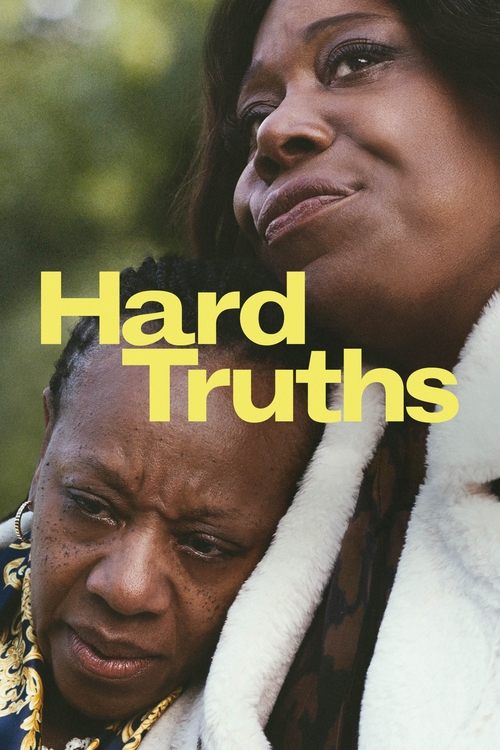
Hard Truths
2024 · Mike Leigh
When you want a film that earns its emotion the hard way — for a night you're up for laughing and aching in the same breath, and thinking about your own family after.
What it's about
Pansy lives in a spotless London house nobody is allowed to actually live in, and she wakes up furious — every errand, from the supermarket to the dentist, becomes a battle, while her husband and grown son retreat into silence around her. Her younger sister Chantelle runs a hair salon on warmth and easy talk, and the film watches these two women, one armored in rage and one open to the world, try to stay family. Underneath the anger is the question of where all that pain comes from.
The experience
Bruising and very funny at once — Pansy's tirades are so precise you laugh, then catch yourself, because the film never lets you forget the suffering underneath. It ends up piercingly sad and deeply humane.
Performances
Marianne Jean-Baptiste is astonishing — a full-body performance of rage as armor, reuniting with Leigh nearly three decades after Secrets & Lies, with Michele Austin's warm, patient Chantelle as its perfect counterweight.
The craft
Built through Leigh's signature method of long improvisation with actors before a frame is shot, so every character feels lived-in down to the smallest gesture. It's a lean chamber piece, under a hundred minutes, where the writing and playing do everything.
Why it matters
Mike Leigh's twenty-third feature and one of the most acclaimed performances of its year — proof late in a great career that his actor-first method still cuts deeper than almost anything else in British cinema.
Snapshot
Mike Leigh's twenty-third feature is a contemporary London chamber piece about a woman whose every waking hour is organised around attack. Pansy Deacon (Marianne Jean-Baptiste) wakes screaming, scours a house nobody is allowed to live in, and turns each errand — the supermarket, the dentist, the car park, the furniture showroom — into an occasion for verbal assault. Her husband Curtley (David Webber), a plumber, has retreated into near-silence; their adult son Moses (Tuwaine Barrett) walks the streets all day rather than occupy the same rooms. Against this, Leigh sets Pansy's younger sister Chantelle (Michele Austin), a hairdresser whose salon runs on easy talk, and Chantelle's two grown daughters, who move through the world with an ordinary appetite for it.
The film is short by Leigh's standards, under a hundred minutes, and it refuses almost every structural comfort available to it. There is no diagnosis, no backstory reveal that explains Pansy, no therapeutic arc. What there is instead is a hinge — a Mother's Day visit to the sisters' mother's grave, and the family meal that follows — where the rage briefly gives way and reveals the grief underneath it, before closing again. It premiered at the Toronto International Film Festival in September 2024 and was released in North America by Bleecker Street on an awards-season platform pattern. Two facts shadow it: it reunites Leigh with Jean-Baptiste for the first time since Secrets & Lies (1996), and it is the final collaboration between Leigh and cinematographer Dick Pope, who died in October 2024 after more than three decades shooting Leigh's films.
Industry & production
Hard Truths was produced by Georgina Lowe, Leigh's producer since Another Year (2010), through Thin Man Films, the company Leigh founded with the late Simon Channing Williams. The production returns Leigh to the scale he works best at after Peterloo (2018), his largest and most expensive film — a crowd-heavy historical reconstruction that absorbed six years of his working life and, by most accounts, did not find the audience its budget required. Hard Truths is the opposite proposition: contemporary, interior, a handful of locations, a cast small enough to fit in one room.
The commercial peculiarity of a Leigh production is that it is financed without a screenplay. Backers commit on the strength of a director, a producer, a budget and a rehearsal period, with no document describing what will be made; the film is written during the process it funds. This has been Leigh's arrangement since the 1980s and it has grown harder, not easier, to sustain — he has been candid over the years that each film is raised as if it were the first. The specific financing structure behind Hard Truths follows the mixed European public-and-private pattern of his recent work, but the budget figure has not been publicly detailed, and it would be wrong to invent one here.
Its release landed in a market that had largely stopped making room for mid-budget adult drama in cinemas. The film's theatrical life ran through specialty distribution and critics' awards rather than wide play, and its commercial performance was modest — the kind of release whose success is measured in a leading performance entering the year's conversation rather than in returns.
Technology
Leigh shot on 35mm for most of his career and moved to digital capture with Mr. Turner (2014), where Pope's work with the Alexa was explicitly an attempt to reach painterly light — Pope took the Vulcan Award for technical artistry at Cannes that year. Hard Truths is digitally captured and finished, and the technology is pointedly undemonstrative: no shallow-focus gloss, no aggressive grade, no handheld texture borrowed from documentary. The digital intermediate is used to hold a very particular flatness in the Deacon house — even, cool, shadowless — and to let Chantelle's flat and salon run warmer and more saturated by contrast.
The more consequential technology in a Leigh film is not in the camera department at all. It is the rehearsal room: months of individually built characters, improvisations conducted in strict compartments so that actors know only what their characters could know, and a gradual hardening of improvised material into fixed, tightly structured scenes. Nothing is improvised on camera. By the time the unit arrives at a location, the scene has been written by being played, many times, in a hall somewhere. The apparatus is time, and time is the budget line that a no-script film exists to protect.
Technique
Cinematography
Pope's camera is close to static throughout. Characters are framed centrally, often squarely, in doorways and against blank walls; the Deacon house is boxed by its own architecture, and Pansy is repeatedly held in compositions that leave no air around her. Coverage is classical and unhurried — the two-shot is allowed to carry long exchanges rather than being chopped into reverse angles — which means the comedy and the cruelty arrive in the same frame, without the editor's intervention to tell us which we are watching. The lighting of the house is the film's key visual argument: flat, cold, sourceless-seeming daylight through half-drawn curtains, a domestic space lit like an institution. When the film moves to the salon, the graveyard or Chantelle's flat, the palette warms and the frame loosens, and the effect is almost physiological.
Editing
Jon Gregory, who has cut Leigh's films since the 1980s, builds the picture as an accumulation of discrete encounters rather than a causal chain. Scenes begin late, end without resolution, and are separated by hard cuts; the structure reads closer to a series of panels than a plot. This is the engine of the film's dread — each new encounter arrives with the audience already braced, and the tension is not what will happen but how far it will go this time. The compactness matters: at under a hundred minutes this is among Leigh's shortest features, and the brevity keeps the accumulation from becoming a catalogue.
Mise-en-scène / staging
The Deacon house is the film's thesis object. It is spotless, under-furnished, curtained, joyless — a home maintained as a defence against contamination, in which cleanliness has replaced every other form of care. Nothing is out of place because nothing is used. Chantelle's flat is its rebuttal: colour, objects, food, noise, people occupying the space in ways that leave marks on it. Leigh's staging keeps bodies at fixed distances — Curtley and Moses orbit Pansy at the maximum radius the rooms allow — and the blocking does the exposition that the dialogue withholds. The salon, where Chantelle works, is staged as a place where talk is a service rendered gently, a direct inversion of Pansy's use of speech as a weapon.
Sound
Score is used sparingly. Gary Yershon, Leigh's composer since Happy-Go-Lucky (2008), works in small, astringent chamber figures that mark transitions rather than underline feeling, and long stretches carry no music at all. What fills the silence is the acoustic of over-cleaned rooms — hard surfaces, no soft furnishing to absorb anything, so that voices ring slightly. The film's most striking sound is the range of Jean-Baptiste's delivery: the flat, low register of Pansy at rest and the sudden, unmodulated volume of the eruptions, with almost nothing in between. Leigh lets the tirades run at full length and full loudness, which is what converts them from comic set-pieces into something the audience wants to escape.
Performance
Jean-Baptiste's Pansy is a performance of extraordinary technical control disguised as loss of control. The carriage is rigid, the shoulders raised, the face set against expression; the voice moves between a clipped declarative and a full-throated assault with no transitional gear. Crucially, the early tirades are funny — the timing is comic timing, the invective is inventive — and the film's method is to keep the register constant while the audience's relation to it curdles. Michele Austin's Chantelle is the harder job and the quieter achievement: warmth that is not sentimentality, a listening presence, and a slowly visible exhaustion at being her sister's only remaining tether. David Webber gives Curtley almost nothing to do and makes the withholding legible as its own damage. Tuwaine Barrett's Moses is largely wordless bulk in motion, a young man whose only available action is to be elsewhere.
Narrative & dramatic mode
Leigh has never written plots in the screenwriting-manual sense, and here he dispenses with them almost entirely. The film's mode is the comedy of embarrassment inherited from his television work — Abigail's Party (1977), Nuts in May (1976) — pushed past the point where embarrassment is survivable. We watch social situations fail, repeatedly, according to the same mechanism, and the repetition is the form.
The Mother's Day sequence is the single structural pivot. At the grave, Pansy's armour slips and what emerges is grief, and a much older grievance about being unloved; at the meal afterwards, the family briefly holds a shape before she detonates it. Leigh then declines the payoff. No one names depression, no treatment is sought, no reconciliation is staged. The final images leave Pansy immobile in a darkened room and Curtley alone with what he has not said. The title's hardest truth is that understanding a person's pain does not, by itself, relieve it or make them bearable — and that the people who love her are not going to be rescued either.
Genre & cycle
Nominally drama-comedy; in practice a character study operating in the British domestic tragicomedy that Leigh essentially invented for the screen. It sits inside his own cycle of bleak family films — Grown-Ups (1980), Meantime (1983), All or Nothing (2002) — and functions as a deliberate negative image of Happy-Go-Lucky (2008), whose Poppy met the world with an optimism as unshakeable and as unexplained as Pansy's rage. Critics drew that comparison immediately and Leigh has not discouraged it.
It also belongs, obliquely, to a cycle of contemporary British films about Black family life in a domestic rather than sociological register — debbie tucker green's Second Coming (2014) is the closest formal relative, another study of a Black British woman's interior crisis staged in living rooms. That adjacency generated the film's one substantial critical argument: whether a white Jewish director from Salford, then in his eighties, was the author of this Black British family. The defensible answer lies in method rather than biography — under Leigh's process the characters are built by the actors, from their own research and lives, before Leigh shapes the whole — but the question was raised seriously and in good faith by several writers, and it is part of the film's reception history.
Authorship & method
Leigh's authorship is real but shared in an unusual way. He takes sole writer-director credit, and the structure, the shaping and the final text are his; the characters, their histories and their speech are generated collaboratively in rehearsal by actors working in isolation from one another. He built the method in devised theatre in the 1960s and carried it into Bleak Moments (1971) and the BBC Play for Today films that made his reputation.
The collaborators matter accordingly. Dick Pope shot Leigh's films from Life Is Sweet (1990) onward and received two Academy Award nominations — for The Illusionist (2006) and Mr. Turner — before his death in October 2024, which makes Hard Truths the end of one of the longest director–cinematographer partnerships in British cinema. Jon Gregory's editing gave Leigh's work its characteristic refusal of emphasis. Gary Yershon's scores have, since 2008, replaced the warmer music of Leigh's earlier films with something more sceptical. Georgina Lowe's producing keeps the no-script model financeable. And the performers constitute a repertory in the proper sense: Jean-Baptiste, Oscar-nominated for Secrets & Lies and widely noted as the first Black British actress to receive an Academy Award nomination, returns after nearly three decades largely spent working in American television — a career trajectory she herself publicly connected, in the late 1990s, to the British industry's indifference to Black actors. Michele Austin played Hortense's friend Dionne in Secrets & Lies and has returned to Leigh's company since. Casting those two as sisters is an authorial act in itself: the film carries the memory of the earlier one.
Movement / national cinema
The obvious lineage is British social realism — Free Cinema, the New Wave's kitchen-sink films, and the long parallel track of Ken Loach. Leigh has consistently resisted the label, and the resistance is well-founded: his films are not documentary in impulse, do not use non-professionals as authenticity guarantors, and are heavily stylised at the level of speech and behaviour. The truer ancestors are theatrical — Chekhov's ensembles of thwarted people, Pinter's menace inside domestic banality, Beckett's comedy of stasis — filtered through a devising practice that came out of British regional theatre. Leigh has also repeatedly named Ozu among his touchstones, and the debt shows in Hard Truths: the static camera, the domestic interior as complete world, the refusal to dramatise.
The film also sits in the field of Black British cinema without claiming membership of it — a field running from Horace Ové's Pressure (1976) and Menelik Shabazz's Burning an Illusion (1981) through the Black Audio Film Collective to Steve McQueen's Small Axe (2020) and, more recently, a commercial wave including Rye Lane (2023). Hard Truths engages that context through its cast and its subject rather than through its authorship, which is precisely why the engagement was debated.
Era / period
The film is set in a recognisable post-pandemic, cost-of-living Britain: waiting rooms, appointment systems, chain shops, retail parks, a service economy in which most human contact is transactional. Leigh does not editorialise about any of it, but the texture of exhausted public and commercial space is what Pansy's rage has to attach itself to. It is also a late film in an obvious sense — Leigh was eighty-one in 2024 — and it carries the concerns of lateness: a marriage worn down to silence, a grown child with nowhere to go, a dead mother still adjudicating her daughters' lives, and a refusal to pretend that any of it improves.
Themes
Rage as the visible surface of unmetabolised grief is the central proposition. Pansy's fury is coherent once read as fear — of dirt, illness, intrusion, being seen — and the film's discipline is to let us reach that reading without ever handing it to us. Cleanliness functions as control, and control as a defence against a loss the film locates at the mother's grave. Around this, Leigh works several other seams: the wildly unequal distribution of warmth between two sisters raised in the same house; masculine silence as a survival strategy that transmits damage to the next generation; the class and respectability pressures on a family maintaining a home it cannot enjoy; and, most uncomfortably, the limits of love as a treatment. Chantelle loves Pansy, Curtley and Moses endure her, and none of it is sufficient.
Reception, canon & influence
Critical reception was strongly positive, and overwhelmingly centred on Jean-Baptiste, whose performance was treated as one of the outstanding screen performances of the year. She took a long run of critics' prizes over the 2024–25 season, including the New York Film Critics Circle's best-actress award, and her absence from the eventual Academy Award nominations became one of that season's most widely aired grievances. Reviews for the film itself were more varied in emphasis than in quality: a broad consensus that it was a return to Leigh's strongest form after Peterloo, alongside a genuine argument about whether the film's refusal to explain or relieve Pansy was rigour or withholding, and the separate question of Leigh's relation to his Black British subjects.
Looking backward, the influences on the film are mostly Leigh's own: Bleak Moments for the study of inarticulacy as suffering, Abigail's Party for social agony played as comedy and anchored by one overwhelming female performance, Naked (1993) for verbal aggression as a mode of being, All or Nothing for the bleak family unit, Happy-Go-Lucky for the inverted temperamental extreme, and Secrets & Lies for the family secret located at a mother. Behind those, the Chekhov–Pinter–Beckett theatrical line and Ozu's domestic stillness.
Looking forward, honesty requires admitting the record is thin. A film released in late 2024 has not yet had time to shape anything, and it would be invention to claim otherwise. What can be said is narrower and real: it restored Marianne Jean-Baptiste to British cinema in a leading role after a near-three-decade absence that was itself an indictment of the industry, and the reception made that history part of the story; it stands as Dick Pope's last work with Leigh and closes a partnership that defined the look of British art cinema from 1990 onward; and it demonstrated that Leigh's rehearsal method, now sixty years old, can still produce a performance and a character that nothing else in contemporary cinema resembles. Leigh's larger legacy — the devised-performance approach visible in the working methods of Shane Meadows and others, and the generation of actors formed in his rehearsal rooms from Gary Oldman and Tim Roth through David Thewlis, Imelda Staunton, Lesley Manville, Eddie Marsan and Sally Hawkins — is long established. Where Hard Truths finally sits within it is a judgement that will take another decade to make.
A Deleuzian reading
She wakes screaming.
The full Deleuzian reading of Hard Truths →
Reception
Premiered at TIFF 2024 to warm reviews as a late-career return to form, but its reception story quickly became the awards story: Marianne Jean-Baptiste swept the major US critics' prizes and then missed the Best Actress Oscar nomination, a snub that arguably raised the film's profile more than a nomination would have.
How Hard Truths was received, from release to now →
Influences: the films it descends from and the films it influenced
- Bleak Moments (1971) — Leigh's first feature established the device Hard Truths runs on — the held, unbroken two-shot in which a conversation is allowed to fail and die on camera, so that inarticulacy becomes the scene's actual event rather than its obstacle.
- Abigail's Party (1977) — A single domestic interior, one monologuing woman who controls the room's oxygen, and social humiliation sustained well past the point of laughter — Pansy's dinner and car scenes reprise Beverly's architecture of the comedy of embarrassment with the hostess's cheer stripped out.
- Meantime (1983) — Leigh worked out blocking-as-exposition here — council-flat stasis shot in flat frontal wides where where a body sits, and for how long, carries the information the dialogue withholds.
- Naked (1993) — Johnny's assaultive monologues made verbal aggression a complete mode of being rather than a character trait; Jean-Baptiste's Pansy is that instrument rebuilt in a domestic register, articulacy deployed to prevent contact.
- Secrets & Lies (1996) — The locked-off, single-set-up sustained two-shot Leigh and Dick Pope formalised in the café scene becomes Hard Truths' default grammar — and the film's structure of a wound located at a mother, with Jean-Baptiste on the other side of the frame, is the same load-bearing beam.
- All or Nothing (2002) — Pope's cold, desaturated, sourceless estate-flat light and the immobile sofa tableau of a family that cannot speak to each other supply the exact photographic and staging conditions of Pansy's house.
- Tokyo Story (1953) — The fixed low camera addressing figures frontally across a domestic interior, and the decision to hold a shot after the dramatic beat has passed so the room itself registers, is the framing logic Leigh and Pope adopt for the house-as-thesis-object.
- Jeanne Dielman, 23 quai du Commerce, 1080 Bruxelles (1975) — An unvarying frontal camera at a fixed distance turns a compulsively maintained flat into the film's argument — the same method by which Pansy's scoured, hard-surfaced, echoing rooms and their room tone function as diagnosis without a word of explanation.
- A Woman Under the Influence (1974) — Scenes are constructed to run past the limit of social endurance around a woman the film pointedly refuses to diagnose or cure — the duration-plus-withheld-resolution contract Hard Truths signs with its audience.
- Family Life (1971) — Loach fed his cast scenes in sequence while withholding the script, so actors met information as their characters did — the compartmentalised-improvisation principle, applied to a breakdown located inside a parental house and left unexplained.
- The Caretaker (1963) — Pinter's dialogue as territorial combat — repetition, non-sequitur, insult delivered in flat domestic register — filmed in one cluttered house with a near-static camera; the theatrical line Leigh's verbal method descends from.
- Nil by Mouth (1997) — Oldman, formed in Leigh's rehearsal room on Meantime, directed a South London family film out of rehearsal-derived scenes in which kitchen-table verbal violence, not plot, is the event — the method carried out of Leigh's shop by one of his actors.
- This Is England (2006) — Meadows builds from devised rehearsal rather than a shooting script, keeping actors in character to find dialogue on the floor — the most direct transplant of Leigh's process into a later generation of British filmmaking.
- Rocks (2019) — A long workshop process let a non-professional Black British cast generate their own speech and histories before shooting — the devised model applied to exactly the domestic territory, and the questions of authorship over it, that Hard Truths' reception raised.
- Vera Drake (2004) — The purest application of Leigh's compartmentalised rehearsal: the family cast were never told what Vera did, so their shock at the arrest is genuinely first-time, and the film's structure is built to capture it in one unbroken take.
- Another Year (2010) — Four seasonal panels, each a self-contained social gathering with no arc carrying between them — the episodic panel structure Jon Gregory cuts, and the refusal of an emphatic climax, that Hard Truths inherits wholesale.
- Happy-Go-Lucky (2008) — The identical method aimed at the opposite temperamental extreme — Poppy's compulsive brightness as an equally impermeable defence — and the first Gary Yershon score, which replaced Leigh's earlier warm music with the sparse, astringent commentary Hard Truths uses.
- Archipelago (2010) — Hogg gives her cast the situation but no written lines, then shoots the result in static frontal wides of a house with no score and live hard-surface room tone — a family dinner of accumulating embarrassment built from the same components as Pansy's.
Similar films
- Secrets & Lies (1996) — influence & lineage · same viewing thread
- Bleak Moments (1971) — influence & lineage
- Another Year (2010) — influence & lineage
- Naked (1993) — influence & lineage
- Father Mother Sister Brother (2025) — same viewing thread
- Ghostlight (2024) — same viewing thread
- Short Term 12 (2013) — same viewing thread
- Hamnet (2025) — same viewing thread
All the films related to Hard Truths →
Watch it with: curated runs of related films
- Funny Because It Aches — A run of tender, deadpan dramedies where love, grief, and the panic of becoming yourself all get metabolized through jokes — watch these when you want to laugh and cry in the same scene.
- When the Family Comes Undone — Watch these when you want intimate, one-household dramas where love and grief are the same thing — a parent fading, a marriage on trial, a child at the center of the wreckage.