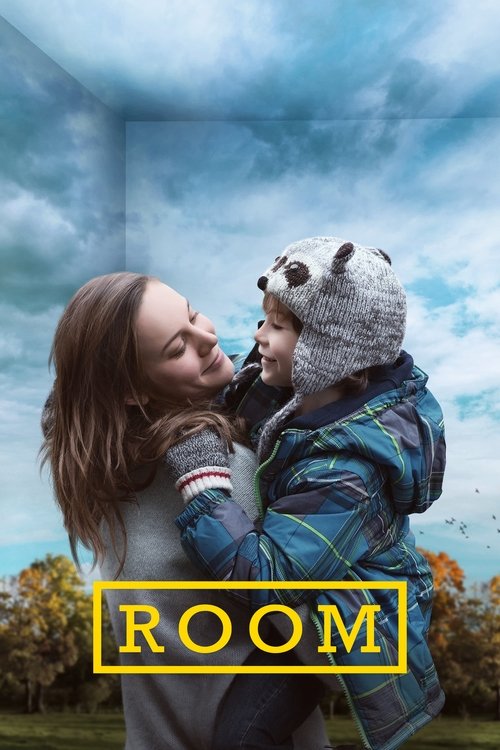
Room
2015 · Lenny Abrahamson
For a night when you want to feel something deeply and don't mind crying — this is a challenge, not a comfort watch, but it pays you back with real uplift. Reach for it when you want a film about love under impossible pressure.
What it's about
A young woman and her five-year-old son live in a single locked room — for him, it is the entire world, its wardrobe and skylight as familiar as friends, because he has never known anything else. She has been held there for years by the man who abducted her, and she has built a whole universe of games and rituals to protect her boy from the truth. The story follows what happens when she decides he is old enough to learn what lies beyond the walls, and what freedom actually costs once you have it.
The experience
Wrenching and intimate, told largely through the boy's eyes, so terror and wonder arrive in the same breath. The suspense in the first half is almost unbearable, and the second half trades it for something quieter and just as hard: the ache of learning to live. You come out wrung out but strangely hopeful.
Performances
Brie Larson won the Best Actress Oscar as Ma, holding fierce protectiveness and private despair in the same face; Jacob Tremblay, then about eight, gives one of the great child performances — the whole film rests on his wide-open credibility and it never buckles.
The craft
Emma Donoghue adapted her own novel, and the script's masterstroke is keeping the camera at a child's eye level, so an eleven-by-eleven shed feels like a cosmos. Lenny Abrahamson directs with restraint where a lesser film would milk the horror, and the sound design makes the sudden hugeness of the outside world land physically. It works on any screen because its scale is emotional, not visual.
Why it matters
A breakout that turned Brie Larson into a star and proved a harrowing premise could be handled with grace — it became a touchstone for how to film trauma through innocence rather than exploitation.
Snapshot
Room is a chamber drama that becomes an escape thriller and then a study of aftermath, adapted by Emma Donoghue from her own 2010 novel and directed by the Irish filmmaker Lenny Abrahamson. Its premise is deliberately austere: a young woman, Joy "Ma" Newsome (Brie Larson), and her five-year-old son Jack (Jacob Tremblay) have been held for years in a single soundproofed garden shed by their captor, "Old Nick." The film's radical formal choice is to filter this reality through Jack's consciousness — for the boy, the eleven-by-eleven-foot space is not a prison but the entire universe, its objects (Wardrobe, Skylight, Table) proper nouns and companions. The narrative pivots on an escape roughly at its midpoint, then spends its second half on the harder, less cinematic problem of reentry: how a child raised in a single room, and a mother stalled at nineteen, learn to inhabit a world that is at once liberation and overwhelming. Larson's performance won the Academy Award for Best Actress and swept the 2015–16 precursor season; the film earned four Oscar nominations including Best Picture. It stands as a high-water mark for A24's early prestige period and for the quiet, empathetic realism that defines Abrahamson's cinema.
Industry & production
Room was an Ireland–Canada co-production, produced principally by Ed Guiney and Element Pictures — the Dublin company that had become the central engine of contemporary Irish art cinema — in partnership with No Trace Camping and Canadian producers, drawing on Irish and Canadian public film financing (the Irish Film Board and Telefilm Canada among the supporting bodies). The budget was modest by studio standards; precise, verified figures are not something I will assert here, but the film was made economically, its single principal location an advantage rather than a constraint. Photography took place largely in Toronto, where the exterior world of the second half was found and the confined interior was purpose-built on a soundstage.
The distribution story is a significant part of the film's cultural footprint. A24 handled the U.S. release, and Room arrived during the young distributor's formative run of critically embraced, awards-viable independents; StudioCanal and other partners handled international territories. The film's commercial breakthrough followed a festival launch rather than a marketing push: its selection at the Telluride and Toronto film festivals in the autumn of 2015, and specifically its win of the Toronto International Film Festival's People's Choice Award — historically a reliable Oscar bellwether — converted a small literary adaptation into a genuine awards contender. That trajectory (festival acclaim → platform release → awards campaign) is the classic path Room exemplifies, and the eventual Best Picture nomination and Larson's Best Actress win validated the strategy.
Technology
Room was shot digitally, and its technical program is notable less for novel equipment than for how conventional tools were bent to an unusually cramped space. The single greatest production challenge was physical: how to photograph a genuinely small room without either cheating its dimensions (which would betray the film's premise) or flooding it with the compromises of a wild-walls set. The production built the Room set to felt-real proportions, and much of its power comes from the camera being forced to negotiate the same tight space its characters do. Where the record is thin on exact lens and camera-body specifications I will not invent them, but the visible strategy is one of proximity: short focal lengths and handheld operation that keep the viewer inside Jack's arm's reach. Digital capture also served the film's low-light naturalism — the Room lit largely as it plausibly would be, from the skylight and practical lamps — allowing an interior that reads as lived-in and starved of daylight rather than dressed for the camera.
Technique
Cinematography
Danny Cohen — whose credits include The King's Speech and Les Misérables — shot Room, and his work here is a study in scale and point of view. The film's governing idea is that we largely see the world as Jack sees it: low, close, fragmentary, protective. Inside Room, Cohen keeps the camera at or near the child's height, isolating textures and objects so that the space feels vast to Jack even as it registers as claustrophobic to us — the film holds both truths at once. The escape sequence, in which Jack is rolled in a rug and carried into the open, is the visual and emotional hinge: the sudden verticality of the sky, the abstraction of light and motion glimpsed by a boy who has never seen distance, is rendered as sensory overload rather than triumphant vista. In the second half, the visual grammar loosens as the world literally opens up, but Cohen resists making the outside world beautiful in any consoling way; it is bright, hard-edged, and disorienting, its freedom laced with threat.
Editing
Nathan Nugent's editing is structurally decisive. The film's most discussed formal gambit is its refusal to end where a lesser treatment would — at the escape. By placing the rescue near the middle, the cut commits the film to its more difficult second movement, where the drama is internal and the stakes are psychological recovery rather than physical survival. Nugent modulates the film's rhythm accordingly: the Room passages are patient, built on duration and the accretion of small routines; the escape is a compressed, breath-held set piece; the aftermath is elliptical, moving across the uneven, non-linear progress of trauma. The editing also disciplines the point of view, staying close to Jack's comprehension and withholding the adult context he cannot grasp, so that revelations reach us at the pace they reach him.
Mise-en-scène / staging
Production designer Ethan Tobman's Room is arguably the film's second protagonist. Every object is characterized — named, worn, assigned a place in Jack's cosmology — and the set was built to be at once a complete world and an unmistakable cell. The staging inside Room is choreographed around scarcity: the same few square feet must serve as bedroom, kitchen, bathroom, and playground, and Abrahamson blocks the actors so that domestic tenderness and imprisonment share the same frame. The contrast with the second half is deliberate and unsettling — the ordinary suburban home Jack and Ma return to is larger, but its rooms are staged as newly bewildering, the mundane furniture of normal life made strange through the child's eyes.
Sound
Sound design carries much of the film's subjective weight. Room is established as acoustically sealed — the muffled world beyond its walls is part of Jack's understanding that "Outside" is not real — and the rupture of that soundscape at the escape is a key expressive event. Stephen Rennicks's score is restrained and largely wordless in its sympathies, avoiding sentimentality and instead underscoring wonder and dread with equal reticence. The film's most memorable aural texture is Jack's voice-over narration, which frames the story in a child's grammar and cosmology and is the primary device by which the film sustains its point of view.
Performance
Performance is where Room is most celebrated. Brie Larson's Ma is a portrait of a woman performing stability for her child while privately eroding — protective, fierce, and, after the escape, unmoored, as the identity she suppressed to survive resurfaces without a place to go. Larson's restraint, and her willingness to let Ma be difficult and depleted in the aftermath, is what lifts the role above victimhood. Jacob Tremblay's Jack is one of the era's great child performances, credible both as a boy who knows nothing of the world and as a resilient narrator of it; the film depends entirely on his lack of self-consciousness. The supporting work — Joan Allen and William H. Macy as Ma's parents, negotiating their own guilt and estrangement, and Sean Bridgers as Old Nick, kept mostly at the edges of Jack's awareness — is calibrated to the film's child's-eye discipline.
Narrative & dramatic mode
Room operates in the register of intimate psychological realism, but its architecture is unusual: it is a two-part structure that deliberately subverts the escape-thriller template it briefly inhabits. The first movement is a confinement drama; the escape functions as a genre climax; and then the film insists that liberation is a beginning, not an ending. This is its central dramatic argument — that surviving captivity and surviving freedom are different ordeals. The consistent through-line is point of view: by anchoring the story in Jack, the film transforms potentially lurid material into something tender and philosophical, a story about the making of a world and the shock of discovering it is not the only one. The dramatic mode is closer to the coming-of-age film and the family drama than to the true-crime thriller its logline might suggest.
Genre & cycle
The film sits at the intersection of several genres — captivity thriller, family melodrama, coming-of-age story — while belonging fully to none. It arrived amid a cycle of literary adaptations and abduction-themed dramas, and it is often discussed alongside other 2010s films preoccupied with captivity and survival. Its most distinctive generic move is to treat the abduction premise almost entirely from within the domestic and the childlike, deliberately declining the procedural and exploitation pleasures the material could offer. In that sense it is best understood within the A24-era cycle of small, character-driven prestige dramas that prized restraint, performance, and formal point of view over plot mechanics.
Authorship & method
Lenny Abrahamson's authorship is defined by empathy, understatement, and an interest in people living at the margins or under pressure — from Adam & Paul and Garage through What Richard Did and Frank. Room extends his method: a refusal of sensationalism, a patient attention to behavior, and a trust in the viewer to feel rather than be told. The decisive collaboration was with Emma Donoghue, who adapted her own novel — a comparatively rare instance of a novelist scripting her own work, and one that preserved the book's defining device of the child narrator. Cinematographer Danny Cohen supplied the point-of-view rigor; production designer Ethan Tobman built the world; composer Stephen Rennicks (a frequent Abrahamson collaborator) and editor Nathan Nugent shaped its tone and structure. Producer Ed Guiney and Element Pictures provided the production culture — Irish art cinema with international reach — within which the film was possible. The method throughout was to subordinate technique to subjectivity: nearly every formal decision serves the question of what Jack can perceive and understand.
Movement / national cinema
Room is a landmark of contemporary Irish cinema in its international, co-production mode. Element Pictures, Abrahamson, Donoghue, and Guiney represent a generation of Irish filmmaking that operates fluidly across borders — drawing on Irish talent and financing while shooting abroad and competing on the world festival and awards stage. The film's success, alongside other Element productions of the period, helped establish Irish independent cinema as a reliable source of critically serious, awards-caliber work. At the same time, as a Canada-set, Toronto-shot film with an American star, Room is a genuinely transnational object, and it belongs as much to the ecosystem of festival-launched, A24-distributed American independents as to any single national cinema.
Era / period
Made and released in 2015, Room is emblematic of mid-2010s independent filmmaking: digitally shot, festival-launched, performance-forward, and distributed by a boutique label building its brand on exactly this kind of film. It reflects the period's appetite for literary adaptations that foreground point of view and for dramas that treat trauma with seriousness rather than spectacle. It also arrived at a moment of intensifying attention to how women's experiences of captivity and violence were depicted on screen, and it was frequently praised for centering survival and interiority over the mechanics of the crime.
Themes
The film's dominant theme is the construction of reality — the way a world can be made whole for a child through love and story even inside a cell, and the vertigo that follows when that world is revealed to be one small part of a vaster one. Bound to this is the theme of motherhood as both salvation and sacrifice: Ma builds Jack's universe at the cost of her own self, and the second half asks what remains of her once the performance of normalcy is no longer required. Freedom itself is interrogated: the film argues that escape does not resolve trauma but relocates it, and that reentry into ordinary life can be its own kind of confinement. Perception, naming, and story-telling recur as the tools by which the vulnerable survive. And underlying all of it is resilience — not as triumph, but as the slow, non-linear, unglamorous work of continuing.
Reception, canon & influence
Critical reception was strongly positive, centering on the two lead performances and on the film's tonal control of difficult material. Larson's work was near-universally acclaimed and won the major awards of the 2015–16 season, culminating in the Academy Award for Best Actress; Jacob Tremblay's performance was widely celebrated as one of the great child performances of its era, and its omission from the Oscar nominations was a common point of critical discussion. The film received Academy Award nominations for Best Picture, Best Director (Abrahamson), and Best Adapted Screenplay (Donoghue) in addition to Larson's win, and its Toronto People's Choice Award marked its emergence as a contender.
Its influences run backward to the source material — Donoghue's novel, whose child-narrator conceit the film faithfully preserves — and, more broadly, to real cases of long-term captivity that entered public consciousness in the years before the book, which informed the premise without the film being a dramatization of any single case. Formally, it draws on a lineage of point-of-view realism and of confinement dramas that find expansiveness within constraint.
Looking forward, Room consolidated several reputations: it was a defining early success for A24's prestige identity, a career-making showcase for Larson (who moved from independent film to major studio work) and for Tremblay, and a further validation of Abrahamson, Donoghue, and Element Pictures on the international stage. Its clearest legacy is as a model for how to treat sensational subject matter with restraint and subjectivity — an argument, widely absorbed in the character-driven independent cinema that followed, that the most harrowing stories are best told through empathy and point of view rather than through the spectacle of the crime itself.
Reception
An awards juggernaut on arrival — TIFF People's Choice winner, four Oscar nominations, Brie Larson's Best Actress win — it's since settled into memory less as a Best Picture contender and more as the film that launched Larson and Jacob Tremblay, still quietly beloved as one of the great tearjerkers of the 2010s.
How Room was received, from release to now →
How to watch Room: what to notice on a first viewing
- Notice the camera stays low, near Jack's height, inside Room. Danny Cohen keeps the lens close and fragmentary throughout the first half, isolating objects and textures rather than showing the whole space at once. The room reads as vast to Jack and cramped to you at the same time.
- Listen for Jack's voice-over and how muffled the outside world sounds. The narration frames everything in a child's grammar, and Room is built as an acoustically sealed space. You are hearing the story exactly at the pace Jack understands it, no faster.
- Notice how objects like Wardrobe and Skylight are named, not just used. Every item in the single set is treated as a character with a place in Jack's private cosmology, built by production designer Ethan Tobman. Naming turns a cell into a whole world for a child raised inside it.
- Watch how the same few feet serve as bedroom, kitchen, and playground. Abrahamson blocks Ma and Jack so domestic routine and imprisonment occupy the identical cramped space, never separated into different rooms. Scarcity forces tenderness and captivity to share one frame, over and over.
The whole guide to watching Room, with the keys for a rewatch →
Influences: the films it descends from and the films it influenced
- The Spirit of the Beehive (1973) — Founds the child's-eye realism Room inherits, framing the whole world through a young child's literal belief so that reality is filtered by the limits of her comprehension rather than an adult's.
- Forbidden Games (1952) — Renders adult horror obliquely by anchoring to a child's ritual play, the same displacement Jack uses to make captivity survivable and legible to himself.
- The 400 Blows (1959) — Models the observational child-protagonist drama that ends on an act of liberation/escape, the structural pivot Room echoes in its midpoint break to the outside.
- Ratcatcher (1999) — Supplies the low, child-height poetic realism that finds wonder and tactility inside a deprived, confined environment rather than treating deprivation as spectacle.
- Dogtooth (2009) — Dramatizes a captor fabricating a sealed alternate reality for children who have never seen outside, the exact construction-of-reality mechanism behind Ma's Room-as-whole-world.
- Life Is Beautiful (1997) — Establishes the parent who invents a protective fiction/game to shield a child from the truth of confinement, the survival strategy Ma deploys with Jack.
- The Diving Bell and the Butterfly (2007) — Makes the camera the boundary of a single consciousness, the subjectivity-first principle Danny Cohen adapts so nearly every shot is limited to what one mind can perceive.
- Nobody Knows (2004) — Sustains observational child-POV realism of children sealed inside an apartment-world, treating the confined domestic space as an entire universe seen at kid level.
- What Richard Did (2012) — Sets Abrahamson's own method of behavioral restraint and refusal to sensationalize trauma, letting the viewer feel through observation rather than dramatization — the authorial DNA Room extends.
- Short Term 12 (2013) — Showcases Brie Larson's restrained trauma-drama register — reactive, contained, withholding — the same performance grammar she brings to Ma.
- Misery (1990) — Plays a big premise small in one locked room, mining intimacy and suspense from a captive's daily management of confinement and an unequal captor relationship.
- Precious: Based on the Novel 'Push' by Sapphire (2009) — Extends the abuse-and-survival subject through radical subjective interiority, staging the captive's coping imagination as a formal device and pairing a raw mother-child dyad.
- The Florida Project (2017) — Plants the camera at a child's eye level so adult precarity reaches us pre-filtered through play and wonder, directly extending Room's child-height cinematography.
- Petite Maman (2021) — Builds a self-contained emotional reality entirely inside a child's frame of understanding, carrying forward Room's restraint and its trust that the child's perception structures the film.
- Aftersun (2022) — Extends the elliptical-trauma rhythm — meaning withheld, reconstructed later from a child's partial comprehension — that Nathan Nugent's editing uses to handle Room's aftermath.
- Chithha (2023) — Centers a captive child's protector and their intimate domestic bond, keeping the horror off-screen so that the aftermath — not the crime — becomes the true subject.
- Buried (2010) — Proves a feature can be staged entirely within one sealed enclosure by generating expansiveness through blocking, sound and lens changes rather than leaving the space — the single-room-set problem Room also solves.
- Beasts of the Southern Wild (2012) — Uses a young child's voiceover to reframe material hardship as personal cosmology, the same mid-2010s indie device by which Jack's narration mythologizes his confinement.
- Son of Saul (2015) — Restricts the frame to one character's immediate perception to refuse the spectacle of atrocity, arriving the same year at Room's argument that unbearable subjects are best handled through subjectivity.
- Farha (2021) — Confines the drama to a single locked interior and binds the audience strictly to a captive's restricted knowledge, treating the enclosing walls and their gaps as the film's entire visual grammar.
Similar films
- Short Term 12 (2013) — influence & lineage
- Son of Saul (2015) — influence & lineage
- Anatomy of a Fall (2023) — same viewing thread · often watched together
- Hamnet (2025) — same viewing thread
- Amour (2012) — same viewing thread
- Close (2022) — often watched together
- Minari (2021) — often watched together
- Boyhood (2014) — shared sensibility
All the films related to Room →
Watch it with: curated runs of related films
- When the Family Comes Undone — Watch these when you want intimate, one-household dramas where love and grief are the same thing — a parent fading, a marriage on trial, a child at the center of the wreckage.