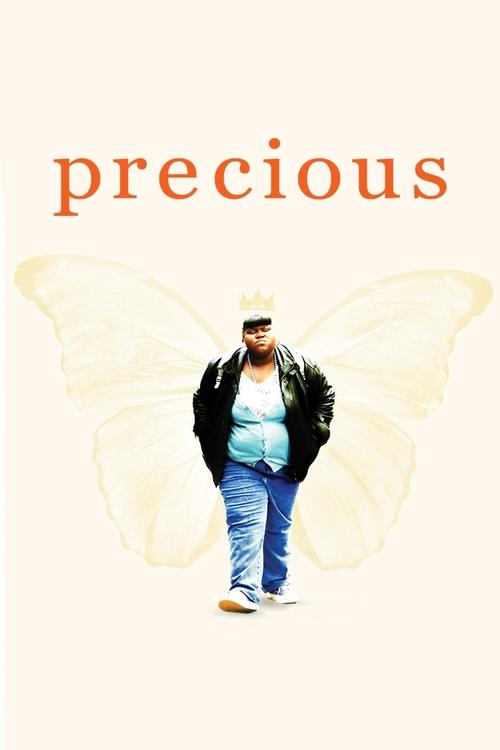
Precious: Based on the Novel 'Push' by Sapphire
2009 · Lee Daniels
When you're ready to be put through it — a film for when you want to feel something real and come out the other side. This is challenge, not comfort, but it's the good kind: the kind that ends in a hard-won light.
What it's about
Harlem, 1987. Precious Jones is sixteen, pregnant for the second time by her absent father, and trapped at home with a mother whose rage fills every room. She's reached ninth grade carrying a secret — she can't read — and when she lands in an alternative school, a sliver of a different life opens up. The film follows her fight to claim a self that everyone around her insists she doesn't deserve.
The experience
Brutal and tender in alternating waves — it hits hard, then cuts into blazing fantasy sequences where Precious imagines the life she's owed, so you're wrung out and lifted in the same scene. It earns its hope without softening anything.
Performances
Gabourey Sidibe, cast from an open call with no film experience, anchors everything with an astonishing stillness, and Mo'Nique is volcanic as the mother — a performance of pure fury with something wounded underneath that won her an Academy Award.
The craft
Lee Daniels refuses the tasteful restraint this material usually gets, smashing grim kitchen-sink realism against red-carpet fantasy in a maximalist style that divided critics and defined him. The editing between the two registers is the film's nervous system — escape and reality colliding mid-scene.
Why it matters
It stormed Sundance 2009, taking both the Grand Jury Prize and the Audience Award, drew Oprah Winfrey and Tyler Perry as champions, and became a landmark moment for Black independent film reaching a mass audience.
Lee Daniels' second feature arrived at Sundance 2009 as a thunderclap, taking both the Grand Jury Prize and the Audience Award before Oprah Winfrey and Tyler Perry lent their names to its release. Adapted from Sapphire's 1996 novel, it follows an illiterate Harlem teenager through a gauntlet of abuse toward the fragile possibility of self-authorship, and Daniels refuses the tasteful restraint such material usually receives: he cuts from grim kitchen-sink realism into blazing fantasy sequences — red carpets, photo shoots, a self that exists only in the girl's head — a melodramatic maximalism that divided critics and defined his career. Gabourey Sidibe, cast from an open call with no film experience, holds the center with astonishing stillness, while Mo'Nique's volcanic turn as the mother won her an Academy Award. Geoffrey Fletcher became the first African American writer to win the Oscar for adapted screenplay. Mariah Carey, scrubbed of glamour as a weary social worker, is the film's quietest surprise.
Reception
A Sundance 2009 sensation (it won both the Grand Jury Prize and Audience Award) that rode an Oprah-and-Tyler-Perry-powered wave to six Oscar nominations — then weathered a fierce backlash over whether it was empathy or exploitation, a debate that still defines how it's discussed more than the film itself.
How Precious: Based on the Novel 'Push' by Sapphire was received, from release to now →
Influences: the films it descends from and the films it influenced
- The Color Purple (1985) — Adapts an epistolary novel of a Black woman's abuse into cinema where literacy and writing become the literal mechanism of self-authorship and escape — Precious inherits its 'learning to read/write oneself into personhood' structure.
- Billy Liar (1963) — Codified the kitchen-sink-realism-plus-daydream template: a trapped working-class protagonist's grim milieu is punctured by lush fantasy interludes, the exact reality/fantasy cross-cutting Daniels uses for Precious's red-carpet escapes.
- Requiem for a Dream (2000) — Supplies the technique of splicing hyper-stylized subjective fantasy/hallucination inserts against squalid realism, using rhythmic montage to render an interior state the character can't voice.
- Kes (1969) — The social-realist blueprint of an unglamorous, bullied poor child carried by a near-documentary, unmannered lead performance that resists melodramatic 'acting'.
- Monster's Ball (2001) — Lee Daniels's own producing method rehearsed here: casting a glamorous star (Halle Berry) deglamorized into raw degradation — the same against-type gambit he'd run with Mo'Nique and Mariah Carey in Precious.
- A Woman Under the Influence (1974) — Model for the volcanic, unbroken domestic-abuse performance scene — the mother filmed in extended emotional extremity with the camera refusing to look away, prefiguring Mo'Nique's climactic monologue.
- The 400 Blows (1959) — The empathetic-realist portrait of a neglected, abused adolescent whose inner life is dignified by the camera's patient attention rather than pity.
- Boyz n the Hood (1991) — Established the Sundance-to-mainstream pathway for unsparing Black American inner-city social realism led by a first-time nonprofessional-feeling cast.
- 8½ (1963) — The originating grammar of the fantasy sequence as externalized psychology — glamour daydreams staged as the character's compensatory interior theater, which Precious's mirror/spotlight visions quote directly.
- Beasts of the Southern Wild (2012) — Extends the craft of overlaying poetic fantasy imagery onto a poor Black girl's brutal material world, a nonprofessional child lead's imagination reframing deprivation — a Sundance breakout in Precious's lineage.
- Fruitvale Station (2013) — Carries forward the Sundance-launched, intimate handheld social realism of Black American life, building a whole film around a single deglamorized lead's lived texture.
- Moonlight (2016) — Advances the abuse-and-survival portrait of Black American selfhood forged in indie melodrama, with a drug-ravaged mother figure and against-type casting as central formal choices.
- Room (2015) — Extends the abuse-and-survival subject through radical subjective interiority, staging the captive's coping imagination as a formal device and pairing a raw mother-child dyad.
- The Butler (2013) — Daniels's own continuation of his melodramatic, star-studded treatment of the Black American experience — the authorial signature of grand emotional register plus prestige-cast-against-type first tested in Precious.
- Pariah (2011) — Shares the indie-realist coming-of-age of a Black teen surviving a hostile home, using stylized light/color inserts against kitchen-sink domestic scenes to mark inner life.
- Winter's Bone (2010) — Parallel Sundance breakout built on a young woman's survival amid generational poverty rendered in unblinking kitchen-sink realism, launching an unknown lead the way Precious did Sidibe.
Similar films
- Moonlight (2016) — influence & lineage
- The Color Purple (1985) — influence & lineage
- Pariah (2011) — influence & lineage
- Beasts of the Southern Wild (2012) — influence & lineage
- Boyz n the Hood (1991) — influence & lineage
- The 400 Blows (1959) — influence & lineage
- 12 Years a Slave (2013) — shared sensibility
- Mudbound (2017) — shared sensibility
All the films related to Precious: Based on the Novel 'Push' by Sapphire →