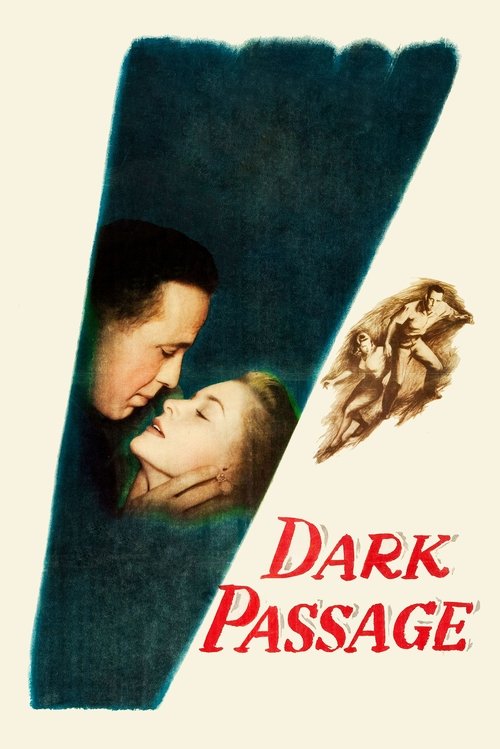
Dark Passage
1947 · Delmer Daves
When you're in the mood for a rainy-night noir — shadows, danger, a doomed-feeling romance — and want one with a genuinely odd formal hook to talk about after. Comfortable in length, prickly in atmosphere.
What it's about
A man convicted of murdering his wife breaks out of San Quentin and goes to ground in San Francisco, where a stranger — a woman with her own reasons for believing him — shelters him while he tries to prove his innocence. His one shot at a new life runs through a back-alley plastic surgeon and a city full of people who might recognize him.
The experience
Tense and claustrophobic in a peculiarly intimate way: for a long stretch you see the world through the fugitive's own eyes, faces looming into frame, every stranger a potential threat. It's a lean, paranoid thriller with a surprisingly tender center.
Performances
Humphrey Bogart and Lauren Bacall, in their third film together, generate their trademark charge — Bacall especially, carrying long stretches on her own since the camera withholds Bogart's face, playing wary devotion with real conviction.
The craft
The famous gambit: nearly half the film is shot in sustained first-person camera, keeping the star's face hidden until the story's transformation is complete — a bold experiment smuggled inside a studio thriller. Extensive San Francisco location shooting gives it a concrete sense of place unusual for its era, all fog, hills, and fire escapes.
Why it matters
A key entry in late-1940s noir's turn toward real locations and procedural texture, and one of cinema's most sustained uses of subjective camera — a formal dare studios almost never took with a star of Bogart's magnitude.
Snapshot
Dark Passage is a Warner Bros. noir thriller in which escaped San Quentin convict Vincent Parry (Humphrey Bogart) hides his identity across a city — and for nearly half the film, across the frame itself. Sustained first-person cinematography withholds Bogart's face until the narrative's central transformation — plastic surgery that literally reconstructs him — is complete, making the film both a star vehicle and a formal experiment in delayed identification. Shot almost entirely on location in San Francisco and built around Humphrey Bogart and Lauren Bacall's third pairing, it sits at the intersection of the studio system's commercial machinery and the late 1940s vogue for procedural, spatially grounded noir. The film is based on David Goodis's 1946 serialized novel and was written and directed by Delmer Daves, a craftsman-director rarely grouped with the auteur canon but responsible here for one of the most sustained experiments in subjective camera Hollywood produced.
Industry & production
Warner Bros. assigned Dark Passage as the third vehicle for Bogart and Bacall following To Have and Have Not (1944) and The Big Sleep (1946), capitalizing on the couple's off-screen marriage (May 1945) and their proven box-office chemistry. David Goodis's source novel had been serialized in The Saturday Evening Post in 1946 before book publication, giving the property marquee literary recognition without the prestige overhead of a major novel acquisition. Delmer Daves adapted the screenplay himself — unusual for a director-for-hire in the studio system — and also directed, giving the project unusual authorial unity at the script stage.
The production made substantial use of San Francisco locations at a time when Hollywood was beginning to move away from its reliance on backlot constructions toward the kind of location realism that would define postwar American crime cinema. Shooting on actual city streets, near Coit Tower, along the bay, and through the residential hills of the city was both economically practical — the restricted first-person perspective reduced the need for elaborate studio standing sets — and tonally appropriate, lending the fugitive narrative a documentary texture. Warner Bros., despite its identification with urban realism, still required negotiated access to public spaces and coordination with local authorities; the records of that production logistics are not fully documented in the public scholarship.
Technology
The film's most conspicuous technological commitment is its sustained use of first-person optical point-of-view. For approximately the first forty minutes of the running time, the camera stands in entirely for Parry's eyes: we see his hands, hear his voice (Bogart's), but never see his face. This technique required the cinematographer to work with the camera mounted at eye level, carried or operated to simulate a body's movement — a physically demanding approach predating the stabilization technology (such as the Steadicam, developed in the 1970s) that would later make such shooting routine.
The technique puts Dark Passage in direct conversation with Robert Montgomery's Lady in the Lake (MGM, January 1947), which employed first-person cinematography for its entire running time. Both films were in production near the same period; Lady in the Lake reached release earlier in 1947. Where Montgomery's film committed to the device with an almost programmatic rigidity that critics found alienating, Daves made a more calculated choice: first-person framing is abandoned once Parry undergoes plastic surgery and emerges, bandage-free, as fully legible — and, critically, as unambiguously Humphrey Bogart. The shift from subjective to conventional third-person coverage becomes a narrative release, the formal device paying off its structural promise.
The plastic surgery scenes themselves required careful staging of bandaging and post-operative states without clinical specificity — the film is vague on surgical procedure in ways that served both decorum and plot convenience.
Technique
Cinematography
Sid Hickox, who had photographed To Have and Have Not for Warner Bros., served as cinematographer. The first-person sequences demand a different compositional grammar than conventional Hollywood cinematography: since the camera is the protagonist, standard eyeline-match cutting is unavailable, and reaction shots — a staple of Hollywood continuity — must be built from other performers looking directly into the lens. The effect, familiar now from decades of imitation and parody, registers as simultaneously intimate and uncanny: characters address the audience directly, destabilizing the conventional voyeuristic distance of Hollywood spectatorship.
Once Daves abandons the first-person mode, Hickox's work settles into the tonal chiaroscuro associated with Warner Bros. crime production — deep-focus compositions, low-key interior lighting, and a skilled use of San Francisco's available architectural topography (steep staircases, bay views, fog-diffused exteriors) to build a sense of a city as trap.
Editing
David Weisbart edited the film. The extended first-person opening poses a particular editorial problem: conventional cut-to-coverage strategies are unavailable, so the editing relies heavily on motivated cuts — the character looks at something, we cut to what he sees — and on sound bridges that carry continuity across visual ellipses. The transition from first-person to third-person is a pivotal editorial moment, and Daves and Weisbart stage it as a gradual revelation rather than an abrupt break, using the bandaged face as an intermediate state that allows the audience to acclimate before the full return of conventional cinema grammar.
Mise-en-scène / staging
Irene's San Francisco apartment — a stylishly appointed space that functions as sanctuary, hiding place, and visual counterpoint to the city's danger outside — is staged with a careful sense of off-screen threat. The apartment scenes often position Bacall and Bogart in compositional arrangements that echo the theatrical intimacy of their earlier films while acknowledging the genre's surveillance logic: windows, doors, and thresholds are consistently legible as potential intrusion points.
The film's villain, Madge Rapf (Agnes Moorehead), is staged in contrast: her appearances are brisk, rhetorically aggressive, occupying domestic spaces with the energy of accusation. Her climactic fall — the film's most overtly expressionist staging — resolves the thriller plot with an operatic violence Daves keeps just barely within the bounds of Production Code permissibility.
San Francisco's topography is mise-en-scène as much as geography: Coit Tower, the city's hills, and the bay's visible expanses mark Parry's movements as both flight and exposure, a fugitive in a city that has no flat ground on which to hide.
Sound
Franz Waxman composed the score. Waxman was among the most important Hollywood composers of the classical period, and his Dark Passage work is characterized by the kind of anxious, chromatic string writing he developed across a wide range of crime and psychological thrillers. The first-person sequences present a sound design question — Bogart's voice is present as interiority, but the score must provide emotional commentary without the cue of a visible protagonist — and the music functions more heavily as an atmospheric carrier during these passages than it would in conventionally photographed scenes. Specific musicological scholarship on the Dark Passage score is limited; the film has not attracted the kind of sustained musical analysis that Hitchcock's Waxman collaborations (e.g., Rebecca) have received.
Performance
The withheld-face structure creates an unusual performance asymmetry: Bogart is present in voice and gesture for forty minutes before becoming visually legible, while the supporting cast must perform toward a camera that substitutes for his presence. Agnes Moorehead's Madge is particularly affected by this — her scenes in the early section require her to deliver a hostile, pointed performance at the camera-as-Vincent, creating an intensity that reads as almost confrontational to the audience. Moorehead, already an established stage and radio performer by 1947, handles this with an exactness that several contemporary critics noted.
Bacall's Irene is written as unusually competent: she drives the plot materially, harbors Parry, finances his surgery, and possesses information the investigation requires. This active structural role — rare for female characters in contemporaneous noir — is underwritten with the star's characteristic restraint, avoiding the more coded femme fatale registers that the genre habitually required of female leads.
Bogart, once visible, works within the persona already firmly established: the laconic, physically contained man of action in extremis. His performance does not reach for the deeper registers of his best work from the period (In a Lonely Place, 1950, remains the benchmark), but the formal constraint of the first half gives his eventual appearance an uncommon charge.
Narrative & dramatic mode
The narrative is structured as a fugitive procedural: Parry's escape from San Quentin, his concealment in the city, the surgical transformation, and his gradual piecing together of the evidence necessary to expose the real killer of his wife. The film leans less heavily on the genre's characteristic flashback structure — standard in noir — and more on a present-tense momentum driven by the necessity of staying mobile and unseen.
The central dramatic irony is that Parry is most visible to the audience — most legible as Bogart, most readable as star — precisely when he has transformed his face to become invisible to the city's police. The film's formal experiment is in this sense thematically motivated: the subjective camera in the early sequences enacts the logic of concealment narratively, while the return to objective framing accompanies a character who is simultaneously more visible (as Bogart) and more hidden (as the surgically altered Parry).
The ending — Parry's apparent refuge in South America, followed by Irene's reunion with him — resolves the thriller plot with a happiness that is structurally anomalous for the genre but typical of the Bogart-Bacall franchise requirement for romantic resolution.
Genre & cycle
Dark Passage occupies a specific sub-cycle within late classical Hollywood noir: the first-person or subjectivist thriller, a short-lived formal experiment of which Lady in the Lake is the other major instance. This cycle belongs to a broader postwar tendency in Hollywood crime cinema toward proceduralism, location shooting, and a documentarian aesthetic that was partly a response to Italian neorealism's critical prestige, partly an economic accommodation to reduced production expenditure, and partly an ideological alignment with a culture processing wartime experience through crime narratives. Films like The House on 92nd Street (1945), Call Northside 777 (1948), and The Naked City (1948) form the documentary-noir adjacent tradition; Dark Passage inflects that tendency through the star vehicle system and the formal experiment of subjective framing.
The Bogart-Bacall vehicle format is itself a cycle: the three films have a recognizable template (Bogart in jeopardy, Bacall as competent helper, romantic resolution, urban or quasi-urban setting) and were marketed as much on the couple's off-screen identity as on individual narrative merits.
Authorship & method
Delmer Daves was a contract director at Warner Bros. whose career spanned crime films, war pictures, and westerns. He is most frequently cited by critics interested in American genre cinema for Broken Arrow (1950), an early revisionist western, and 3:10 to Yuma (1957). In the auteurist criticism that defined serious Hollywood scholarship from the 1960s onward, Daves received less attention than directors whose work was legible through consistent thematic or stylistic signatures. Dark Passage is perhaps his most formally ambitious film, and the decision to adapt the Goodis novel himself — and to commit to the first-person device rather than normalize it — suggests a directorial investment beyond the usual craftsman brief.
Sid Hickox (cinematographer) brought continuity from the earlier Bogart-Bacall productions and a reliable command of Warner Bros. chiaroscuro. Franz Waxman (composer) was, at this point in his career, one of Hollywood's most in-demand composers for psychological thrillers and crime films. David Weisbart (editor) was a journeyman editor at Warners who later transitioned to producing.
David Goodis (source novelist) warrants particular notice: he is one of the defining figures of mid-century American noir fiction, a writer whose protagonists are characteristically men in vertiginous social and psychological free-fall. His work attracted French New Wave attention — Truffaut adapted his novel Down There as Shoot the Piano Player (1960) — and the Série Noire translations of his novels gave him a European critical standing that outran his American reputation. Dark Passage is among his earlier works; the Goodis signature of a protagonist who cannot escape his own capacity for destruction is present but more generically managed here than in his later, more desolate novels.
Movement / national cinema
Dark Passage is a product of classical Hollywood at the height of its studio system formation, but it registers multiple pressures from outside: the European émigré influence on noir visual grammar (several of the cycle's key cinematographers and directors were German or Central European by training), the postwar American documentary tendency, and — less directly — the existentialist current in popular fiction that was influencing the pulp and serialized fiction from which noir drew its source material. It is not formally affiliated with any national cinema movement outside the Hollywood mainstream; its San Francisco location work gives it a geographical specificity unusual for studio production without marking it as regional cinema in any programmatic sense.
Era / period
The film sits at the midpoint of the classical noir cycle, which is most usefully dated from roughly 1941 (The Maltese Falcon) to roughly 1958 (Touch of Evil, though periodization varies by scholar). In 1947, the genre was fully formed but had not yet reached the existential extremity of its late period: the formal experiments, political pressures, and psychological intensity that mark the cycle's final years were still ahead. The postwar moment — returning veterans, reconstituted domestic ideologies, anxieties about criminal guilt and institutional justice — is inscribed in the fugitive narrative's assumption that institutional justice (the prison, the courts) is an unreliable arbiter of actual innocence.
Themes
The film's central thematic concern is identity under erasure: Parry cannot exist as himself and survive, so he replaces his face. The first-person camera enacts this: we see the world as Parry does, but we are denied Parry as an object of identification. This thematic structure connects Dark Passage to a broader noir obsession with the instability of selfhood — the man who cannot be what he appears, the self that must be performed or disguised to survive.
The city as environment of surveillance and exposure is a related motif: San Francisco is beautiful in Hickox's photography and lethal as a narrative space — a city of hills from which escape routes are always visible, of a bay that marks geographic limit. The apartment as sanctuary-and-trap is a recurring spatial figure: Irene's space offers safety that is structurally temporary, dependent on continued concealment.
The question of institutional justice versus actual innocence — a man the law has condemned who is, the film asserts, innocent — participates in the period's broader anxiety about legal and social legitimation. Whether this carries political weight beyond genre convention is a matter the film does not resolve, though the ending's relocation to South America suggests that American institutional justice offers no remediation: exile is the only available freedom.
Reception, canon & influence
Backward influences: The most direct formal antecedent is Lady in the Lake, which preceded Dark Passage to release in early 1947 and demonstrated both the formal possibilities and the audience resistance that first-person filmmaking generated. The Goodis novel provided the narrative armature. Behind both films lies a tradition of first-person literary fiction and the more occasional first-person passages in earlier Hollywood (the opening of Rebecca, 1940, is sometimes cited; murder-perspective sequences in various crime films of the late 1930s and early 1940s are scattered precedents). The hard-boiled fiction tradition — Hammett, Chandler, and their successors — underwrites the epistemological structure: the protagonist as investigator of his own situation, the city as illegible text.
Contemporary reception: Critical response in 1947 was mixed to moderately positive. The first-person device attracted commentary — it was visible enough to require acknowledgment — and opinion divided on whether the formal experiment was a genuine innovation or a publicity conceit. The Bogart-Bacall pairing remained a reliable critical and commercial magnet, and reviews tended to evaluate the film at least partly as a vehicle for the stars. Precise box-office records are not reliably available in the scholarly literature; the film is not known to have been a major commercial failure or success by Warner Bros. standards of the period.
Canonical standing: Dark Passage occupies a secondary position in the noir canon — discussed in the genre's serious scholarship (James Naremore's More Than Night, for instance, engages the period's subjectivist experiments) but rarely placed at the cycle's center. It is more frequently cited as a curiosity of formal experiment than as a thematic or stylistic touchstone. The Bogart-Bacall films as a group are canonically secure; within that trio, The Big Sleep commands the most critical attention.
Forward influence: The film's sustained first-person cinematography has been periodically revisited in discussions of subjective camera, point-of-view ethics, and the phenomenology of spectatorship in film theory. Its specific influence on subsequent filmmaking is difficult to trace directly — the technique was not widely imitated in the postwar period, partly because audience response to Lady in the Lake's more extreme deployment had been cautious. The subjective camera returned with renewed critical interest in later decades (Peeping Tom, 1960; Being John Malkovich, 1999; a range of video game-adjacent cinema) without Dark Passage being frequently identified as a proximate source. David Goodis's novel and its critical rehabilitation — driven substantially by French reception — ensured the source material a longer afterlife than the film itself, though the film remains the Goodis adaptation most widely available and discussed in English-language cinema contexts.
A Deleuzian reading
Somebody leans into the camera and starts talking to you.
The full Deleuzian reading of Dark Passage →
Reception
Dismissed in 1947 as the weakest of the Bogart-Bacall vehicles and knocked for its central gimmick, it's since been reclaimed by noir fans as one of the great San Francisco films and a bold formal experiment ahead of its time.
How Dark Passage was received, from release to now →
Influences: the films it descends from and the films it influenced
- Lady in the Lake (1947) — Montgomery's film, released months before Dark Passage, sustained unbroken first-person cinematography across its entire runtime and demonstrated both the formal possibilities and the audience-resistance problem that Daves navigated by reserving the device for only the film's first act.
- Murder, My Sweet (1944) — Dmytryk's drugging and knockout sequences used optical superimposition and crash-zooms to render Marlowe's disoriented subjectivity, establishing the expressionist grammar for subjective-camera states that Daves deploys in Dark Passage's post-surgical transition.
- Rebecca (1940) — Franz Waxman's chromatic Gothic string writing for this film — surging, harmonically unstable, keyed to psychological instability — directly establishes the scoring register that Waxman extends to Dark Passage's romantic-noir idiom seven years later.
- Double Indemnity (1944) — Wilder's confessional structure locks spectator identification to a criminal narrator from the opening frame, establishing the epistemological premise that Dark Passage extends from audio first-person to sustained visual POV — the audience sutured to a compromised consciousness.
- Phantom Lady (1944) — Siodmak's angular shadow-raked cinematography and the innocent-protagonist-wrongly-accused procedural structure codify the chiaroscuro grammar and fugitive-procedural template that Daves inherits for Dark Passage's nocturnal San Francisco sequences.
- The House on 92nd Street (1945) — Hathaway's semi-documentary method — actual New York locations, semi-newsreel narration, real institutional interiors rather than studio sets — inaugurated the documentary-noir aesthetic that Daves deploys when shooting Vincent Parry's fugitive itinerary on the actual hills and streets of San Francisco.
- Vertigo (1958) — Hitchcock uses San Francisco's specific hills, towers, and Bay topography as psychological geography for an identity-transformation plot; Bernard Herrmann's chromatic string writing and the delayed revelation of Judy's reconstructed identity both extend the transformation-reveal device and location-as-psychology grammar of Dark Passage.
- Shoot the Piano Player (1960) — Adapted from Goodis's Down There — drawing on the same author's fugitive-with-concealed-identity grammar — Truffaut's jump-cut motivated editing and the pianist's refusal to disclose his past identity extend Dark Passage's architecture of performed anonymity into the French New Wave.
- Peeping Tom (1960) — Powell literalizes what Dark Passage's subjective camera leaves implicit: Mark's camera-tripod kills by the act of filming, making the audience's identification with a camera-eye — the formal device Daves deploys — an explicit ethical charge rather than a stylistic conceit.
- Eyes Without a Face (1960) — Franju takes the plastic surgery / new-face mechanism that structures Dark Passage's identity concealment and extends it into lyrical horror: the father's surgical reconstruction of his daughter's face becomes both the film's central act and its moral catastrophe, pushing the transformation-reveal to its darkest consequence.
- Experiment in Terror (1962) — Edwards choreographs thriller action through San Francisco's specific geography — Embarcadero warehouses, Candlestick Park — using the same urban-topographic grammar Daves developed: the city's distinctive hills and waterfront as spatial determinants of the fugitive's options rather than neutral background.
- Seconds (1966) — Frankenheimer makes surgical identity transformation the film's central mechanism; James Wong Howe's distorting wide-angle handheld shots extend Dark Passage's first-person POV grammar into paranoid subjective distortion, particularly in the bank and reorientation sequences following the protagonist's emergence with a new face.
- Point Blank (1967) — Boorman deploys San Francisco and Los Angeles locations as spatial-disorientation devices for a wronged man pursuing justice; his motivated-cut editing — repeatedly fracturing to memory-match fragments — extends the POV-to-third-person transitional logic Daves uses when shifting between Vincent's subjectivity and objective narration.
- Being John Malkovich (1999) — The portal sequences sustain unbroken first-person cinematography — cramped, slightly off-kilter framing — to literalize inhabiting another's sensory subjectivity, extending the phenomenological thought experiment about camera-identification that the Lady in the Lake / Dark Passage cycle raised without fully following through on its ethical implications.
- The Diving Bell and the Butterfly (2007) — Its opening reels lock the camera inside the hero's skull so the world is only ever glimpsed through his gaze — the same 'trapped behind one point of view' staging Diving Bell holds from a fixed vantage on the hospital bed.
- Phoenix (2014) — Post-surgical noir in which a bandaged man with a new face moves back among people who knew him to assemble evidence of a crime — the plot engine of Phoenix, including the deliberate withholding of the reconstructed face from the camera.
- They Live by Night (1948) — Ray's aerial-shot opening observes the fugitive couple from a surveillance distance that registers their spatial vulnerability in real geography; the film shares Dark Passage's grammar of location-as-procedural-pressure rather than studio expressionism as the primary instrument of nocturnal anxiety.
- Gun Crazy (1950) — The famous unbroken back-seat bank robbery sequence — camera mounted inside the car, capturing the heist in a single continuous take — extends the documentary-subjective grammar of motivated location shooting into its most kinetic expression, developing the formal logic Daves applies to Parry's street-level fugitive itinerary.
Similar films
- Murder, My Sweet (1944) — influence & lineage
- Point Blank (1967) — influence & lineage
- Vertigo (1958) — influence & lineage
- The Big Sleep (1946) — shared sensibility
- The Maltese Falcon (1941) — shared sensibility
- The Woman in the Window (1944) — shared sensibility
- In a Lonely Place (1950) — shared sensibility
- Elevator to the Gallows (1958) — shared sensibility
All the films related to Dark Passage →