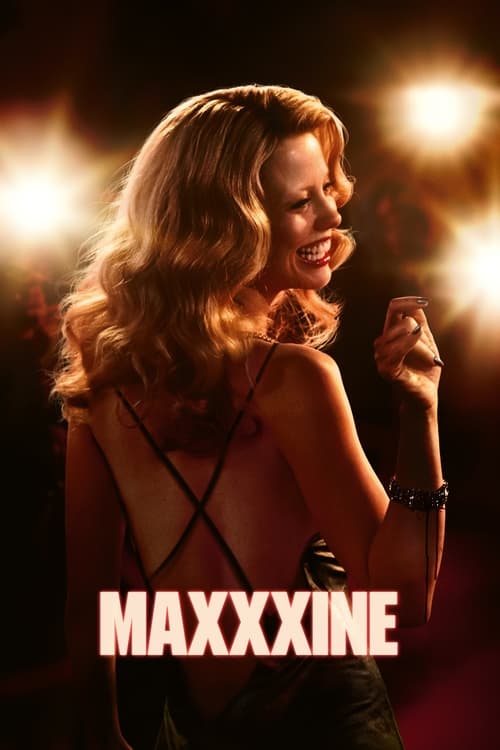
MaXXXine
2024 · Ti West
When you're craving stylish pulp — a violent, confident genre ride with a period soundtrack — rather than a film that terrifies you. Best with some tolerance for gore and a soft spot for old-school Hollywood sleaze.
What it's about
Hollywood, 1985. Maxine Minx, an adult-film star hungry for legitimate stardom, lands her breakout role in a horror sequel — just as a killer begins stalking the young women on the industry's margins, with the real-life Night Stalker panic hanging over the city. Her past has a body count of its own, and the trail of blood keeps threatening to drag it into the light. It's the closing chapter of Ti West's trilogy about wanting fame badly enough to survive anything.
The experience
Sleazy, neon-soaked, and swaggering — more of a paranoid Hollywood thriller with slasher eruptions than a straight scare machine. It's tense and nasty in bursts, but the dominant sensation is grimy 1985 atmosphere: video stores, smog, and the feeling of being watched.
Performances
Mia Goth carries her third film in the trilogy with feral conviction — Maxine's refusal to be a victim reads in every line of her face, and Goth makes ruthless ambition feel like a survival instinct.
The craft
Ti West rebuilds mid-80s Los Angeles as a pastiche of the era's glossy, disreputable thrillers — giallo lighting, video-store texture, period grain — and each film in his trilogy wears a different genre's skin. The production design and needle-drops reward a big screen and loud speakers; it's a film about surfaces that takes its own surfaces seriously.
Why it matters
It completed the X trilogy, a rare modern horror project shot as three interlocking films with one star, and cemented the Ti West–Mia Goth partnership as one of the defining collaborations of A24-era horror.
Horror · Giallo · Slasher · Exploitation & grindhouse. Sleazy, neon-soaked 1985 Hollywood giallo: a stalking killer, grimy paranoia, and gory kills staged as swaggering set pieces.
Snapshot
MaXXXine is the third and concluding film in Ti West's "X" trilogy, following X and Pearl (both 2022), all three built around Mia Goth and produced through A24. It relocates the trilogy's recurring meditation on stardom, mortality, and the pornography of looking from the rural Texas of X to the neon-and-smog Hollywood of 1985. Maxine Minx, the sole survivor of the Texas massacre in X, is now an adult-film performer clawing toward legitimacy, cast in a horror sequel called The Puritan II even as a serial killer stalks the industry's margins against the real-life backdrop of the Richard Ramirez "Night Stalker" murders and the Reagan-era "satanic panic." Where X was a Tobe Hooper–inflected slasher and Pearl a Technicolor melodrama, MaXXXine is a pastiche of the sleazy, glossy Los Angeles thriller — giallo, De Palma, the video-nasty moral panic, Hollywood Babylon. It is the trilogy's most self-consciously "industry" film: a horror movie about a woman trying to escape being a horror-movie victim.
Industry & production
The film was produced and released by A24, the American distributor whose brand became closely tied to the 2010s–2020s prestige-horror conversation. It was made through Ti West and Goth's producing arrangement (West's Mad Solar banner, with Goth and Jacob Jaffke among the producing team), the same infrastructure that enabled the trilogy's unusual production history: Pearl was shot back-to-back with X in New Zealand during COVID-era production, conceived and written on location, and revealed as a surprise. MaXXXine was the deferred payoff — announced at the end of X with a teaser promising the "Maxine" chapter — and the only one of the three shot in the United States, on and around Los Angeles, including work at Universal's backlot.
That backlot is central to the film's production identity: Maxine's shoot for The Puritan II takes place amid recognizable studio landmarks, and the film stages sequences on the standing Bates house and Psycho motel façade, folding real Hollywood iconography into its fiction. MaXXXine was reported to be the largest and most expensive undertaking of the trilogy, with a broader ensemble and more location-heavy shoot than its predecessors' contained settings. The cast reflects that scale-up: alongside Goth, it features Elizabeth Debicki as the imperious British director Elizabeth Bender, Kevin Bacon as a sleazy private investigator, Giancarlo Esposito as Maxine's agent, Michelle Monaghan and Bobby Cannavale as LAPD detectives, and supporting turns from Halsey, Moses Sumney, Lily Collins, and others. Precise budget and box-office figures are outside what can be responsibly stated here; contemporaneous reporting framed the film as a commercial step up in ambition whose returns were more modest than its A24 stablemates' biggest hits, but I will not assert numbers I cannot verify.
Technology
MaXXXine is a digitally originated film styled to evoke a photochemical past. West and his cinematographer pursue a look that reads as 1980s celluloid — grain, halation around light sources, saturated neon — without necessarily shooting the format it imitates; the trilogy has consistently used contemporary capture and grading to reconstruct period texture. The film's most pointed technological gesture is diegetic: it is set at the hinge between film and video, and it treats videotape, the camcorder, and the burgeoning home-video market as both plot engine and thematic anxiety. Surveillance footage, blackmail tapes, and the peep-show apparatus of the adult industry make the era's recording technologies part of the story's machinery — the killer's currency is compromising tape. This continues a preoccupation visible across West's career (the found-footage logic of The Sacrament, the analog fetishism of The House of the Devil), where the recording device is never neutral.
Technique
Cinematography
Eliot Rockett, who photographed all three "X" films, is the through-line of the trilogy's visual authorship, and MaXXXine is his most maximal entry. Where X used naturalistic golden-hour grime and Pearl used candy-bright storybook color, MaXXXine leans into the artificial: sodium-vapor streetlight, red-and-blue neon, hard shadow, and the deep-focus, wide-angle compositions associated with Brian De Palma. The camera is showier here than in the trilogy's earlier, slower-burning films — split-diopter-style deep staging, voyeuristic long-lens setups, and prowling movement that aligns the audience with a watcher. The Los Angeles of the film is rendered as a lurid set: the Walk of Fame, adult theaters, the Hollywood sign, and the studio backlot are lit less for realism than for iconographic charge.
Editing
West has historically been a formalist of pacing, favoring the slow build and the withheld payoff; his early features are almost defiantly patient. MaXXXine is faster and more incident-driven than The House of the Devil or The Innkeepers, but it retains his taste for the held wide shot and the deliberate reveal, cross-cut against period-accurate montage. West has frequently edited his own work, and the trilogy's rhythmic signature — the tension between languor and sudden violence — is consistent with his authorship; I flag that the exact editorial credit on MaXXXine is a detail I would want to confirm rather than assert.
Mise-en-scène / staging
Production design is the trilogy's great strength, and MaXXXine is a dense reconstruction of mid-1980s Hollywood: video stores, seedy motels, the interiors of an adult-film economy, and the artifice of a movie set within the movie. The staging repeatedly nests screens within screens — Maxine performing for a camera, watched on a monitor, watched again on tape — so that mise-en-scène itself dramatizes the theme of the woman as image. The Psycho house on the backlot is the signature set-piece location, a literalization of the film's argument that horror history is the ground Maxine walks on.
Sound
The soundscape is emphatically period. The score works in the synth-driven idiom of 1980s genre cinema — pulsing electronics, stingers, dread drones — and the film is dense with era needle-drops that function as both atmosphere and irony, scoring sleaze and ambition to the pop of the moment. (I'll note specific song attributions only in general terms, since exact music cues are easy to misremember.) Sound design foregrounds the mechanical: shutter clicks, tape hiss, the whir of projectors and camcorders, keeping the apparatus of recording audible.
Performance
Mia Goth's performance is the trilogy's animating force and the reason the whole edifice holds. Having played both young Maxine and aged Pearl in X and the title role in Pearl, Goth here plays Maxine as brittle armor over trauma — a survivor performing invulnerability, whose mantra "I will not accept a life I do not deserve" (carried over from X) is both ambition and delusion. The supporting cast plays broad genre types with relish: Bacon's greasy investigator, Debicki's icy auteur, Esposito's silver-tongued agent. The register is heightened, closer to the arch performance style of giallo and De Palma than to naturalism.
Narrative & dramatic mode
The film is structured as a stalker-thriller with a mystery spine: as starlets are murdered, suspicion, blackmail, and Maxine's concealed past converge. Its dramatic mode braids several registers — the rise-to-fame showbiz narrative, the slasher, the police procedural (via the detective subplot), and the revenge tale. The Night Stalker killings supply a real-historical pressure that keeps the fictional murders ambiguous. Thematically, the plot turns on the return of the repressed: Maxine's origin — a childhood shaped by a fire-and-brimstone televangelist father — surfaces as the engine of the violence, so that the "big break" and the buried past are revealed to be the same story. The dramatic irony is that Maxine, desperate to escape being a victim in a horror film, is trapped inside one.
Genre & cycle
MaXXXine sits at the intersection of the slasher, the neo-giallo, and the "Hollywood Babylon" exposé — the sub-tradition that mythologizes the film industry as a machine that consumes women. It belongs to a 2010s–2020s cycle of retro-styled, cinephilic horror that treats the genre's own history as raw material, and specifically to the wave of A24-associated horror often labeled "elevated." Within the trilogy it completes a formal experiment: three films, one star, three distinct genre skins (backwoods slasher, Douglas-Sirk-adjacent melodrama, sleaze-thriller), unified by a meditation on youth, fame, and death. The film is also a period reconstruction of the video-nasty moral panic and the satanic-panic media climate, making the cultural war over "corrupting" images part of its subject.
Authorship & method
Ti West is the film's writer-director and the trilogy's author-organizer. West emerged in the late-2000s American independent horror scene sometimes grouped as "mumblegore," making meticulously controlled, slow-burn genre exercises — The House of the Devil (a scrupulous 1980s pastiche), The Innkeepers, The Sacrament — before a foray into the Western with In a Valley of Violence and a period in television. The "X" trilogy is his most ambitious statement: a body of work about the pornography of looking, the terror of aging, and the American appetite for self-invention, executed as escalating stylistic homage.
His key collaborators define the trilogy's coherence. Mia Goth is co-author as much as star, credited as a producer and shaping the Maxine/Pearl throughline. Cinematographer Eliot Rockett provides the visual continuity across all three films. The music is anchored by Tyler Bates, working in the synth-forward genre idiom (with Timothy Williams collaborating on the trilogy's scoring). Elizabeth Debicki's director-within-the-film functions almost as a commentary on West's own authorship — a filmmaker insisting that "genre" work can be art. West's method is pastiche-as-argument: he reconstructs a specific past cinema so faithfully that the reconstruction becomes a critique of it.
Movement / national cinema
The film is a product of American independent-adjacent studio horror in the A24 mode — mid-budget, auteur-branded, cinephile-facing genre filmmaking positioned against both franchise horror and the low-budget indie fringe West came up in. It participates in a distinctly American mythology (Hollywood, the frontier of self-reinvention, the entertainment industry as national dream-factory) while wearing the stylistic clothes of European genre cinema — Italian giallo above all — filtered through American appropriators like De Palma. Its national-cinema identity is therefore double: American subject, transatlantic style.
Era / period
MaXXXine is a 2024 film about 1985, and both dates matter. The 1985 setting places it at the peak of the Night Stalker terror, the ascendancy of home video, the moral-majority backlash against pornography and horror, and the Reagan-era collision of prosperity-gospel piety with commercial sleaze. The 2024 vantage places it inside the post-2010s horror renaissance and the streaming/theatrical realignment, at a moment when "legacy" horror and self-reflexive meta-horror were dominant. The film's nostalgia is thus knowing: it recreates a cultural war over indecent images at a time when the industry was again negotiating what horror is permitted to be and who gets to make it.
Themes
The trilogy's governing theme is the terror of being looked at and the cost of wanting to be seen. MaXXXine sharpens this into a study of female ambition inside an exploitative machine: Maxine's drive to matter is inseparable from her willingness to be consumed as an image. Religious repression is the film's dark engine — the televangelist father, the "puritan" film title, the satanic panic — staging a very American dialectic between Puritan shame and pornographic exposure, in which prudery and prurience are two faces of the same obsession with the female body. Survival and self-authorship run underneath: Maxine's refusal of the victim role is heroic and monstrous at once. And there is the trilogy's constant, mortality — youth as capital that fame promises to preserve and time inevitably spends.
Reception, canon & influence
Critical reception treated MaXXXine as an accomplished but divisive conclusion. Reviewers broadly praised Goth's performance, Rockett's photography, and the density of the 1980s reconstruction, while a significant strand of criticism found it the least emotionally resonant of the three — more surface homage than the character study Pearl had delivered, its mystery plotting thinner than its style. The consensus that formed placed X and especially Pearl higher in the trilogy's canon, with MaXXXine valued as the flashiest and most referential but least surprising installment. I'd caution that any single "definitive" critical verdict overstates the case; the reception was genuinely split.
The influences on the film are legible and deliberate: Italian giallo (its stylized murders and gloved-killer grammar), Brian De Palma (voyeurism, split staging, Hollywood-as-subject, films like Body Double and Dressed to Kill), Hitchcock via the literal Psycho backlot, the video-nasty and slasher cycles of the early-to-mid 1980s, and the "Hollywood Babylon" tradition of industry exposé. West's own The House of the Devil is a clear precedent for the fetishistic period reconstruction.
Its forward legacy is still crystallizing given its recency. Most concretely, MaXXXine completes and closes the "X" trilogy as a landmark of 2020s auteur horror and a defining showcase for Mia Goth's stardom — a body of work likely to be cited as a model for genre filmmaking that treats horror history as a serious artistic inheritance, and for the star-plus-director authorial partnership as an independent-horror strategy. Whether the film itself spawns direct imitators is not yet answerable; what can be said is that the trilogy as a whole consolidated a template — cinephilic pastiche, formal rigor, a woman's interiority at the center of exploitation genre — that the horror field of the mid-2020s was already moving toward, and that MaXXXine embodies in its most maximal form.
A Deleuzian reading
The last act of *MaXXXine* plays out on a hill at Universal, in front of the house from *Psycho*.
The full Deleuzian reading of MaXXXine →
Reception
It arrived with trilogy-capper hype and A24's biggest-ever horror opening, then landed with a thud: mixed reviews and a quick fan consensus that it was the trilogy's weak link. Two years on it's less reviled than shrugged at — with a vocal minority insisting the sleaze-homage vibes were the point.
How MaXXXine was received, from release to now →
How to watch MaXXXine: what to notice on a first viewing
- Watch foreground and background stay knife-sharp at the same time. Rockett uses split-diopter staging borrowed from De Palma, holding near and far objects in simultaneous sharp focus within a single shot. The technique lets the frame hide a threat in plain sight, right next to what you're looking at.
- Notice sodium streetlight and red-and-blue neon lighting Los Angeles. Rockett lights the city for iconographic charge rather than realism, hard shadow and lurid color turning the Walk of Fame and backlots into a stylized set. The neon tells you how to feel about a street before anyone walks into it.
- Watch Maxine performed for a camera, then watched on a monitor. The staging nests screens inside screens, performances appearing on tape and on monitors. You feel a second watcher in the room every time the film shows you a screen.
- Listen for shutter clicks, tape hiss, and the whir of projectors. Sound design keeps the mechanics of recording constantly audible, alongside Tyler Bates's pulsing synth score under the period needle drops. The apparatus that's watching Maxine never lets you forget it's running.
The whole guide to watching MaXXXine, with the keys for a rewatch →
Influences: the films it descends from and the films it influenced
- Psycho (1960) — MaXXXine stages its climax on the actual Universal Psycho backlot, borrowing the Bates house and the shower-murder cutting grammar as literal diegetic set and reference.
- Peeping Tom (1960) — Establishes the camera-as-weapon and filmmaker-voyeur equation — the recording apparatus that kills what it looks at — which MaXXXine literalizes through its snuff/porn-industry gaze.
- Blood and Black Lace (1964) — Codifies the giallo's faceless black-gloved killer and the murder-as-colored-light-set-piece, the gloved-killer grammar West's neo-giallo staging directly inherits.
- Deep Red (1975) — Supplies the subjective first-person killer POV gliding over fetish objects married to a pulsing analog synth score, a template for MaXXXine's stalking sequences and Bates's synth cues.
- Suspiria (1977) — Model for saturated primary-gel and sodium-vapor color lighting as expressive horror grammar, echoed in Rockett's neon-drenched 1985 Hollywood palette.
- Dressed to Kill (1980) — Fuses split-diopter deep-focus staging with a gloved slasher and a voyeuristic tracking camera — the exact De Palma toolkit MaXXXine's split-diopter compositions quote.
- Blow Out (1981) — Makes the recording apparatus the narrative engine — a technician reconstructing a death from captured media — feeding MaXXXine's theme of the screen that captures murder.
- Body Double (1984) — Sets porn-industry-as-subject inside a Hollywood self-portrait, voyeurism mediated through screens and split staging — the closest structural ancestor to MaXXXine's world.
- Videodrome (1983) — Establishes the video-nasty/VHS hinge and screens-within-screens as a medium of bodily and moral threat, the analog-media anxiety MaXXXine sets in its Reagan-era frame.
- Sunset Boulevard (1950) — Originates the Hollywood-Babylon exposé shot on the working studio backlot, the industry-devours-its-women mode MaXXXine updates to the 1980s.
- The House of the Devil (2009) — West's own scrupulous 1980s pastiche — period lenses, needle-drops, and slow-burn framing — establishing the fetishistic-reconstruction method he maximalizes in MaXXXine.
- X (2022) — First trilogy entry with the same DP Eliot Rockett and star Mia Goth, built as 1970s grindhouse-grain pastiche to MaXXXine's glossy 1980s De Palma register.
- The Neon Demon (2016) — Shares the sodium-vapor-and-neon photographed portrait of Los Angeles beauty industries as predatory spectacle, a parallel neo-giallo formalism about women consumed by looking.
- Berberian Sound Studio (2012) — Meta-giallo built around the recording apparatus itself — the Foley and post-sync machinery of Italian horror — sharing MaXXXine's fixation on the technology that records screaming.
- Last Night in Soho (2021) — Deploys giallo neon lighting, mirror-doubling and screen-refracted staging in a nostalgic period reconstruction, the same pastiche-as-argument about a woman navigating an exploitative showbiz past.
- Censor (2021) — Sets its horror inside the early-1980s video-nasty moral panic with meticulous VHS-era texture, sharing MaXXXine's video-nasty hinge and return-of-the-repressed structure.
- Amer (2009) — Pure formalist neo-giallo reconstruction — extreme close-ups, gloved hands, gel lighting and Morricone-style cues stripped to sensation — the maximal pastiche mode MaXXXine narrativizes.
Similar films
- X (2022) — influence & lineage · same viewing thread
- Pearl (2022) — influence & lineage · same viewing thread
- Body Double (1984) — influence & lineage · same viewing thread
- Sunset Boulevard (1950) — influence & lineage
- Videodrome (1983) — influence & lineage
- Blood and Black Lace (1964) — influence & lineage · same viewing thread
- Malignant (2021) — same viewing thread
- Fear Street: 1994 (2021) — same viewing thread
All the films related to MaXXXine →
Watch it with: curated runs of related films
- The Killer You Can't Look Away From — A run of murder mysteries where obsession — the witness's, the investigator's, the killer's own — curdles into pure style, from the gloved-hand giallo that invented the look to the modern heirs still working the vein.
- Fresh Blood: 2020s Studio Horror — A run of the decade's mainstream fright machine — abduction shockers, franchise revivals, and one arthouse throwback — best watched back-to-back to feel how modern horror hunts its prey.
- Slashers That Know the Rules — A run of body-count films that know their own genre: requels, camp-slasher love letters, Ti West's X trilogy and outright parodies, all reworking the masked killer, the final girl and the cursed summer camp, so each one sharpens the jokes and scares in the next.
- The Grindhouse and Its Heirs — A run from the 70s–80s drive-in and 42nd Street originals (Texas Chain Saw, Maniac, Basket Case, Chopping Mall, Near Dark) to the filmmakers who grew up on them and rebuilt their grime, roadside dread and gleeful excess (Rodriguez, Zombie, Ti West, Cosmatos, Mollner, Leone). Watched near each other, the lineage plays…
- Black Gloves, Bright Blood: Giallo and Its Heirs — A run from the Italian giallo's masked killers and witnesses who half-saw the crime, through De Palma's American versions, to the recent films that still borrow its gloves, colour and voyeurism. Watch them close together and you can see where each trick came from.