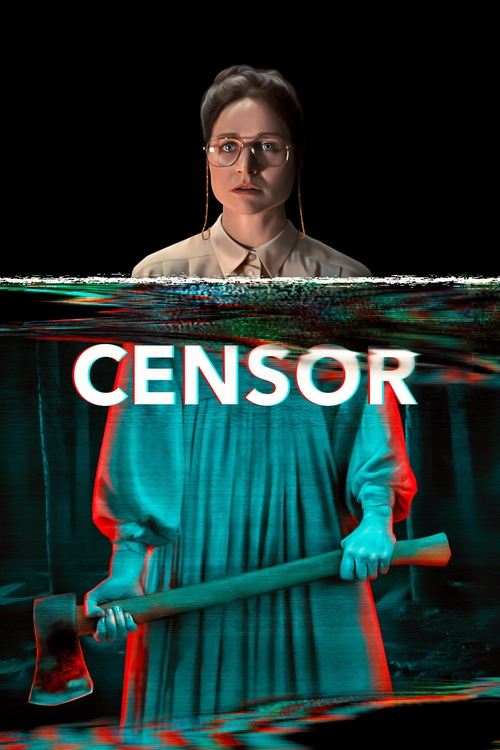
Censor
2021 · Prano Bailey-Bond
When you want a film to chew on for days — a cerebral, atmospheric horror for a night when ambiguity thrills rather than frustrates. More hypnotic than scary, and all the better for it.
What it's about
Britain, 1985, at the height of the video nasties panic: Enid is the strictest examiner at the film classification board, dutifully logging eye-gougings and ordering cuts, certain she's protecting the public. Her sister vanished when they were children, and Enid can't remember what happened. When the press ties a real killing to a film she passed — and a new low-budget nasty features an actress who looks like her sister grown up — her tidy world and her grip on reality start to come apart.
The experience
Cold, controlled, and quietly unnerving, then increasingly feverish as the film's own images begin to warp into the trash horror Enid polices. It's a slow-burn psychological spiral that trusts you to lean in, and it leaves you arguing with yourself about what you saw.
Performances
Niamh Algar is riveting as Enid, buttoned-down and brittle, letting the character's composure crack by tiny degrees until the performance becomes genuinely frightening.
The craft
Prano Bailey-Bond's debut is a feat of texture: the lighting, color, and film grain slide from drab 80s office realism toward the lurid look of the VHS nasties themselves, so the format of the movie mirrors Enid's mind. It rewards a dark room and close attention to how the frame itself changes.
Why it matters
A Sundance Midnight debut that announced Bailey-Bond as a major new British horror voice and revived serious interest in the video nasties era — the 80s moral panic over violent horror on tape.
Snapshot
Censor is a British psychological horror film set in 1985, at the height of the "video nasties" panic. Enid Baines (Niamh Algar) is a scrupulous examiner at the British Board of Film Classification. She takes her job as a public duty: she logs the eye-gougings and decapitations in low-budget horror tapes and orders them cut, sure that she is protecting viewers. Her sister Nina vanished in childhood, and Enid cannot remember what happened. When the press links a real killing to a film she passed, and a new nasty stars an actress who looks like a grown-up Nina, her hold on reality gives way. The film's lighting, colour and image texture slide toward the films she was paid to police.
The film was Welsh director Prano Bailey-Bond's first feature, co-written with Anthony Fletcher. It premiered in the Midnight section of the Sundance Film Festival in January 2021 and was released in British cinemas that August. It does two things at once. It is a carefully researched period piece about the British state's attempt to regulate home video, and it is a horror film that takes on the grammar of the material under attack. Its central question is one the censorship debate never settled: does screen violence corrupt the viewer, or does the viewer bring her own damage to the screen?
Industry & production
Censor came out of the publicly supported British independent sector that has incubated many recent UK genre debuts. Its backers included Film4, the BFI and Ffilm Cymru Wales. Helen Jones produced through Silver Salt Films. In the UK it was distributed by Vertigo Releasing, and in the US by Magnet Releasing, Magnolia Pictures' genre label, which has long specialised in festival-launched horror.
The feature grew out of Bailey-Bond's earlier short Nasty (2015), co-written with Fletcher. In it, a boy searches for his missing father through the world of video nasties. That short established the subject and the key idea: a disappearance read through, and confused with, a VHS horror tape. The feature kept that idea and moved it into the institution charged with judging such tapes.
The budget was modest and the film's scale is close and interior. Most of it takes place in viewing rooms, offices, a bedsit, a few London streets and a film shoot. The public record on detailed production history (shooting schedule, exact budget, specific locations) is thin, and this account does not attempt to reconstruct it. Release timing mattered. The Sundance premiere was virtual because of the COVID-19 pandemic, and the film also played the Berlinale's Panorama section in 2021. That meant it reached many critics and audiences at home, through the kind of private screen whose regulation is its subject. Several reviewers noticed the irony.
Technology
The film is about a technology: the domestic videocassette recorder and the unregulated rental market it created in early-1980s Britain. Before the Video Recordings Act 1984, home video sat largely outside the BBFC's statutory film certification. Distributors could release uncut horror and exploitation titles on tape, and many sold them with lurid sleeve art. In response, the Director of Public Prosecutions compiled a list of titles open to prosecution under the Obscene Publications Act, the so-called DPP list. The 1984 Act then required BBFC classification for most video releases. Censor is set just after that legislation, while the Board was working through a backlog of tapes under new legal pressure.
The film pays close attention to the physical apparatus of that moment. It shows cassettes and their sleeves, the clunk of a top-loading deck, CRT monitors, examiners' notepads and typed reports, and the procedure of rewinding and rewatching a cut to the second. As Enid's mind fails, the film's own image takes on the look of the medium: video softness, tracking distortion and the bleed of analogue colour. The technology appears both as historical subject and as visual texture. Precise technical details of capture and finishing, such as camera formats and how much of the degradation was optical or digital, are not well documented in published sources, so this dossier does not specify them.
Technique
Cinematography
Annika Summerson's cinematography sets up two visual registers and then lets one take over the other. The BBFC offices and Enid's home life are shot in drab, institutional tones: beiges, browns and the grey of mid-1980s Britain, with careful, often static compositions that suit Enid's buttoned-up order. The films she watches, and increasingly the world around her, are lit in saturated primaries, mainly hard reds and electric blues. That palette clearly recalls Italian gothic and giallo, especially Mario Bava and Dario Argento, whose work was caught up in the nasties panic. The rule of the film is that colour is contagion: the more Enid's perception slips, the more the gel-lit look of exploitation cinema leaks into ordinary spaces. In the last movement the image becomes, in effect, a video nasty itself.
Editing
Mark Towns's editing starts out procedural and ends up hallucinatory. The early scenes of examiners at work are built on the rhythm of the job: watch, pause, rewind, note, deliberate. They mimic the stop-start attention of censorship, a form of viewing that is all interruption. As the plot speeds up, the cutting loosens and the line between diegetic tapes, memory flashes and Enid's present blurs. The film often leaves it ambiguous whether a shot belongs to a film-within-the-film or to Enid's world. That ambiguity is the editing's main contribution to the theme.
Mise-en-scène / staging
Production designer Paulina Rzeszowska and the costume and make-up team build Enid as a figure of control. She wears a severe bob, a high-necked blouse, a modest coat and glasses, and her bedsit is neat and spare. Against her are the cheap, garish sets of the tapes she watches: a cabin in the woods, a church, a shed of torture props. Late in the film she literally walks into one of these sets. The staging of the BBFC itself (screening rooms, shared offices, colleagues who joke about the gore) is grounded and slightly comic. It presents censorship as an ordinary office job done by people with mixed motives. Newspaper headlines, TV news and rental-shop shelves fill in the wider moral panic without long exposition.
Sound
Sound design is central to the film's effect. Inside the films-within-the-film, the squelches, screams and synth stings are deliberately exaggerated, as in low-budget 1980s horror. Outside them, the soundscape is drier: typewriters, office murmur, the mechanics of the VCR. Emilie Levienaise-Farrouch's score mostly works through texture rather than melody, with low, pulsing drones and processed tones that suggest analogue electronics without becoming pastiche. Critics generally saw it as one of the main sources of the film's sustained unease. Unexplained noises and sound bridges also help dissolve the boundaries between Enid's viewing and her life.
Performance
Niamh Algar's performance carries the film. She plays Enid as a woman whose rigid self-discipline is both a vocation and a defence against an unbearable memory. The stillness, the clipped speech and the brittle politeness carry obvious strain long before anything breaks. Reviewers widely singled her out, and the film raised her profile considerably. Michael Smiley plays Doug Smart, a sleazy producer of the films Enid judges, with a calculated lightness that makes him both funny and menacing. Nicholas Burns is a fellow examiner who supplies dry office comedy. Vincent Franklin plays Frederick North, director of the nasty that obsesses Enid, and Sophia La Porta plays Alice Lee, the actress Enid believes is her lost sister. The supporting cast pitch their work at a heightened, slightly arch level. This makes the 1980s world feel both period-specific and faintly unreal from Enid's point of view.
Narrative & dramatic mode
Censor is a subjective psychological thriller that turns into delirium. It is told almost entirely from Enid's point of view, and its final act gives up reliable narration altogether. The structure is simple. It begins with the routine of examination. A public scandal follows when a murder is linked in the press to a film Enid passed, and her name is leaked. Then come the discovery of the actress, Enid's investigation into the production, and her descent into a fantasy in which she "rescues" her sister. The film ends on a sequence in which the grubby world and an idealised, almost advertising-bright family reunion are shown together, and the viewer can see the gap between Enid's perception and what is actually happening.
The dramatic mode is ironic. The woman who believes violent images corrupt is the one the film shows being undone, though the story makes clear that her damage comes from guilt and repressed memory, not from the tapes. The open ending, which some critics found unsatisfying and others found apt, declines both resolution and a clear moral.
Genre & cycle
The film belongs to the horror-about-horror tradition. These are works that make the making, watching or policing of horror their subject, from Michael Powell's Peeping Tom (1960) to David Cronenberg's Videodrome (1983), Wes Craven's New Nightmare (1994) and Peter Strickland's Berberian Sound Studio (2012). Berberian, in which a meek English technician comes apart while working on an Italian giallo, is the most frequently cited relative.
Censor also draws on the female-breakdown film, especially Roman Polanski's Repulsion (1965), another story of a repressed woman disintegrating in a London flat. It quotes and pastiches the video nasties themselves: the cabin-in-the-woods grisliness of Sam Raimi's The Evil Dead (1981), Italian cannibal and zombie films, and the rough British and American exploitation fare that filled the DPP list. Within the 2010s–2020s cycle of "elevated" or art-horror, it sits with films that use the forms of genre to explore trauma and grief, but its tone is more knowing and more affectionate toward trash cinema than many of those films.
Authorship & method
Prano Bailey-Bond's method, visible from Nasty onward, joins archival interest in a real cultural episode with formal play on genre surfaces. In interviews around the release she described extensive research into the nasties era and the BBFC. The film's verisimilitude about procedure (examiners' notes, the language of "cuts," the institutional nervousness) reflects that work.
Anthony Fletcher (co-writer) developed the story with Bailey-Bond from the short onward. The script combines institutional satire with psychological horror.
Annika Summerson (cinematographer) created the film's split visual language: drab realism against saturated, gel-lit pastiche.
Mark Towns (editor) handled the transition from procedural to hallucinatory.
Emilie Levienaise-Farrouch (composer) wrote a textural, electronic score that sustains dread without heavy cueing.
Paulina Rzeszowska (production designer) built the visual contrast between Enid's ordered spaces and the garish film sets.
Helen Jones (producer, Silver Salt Films) shepherded the project through the British public-funding system.
Movement / national cinema
Censor is a British, and specifically Welsh-supported, independent genre film. It belongs to a notable moment in UK horror in the late 2010s and early 2020s, when a number of debut features by women directors drew critical attention. Rose Glass's Saint Maud (2019) and Charlotte Colbert's She Will (2021) are the usual companions, and Censor was often discussed alongside them. These films share an interest in female subjectivity under pressure, in religion, repression and bodily horror, and in the use of genre to address specifically British institutions and histories.
The film also takes part in a long British tradition of reflecting on the country's own censorship history. That history includes the BBFC's role, Mary Whitehouse's campaigning, and tabloid moral panics. It earlier produced documentaries such as Jake West's Video Nasties: Moral Panic, Censorship & Videotape (2010), and Censor fictionalises the same terrain.
Era / period
The film is set in 1985 and is careful about the climate of Thatcher-era Britain: economic austerity, the aftermath of the miners' strike, tabloid-driven moral panic and a political culture that blamed social disorder on corrupting media. It shows how the nasties scare linked anxieties about class (working-class audiences renting unregulated tapes), youth crime and national decline, and how politicians and newspapers used horror videos as scapegoats.
The film's murder-blamed-on-a-film subplot echoes a recurring pattern in British media panics, from the nasties era through later controversies, without reproducing any specific historical case. Made in 2019–2020 and released in 2021, the film also arrived during renewed debate over online content regulation. Some critics read its period setting as a mirror for contemporary arguments about harmful media, though the film itself does not press the analogy.
Themes
- Censorship and the gaze. Censors are the most intensive viewers of all. They must look at what nobody else is allowed to see. The film asks what that looking does, and suggests that the censor's protective stance is itself a kind of obsession.
- Media effects and moral panic. The film satirises the "copycat" theory of screen violence while taking seriously the power of images to shape psychology. Its final suggestion is that meaning and harm lie in the viewer's history, not in the tape.
- Repression, trauma and memory. Enid's lost sister and her missing memory are the real horror. Censorship becomes a metaphor for her mind's own suppression of what it cannot bear.
- Reality versus image. As cinematic codes take over Enid's world, the film questions whether trauma can be processed only through fictions, and whether fiction can offer a false "happy ending."
- Institutions and gendered respectability. Enid's identity rests on propriety and professional rigour. She is a woman guarding the public against images of violence against women, and the film examines how much that role costs her.
- Love of trash cinema. Beneath the critique is evident affection for the scorned, scrappy films of the nasties era, along with an implicit argument for their place in film history.
Reception, canon & influence
Critical reception. Censor was well received from its Sundance premiere onward. Critics praised Algar's performance, the film's period detail, its visual design and its fusion of intellectual premise with genre pleasure. The most common reservation was about the final act. Some reviewers felt its leap into delirium was thematically fitting but narratively thin, and that the film's ideas outran its plot. It received recognition in the British awards circuit, including British Independent Film Awards attention, and it quickly became a reference point in discussions of new British horror. This account does not give box-office figures, which were modest and are not consistently reported.
Influences on the film (backward). These include the video nasties themselves (The Evil Dead, Italian cannibal and zombie cinema, the DPP list in general), Italian gothic and giallo colour design (Bava, Argento), Repulsion, Peeping Tom, Videodrome and David Lynch's identity-dissolving narratives. The closest recent model is Berberian Sound Studio. Bailey-Bond's own short Nasty (2015) is the direct precursor. The historical BBFC, the Video Recordings Act 1984 and the British press campaigns of the early 1980s provide the documentary foundation.
Legacy (forward). It is too soon to measure Censor's long-term influence with confidence, and claims of direct lineage should be treated cautiously. The film did help establish Bailey-Bond and Algar as significant figures in British genre filmmaking. It is a standard example in the wave of British women-directed horror debuts of the period. It also became part of a broader early-2020s revival of interest in analogue media horror, the textures of VHS and the history of exploitation cinema, alongside works that look back at 1970s and 1980s horror production. It is also an accessible fictional entry point into the history of the video nasties panic, and it is often recommended alongside documentaries on the subject.
Influences: the films it descends from and the films it influenced
- Peeping Tom (1960) — Its British template of a professional viewer whose job is looking at violent images, with the camera turned back on the audience's complicity, gives Censor its examiner-as-voyeur premise and its framing of the screening room as a site of guilt.
- Repulsion (1965) — Polanski's slow drift from mundane routine into the hallucinations of a sexually repressed woman, carried by amplified everyday sounds (ticking, dripping, ringing), is the direct model for Enid's buttoned-down unravelling and Censor's exaggerated diegetic sound.
- Blood and Black Lace (1964) — Bava's unmotivated primary-colour gels (magenta, green, blue washes across studio sets) supply the lighting grammar Annika Summerson uses for the nasty-film scenes, so that saturated colour itself signals that we have entered the movie.
- Suspiria (1977) — Argento's expressionist red and blue gel lighting, which breaks with realism, sets the saturated register that Censor places against its drab grey-brown office world.
- The Evil Dead (1981) — A DPP-listed video nasty whose cabin-in-the-woods setting, low-budget practical gore and lurching subjective camera Censor pastiches for its film-within-film 'Don't Go in the Church' and in its final forest set.
- Videodrome (1983) — Cronenberg's premise of a professional screener of illicit videotape whose perception is rewritten by what he watches, with tracking distortion and scan lines turning into the texture of hallucination, is the structural core of Censor's procedural-to-delirium arc.
- Demons (1985) — A product of the nasties era in which violence crosses from a screened horror film into its audience. It literalises the media-effects panic that Censor dramatises through Enid's 'copycat killing' guilt.
- Mulholland Drive (2001) — Lynch's mid-film switch from one identity and reality to another, with a woman remaking her trauma as a Hollywood fantasy set within the film, prefigures how Censor's last act replaces Enid's world with the movie she wants to be true.
- Inland Empire (2006) — Lynch's degraded consumer-video image and an actress who walks off a soundstage into the film's own fiction anticipate Censor's analogue-video breakdown and Enid's literal entry onto Frederick North's set.
- Berberian Sound Studio (2012) — The closest model: a buttoned-up British technician employed to process lurid exploitation horror (giallo foley) loses his grip as the work's methodical procedure gives way to the film's own register. Censor applies the same structure to the BBFC.
- Nasty (2015) — Bailey-Bond's own short, set in the 1980s VHS world, in which a boy is drawn into a video nasty. Here she first developed the tape-degradation texture and the idea of horror bleeding out of the cassette that Censor expands.
- X (1979) — A horror film about making a disreputable film, set in the late-1970s exploitation era. It cuts between the crew's in-film footage and the slasher plot and rebuilds period analogue texture, extending Censor's horror-about-horror production self-reflexivity.
- Pearl (2022) — A repressed woman's fantasy of being in the movies is rendered in saturated, Technicolor-pastiche colour that clashes with her drab farm life. The same split between drab reality and saturated fantasy turns against the protagonist, as it does for Enid.
- I Saw the TV Glow (2024) — It develops Censor's analogue-media horror: a protagonist's identity is rewritten by a half-remembered broadcast and VHS fiction, with scan-line degradation and a textural electronic score blurring the line between watching and being.
- In Fabric (2018) — A British giallo pastiche that sets drab, satirised institutional routine (department-store and bank bureaucracy) against saturated Bava-style colour, matching Censor's dual visual register and its comic-dread tone about officialdom.
- Saint Maud (2019) — A twin of Censor in the British women's horror debut wave: a tightly controlled, repressed female lead seen through unreliable subjective delirium, with a closing flash that reveals the gap between her vision and reality.
- Last Night in Soho (2021) — Released in the same year, it uses the same device of a young woman's present-day realism dissolving into neon, gel-lit pastiche of a past media era, with period glamour and violence turning into hallucination.
- Enys Men (2022) — British folk-horror shot on hand-processed 16mm. Like Censor, it builds dread through analogue material texture, a solitary woman's ritual routine and an electronic drone, and it dissolves linear time into ambiguous delirium.
- MaXXXine (2024) — Sets its horror inside the early-1980s video-nasty moral panic with meticulous VHS-era texture, sharing MaXXXine's video-nasty hinge and return-of-the-repressed structure.
Similar films
- Berberian Sound Studio (2012) — influence & lineage
- Videodrome (1983) — influence & lineage
- Peeping Tom (1960) — influence & lineage
- Repulsion (1965) — influence & lineage
- Possessor (2020) — shared sensibility
- Interrogation (1989) — shared sensibility
- Possession (1981) — shared sensibility
- Fat Girl (2001) — shared sensibility