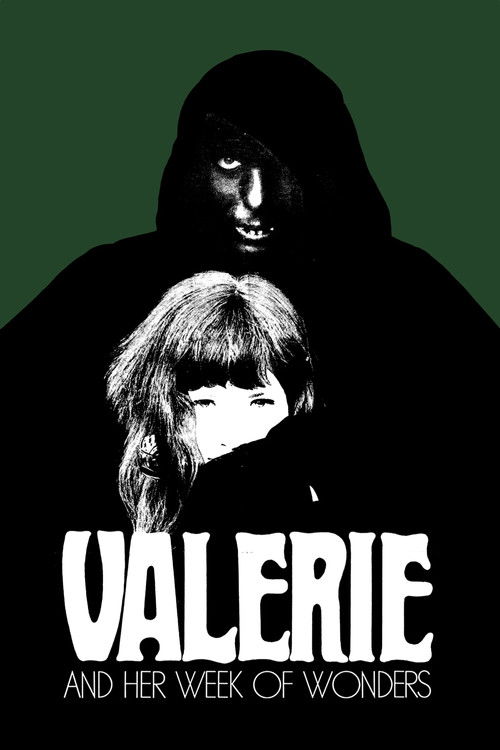
Valerie and Her Week of Wonders
1970 · Jaromil Jireš
For when you want to be enchanted and unsettled at the same time — a late-night, lights-off pick for viewers who'd rather surrender to atmosphere than track a story. A gorgeous challenge, not a comfort watch.
What it's about
A thirteen-year-old girl living with her grandmother in a small Czech town slips into a week where the world stops making ordinary sense: a pair of magic earrings, a visiting missionary who is not what he seems, a pale creature in the shadows, and adults who keep changing faces. As Valerie crosses into womanhood, everything around her — church, family, desire — reveals a stranger, more predatory shape, and she has to find her own way through the dream.
The experience
Like falling into a beautiful, sinister fairy tale — sun-dappled and lyrical one minute, genuinely eerie the next, with dream logic replacing plot. It's short, hypnotic, and hard to shake; you drift through it more than follow it.
Performances
Jaroslava Schallerová, cast at thirteen, carries the film with an open, curious calm that keeps the swirling nightmare anchored in a real girl's point of view.
The craft
Every frame is lush — lace, orchards, candlelight, and white interiors shot with a soft radiance that makes the horrors stranger — and Luboš Fišer's chiming, choral score is one of the most beloved in cult cinema. It's a sensory bath that rewards the biggest, best-sounding presentation you can give it.
Why it matters
The last major flowering of the Czechoslovak New Wave, finished in the shadow of the Soviet invasion, it became a touchstone for later dreamlike and folk-tinged horror and a cult object endlessly rediscovered by musicians and filmmakers.
Snapshot
Valerie a týden divů is the last major flowering of the Czechoslovak New Wave and, arguably, the only fully realized Surrealist feature the movement produced. Shot between 28 June and 6 November 1969 — after the Warsaw Pact invasion, before normalization had finished its work — and premiered in Czechoslovakia on 16 October 1970, it runs a compact 77 minutes and adapts Vítězslav Nezval's 1935 novel (published 1945), a knowing pastiche of the Gothic "black novel" written by one of the founders of the Czech Surrealist Group.
The film's argument is simple and radical: a thirteen-year-old's first menstruation opens a week in which the adult world reveals itself as a bestiary. Grandmother becomes a vampire's consort and then a rival; the missionary preacher is a predator; the constable is a polecat with fangs; the boy Orlík is brother, lover, and rescuer by turns. Nothing is stabilized. The film never signals dream, never returns to a waking frame, never explains.
It was received quietly at home and then largely forgotten outside specialist circles for two decades. Its second life — through UK and US home video, a 4K restoration issued by the Criterion Collection in June 2015, a soundtrack reissue, and an adopted afterlife in psychedelic-folk and hauntological music — has made it far more visible in the 2000s than it ever was in 1970.
Industry & production
Valerie was made inside Filmové studio Barrandov, the nationalized Czechoslovak studio, under the creative-group system that had given the New Wave its unusual latitude through the 1960s: semi-autonomous production units with real authority over greenlighting. That latitude was closing fast. Gustáv Husák replaced Alexander Dubček in April 1969; the purges of Barrandov and the Union of Film and Television Artists followed; by 1973 a set of New Wave features had been shelved "forever."
Jireš arrived at Valerie from precisely that collision. His The Joke (Žert, 1969), from Milan Kundera's novel, is one of the most direct indictments of Stalinist Czechoslovakia the period produced; it opened, had initial success, and was then banned for roughly two decades. That Valerie — a period fantasia with no visible politics — followed immediately is the central fact of its production history. The common reading, that Jireš took cover in the ahistorical and the oneiric, is plausible and widely made, but it should not be pushed into biography the record does not support: no reliable documentation establishes the project as a defensive choice rather than a long-held enthusiasm for Nezval.
Production was economical and location-led. The principal setting is Slavonice, the Renaissance town on the Bohemian–Moravian border whose sgraffito facades and arcaded square supply an already-ornamented world requiring almost no construction; further material was shot at the Kostelní Vydří monastery. Jaroslava Schallerová, thirteen during production (b. 25 April 1956), was cast from a very large open search — the figure of roughly 1,500 auditioning girls is the one repeated in the standard accounts. Reliable budget and admissions figures are not available in the English-language record, and no honest account should supply them.
Technology
Technically the film is unexceptional and deliberately so. It is a 35mm color production of the period, finished in the Academy ratio of 1.37:1 and carrying a mono optical soundtrack, made with the lightweight, hand-holdable camera equipment that had underwritten the New Wave's mobility since the early 1960s. Sound was post-synchronised, as virtually all Czechoslovak features then were.
What matters is the near-total absence of trick technology. There is no significant process work, no matte painting, no mechanical creature effect of consequence beyond dental prosthetics. The transformations — grandmother into Elsa, man into vampire, a girl burning at the stake and then not — are achieved by photography, costume, and above all by the cut. Optical-printer work is used sparingly for superimposition and for the flaring, bleached dissolves. The film's modernity, such as it is, lies in filtration and exposure: heavy diffusion, shooting into the sun, whites allowed to bloom past the shoulder of the negative. This is a fantasy assembled from the ordinary resources of a realist studio, which is one reason its images feel found rather than fabricated.
Technique
Cinematography
Jan Čuřík, who had shot Jireš's debut The Cry (1964) in a documentary-adjacent register, does something almost opposite here. The palette is narrow and emblematic: cream, white, gold, unripe green, punctuated by black vestments and a very few reds — blood on a daisy, blood on a mouth, a red skirt. Highlights are permitted to blow out. Lace, muslin, gauze curtains, hair, and water are used as in-frame diffusers, so that the softening reads as belonging to the world rather than to the lens.
Camera height sits low and close, frequently at Valerie's eyeline, with wide-ish lenses brought near the face; adults loom, and the geometry of the town tilts away behind them. Čuřík consistently withholds the establishing shot. Interiors are rarely mapped; a cellar leads to a courtyard that leads to a bedroom that was elsewhere five shots ago. The film's spatial incoherence is a photographic decision before it is an editorial one.
Editing
Josef Valušiak — later the author of a standard Czech textbook on editing — builds the film out of elision. Transitions that classical cutting would smooth are simply removed: a glance initiates a match that lands in an impossible place; an action begun in one costume completes in another. Crucially, there is no grammar of dream. No ripple dissolves, no "she wakes up." The wonders are cut with the same matter-of-factness as a meal.
Rhythm tightens sharply in the ecstatic passages — the carnival, the pursuit through the woods, the burning — and slackens into near-stillness for the tableaux. The result is a film that feels continuous rather than episodic despite having no continuity in the technical sense, and it is the score, more than the cutting, that carries the sense of a single unbroken week.
Mise-en-scène / staging
This is the film's most identifiable signature and it belongs substantially to Ester Krumbachová, credited on production design as well as co-writing. The vocabulary is folk-Baroque and funerary: embroidered bodices, communion white, ecclesiastical black, veils, coffins, feathers, dried flowers, water, chickens, bells. Objects recur as rhymes rather than props — the earrings, the daisy, the well, the bed. Krumbachová had already built comparable worlds for Věra Chytilová's Daisies (1966) and Jan Němec's A Report on the Party and the Guests (1966), and Valerie extends that project: costume used not to signify period but to arrange the frame.
Staging favours frontality and procession. Characters arrange themselves in friezes; the camera watches. Thresholds — windows, cellar hatches, the mouth of a well, the lid of a coffin — organize nearly every movement between registers.
Sound
Luboš Fišer's score is the film's connective tissue and its most widely circulated element. Fišer was a serious concert composer — his Fifteen Prints after Dürer's Apocalypse took the UNESCO prize in Paris in 1967 — and he had scored Juraj Herz's The Cremator (1969) the previous year. For Valerie he writes with disarming diatonic plainness: a hymn-like principal theme, mixed and children's choir, bells, harpsichord-bright keyboard textures, folk-modal turns. The effect is liturgical and lullaby-like at once, and it is doing structural work — where the cutting refuses continuity, the recurrence of the theme insists that these fragments belong to one week.
Ambient sound is thin to the point of abstraction. Post-synchronised dialogue floats slightly free of the bodies speaking it, an artifact of Czechoslovak practice that the film converts into an asset: everyone sounds slightly recalled rather than heard.
Performance
Schallerová's performance is almost entirely reactive — watching, being looked at, occasionally smiling at something the audience is not shown. It is non-technique used precisely, and the film depends on it: any psychologised playing would collapse the allegory into case study. Around her, the adults are played as emblems with unstable identities. Helena Anýžová carries the film's doubling scheme across grandmother, Elsa, and mother. Jiří Prýmek's Constable/Richard is the vampiric figure of predation and decay. Jan Klusák — himself a composer, and a recurring presence as an actor in New Wave films — plays the missionary Gracián with a queasy, sweating fervor that gives the film its sharpest satirical edge.
Narrative & dramatic mode
Valerie is not plotted; it is cycled. The week is a ritual container, and the film's mode is closer to the fairy tale or the dream-narration than to drama: characters are functions that mutate, motivations are not supplied, and causality is associative. Kinship is the specific instability — Orlík is brother, then not, then lover; the vampire is a stranger, then Valerie's father, then a bishop; the grandmother is a rival, a corpse, and a beauty.
There is no reliable diegetic ground. The film declines to nominate any level as "real," and refuses the retrospective key that would let a viewer sort the wonders into fantasy. It ends not with resolution but with reconciliation staged as festival: a bed in a wood, the whole cast wandering through, the antagonists disarmed by inclusion. This is a comic ending in the oldest structural sense, and it is what separates Valerie from the horror films it superficially resembles.
Genre & cycle
The film is a genre hybrid held in unusual balance: Gothic vampire tale, fairy tale, and coming-of-age story, with the satire of clerical hypocrisy inherited from its literary sources. Nezval's novel was explicitly a homage to the black novel — the Lewis/Maturin/Radcliffe line and the French frénétique tradition — and Jireš keeps the pastiche knowingly intact.
Its release coincides, almost eerily, with the European erotic-Gothic cycle of 1970–71: Hammer's Karnstein pictures, Jean Rollin's vampire films, Jess Franco's Vampyros Lesbos. The overlap in motifs — the adolescent girl, the lesbian-coded vampire, the ruined estate — is real, and no evidence suggests direct exchange in either direction. The difference is address. Those films are constructed for an adult male spectator and price their eroticism accordingly; Valerie is anchored inside its protagonist's perception, and its nudity is presented as bewildering rather than available. It also inverts the Czechoslovak pohádka, the state-supported fairy-tale film for children, by keeping the form and restoring the sexual content the tradition had scrubbed out.
Authorship & method
Jaromil Jireš (1935–2001) trained at FAMU and made The Cry (1964), often named as an inaugural New Wave feature and awarded a special recognition for a young director at Cannes that year; he contributed the "Romance" episode to the Bohumil Hrabal omnibus Pearls of the Deep (1966), and then The Joke. After Valerie he continued working through normalization rather than emigrating or being silenced — unlike Němec, Forman, or Chytilová — and the accommodations of that later career have depressed his critical standing in ways that color retrospective accounts of this film.
The strongest authorship claim here is collaborative. Ester Krumbachová's authorship of the film's visual and material world, and her share of the screenplay, place Valerie firmly within her body of work; the case for reading it as substantially hers is as strong as the parallel case for Daisies. Jiří Musil is credited with the dialogue. Čuřík supplies the photographic idiom, Valušiak the elliptical architecture, Fišer the through-line. And Nezval is a genuine absent co-author: the film's dream-logic is not invented for cinema but transposed from a Surrealist novel written thirty-five years earlier.
Movement / national cinema
Two lineages meet. The first is the Czechoslovak New Wave proper — the FAMU generation of the 1960s (Forman, Passer, Chytilová, Menzel, Němec, Schorm, Juráček, Jireš) alongside the older or parallel Vláčil, Herz, and the animator Jan Švankmajer. Valerie arrives at the movement's end, sharing personnel and studio with it while abandoning its dominant realist and satirical modes.
The second is Czech Surrealism, which is not a borrowing here but a domestic inheritance. Nezval, with Karel Teige, moved Czech Poetism of the 1920s into the Surrealist Group founded in 1934, alongside the painters Toyen and Jindřich Štyrský. That current survived underground through the Stalinist years and continued into Švankmajer's circle. Valerie is the point where it surfaces in a state-funded feature — which makes it, in national-cinema terms, less an outlier than an eruption of something continuously present.
Era / period
The film sits in a narrow historical seam: shot in the second half of 1969, released a year later, into a country whose cultural apparatus was being systematically dismantled. It is a work of interior emigration, and its refusal of contemporary reference is legible as both aesthetic conviction and prudence. Internationally, 1970 is the year of post-'68 disillusion across European cinema, of the counterculture's turn toward the pastoral and the medieval, and of the erotic-Gothic boom — contexts Valerie touches without belonging to any of them.
Its own period setting is deliberately unfixed: a nineteenth century assembled from costume and architecture rather than dated by event.
Themes
Menarche is the film's engine, stated in its first minutes and never softened: the drop of blood is the door. What follows is an account of what a girl's body means to the adults around it. The vampire is the aged body's appetite for youth — the grandmother literally trades herself for Elsa's beauty — and the priest is the institution that sanctifies predation, denounces its object as a witch, and lights the fire.
Kinship instability is the second theme, and it is where the film is most Surrealist and most uncomfortable: incest is not dramatized as transgression but held as ambient possibility, the natural consequence of a world in which every man may be father, brother, or lover. The double runs throughout — grandmother/Elsa, mother/Elsa, brother/lover, priest/vampire — and desire is treated as impersonal, a weather system rather than a psychology.
The film also raises, honestly, a question later criticism has pressed harder than 1970 did: what it means that an adult camera renders a thirteen-year-old's sexual awakening as beauty. Valerie is not exploitation cinema, and its point of view is genuinely hers; it is also a film in which a child is repeatedly framed nude and desired. Both things are true, and the more interesting readings hold them together rather than resolving them.
Reception, canon & influence
Domestic reception in 1970 was muted, in a year when critical discourse itself was being disciplined; the substantial documentary record of its first release is thin, and English-language scholarship has largely reconstructed its reputation backwards from later revivals. The film traveled the international fantastic-film circuit — it screened at Sitges, among other festivals — but claims of specific major prizes should be treated cautiously, as they are inconsistently reported.
Backward. The direct source is Nezval's novel and the Gothic tradition it parodies. Behind that stand Czech Poetism and Surrealism (Teige, Toyen, Štyrský); Lewis Carroll's Alice, whose logic of unmotivated transformation the film shares; Cocteau, especially La Belle et la Bête (1946), for the treatment of the marvelous as a matter of texture and household objects; and Buñuel, for the yoking of eroticism to anticlericalism. Within Czechoslovak cinema, Vláčil's Marketa Lazarová (1967) had already demonstrated that a de-modernised, sensuous past could be filmed without costume-drama piety.
Forward. Its documented afterlife runs strongly through music. Fišer's score was first commercially released in December 2006 by Finders Keepers, and became a touchstone for the "hauntology" and library-music revival. The Valerie Project, a Philadelphia collective drawn from Espers, Fern Knight and Fursaxa, composed and toured an alternative live score to the film from 2006 to 2008 — a genuinely unusual instance of a film being re-authored by a music scene.
In cinema, the clearest line is to the British fairy-tale Gothic of Angela Carter and Neil Jordan; Carter is reported to have seen the film during its English release, and The Company of Wolves (1984) shares its terrain of adolescence, wolves, grandmothers and blood. Beyond that, the honest framing is affinity rather than proven descent: Švankmajer's Alice (1988), the menarche-horror strain running through Ginger Snaps (2000) and Raw (2016), the folkloric image-worlds of Peter Strickland and of Rainer Sarnet's November (2017), all inhabit territory Valerie mapped, but citation is not the same as influence and should not be asserted where it is not on record.
Its canonical position was secured materially: Facets and Redemption DVDs in 2004, then Criterion's 4K restoration in June 2015 with interviews with Schallerová and Klusák. It now sits, reliably, among the handful of films — with Daisies and The Cremator — through which the Czechoslovak New Wave is known outside the Czech Republic, and it is cited more often for its images than for anything it says. That is a fair reflection of what it is: a film that argues by texture, and whose account of growing up female is delivered entirely in lace, blood, bells, and light.
A Deleuzian reading
A white daisy with a drop of blood on it.
The full Deleuzian reading of Valerie and Her Week of Wonders →
Reception
Released as the Czech New Wave was being smothered by post-1968 'normalization', it was one of the movement's last gasps and stayed a hard-to-see obscurity abroad for decades — until soundtrack reissues, restorations, and a 2015 Criterion release turned it into a canonical fairy-tale-horror touchstone.
How Valerie and Her Week of Wonders was received, from release to now →
How to watch Valerie and Her Week of Wonders: what to notice on a first viewing
- Notice that no dissolve or fade ever marks a dream starting. Valušiak cuts every transformation with the same plainness as an ordinary action, no haze, no waking frame, no signal that anything strange just happened. You are never told which parts are real, because the film refuses to mark the difference at all.
- Notice that a cellar, a courtyard, and a bedroom never quite connect. Čuřík withholds establishing shots throughout, so a space glimpsed in one scene can reappear somewhere else entirely a few shots later. You never get a stable floor plan to stand on, only rooms that keep arriving.
- Watch for lace and curtains softening the light inside the shot. Čuřík shoots into the sun and lets whites bloom out, using gauze, hair, and water as diffusers built into the world rather than the lens. The softness feels like a property of this world, not a camera trick laid over it.
- Listen for the same choir-and-bell melody returning again and again. Fišer's hymn-like music, with children's choir, bells, and harpsichord, keeps recurring across scenes that otherwise share nothing else. The score is what tells you these fragments belong to one single week.
- Notice the earrings, the daisy, and the well recurring across the week. The same handful of objects keep reappearing, not as props that advance a plot but as rhymes the film returns to. The objects hold the film together in place of a story with cause and effect.
The whole guide to watching Valerie and Her Week of Wonders, with the keys for a rewatch →
Influences: the films it descends from and the films it influenced
- Vampyr (1932) — Rudolph Maté shot through gauze stretched in front of the lens to bleach highlights and soften spatial edges, and Dreyer withheld establishing geometry so rooms connect only by dream-logic — the same in-frame diffusion plus refused master shot that Jan Čuřík and editor Josef Valušiak use to make Valerie's house unmappable.
- La Belle et la Bête (1946) — Establishes the marvelous as a matter of texture and in-camera household trickery — living candelabra, billowing drapery, reversed and undercranked film — rather than optical printing, which is precisely Valerie's 'no trick effects' rule: transformation achieved by costume, makeup, cut and light.
- Un Chien Andalou (1929) — Invents the unmotivated match cut across incompatible spaces and the false temporal title card, the surrealist editing license that lets Valerie jump between courtyard, crypt and bedroom without any connective coverage.
- Viridiana (1961) — Puts liturgical props into erotic circulation — crucifix, communion cloth, novice's habit handled as fetish objects — the object-level anticlericalism Valerie applies to Gracián's vestments and to the sacramental staging of its own seductions.
- The Night of the Hunter (1955) — Stages a child's-eye fairy tale in frontal, storybook tableaux with hymn-singing folded through the score as both diegesis and commentary, the model for Valerie's flat folk-baroque compositions and for Fišer's choral through-line functioning as narration.
- Black Sunday (1960) — Bava's hand-mixed in-frame diffusion — fog, gauze, wind-driven veils and mist raked by hard sidelight — married to a single actress doubled as maiden and crone, the exact apparatus behind Valerie's grandmother/Elsa transfigurations.
- The Innocents (1961) — Freddie Francis lit for candle-flare and blown highlights inside deep-focus CinemaScope and bridged scenes with overlapping dissolves, making a girl's sexual awakening formally indistinguishable from haunting — the same photographic seam Valerie works.
- Diamonds of the Night (1964) — The Czechoslovak New Wave proof that subjective and hypothetical inserts can be cut in with no signposting, no establishing shot and no return to a stable present — the elliptical architecture Valušiak builds Valerie from.
- Daisies (1966) — Ester Krumbachová's method of authoring a film through its material world — costume, prop, wallpaper, foodstuff — so that meaning is carried by objects rather than dialogue; Valerie is the same authorship applied to lace, bells, earrings and blood.
- Marketa Lazarová (1967) — Demonstrated that a de-modernised, sensuous past could be shot without costume-drama piety: overexposed white skies, tactile fur and stone in close-up, post-synchronised sound treated as a separate compositional layer — the register Valerie adopts for its pseudo-medieval village.
- The Company of Wolves (1984) — Angela Carter's nested dream-frame built inside a wholly artificial studio forest, with practical in-camera lycanthropy and grandmother/blood/wolf iconography — the closest thing to a documented transmission of Valerie's fairy-tale-Gothic hybrid into English cinema.
- Alice (1988) — Extends Czech Surrealism's tactile object-logic — a child lead who mostly watches and reacts while props transform through animation and substitution, Carroll's unmotivated metamorphosis handled as a materials problem rather than an effects one.
- Ginger Snaps (2000) — Formalizes the genre innovation Valerie prototyped: menarche as the film's actual transformation engine, with the first blood, the body's change and the monstrous becoming placed on a single causal timeline instead of used as metaphor.
- Innocence (2004) — Builds a girls' enclosure whose geography is never established — corridors, woods and underground passages introduced only in fragments — and advances the story through sound cues and elliptical cuts at thresholds of physical maturation.
- The Duke of Burgundy (2014) — Turns the Finders Keepers-era revival of Fišer's score into a shooting method: a commissioned pastoral-library score, macro inserts of lace and textile, and superimposed dissolve reveries used in place of psychological exposition.
- November (2017) — Shoots folk-baroque material in deliberately blown-out monochrome with practical, non-digital marvels — puppet-like household creatures, in-camera apparitions — reviving Valerie's premise that peasant magic should look handmade rather than rendered.
- The Neon Demon (2016) — Surreal fable of a girl whose blossoming beauty draws vampiric predators, supplying the dream-fable structure and the equation of innocence with prey.
- The Ice Tower (2025) — The dream-logic fairy-tale of a young girl's sexual awakening, built as a fable of doubling and metamorphosis where adult glamour is both seductive and predatory.
- The Cremator (1969) — Stanislav Milota's wide-angle proximity and graphic match cuts that fuse two spaces on a gesture, plus the Czech grotesque's funerary decor as everyday furniture — the same year's parallel experiment in making mortuary ritual look domestic.
- Morgiana (1972) — Direct continuation of the same craft team's gothic: Luboš Fišer again scoring, one actress split across doubled sisters, distorting wide-angle and animal-POV lenses, and an Art Nouveau prop world staged as psychological weather.
- Picnic at Hanging Rock (1975) — Russell Boyd shot through a bridal veil taped over the lens to bloom the highlights, paired with a pan-flute/ethnographic score and a plot that never resolves — the identical formula of diffusion plus withheld explanation for filming adolescent female sexuality.
- Nosferatu (2024) — Surrealist female-centered gothic of awakening sexuality entwined with a vampiric predator — psychosexual coming-of-age dream-logic that parallels Eggers' Ellen-as-center reframing of the vampire myth.
- Institute Benjamenta, or This Dream People Call Human Life (1995) — A Central-European surrealist dark fairy tale built on somnambulant performance and associative, eroticized dream-cutting, drawing on the same Czech literary-fantastique vein the Quays mine through Walser, Kafka, and Schulz.
- The Saragossa Manuscript (1966) — An Eastern-bloc surrealist literary adaptation using the same dream-logic dissolves between reality strata, where fantasy and waking life interpenetrate without hierarchy.
- The Hourglass Sanatorium (1973) — A contemporaneous Central-European surrealist film governed by dream-and-memory montage where time loops and associative logic, not causality, dictates the edit — the same anti-linear editing grammar.
- Beauty and the Beast (1979) — Fellow Czechoslovak dark-fairy-tale surrealism: dream-logic editing, eroticized gothic menace, and the fairy tale as a threshold between childhood and predatory adult desire.
- The Spirit of the Beehive (1973) — Renders a girl's threshold into knowledge as fairy-tale surrealism, using folk-archetype imagery and a child's dream-associative logic to structure the film.
- Céline and Julie Go Boating (1974) — A contemporaneous Carroll-esque female reverie whose dream-logic editing lets a young woman drift between menacing domestic tableaux — the same Alice-in-Wonderland structure of a girl navigating a haunted adult melodrama.
Similar films
- The Cremator (1969) — influence & lineage · same viewing thread
- Marketa Lazarová (1967) — influence & lineage
- Morgiana (1972) — influence & lineage
- Daisies (1966) — influence & lineage
- Vampyr (1932) — influence & lineage
- Alice (1988) — influence & lineage
- Witchhammer (1970) — same viewing thread
- The Third Part of the Night (1972) — same viewing thread
All the films related to Valerie and Her Week of Wonders →
Watch it with: curated runs of related films
- Fever-Dream Horror — Watch these when you want horror that runs on dream logic — witches, circuses, crematoria and occult dread rendered as hand-crafted, hallucinatory nightmare rather than jump-scare.