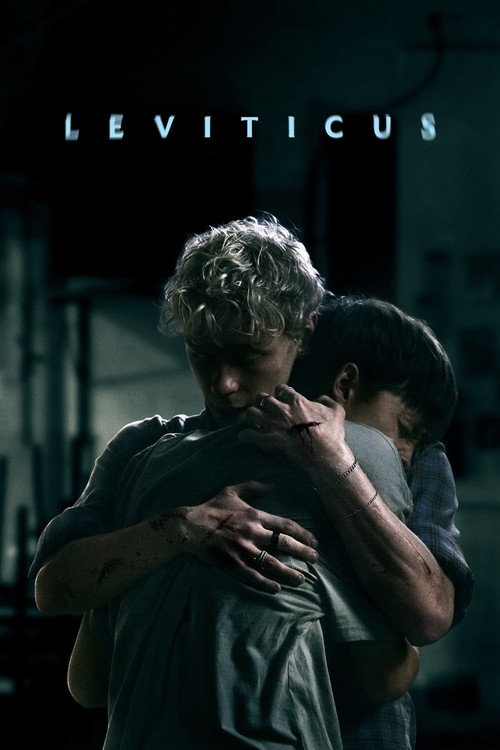
Leviticus
2026 · Adrian Chiarella
When you're craving a real scare with something to say — horror that doubles as a love story, for viewers who want their heart rate up and their heart involved. A challenge with feeling in it.
What it's about
Two teenage boys are stalked by a violent entity with a terrible gift: it takes the form of the person each of them desires most — which is to say, each other. Every glance at the boy he loves has to be tested: is it really him, or the thing wearing his face?
The experience
Tense and clammy — it fuses first-love yearning with dread until you can't tell them apart, which is exactly the point. The scares work on their own, but it's the paranoia between the two boys that gets under your skin.
The craft
The film's power comes from its premise's ruthless writing logic: a monster that obeys a rule, so every romantic beat is also a threat assessment. The scriptural title makes the allegory — shame taught to boys about their own desire — explicit without preaching, and the independent scale keeps the horror intimate rather than spectacular.
Why it matters
An Australian entry in the recent wave of rule-based horror, it flips the genre's old habit of punishing queer desire into a story told from inside that desire.
Australian writer-director Adrian Chiarella builds his horror from a premise of elegant cruelty: two teenage boys are hunted by an entity that takes the form of the person each desires most — which is to say, each other. The mechanism turns the oldest engine of queer dread inside out. Where the classic slasher punished desire from without, here longing itself becomes indistinguishable from threat: every glance at the beloved must be tested — is it him, or the thing wearing him? — so that paranoia and yearning share a single face. The title's invocation of scripture, the biblical book most often weaponized against gay lives, makes the allegory explicit without smothering it; the horror of internalized shame is given literal teeth. It belongs to the recent wave of horror in which the monster obeys a rule — an implacable logic of pursuit — but bends that structure toward romance, asking whether two people can love what they've been taught to flee. An Australian entry in queer genre cinema's boldest current, it treats desire as both the trap and the only way out.
Reception
It arrived hot out of Sundance's Midnight section in January 2026 — a stunned-silence-then-sustained-applause premiere — and held up on release, landing at 92% on Rotten Tomatoes and 'universal acclaim' on Metacritic. Too new for a reappraisal arc; right now it's still in its honeymoon.
How Leviticus was received, from release to now →
Influences: the films it descends from and the films it influenced
- It Follows (2014) — The cited touchstone: a monster governed by transmissible, sexually-charged rules and an unhurried ever-walking pursuit that literalizes desire-as-contagion, plus the roving 360° anamorphic frame that makes any background figure a potential threat.
- Halloween (1978) — Founds the slasher grammar Leviticus inherits — the anamorphic wide-lens stalking frame and a blank, implacable 'Shape' whose unhurried gait, not speed, generates dread.
- A Nightmare on Elm Street (1984) — The rule-bound monster prototype: survival hinges on an explicit condition (don't sleep), and the killer is the return of a buried communal shame punishing adolescents on the cusp of adulthood.
- Cat People (1942) — Horror as the somatic cost of repressed desire — transformation triggered by arousal — with terror built from shadow, sound, and the 'Lewton bus' suggestion rather than the reveal.
- Carrie (1976) — Fuses religious-maternal condemnation to a pubescent coming-of-age, using split-diopter and split-screen to stage shame and making the changing body itself the locus of horror.
- Vertigo (1958) — The doppelganger as object of obsessive, self-annihilating desire — desire-as-trap rendered through the doubled beloved and the spiraling subjective camera.
- The Company of Wolves (1984) — The werewolf as dream-logic allegory for awakening sexuality, nesting fairy-tale frames so that forbidden desire is encoded as transformation and threat.
- Let the Right One In (2008) — Braids a strictly rule-bound monster (must be invited across the threshold) with a tender coming-of-age, framing the queer-coded outsider child in cold, restrained wide compositions.
- Persona (1966) — The formal template for the merging double — two faces dissolving into one identity — that underwrites Leviticus's doppelganger device.
- Saint Maud (2019) — Catholic guilt staged as body horror: internalized shame escalating toward ecstatic self-destruction, with a condemning divine voice heard as intimate address.
- Thelma (2017) — A repressive religious upbringing weaponizes a queer awakening into supernatural power, so that desire literally endangers its object — forbidden love as lethal force.
- Knife+Heart (2018) — The explicitly queer slasher: a masked killer stalks a gay milieu in saturated giallo palettes, eroticizing the stalk-and-kill form rather than punishing sex from outside it.
- Jennifer's Body (2009) — Codes queer desire as literal predation — the desired body becomes a trap that consumes those drawn to it — turning the slasher's victim/monster axis inside out.
- Raw (2016) — Appetite-as-body-horror during a coming-of-age, doubling protagonist against a sister/mirror-self to dramatize the frightening person one is becoming.
- I Saw the TV Glow (2024) — Renders queer dread as slow suffocating unreality and a split, doubled self — the egg-crack horror of an unlived life — extending internalized shame into ambient formal terror.
- Us (2019) — The doppelganger as the returned repressed made flesh — a literal double that hunts the self — deployed as sustained allegory in the same key as Leviticus's rule-bound double.
- Hellbent (2004) — The first out-and-out gay slasher, transposing the stalk-and-kill template onto cruising and queer nightlife and proving the form's genre mechanics could carry explicit queer text.
Similar films
- Us (2019) — influence & lineage · same viewing thread
- Let the Right One In (2008) — influence & lineage · same viewing thread
- Carrie (1976) — influence & lineage
- Heretic (2024) — same viewing thread
- Strange Darling (2024) — same viewing thread
- The Witch (2016) — same viewing thread
- Fresh (2022) — same viewing thread
- Talk to Me (2023) — same viewing thread
All the films related to Leviticus →
Watch it with: curated runs of related films
- Whatever's Wearing That Face — A run of horror-thrillers where the real terror is that you can't trust what a person appears to be — a double, a shapeshifter, a smiling stranger, the one you desire.