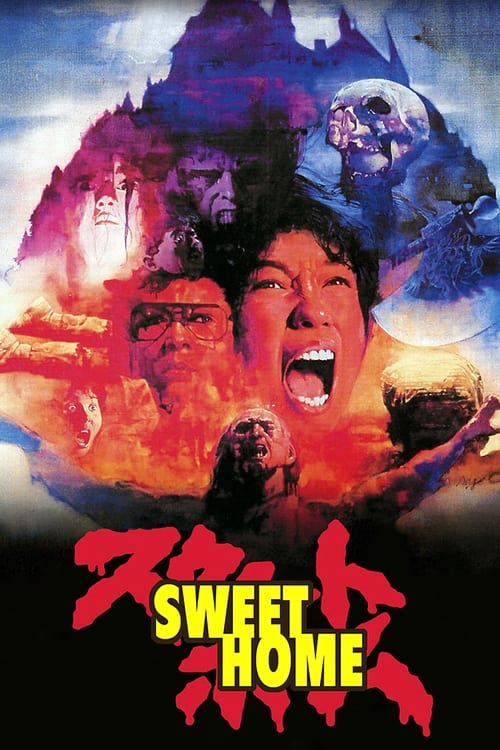
Sweet Home
1989 · Kiyoshi Kurosawa
For a night when you want an old-school haunted house you can actually enjoy — jump-in-your-seat fun with friends rather than something that follows you to bed.
What it's about
A small TV crew drives out to the decaying mansion of a famous dead painter to film and restore the frescoes he left behind. The house has been sealed for decades, and something in it is still grieving: the ghost of the painter's wife, bound to the place by the death of a child thirty years before. What starts as a location shoot becomes a fight to get out alive.
The experience
Classic haunted-house dread that builds from creaky atmosphere into full-on supernatural spectacle, with gooey, practical ghost effects that still land. It's scary in a fun, big-hearted, 80s way — more rollercoaster than nightmare, with a surprising ache of grief underneath.
The craft
Legendary American makeup artist Dick Smith supplied the special effects, and the melting, charring ghost work is the film's showpiece — practical, tactile, and genuinely startling. Producer Jūzō Itami brought studio-scale resources and his regular actors, so the scares sit inside a handsomely mounted production. The mansion itself, all shadowed halls and ruined frescoes, rewards watching in the dark.
Why it matters
It's the first full-length horror film from Kiyoshi Kurosawa, who would go on to redefine Japanese horror, and it spawned a famous Famicom video game that helped shape the survival-horror genre. For J-horror fans it's a foundation stone.
Snapshot
Sweet Home is a haunted-house horror film. A small television crew goes to a ruined mansion to film and restore the lost frescoes of Ichirō Mamiya, a dead painter. In the house they wake the vengeful spirit of the painter's wife, who still grieves a child who died there thirty years earlier. Kiyoshi Kurosawa wrote and directed the film. Jūzō Itami produced it, at the height of his own success as a director, and also played a supporting role. It was Kurosawa's first studio-scale feature, made with real money, a cast of Itami regulars and special makeup effects by the American artist Dick Smith.
The film matters for three reasons, and the film itself is only one of them. It is the first full-length horror film by the director who later made Cure (1997), Kairo (Pulse, 2001) and Retribution (2006), and it already shows his interest in empty spaces, shadows and grief that spreads like an infection. The legal dispute that followed it, over the re-editing of the video version, disrupted Kurosawa's early career and has kept the film largely out of circulation. Finally, Capcom made a Famicom video game of the same name as a tie-in. That game, directed by Tokurō Fujiwara, is widely acknowledged as a direct ancestor of Resident Evil (1996). As a result the film has an influence on popular culture that far exceeds how many people have actually seen it.
Industry & production
By the late 1980s the Japanese studio system had largely dissolved. Production depended on independent producers, outside capital and co-financing, with the major studios mostly acting as distributors. Jūzō Itami was one of the most bankable figures of that period. After The Funeral (1984), Tampopo (1985) and A Taxing Woman (1987) he had the money and the clout to back other people's projects. Sweet Home came out of that position. Itami produced it, cast his wife and regular star Nobuko Miyamoto in the lead, and gave the film the look of a commercial event picture. Toho handled distribution and the film opened in Japanese cinemas in early 1989.
Itami's backing put Kurosawa in an unusual position. His earlier features were the pink film Kandagawa Wars (1983) and The Excitement of the Do-Re-Mi-Fa Girl (1985). Nikkatsu had commissioned Do-Re-Mi-Fa Girl as a roman porno, rejected it, and it was released only after Kurosawa reworked it. Neither film had prepared him for a mainstream genre production. Sweet Home was planned as a commercial project from the start. A Capcom video game was developed alongside it as part of a cross-media campaign, an early example in Japan of a film and game sold together as one property.
The production is best remembered for what happened after it. The film was re-edited for its home-video release without Kurosawa's agreement, with material removed and the cut reshaped. Kurosawa took legal action against Itami over this and lost. Accounts generally agree that the dispute damaged his standing in the industry for several years. Afterwards he worked mainly in direct-to-video "V-cinema" genre films, such as the Suit Yourself or Shoot Yourself series, until Cure re-established him. Because the rights are still tangled, the film has never had an authorized modern disc release. The Japanese VHS and laserdisc editions, and copies of them, remain the usual way to see it. The full legal details are not well documented in English-language sources, so this account stays at the level of the broadly agreed facts.
Technology
The film's technical showpiece is its practical makeup and creature work. Dick Smith supervised the special makeup effects. He was the veteran behind The Exorcist (1973), Altered States (1980) and Amadeus (1984), and was widely seen as the leading makeup-effects artist of his generation. Hiring him signalled ambition and an orientation toward the international market. It also tied the film to the American practical-effects boom of the late 1970s and 1980s, the era of Rick Baker, Rob Bottin and Tom Savini.
The effects in Sweet Home include bodies melting, liquefying and decaying, and the climactic appearance of Lady Mamiya as a monstrous, distended figure. They belong to the latex, foam-rubber and animatronic school of that decade. Some optical and compositing work is used for the shadow attacks and the supernatural light. By later standards these sequences look dated, which is common in films that set their practical effects against more austere material. The film was shot on 35mm, and nothing in the record suggests any unusual camera or sound technology.
Technique
Cinematography
The film was shot by Itami's regular collaborator. Its look is a cleaner, more lit studio-genre style than Kurosawa's later work. The mansion is shown through deep shadow, dust and shafts of light. Darkness is not just the setting: the ghost attacks through shadow, and a person's shadow becomes the thing that kills them. Kurosawa would return to this idea of a shadow as a separable, hostile entity, most famously in the dark stains of Kairo.
Some of Kurosawa's later habits are already present: wide, stable compositions that hold a figure small inside a decaying space, and a readiness to let the frame sit still while something moves at its edge. But the commercial brief often pushes the film toward close-ups and explicit monster footage, which his mature work avoids. Seen today, Sweet Home shows two visual approaches side by side. One is the effects spectacle of the 1980s. The other is the dread built from staging and space that would define his later films.
Editing
Who edited the film is not well documented in standard English-language references. The picture also exists in different forms because of the post-release re-edit. Much of the editing follows a conventional pattern: one crew member after another is picked off, with set-piece escalation in between. The quieter passages in the house, which suggest how Kurosawa might have paced the film without commercial pressure, are the sections most often said to have been cut back in later versions. Without a restored director's version, any firm statement about how Kurosawa meant it to be cut would be speculation.
Mise-en-scène / staging
The Mamiya mansion is the central design element: a Western-style house abandoned in the countryside, filled with rot, cobwebs, collapsed floors, a furnace, and frescoes hidden under grime. The crew comes to uncover and restore the frescoes, and the frescoes turn out to hold the story of the tragedy. The house therefore works as an archive. Uncovering the images uncovers the trauma, which links the plot to the documentary crew's own job.
Kurosawa often places his characters inside rooms that seem to overwhelm them, with doorways and corridors leading into darkness. The emptiness of his later films, with their deserted offices, laundromats and apartment blocks, appears here in Gothic form. The ruined mansion is a familiar genre setting rather than an anonymous modern space, but the way it is staged points ahead to the "empty Tokyo" of Kairo.
Sound
The score is credited to Masaya Matsuura, then a member of the synth-pop group PSY·S and later the creator of PaRappa the Rapper. It is a synthesizer-based score typical of the period. The sound design uses the conventions of 1980s supernatural horror: low drones, sudden stings, and processed or distorted sounds around the ghost. Detailed accounts of the soundtrack are scarce, and this dossier makes no claims about specific cues.
Performance
Nobuko Miyamoto plays Akiko, the producer and the film's emotional and moral centre. She carries over some of the brisk competence of her Itami heroines, but the climax turns her into a substitute mother, confronting the grieving ghost on the ghost's own terms. Shingo Yamashiro plays Hoshino, the documentary's director. The pop singer Nokko, of Rebecca, plays his daughter Emi, whose danger drives the last act. Fukumi Kuroda and Ichirō Furutachi play other members of the crew. Itami himself appears as Yamamura, an old man who knows the house's history and helps the survivors. The cast plays it straight, without the archness of Itami's comedies, though the ensemble's familiarity sometimes pulls the film toward his house style.
Narrative & dramatic mode
The film follows the standard haunted-house plot. A group enters a closed location for professional reasons, signs of an old crime appear, the group is attacked one by one, the ghost's story is pieced together, and the haunting ends when its emotional cause is resolved. That backstory is a maternal tragedy. Lady Mamiya accidentally caused her small child's death in the house's furnace, then killed in grief and despair, and her spirit remains bound to the site of the loss.
The structure is melodramatic. The horror is resolved through recognition and release rather than by killing the monster: the ghost's grief has to be acknowledged and answered, not just defeated. In this respect Sweet Home sits closer to the Japanese tradition of the grieving or wronged female spirit than to the American slasher. It also anticipates Kurosawa's later endings, which are more ambiguous and refuse catharsis but keep the idea that a haunting reflects a broken social or emotional bond. The film's emotional resolution is cleaner and more sentimental than anything in his mature work.
Genre & cycle
Sweet Home belongs to the international haunted-house and special-effects horror cycle of the late 1970s and 1980s. Its closest relatives are The Shining (1980), Poltergeist (1982) and The Evil Dead (1981). Like those films, it combines a contaminated domestic space with elaborate practical effects. Kurosawa has often said he admires Tobe Hooper, and Hooper-style spectacle, as in Poltergeist, is present throughout.
Within Japanese cinema the film comes between earlier cycles and later ones. It follows the kaidan tradition and outliers such as Nobuhiko Ōbayashi's House (Hausu, 1977), another film about a group trapped in a hungry house. It comes before the "J-horror" wave that grew from late-1980s and 1990s video productions, among them the Hōnō shinrei bideo series and Norio Tsuruta's work, and that broke through with Hideo Nakata's Ringu (1998). Sweet Home is not part of that wave in style. It is too indebted to Hollywood effects and too willing to show its monster. But its director became one of the wave's central figures.
Authorship & method
Kurosawa came out of the cinephile culture at Rikkyō University, where he studied under the critic Shigehiko Hasumi. Several directors of his generation came from Hasumi's circle, which revered classical Hollywood genre directors, especially Hawks, Ford and Fleischer, and treated genre as a field for formal rigour. Kurosawa had worked as an assistant director, notably to Shinji Sōmai on Sailor Suit and Machine Gun (1981). Before Sweet Home his own films were low-budget and experimental in a Godardian way.
Sweet Home was Kurosawa's first attempt to apply that cinephile training to a commercial horror film, and the result shows the strain. Several elements that became his signature are already here: the shadow as a predator, attention to architecture and empty space, a non-supernatural professional group (a television crew) as protagonists, and a haunting rooted in an unresolved human failure. Other elements, such as the effects showcase, the star casting and the emotional climax, reflect Itami's commercial influence. The later dispute is often read as a clash between a producer-led and a director-led idea of authorship. That reading is reasonable, but it simplifies a collaboration that is poorly documented.
Key collaborators:
- Jūzō Itami: producer and actor, the film's financial and commercial driving force.
- Dick Smith: special makeup effects.
- Masaya Matsuura: music.
- Cinematography and editing: Itami's production team, though credit details are not well documented in English sources.
- Kiyoshi Kurosawa: screenplay.
Movement / national cinema
The film comes from a period when Japanese cinema had lost commercial ground at home to American imports and television. The leading figures were independent auteur-producers such as Itami. Directors like Kurosawa, Masayuki Suo and Makoto Shinozaki came out of university film culture, and they moved between pink films, V-cinema and studio genre work. Sweet Home is typical of that mixed economy. It was neither a studio programme picture nor an art film, but a producer-driven genre product meant for the multiplex and the merchandising market.
In national-cinema terms it bridges the kaidan tradition and the ghost-cinema boom of the 1990s. Its Japanese elements are clear: the wronged female spirit, the tie between the ghost and a particular place, and grief as a binding force. They sit inside a Western Gothic setting and Hollywood effects grammar. The mixture reflects how far Japanese filmmakers of the 1980s were absorbing American genre cinema.
Era / period
The film was released early in 1989, the year the Shōwa era ended and the Heisei era began, and near the peak of Japan's asset-price bubble. The money available to Itami's productions, the hiring of an American effects artist and the coordinated game tie-in all belong to that moment of confidence. There is a fitting irony in a film about a television crew trying to profit from an artist's legacy and set off a buried tragedy instead, though it would be overreaching to read the film as deliberate social commentary.
Themes
- Grief and the maternal: The haunting comes from a mother's loss and guilt. It is resolved by another woman acting as a mother. Motherhood is both the wound and the remedy.
- The image as archive: The crew comes to restore and record frescoes. Uncovering the images releases what they hold, which links media work, documentation and exploitation to the return of trauma.
- Shadow and the separable self: Shadows act as agents of death, an early version of Kurosawa's later images of identity coming apart and darkness spreading.
- The house as trap: The domestic space, the "sweet home" of the ironic title, has become a tomb. The idea of home is turned inside out.
- The professional group under pressure: Kurosawa often puts ordinary working people at the centre of his horror films, as with the detectives in Cure and the office workers and students in Kairo. Here it is a TV crew whose job puts them in danger.
Reception, canon & influence
Critical reception. At release the film was treated mainly as a commercial genre picture associated with Itami. Detailed contemporary reviews are not well documented in English. Its critical reputation was built later, after Cure and Kairo made Kurosawa internationally known. Critics then went back to Sweet Home as an early, imperfect, revealing work by a major horror director. Its scarcity, since it has never had an authorized modern home-video release, has given it something of a cult status among Kurosawa enthusiasts and horror collectors. That same scarcity means few critics have written about it in depth. Verified box-office figures are not readily available and are not given here.
Influences on the film. These include American effects horror and haunted-house films (Hooper's Poltergeist, Raimi's The Evil Dead, Kubrick's The Shining), Dick Smith's own background in The Exorcist, and the Japanese kaidan tradition of the vengeful female spirit. Through Kurosawa's training under Hasumi, it also draws on classical Hollywood ideas of genre as a disciplined form.
Legacy. The film's most traceable influence passes through the Capcom Famicom game Sweet Home (1989). The game was built around the film's premise: a group exploring a mansion, separate characters with different tools, limited inventory, scattered notes and diaries telling the backstory, and permanent character death. Capcom staff have acknowledged it as a key precursor of Resident Evil (1996), which was first conceived as a remake of it. In that way Sweet Home contributed to the survival-horror genre and indirectly to a major media franchise. Resident Evil's film adaptations later closed the loop back to cinema.
Within Kurosawa's career, the film introduced motifs his later work refined: the shadow as a contagion, haunted architecture and empty space, professional protagonists, and haunting as a social or emotional wound. The industry fallout pushed him into the V-cinema years, where he developed the economical, long-take, low-budget method that shaped Cure and Kairo. In that sense the film's failure was formative. The lesson Kurosawa drew from it, that dread works better through suggestion and space than through effects and display, became central to his best-known work and to the international reputation of J-horror.
Influences: the films it descends from and the films it influenced
- The Haunting (1963) — Shows the house itself as the threat through wide, static frames of its architecture, while a small investigating party is picked off inside it; Sweet Home takes that party-in-a-mansion structure and its patient framing of the building.
- The Legend of Hell House (1973) — A team of specialists enters a sealed mansion to piece together its owner's history from what was left behind, the investigative structure that Sweet Home's TV crew reworks around Mamiya's frescoes.
- The Exorcist (1973) — Dick Smith's foam-latex prosthetics and staged physical changes to the body set the effects vocabulary he later brought to Sweet Home's melting and burning victims.
- House (Hausu) (1977) — The Japanese precedent for a haunted-house film in which a dead woman's grief drives the effects set pieces against a group of visitors, with the house's furnishings turning predatory.
- The Shining (1980) — Wide-lens static compositions of a large, empty Western-style interior, where the building's past is read off its walls and records, a model for Sweet Home's mansion photography.
- The Evil Dead (1981) — Low-budget practical gore and stop-motion and latex body breakdowns aimed at a small group trapped in an isolated house, a template for Sweet Home's string of effects deaths.
- Poltergeist (1982) — The effects-driven haunted-house blockbuster, built around a mother entering the spirit realm to recover a child and a climax of collapsing house and practical creature effects; Sweet Home's maternal rescue climax and effects-showcase structure follow it directly.
- Sweet Home (Famicom) (1989) — Turns the film's mansion premise into game systems: party members with specific tools, diaries and frescoes that carry the backstory, and permanent death, the mechanics that became the basis of survival horror.
- The Guard from Underground (1992) — Kurosawa's first film after Sweet Home drops effects spectacle for long, static takes of empty corporate corridors, the method he learned from the earlier film's failure.
- Resident Evil (1996) — Started as a remake of the Sweet Home game and keeps its Western-style mansion, scattered documents and notes, limited inventory and team-split structure.
- Cure (1997) — Develops Sweet Home's static wide frames in run-down spaces into a full long-take style, where dread spreads through empty institutional rooms rather than through effects.
- Séance (2000) — Brings back the haunting rooted in an adult's failure toward a child, staged in still frames of domestic space where a ghost simply stands in the shot.
- Kairo (Pulse) (2001) — Develops Sweet Home's predatory shadow into the burnt-in shadow stain, a person turned into a mark on the wall, making the earlier film's shadow-as-contagion motif central to the J-horror image.
- Ju-on: The Grudge (2002) — Treats the house as a store of a domestic atrocity, with mother and child spirits who kill each person who enters in separate episodes, an architecture-as-curse model that comes down from Sweet Home's mansion.
- Resident Evil (2002) — The film adaptation of Capcom's franchise brings the mansion-exploration and team-attrition structure back to cinema, closing the loop that Sweet Home started.
- Loft (2005) — Kurosawa goes back to the Gothic-house setup, with a preserved mummified woman and a vengeful female spirit in a crumbling Western-style building, now shot in his mature restrained style.
- Resident Evil (2026) — The direct source text: Kurosawa shoots the Mamiya mansion as a closed inventory of rooms entered in a fixed order, and its Capcom tie-in game converted that room-by-room, item-gated floor plan into the grammar the Spencer Mansion inherits — so the seed's puzzle-box staging descends from a film before it descends from a game.
- A Taxing Woman (1987) — Itami's producer-led production team and Nobuko Miyamoto's capable, practical working-woman persona, which Sweet Home turns into her surrogate-mother role that resolves the haunting.
- Ringu (1998) — A TV journalist investigates a female vengeful spirit whose curse is tied to recorded media and an unresolved wrong, the kaidan-meets-modern-investigator structure that Sweet Home anticipated.
- Dark Water (2002) — A ghost child's longing is resolved when a mother offers herself as a substitute, the same surrogate-mother resolution as Sweet Home's climax, set in a decaying building.
- Noroi: The Curse (2005) — A documentary video crew investigates a buried folk curse, a found-footage version of Sweet Home's TV crew uncovering a hidden past.
Similar films
- Ju-on: The Grudge (2002) — influence & lineage
- Noroi: The Curse (2005) — influence & lineage
- Cure (1997) — influence & lineage
- The Haunting (1963) — influence & lineage
- House (1977) — shared sensibility
- Creepy (2016) — shared sensibility
- Satan's Slaves (2017) — shared sensibility
- Séance (2004) — shared sensibility