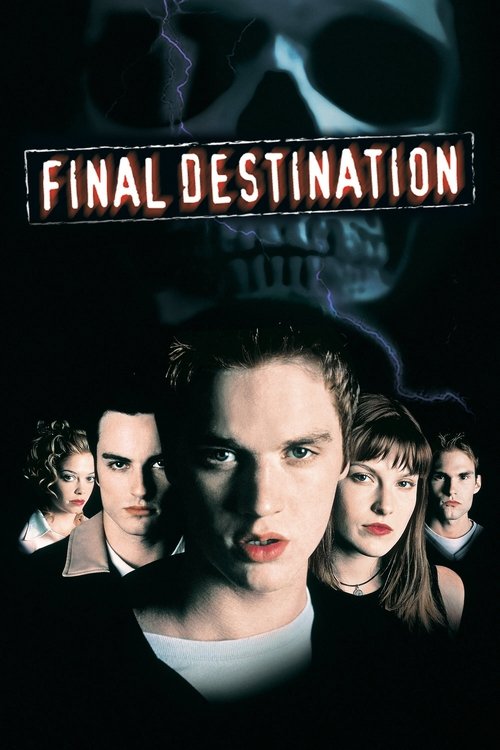
Final Destination
2000 · James Wong
When you're craving a real scare with a hook — great for a group watch where everyone yells at the screen. Choose it for adrenaline and gallows humor, not for sleep-easy comfort.
What it's about
A high-school senior boarding a flight to Paris has a vivid premonition of the plane exploding on takeoff, panics, and gets himself and a handful of classmates thrown off — moments before the disaster happens exactly as he saw it. Then the survivors start dying in freak accidents, one by one, in the order they were meant to go, and they realize death itself is coming to collect.
The experience
A ruthless, grimly playful machine of dread — every ordinary room becomes a puzzle of dangling cords, dripping water, and sharp edges you scan for the kill. It's tense, morbidly funny, and it will make you flinch at household objects for a week.
The craft
The elaborate accident sequences are Rube Goldberg machines of suspense, staged so the camera teases half a dozen possible deaths before springing the real one. The plane-crash premonition remains a genuinely harrowing piece of disaster filmmaking, and the whole design turns an invisible antagonist into a felt presence.
Why it matters
It launched one of horror's most durable franchises and installed a new template for the genre: no killer, no monster — just fate as the slasher. Its set-piece deaths became a cultural shorthand of their own.
Horror · Teen horror · Suspense & terror · Slasher. Teens who cheated death are stalked by an unseen fate; every room turns into a trap of everyday objects, tense and morbidly funny.
Snapshot
Final Destination is a supernatural horror film in which death itself, rather than a masked killer or a monster, functions as the antagonist. A high-school student, Alex Browning (Devon Sawa), experiences a vivid premonition that the transatlantic Flight 180 will explode on takeoff; panicking, he causes a scene that gets himself and several classmates and one teacher removed from the plane, which then explodes exactly as he foresaw. The survivors soon discover that they were meant to die, and that an unseen, patient force begins killing them off in the order they would have perished, engineering elaborate accidents to restore its "design." Released by New Line Cinema in March 2000, the film distilled a single high-concept idea — you cannot cheat death — into a repeatable engine that would sustain one of the more durable horror franchises of the twenty-first century. It arrived at the tail end of the self-aware, teen-driven slasher revival that Scream had ignited in 1996, but its central conceit pointed in a genuinely different direction: horror without a corporeal villain, structured around causality, foreknowledge, and the machinery of the accidental.
Industry & production
The film originated with Jeffrey Reddick, who had written a spec script conceived as a stand-alone story and, by widely repeated account, originally imagined as a potential episode of The X-Files. That lineage is not incidental: the project reached the screen through James Wong and Glen Morgan, longtime writer-producers from the Chris Carter orbit at Fox, whose credits on The X-Files and Millennium had trained them in dread built from the ordinary and the procedural. Wong directed and co-wrote; Morgan produced and co-wrote; Reddick shared story and screenplay credit. The producing team included Warren Zide and Craig Perry, who would shepherd the franchise across its subsequent installments.
New Line Cinema — then a studio with a strong appetite for genre properties and a track record with horror franchises going back to A Nightmare on Elm Street — financed and released the picture. The production was mounted economically, on a budget generally reported in the low-to-mid twenty-million-dollar range, and shot in Vancouver, British Columbia, the "Hollywood North" hub that was already the production home of The X-Files. It returned a strong multiple on that outlay in worldwide theatrical release, enough to green-light sequels almost immediately; precise grosses vary across sources, so exact figures should be treated with caution, but the commercial verdict was unambiguous. That success converted a modest genre gamble into a property: Final Destination 2 followed in 2003, and further sequels extended the series across two decades.
Technology
Final Destination is a film of the late-optical, early-digital transition, and its effects work reflects that hinge moment. The signature set pieces — above all the opening air-disaster premonition — combine physical stunt work, miniatures and full-scale sets, and computer-generated augmentation for elements (fire, structural failure, the shudder of a fuselage) that practical means could not safely or fully deliver. The death sequences that follow are predominantly practical: rigged household hazards, controlled fire, mechanical gags, and prosthetic gore staged so that the camera can follow a chain of physical cause and effect. This practical bias is central to the film's aesthetic effect; the horror depends on the audience believing that the objects in a kitchen or a garage could really turn lethal, and practical rigging sells that plausibility in a way that heavier CGI of the era often could not. The picture belongs to a moment when digital tools had become good enough to extend a catastrophe but not yet cheap enough to replace the tactile pleasures of a well-built practical gag.
Technique
Cinematography
Robert McLachlan, a cinematographer with extensive episodic-genre experience (including work in the X-Files/Millennium world), shot the film. The visual grammar is functional and legible rather than showy, which serves the premise: because the threat is invisible, the camera must do the work of implying malign agency in inert objects. McLachlan and Wong favor slow, insinuating camera moves that drift toward ordinary hazards — a fraying cord, a leaking fluid, a loose screw — cueing the viewer to read the frame as a field of latent danger. The palette leans cool and desaturated, consistent with the Pacific Northwest look that Vancouver productions of the period cultivated. Reflective and transparent surfaces (glass, water, condensation, mirrors) recur as compositional motifs, both because they photograph with an uncanny sheen and because they thematically figure the idea of hidden forces refracted into visible signs.
Editing
James Coblentz cut the film, and editing is arguably its most important craft dimension. Two distinct rhythms govern the picture. The premonition and the death set pieces are built through accelerating, associative montage: the camera and cut isolate a sequence of small elements — a spark, a drip, a swinging object — assembling a Rube Goldberg logic in which the audience is invited to anticipate, and dread, the convergence. The editing deliberately misdirects, planting false alarms so that the fatal cause arrives from an unexpected vector. Between set pieces, the film settles into a more conventional teen-thriller tempo. The tension of the whole rests on the cutting's ability to make inanimate causality feel authored and inexorable.
Mise-en-scène / staging
The film's most original contribution to horror staging is its treatment of the everyday domestic and civic environment as a booby-trapped apparatus. Kitchens, bathrooms, garages, and roadways are dressed and blocked so that every prop is a potential instrument. This "design of death" staging turns production design into narrative: the set is the villain's toolkit. The film also seeds visual foreshadowing throughout — signs, reflections, and background details that reward re-viewing — so that the mise-en-scène operates as a puzzle the attentive spectator can partly decode.
Sound
Shirley Walker composed the score, one of the film's most distinctive and consistent assets; she would return for the sequels until her death in 2006. Her orchestral writing supplies a brooding, propulsive dread that compensates for the absence of an on-screen monster to musically "represent." The sound design is equally load-bearing: the death sequences depend on foregrounded practical sound — dripping, creaking, hissing, the small mechanical noises of a trap assembling itself — to direct the ear toward danger before the eye confirms it. The film also famously deploys John Denver songs, notably "Rocky Mountain High," as recurring aural omens of impending death, a wry, ironic use of gentle diegetic music as a harbinger. This turning of a soothing pop standard into a death-knell became a signature device carried forward by the series.
Performance
The ensemble is a characteristic late-1990s/early-2000s young cast. Devon Sawa anchors the film as Alex, playing dawning horror and guilt with a jittery conviction; Ali Larter plays Clear Rivers, the survivor who allies with him; Kerr Smith plays the antagonistic, skeptical Carter; and Seann William Scott, Chad Donella, and others fill out the doomed cohort. Kristen Cloke plays the teacher Ms. Lewton. The performance register is heightened teen-thriller, and contemporary reviewers frequently found the acting and dialogue the film's weakest link. The standout is Tony Todd — the Candyman star — as the mortician William Bludworth, whose brief, oracular appearances lend the film a note of gravitas and mythos; his casting deliberately imports horror-icon authority into an otherwise youthful ensemble.
Narrative & dramatic mode
Structurally the film is a survival countdown organized around a fixed, revealed order of deaths. The premonition front-loads the stakes and establishes the rules; the remainder plays as a race between the characters' dawning comprehension of the "design" and the accelerating arrival of their appointed ends. This produces a distinctive dramatic mode: dread of the known outcome rather than suspense over an unknown one. Because the audience is told that death intends to reclaim everyone, the tension migrates from whether to how and when — a formal wager that the mechanics of each demise can carry a scene without a mystery to solve. The film flirts with, but ultimately refuses, a clean escape, insisting on the inexorability of its premise. Its dramaturgy is closer to the ironic-fatalist tradition of the anthology twist tale than to the whodunit logic of the slasher.
Genre & cycle
Final Destination sits at an inflection point in the post-Scream horror cycle. The late-1990s teen-slasher revival — self-referential, star-driven, PG-13-adjacent in sensibility — had begun to exhaust itself by 2000. Wong and Morgan's film retained the cycle's demographic (attractive teens picked off one by one) and its structural rhythm (a series of set-piece deaths), but jettisoned the human killer entirely. In doing so it hybridized the slasher with the supernatural fatalism of The Twilight Zone and EC Comics, producing what is best described as a "death-as-antagonist" or "accident horror" subgenre. It thereby helped pivot 2000s horror away from the ironic slasher and toward elaborate, mechanism-driven set-piece horror — a sensibility that would find its fullest commercial expression a few years later in the Saw films and the broader "torture" and death-trap cycle, though Final Destination's own violence is more Rube Goldberg than sadistic.
Authorship & method
The film is fundamentally a James Wong / Glen Morgan work, and it is best understood through their shared apprenticeship in the Chris Carter television system. Their method — dread mined from the mundane, a procedural interest in rules and consequences, and a tolerance for the uncanny left partly unexplained — carries directly from The X-Files and Millennium into the feature. Jeffrey Reddick, whose original concept seeded the project, is the third essential author, and the franchise remains his signature creation.
Among collaborators, three are decisive. Robert McLachlan (cinematography) supplied the cool, insinuating visual field that makes ordinary spaces read as threatening. James Coblentz (editing) built the associative, misdirecting montage on which every set piece depends. And Shirley Walker (score) provided the film's sonic identity and continuity across the series; her contribution is one of the strongest through-lines of the franchise. Tony Todd, while a performer rather than an author, also functions as a kind of genre signature, embedding the film in a lineage of horror iconography.
Movement / national cinema
The picture is a Hollywood studio product of New Line Cinema, but it is materially a Vancouver / "Hollywood North" production, part of the runaway-production ecosystem that made British Columbia a genre-television and mid-budget-feature hub in the 1990s and 2000s. Its creative DNA is inseparable from the Pacific Northwest genre-TV milieu — the X-Files production culture, its crews, its cool visual register — transplanted to the big screen. It does not belong to any art-cinema movement; its "movement" affiliation is to the commercial American horror franchise as an industrial form.
Era / period
Final Destination is emblematically a turn-of-the-millennium film. It captures the late teen-horror boom at the moment of its transformation, sits on the practical-to-digital effects boundary, and reflects a specific pre-9/11 cultural texture — most pointedly in its casual willingness to stage a commercial airliner disaster as its inciting spectacle, a choice that would read very differently after September 2001 and that colored the reception of the franchise's later disaster set pieces. It is also a New Line horror property of the studio's franchise-hungry era, produced with the economy and repeatability that defined studio genre filmmaking at the millennium's turn.
Themes
The film's governing theme is fate versus agency: whether foreknowledge confers the power to change an ordained outcome. Its answer is bleakly deterministic — death has a "design," and evasion only defers, never cancels, the appointment. From this flow several corollaries. There is a strong current of survivor's guilt and the ethics of premonition: Alex's foresight saves lives but also implicates him, and the survivors are haunted by the sense that their continued existence is a debt. There is a memento mori dimension, a pop-cultural rendering of the ancient idea that death is always present and patient. And there is a pervasive anxiety about the treachery of the everyday — the conversion of domestic safety into latent lethality, which taps a modern unease about the technological and material environments we assume are benign. The recurring motif of visible "signs" gestures toward a semi-theological world in which meaning is legible to those who learn to read it, without the film committing to any explicit cosmology.
Reception, canon & influence
Critical reception in 2000 was mixed-to-favorable. Reviewers widely credited the film's premise as clever and its set pieces as inventive and grimly entertaining, while faulting the dialogue and youthful performances; the consensus positioned it as a smart, effective B-movie that punched above its modest origins. Its commercial performance decisively outstripped its critical standing and established it as a franchise cornerstone.
Backward influences. The film draws on a deep tradition of ironic-fatalist horror: the twist-driven morality tales of The Twilight Zone and EC Comics (Tales from the Crypt); the "you cannot escape your death" premise long familiar from folklore and short fiction; and the immediate structural template of the post-Scream teen slasher. Its DNA also carries the X-Files/Millennium sensibility of Wong and Morgan. Commentators have frequently linked its "survivor of a foreseen disaster is stalked by fate" logic to earlier premonition and sole-survivor narratives; those parallels are thematic and widely noted rather than formally credited, and should be read as lineage, not direct citation.
Forward legacy. Final Destination effectively invented a self-sustaining horror premise and spawned a franchise: Final Destination 2 (2003), Final Destination 3 (2006), The Final Destination (2009), Final Destination 5 (2011), and, after a long hiatus, Final Destination Bloodlines (2025). More broadly, it helped shift 2000s horror toward elaborate, mechanism-driven death set pieces, prefiguring the death-trap ingenuity that the Saw series would monetize, and it entered popular language: "a Final Destination–style death" became shorthand for a grotesque chain-reaction accident. Its innovations — death as an invisible antagonist, the pre-scripted order of demise, the planting of decodable visual omens, and the ironic musical harbinger — have been repeatedly imitated and parodied. For a film dismissed by some contemporaries as disposable teen horror, its conceptual footprint on the genre has proven unusually large and lasting.
A Deleuzian reading
The camera leaves the people.
The full Deleuzian reading of Final Destination →
Reception
Dismissed by many critics in 2000 as just another post-Scream teen horror, it quietly became the seed of one of horror's most beloved franchises — and the 2025 revival of the series sent a whole new generation back to discover how lean and genuinely eerie the original is.
How Final Destination was received, from release to now →
How to watch Final Destination: what to notice on a first viewing
- Watch the camera drift off the talking characters toward objects. McLachlan's camera keeps sliding away from dialogue toward a frayed cord, a drip, a loose screw that nobody in the scene notices. The camera is reading the room for danger before any character does, making the space itself feel watchful.
- Listen for John Denver's song playing before a death. The gentle, familiar song recurs right before disaster, so its opening bars start to feel like a warning. Repetition turns a soothing pop song into what the reading calls a mark, a signal that means danger purely by habit.
- Track which hazard you expect versus what actually kills. Coblentz's editing plants an obvious danger, lets you clock it, then delivers the fatal blow from somewhere else entirely. The film teaches you to read a scene for threat, then punishes you for reading it wrong.
- Notice how many kitchen and bathroom objects get close-ups. Cords, screws, leaking fluids, and loose fixtures keep getting dwelt on, as if the set itself were assembling a trap. Production design becomes plot; the ordinary set doubles as the villain's toolkit.
- Watch Tony Todd's brief scenes as the oracular mortician. His handful of appearances carry unusual weight and calm, hinting at rules the film never fully explains. His horror-icon presence supplies gravitas the story needs without ever showing a monster.
The whole guide to watching Final Destination, with the keys for a rewatch →
Influences: the films it descends from and the films it influenced
- The Omen (1976) — Established the baroque ironic death set piece — plate-glass decapitation, lightning-rod impalement — in which everyday objects are engineered into lethal instruments by an unseen force claiming marked victims.
- The Birds (1963) — Model for the invisible, unexplained antagonist turning the mundane lethal, and for the suspense grammar of letting the audience decode a gathering threat before the characters do (misdirection built on foreknowledge).
- Tales from the Crypt (1972) — Transmits the EC Comics / Twilight Zone ironic-fatalist morality tale — the twist-driven comeuppance delivered by a grimly mechanical, inescapable death — directly into the film's structure.
- Carnival of Souls (1962) — Originated the crash-survivor-stalked-by-death premise, staged through uncanny-everyday cinematography that makes banal locations read as threatening.
- Sole Survivor (1983) — The near-literal template: the lone survivor of a foreseen disaster is quietly hunted as death reclaims those who cheated it in fixed order.
- The Dead Zone (1983) — Codifies the premonitory vision of imminent catastrophe as the engine that drives a protagonist to try — and fail — to avert a foreseen death.
- Jacob's Ladder (1990) — Wrings dread from ordinary spaces via an insinuating, uncanny camera and a cool desaturated palette, with a protagonist already marked and unable to escape his death.
- Scream (1996) — Supplied the immediate post-Scream template: a self-aware, rules-based teen-slasher ensemble picked off one by one in sequence.
- Final Destination 2 (2003) — Escalated the opening-premonition-then-Rube-Goldberg-death into the franchise's defining grammar with the highway logging-truck pile-up, formalizing the chain-reaction set piece.
- Final Destination 3 (2006) — Wong turns the planted visual omen into a game — photographs of each victim encode the manner of their death — extending the decodable-clue device around the rollercoaster disaster.
- Final Destination 5 (2011) — Engineered the suspension-bridge collapse and calibrated its near-miss misdirection to 3D depth, refining the fake-out staging that precedes each real kill.
- Final Destination Bloodlines (2025) — Revives the premonition-opener and chain-reaction death engine while extending the fixed-order countdown across a generational lineage of the doomed.
- Saw (2004) — Monetized the mechanism-driven death, turning the elaborate lethal contraption — the intricately engineered kill as centerpiece — into its own franchise economy.
- The Happening (2008) — Extends death-as-invisible-antagonist by having an unexplained force drive ordinary people to self-destruction, cued by ironic everyday omens (the wind, the breeze) rather than a visible killer.
- It Follows (2014) — Builds a rule-bound, invisible, inexorable pursuer that takes victims in order, rendered through patient insinuating camera moves and a cool desaturated suburbia that turns open space into threat.
- Countdown (2019) — Literalizes the pre-scripted countdown — an app assigns each character a fixed death-time — and runs the same ironic-fatalist plot of trying to cheat an appointed death.
- Smile (2022) — An inexorable curse marks victims for death with decodable omens and insinuating, floating camera moves that make everyday space read as menacing — the insinuating-camera-plus-planted-omen craft applied to a contagion premise.
- Saw II (2005) — Parallel deadly-game craft of intricate practical death-machine set pieces governed by an unseen moral/cosmic reckoning, engineered for suspense-of-mechanism rather than a slasher.
Similar films
- Final Destination 3 (2006) — influence & lineage · same viewing thread
- Final Destination Bloodlines (2025) — influence & lineage
- Saw (2004) — influence & lineage
- Scream (1996) — influence & lineage
- The Birds (1963) — influence & lineage · same viewing thread
- The Final Girls (2015) — same viewing thread
- It Follows (2015) — same viewing thread
- Ring (1998) — shared sensibility
All the films related to Final Destination →
Watch it with: curated runs of related films
- Slashers That Know the Rules — A run of body-count films that know their own genre: requels, camp-slasher love letters, Ti West's X trilogy and outright parodies, all reworking the masked killer, the final girl and the cursed summer camp, so each one sharpens the jokes and scares in the next.
- Nowhere to Run — They rhyme on dread you can't reason with or escape: a curse that walks toward you, a family that won't let you leave, a nurse who won't let you go, birds that attack for no reason, and death collecting what it's owed.