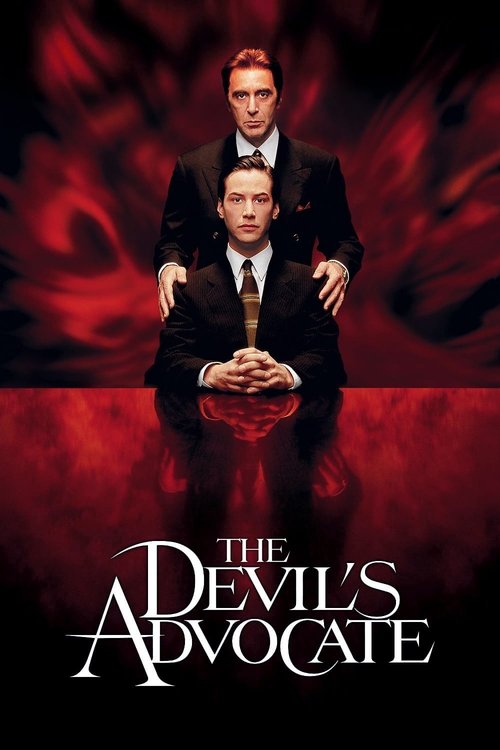
The Devil's Advocate
1997 · Taylor Hackford
For when you want a long, juicy, slightly trashy-in-the-best-way thriller to sink into on a weeknight — ambition, temptation, and brimstone, with a finale worth staying up for.
What it's about
A hotshot Florida defense lawyer who has never lost a case gets recruited by a glittering Manhattan firm, complete with a palatial apartment and a magnetic senior partner who takes an unusual interest in him. As the cases get uglier and his wife starts unraveling in their gilded new life, he begins to suspect the price of his winning streak — and that his boss may be something far older and worse than a crooked attorney.
The experience
A slow-burn seduction that plays its lurid premise dead straight — part legal drama, part marriage-in-crisis story, part creeping supernatural nightmare, building for two-plus hours before going gloriously over the top. It's talky, adult, and unsettling, with an undertow of dread the whole way.
Performances
Al Pacino delivers one of his great late-career arias — a charming, monologuing tempter having the time of his life — while Keanu Reeves anchors it as the ambitious young lawyer and Charlize Theron, early in her career, does the film's most wrenching work as his increasingly isolated wife.
The craft
Taylor Hackford shoots it as a real, location-heavy New York melodrama, which makes the supernatural intrusions land harder when they come; the production design turns luxury real estate into something quietly infernal. The writing gives Pacino some of the most quotable devil's-bargain speeches in the genre.
Why it matters
It became a touchstone for the deal-with-the-devil story in modern dress — endlessly quoted, especially its climactic monologue — and a defining Pacino showcase of the era.
Snapshot
A Gainesville defense attorney with an unbroken acquittal record is recruited by a Manhattan firm whose senior partner turns out to be Satan, his father, and the architect of a dynastic plan to breed the Antichrist. Taylor Hackford's film takes that pulp premise entirely seriously for two and a half hours, and its peculiar durability comes from the mismatch: a slow, adult, location-shot New York melodrama about ambition and marriage, which then detonates into full baroque apocalypse in its final reel. Adapted from Andrew Neiderman's 1990 novel — Neiderman being best known as the writer who continued the V.C. Andrews franchise after her death, a provenance that tells you something about the material's register — the film was credited to screenwriters Jonathan Lemkin and Tony Gilroy after a long development. Al Pacino, as John Milton, delivers what is arguably the last of his great theatrical arias before the mode hardened into self-parody; Keanu Reeves plays the vessel; Charlize Theron, in her first substantial lead, plays the person the story actually destroys. It was released by Warner Bros. in October 1997, did respectable business (stronger internationally than domestically), divided critics, and has since become one of those films whose reputation is carried almost entirely by clips.
Industry & production
The film sits precisely in the vanished middle of the American studio slate: a $50–60 million-range adult genre picture with movie stars, an R rating, a 144-minute runtime, and no franchise ambitions. Warner Bros. in the mid-1990s was still building such things routinely; within a decade the category would be gone.
Development was protracted. Neiderman's novel had circulated since 1990, and the screenplay passed through multiple hands before arriving at the credited Lemkin/Gilroy pairing. The specifics of who contributed what are murky in the public record, and the arbitration history is not well documented — worth stating plainly rather than reconstructing. What is legible in the finished film is a structural bet: keep the supernatural almost entirely suppressed for ninety minutes, so that the courtroom procedural and the marital collapse have to carry the picture on their own terms.
Casting was the leverage. Pacino, coming off Heat, City Hall, and Donnie Brasco, was at his most commercially potent, and it has long been reported that Reeves accepted a substantially reduced fee to keep Pacino's salary within budget. Reeves himself was in a soft commercial patch after Speed — post-Johnny Mnemonic, pre-The Matrix — and the role was pitched as a return to dramatic weight. Theron had two supporting credits to her name; Connie Nielsen was almost unknown to English-language audiences. The supporting bench is unusually strong for a horror picture: Jeffrey Jones, Craig T. Nelson, Delroy Lindo, Judith Ivey, Tamara Tunie, and a young Heather Matarazzo, fresh from Welcome to the Dollhouse, as the schoolgirl witness in the opening trial.
Production shot extensively on location in New York, and the film's most valuable asset is that Manhattan is real — the streets, the subway, the office towers, the park. The one production episode that entered the historical record permanently is a legal one. Sculptor Frederick Hart sued Warner Bros., contending that the animated bas-relief dominating Milton's penthouse infringed his Ex Nihilo, part of the Creation sculptures on the west façade of Washington National Cathedral. The suit was settled, with the studio agreeing to alter the sculpture's appearance for home-video release and to disclaim association — an outcome now routinely cited in discussions of moral rights and artists' claims against film production under U.S. law.
Technology
The film arrives at a hinge moment. Jurassic Park was four years back; Titanic opened two months later. Digital compositing was mature enough to be invisible but expensive enough that a mid-budget horror film had to ration it. The Devil's Advocate solves this by hoarding: it spends almost nothing for two acts, then spends everything at once.
The two showpieces are the frieze and the faces. The frieze — a churning Rodin-by-way-of-The Gates of Hell wall of bodies — combines sculpted practical relief with digital animation, so that figures previously read as stone begin to writhe, separate, and speak. The trick works because the object has been sitting in frame, inert, for an hour; the audience has stopped looking at it. The second effect is the recurring facial distortion, in which women's features slide into demonic configurations for a few frames at a time. These are largely built from prosthetic and makeup work rather than pure CGI, with digital morphs handling the transitions — a hybrid approach characteristic of the period, and one that ages considerably better than the era's all-digital equivalents. The film also makes heavy, unglamorous use of a much older technology: glass. Reflections, mirrored elevator walls, curtain-wall towers, and the penthouse's transparent surfaces do much of the work that effects would do in a later production.
Technique
Cinematography
Andrzej Bartkowiak shoots the film, and the choice is meaningful rather than incidental. Bartkowiak was Sidney Lumet's principal collaborator through Prince of the City, The Verdict, and Q&A — which is to say, the definitive photographer of the American legal system as a grubby, wood-panelled, fluorescent-lit institution. He brings that vocabulary intact to the film's first hour: courtrooms are shot flatly and without romance, the Florida sequences hot and overexposed, faces sweating.
Manhattan is then rendered in a different register — burnished, amber, mahogany and brass and firelight, the interiors of power photographed as if lit by hearth rather than by ceiling. The contrast is legible and slightly obvious, and it works. Bartkowiak's compositions repeatedly place Reeves against reflective planes: glass partitions, elevator interiors, bathroom mirrors, the penthouse windows. Kevin is almost never alone in frame even when he is alone; there is always a second version of him, which is the film's thesis stated optically well before it is stated in dialogue. As the supernatural surfaces, the camera loosens — handheld intrusions, canted framings, and a growing willingness to let sources of light go hot and unmotivated.
Editing
Mark Warner's cutting is the least fashionable thing about the film and among its smartest choices. The picture is long and paced like a drama, not a horror film. Scenes are allowed to run; Pacino is allowed to finish. The editorial strategy is one of accumulation rather than shock — dread is built by duration, and the few hard cuts to hallucination land precisely because the surrounding grammar is so patient. The film's structural gamble sits in the last ten minutes, where a reset device (the entire Manhattan arc revealed as a temptation Kevin can refuse, followed by an immediate return to the Florida courtroom) requires the audience to re-read everything at speed. Whether the reversal reads as elegant or as a cheat is the single most divisive question about the film, and reasonable critics have landed on both sides.
Mise-en-scène / staging
Production design by Bruno Rubeo builds the firm of Milton, Chadwick & Waters as a cathedral — vaulted lobby, vertical circulation, an office tower whose iconography is explicitly ecclesiastical. Milton's penthouse is its inversion: black, glass, unornamented except for the one enormous religious artwork. The Lomaxes' apartment is decorated by Mary Ann into progressively hostile shades, her interior decoration functioning as a readout of her mental state — a device inherited wholesale from Rosemary's Baby.
Staging is theatrical in the specific sense that Hackford builds his key scenes as two-handers in enclosed rooms and then lets his actors move through them. The climactic monologue is blocked as stagecraft: fire, statuary, a man circling another man, an audience of one.
Sound
James Newton Howard's score is choral and liturgical, deploying Latinate chant, low brass, and processed and reversed vocal textures. It is a deliberately sacred sound applied to a secular institution, which is the joke and the argument simultaneously. The sound design layers the city into a susurrus — traffic and HVAC and crowd noise pitched so that whispering emerges from it without a clean boundary, so that the audience is never certain whether Kevin is hearing voices or hearing New York. Over the end credits, the Rolling Stones' "Paint It Black" — a choice that is knowing, tonally slightly glib, and entirely of its decade.
Performance
Pacino's Milton is a legitimately great late-career construction, and the reason is restraint at the level of design rather than volume. For most of the film he is charming, physically loose, mercurial, and quiet — a man who listens. The shouting is rationed to a single sustained aria, and it detonates because nothing preceded it. "Vanity — definitely my favorite sin" survives as one of the most-recirculated lines in 1990s American cinema.
Reeves is the film's contested element. His Florida accent drifted, and contemporary reviewers said so. But the performance is doing something the criticism often misses: Kevin is written as a blank, a man whose defining quality is that he has no interior objection to anything, and Reeves' famous opacity serves that. He is best in the second half, when the character is required to be frightened rather than confident.
Theron gives the film's most demanding performance and receives the least protection from it. Mary Ann's arc — isolation, hallucination, self-mutilation, institutionalization — is the horror engine, and Theron plays the deterioration without vanity. Connie Nielsen and Jeffrey Jones do precise, cold work in support.
Narrative & dramatic mode
The film is a Faust story that conceals its structure until the final scene. Its three movements are generically distinct: legal procedural, paranoid domestic melodrama, and apocalyptic horror, in that order, with the audience largely unaware that a genre migration is underway. The device holding this together is the moral test — the New York arc functions retroactively as a proposition set before Kevin, which he is permitted to decline.
The genuinely interesting move is the last one. Having refused power, Kevin immediately accepts flattery, and the devil's closing remark identifies vanity as the operative sin — not ambition, not greed, not lust, all of which the film has spent two hours cataloging. The reset is therefore not a cheat about consequence but a reframing of the temptation itself: the film argues that the deal was never about what Milton offered, and that a man who refuses the world will still take the compliment.
Genre & cycle
The Devil's Advocate stands at the junction of two cycles and belongs cleanly to neither. From the 1990s legal thriller — the Grisham adaptations, The Firm above all — it takes the naïf recruited into a firm whose partnership is a trap. From the Satanic horror lineage running Rosemary's Baby → The Exorcist → The Omen → Angel Heart it takes its cosmology and its imagery.
More consequentially, it opens the short millennial-Satanic cycle: within three years came Fallen (1998), Stigmata, The Ninth Gate, End of Days (all 1999), Lost Souls and Bless the Child (2000). The approach of the year 2000 generated an appetite for apocalyptic religiosity in American commercial cinema, and this film both anticipated and helped license it.
Authorship & method
Hackford is not an auteur in the signature-style sense; he is a craftsman with a documentary background (he came up through public television and won an Academy Award for the short Teenage Father) whose filmography — An Officer and a Gentleman, White Nights, Blood In Blood Out, Dolores Claiborne, later Ray — is defined by long-form character work and a taste for performance. The closest antecedent is Dolores Claiborne (1995), his previous excursion into genre material treated as serious drama, and the two films share a method: take the pulp source at face value, cast well, run long, and refuse to wink.
The collaborators supply the film's specificity. Bartkowiak imports Lumet's institutional realism as the ground against which the supernatural registers. Howard supplies the sacred idiom. Rubeo builds the cathedral. And Tony Gilroy is the figure whose subsequent career most illuminates the material: ten years later he would write and direct Michael Clayton, a film about a law firm as an instrument of moral annihilation with the metaphysics stripped out entirely. Reading the two together, The Devil's Advocate looks less like a horror film with a legal setting than an early draft of a lifelong argument about professional complicity.
Movement / national cinema
This is American studio filmmaking in its late-classical mode: a Warner Bros. picture, star-driven, location-shot, mid-budget, aimed at adults, with no ancillary universe attached. It belongs to no movement. Its national character is specific, though — the film is a New York movie in the tradition of Balzac and Dreiser transplanted to Manhattan, the provincial with talent who comes to the capital and is consumed. Its 1990s ancestor in that lineage is Wall Street; its literary sibling is The Bonfire of the Vanities. The distinctly American element is that the corrupting institution is not the state or the church but a private firm, and that the devil's chief argument is a defense of the adversarial legal system.
Era / period
1997: Titanic, L.A. Confidential, Boogie Nights, Face/Off. A year in which digital effects were about to become industrial and the mid-budget adult picture was about to become endangered. The film's anxieties are period-specific — the finance-and-real-estate Manhattan of the mid-1990s, the professional-class marriage in which one partner's career erases the other's life, the pre-millennial suspicion that prosperity was a transaction with terms not yet disclosed.
Themes
Vanity as the master sin. The film's explicit thesis, withheld until the final line: pride is more portable than greed and survives every renunciation.
The law as amoral machinery. Milton's most persuasive speeches are not seductions but accurate descriptions of the adversarial system. The film's real provocation is that the devil's case for defense attorneys is correct.
Free will. Milton insists throughout that he compels nothing and merely offers. The film mostly endorses him, which is what makes the ending a genuine test rather than a rescue.
Marriage as collateral. Mary Ann's destruction is the price of Kevin's ascent, and the film is clear-eyed that he permits it in increments, each individually defensible. The picture is also, by contemporary standards, punishing toward its female characters in ways worth naming: Mary Ann's suffering is instrumentalized, and the demonic-feminine imagery leans on old and unexamined associations.
Paternity. The absent father returns as employer, which is the film's neatest structural pun.
Reception, canon & influence
Critical reception in 1997 was genuinely split. Praise concentrated on Pacino's performance, the ambition of the conception, and the seriousness with which Hackford treated disreputable material; objections concentrated on the runtime, Reeves' accent and affect, the tonal rupture of the third act, and the reset ending. It was not an awards contender. Commercially it performed modestly in North America and considerably better overseas, finishing comfortably ahead of its cost — precise figures vary by source and are best consulted directly rather than recited here.
Backward. Rosemary's Baby is the structural template: the apartment, the urbane conspiracy, the wife who is right and disbelieved, the pregnancy as plot. Angel Heart supplies the devil in mortal disguise with a punning name; Wall Street supplies the mentor-protégé corruption arc; The Firm supplies the recruitment thriller. Above all, John Milton supplies both the character's name and his rhetorical position — Pacino plays the Romantic reading of Paradise Lost, Blake's Satan, the most articulate figure in the room. Rodin's Gates of Hell, Bosch, and Blake furnish the visual register.
Forward. The film's most durable contribution is a figure: the devil as charismatic urban professional, seductive and reasonable and funny, at home in glass towers. That archetype propagates through Bedazzled (2000), Constantine (2005) — with Reeves again on the other side of the same theology — Reaper, Damien, and most visibly the long-running Lucifer, where the premise is entirely the Miltonic devil as charming metropolitan operator. Gilroy's Michael Clayton is the film's secular descendant. Theron's career effectively begins here. And the picture has had an unusual afterlife in legal education and legal-ethics discussion, where Milton's speeches are cited more or less unironically as a statement of the defense attorney's dilemma.
Its final, faintly ironic legacy is one of fragmentation: the closing monologue circulates online, endlessly excerpted, as a self-contained artifact detached from the two hours of patient, unfashionable drama that make it land. The film survives as a clip. It deserves better, and the reason it deserves better is precisely the part nobody watches.
Reception
A modest hit with mixed reviews in 1997 — critics shrugged at the pulp and rolled their eyes at Keanu's Southern accent — it's since become a beloved late-90s rewatchable, treasured precisely for its excess, with Pacino's performance reappraised as gloriously, knowingly over the top.
How The Devil's Advocate was received, from release to now →
How to watch The Devil's Advocate: what to notice on a first viewing
- Watch how differently Florida and Manhattan are lit. Andrzej Bartkowiak shoots the Florida courtrooms flat, hot, and overexposed with sweating faces. New York arrives in mahogany, brass, and firelight, as though the offices of power were lit by hearth. The move from one world to the other is stated in light well before anyone describes what the job is.
- Count how often Reeves shares the frame with his reflection. Glass partitions, elevator interiors, bathroom mirrors, penthouse windows. Bartkowiak keeps a second Kevin in the shot even in scenes where the character is entirely alone. The film makes its argument about a divided man optically, long before anybody says it out loud.
- Look at the shape of the law firm's lobby. Bruno Rubeo builds Milton, Chadwick and Waters as a cathedral, with a vaulted entry and long vertical circulation. Milton's penthouse inverts it into black glass and one enormous carved relief. The office is dressed as a church, which tells you what this institution expects people to worship.
- Listen for whispering inside the traffic noise. James Newton Howard writes Latin chant, low brass, and reversed vocal textures. The sound design blends city noise, ventilation, and crowds so that voices surface out of them with no clean edge. You cannot tell whether Kevin is hearing something or just hearing New York, which is exactly the intended position.
- Watch how quietly Pacino plays Milton at first. He listens, jokes, moves loosely, and rations the volume for two hours. The famous shouting arrives once, and it detonates because nothing before it prepared you for the size of it. The performance is built by withholding, so the big aria works as release rather than as a style.
The whole guide to watching The Devil's Advocate, with the keys for a rewatch →
Influences: the films it descends from and the films it influenced
- The Devil and Daniel Webster (1941) — Establishes the courtroom rather than the crossroads as the Faustian venue — Mr. Scratch argued as a folksy litigator and the soul-contract adjudicated before a jury — the structural premise Hackford relocates to a Manhattan firm.
- Bedazzled (1967) — Peter Cook's George Spiggott is the performance template for Milton: the devil as bored, witty metropolitan operator who works by extended two-handers of seductive argument rather than menace.
- Rosemary's Baby (1968) — The structural template beat for beat — satanic conspiracy staged with apartment-block social realism, the husband trading the wife for career advancement, the wife isolated and disbelieved, pregnancy as the plot engine.
- The Omen (1976) — Goldsmith's Latin inverted-Mass choral score licensed the liturgical idiom laid over institutional/corporate imagery that James Newton Howard works in for Milton's tower.
- ...And Justice for All (1979) — Pacino's courtroom harangue as an aria that ruptures the scene's realism — a legal-ethics argument the whole film has been engineering toward — the direct precedent for the closing monologue's scale and register.
- The Verdict (1982) — Bartkowiak's own Lumet grammar — sourced amber practicals, wood-and-brass legal interiors, long lenses in real institutional rooms — imported wholesale as the documentary ground against which the supernatural is made to register.
- Wall Street (1987) — The mentor-protégé corruption arc built around the tempter's set-piece address, with the apartment-and-wardrobe upgrade montage functioning as the visible ledger of the bargain.
- Angel Heart (1987) — The devil in mortal disguise with a punning name and manicured calm (Louis Cyphre → John Milton), plus the sulfurous amber-and-shadow interiors and the reveal that the protagonist was contracted before frame one.
- Jacob's Ladder (1990) — In-camera demonic distortion — shutter-speed head-shakes, prosthetic faces caught at the edge of the frame in an unremarkable New York — married to a retroactive reset that rewrites everything preceding it.
- The Firm (1993) — The recruitment-thriller mechanics: the young hire seduced by salary, house and car, the firm as total institution with a hidden partnership secret, and the wife who perceives the rot first.
- Dolores Claiborne (1995) — Hackford's immediate precedent for the method — pulp source taken at face value, run long, built on sustained theatrical two-handers between a star and a visibly deteriorating woman, with no wink.
- End of Days (1999) — Takes the figure literally — Satan as a tailored Wall Street professional moving through glass towers — and stages prosthetic-into-CG hybrid transformations inside ecclesiastical sets built to the same cathedral-in-the-office logic.
- Angels in America (2003) — Pacino again as the monstrous New York attorney whose entire power is rhetorical, staged as long theatrical two-handers, with practical-digital hybrid effects reserved for sacred apparitions.
- Constantine (2005) — Puts Reeves on the other side of the same theology: Catholic-liturgical production design dropped into corporate Los Angeles, with Stormare's Satan played as an amused, well-tailored professional rather than a monster.
- Michael Clayton (2007) — Gilroy's secular rewrite of his own script — the law firm as an instrument of moral annihilation, the fixer's bargain, and an unhinged client monologue carrying the metaphysical charge the supernatural used to.
- Lucifer (2016) — Adopts the archetype as its entire premise: the Miltonic devil as charming metropolitan operator who prefers argument to force, with the seductive two-hander as the recurring signature scene.
- Fallen (1998) — Renders the city as a body evil moves through via crowd-transferred voices and a susurrating whisper track, and closes on a doom-reset that voids the hero's apparent victory.
- The Ninth Gate (1999) — Treats satanic engravings as animated, readable iconography that predicts plot — Devil's Advocate's bas-relief made into the narrative engine — inside the same network of urbane, wealthy collectors.
Similar films
- Michael Clayton (2007) — influence & lineage
- The Verdict (1982) — influence & lineage
- Constantine (2005) — influence & lineage
- The Conversation (1974) — often watched together
- Chinatown (1974) — often watched together
- Touch of Evil (1958) — often watched together
- Donnie Brasco (1997) — often watched together
- GoodFellas (1990) — often watched together