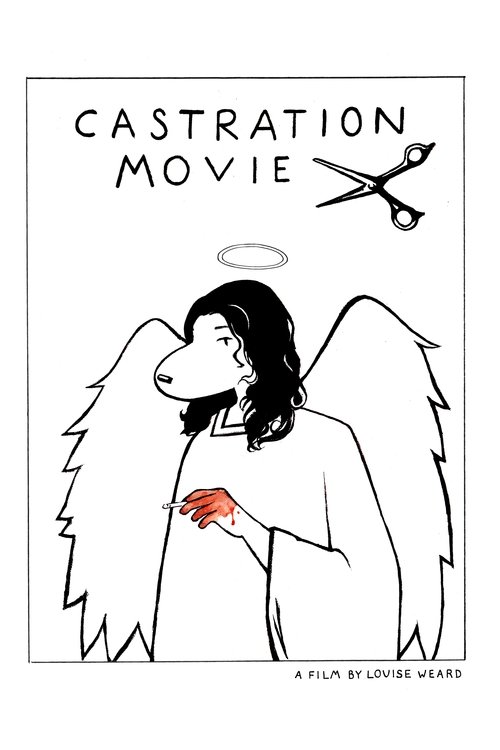
Castration Movie Anthology i. Traps
2024 · Louise Weard
For when you want cinema with no chaperone — something underground, argumentative, and alive, the kind of film you watch to have an opinion about. Definitely a challenge, not a comfort.
What it's about
In Vancouver, a trans sex worker nicknamed Traps hustles to get by while mentoring a newly out friend and nursing a stubborn dream of becoming a mother. Running alongside her story is Turner, a lowly film-crew production assistant whose collapsing relationship sends him spiraling into incel bitterness — two lives circling the same city, the same loneliness, from opposite directions.
The experience
Raw, talky, and confrontational — scenes run long past comfort, the humor is filthy and exhausted, and the camcorder texture makes you feel like you're in the room whether you want to be or not. It's funny and abrasive in the same breath, and it does not care if you flinch.
The craft
Shot self-financed on consumer video, it turns the cheapness into intimacy — the DIY look of public-access TV carrying long, unbroken scenes of conversation that most films would cut in half. Weard trusts talk to do what plot usually does, and the anthology structure lets the two storylines rub against each other without resolving neatly.
Why it matters
It arrived from the Vancouver underground with a title built to filter its audience and became one of the most argued-about works of new trans cinema — trans art made entirely on its own terms.
The opening movement of Louise Weard's sprawling, self-financed epic arrived from the Vancouver underground with a title designed to filter its audience — and became one of the most argued-about works of new trans cinema. Shot on consumer video with a camcorder intimacy that recalls the DIY lineage running from public-access weirdness through mumblecore, it braids two spirals: Michaela 'Traps' Sinclair, a trans sex worker mentoring a newly out friend while nursing an improbable dream of motherhood, and Turner, a production assistant sinking into incel resentment as his relationship rots. Weard lets scenes run long past comfort, trusting talk — filthy, funny, theory-laced, exhausted — to carry what plot won't. The film refuses respectability politics entirely: it is trans art made without a cis chaperone, as interested in cruelty and bad decisions as in tenderness. Passed around like samizdat through festival one-offs and word of mouth, it announced a filmmaker building, part by part, one of the strangest long-form projects in contemporary independent film.
Reception
Launched in 2024 as a 4.5-hour Hi8 camcorder epic the director sold herself, it spread purely by word of mouth through trans and underground film circles — and within two years the DIY provocation had climbed all the way onto the Criterion Channel.
How Castration Movie Anthology i. Traps was received, from release to now →
Influences: the films it descends from and the films it influenced
- Out 1 (1971) — The template for the durational independent epic: parallel plot strands unspooled across a runtime long enough that structure itself becomes the subject, with scenes built from rehearsal and improvisation rather than tight scripting.
- Faces (1968) — Handheld 16mm shooting that lets long, unbroken takes run past the point of comfort so raw, halting, naturalistic performance emerges from the duration itself.
- Jeanne Dielman, 23 quai du Commerce, 1080 Bruxelles (1975) — Real-time long takes of domestic and maternal labor, using duration as the argument — the camcorder-intimate patience with motherhood descends directly from this fixed-frame durational method.
- Funny Ha Ha (2002) — The foundational mumblecore text: overlapping, halting, talk-driven scenes performed by nonprofessionals on cheap film stock, where inarticulacy is the aesthetic.
- Hannah Takes the Stairs (2007) — Prolific, low-cost DIY production shot on consumer digital video with improvised dialogue, proving a talk-driven feature could be made outside any industrial apparatus.
- Tarnation (2003) — A queer autobiography assembled from a lifetime of accumulated camcorder home-video diaries, treating consumer-video footage as the raw material of first-person cinema.
- Weather Diary 1 (1986) — First-person consumer-video confessional diary from the underground: the camcorder as intimate, unglamorous instrument of self-exposure and DIY duration.
- It Wasn't Love (1992) — Diaristic queer first-person video shot on a Fisher-Price PixelVision toy camera, establishing the low-resolution consumer-device intimacy as a queer formal signature.
- Funeral Parade of Roses (1969) — Underground trans/queer portraiture that blends documentary interview and staged fiction with self-reflexive breaks, an early model for talk-driven trans cinema outside respectable form.
- Frownland (2007) — An abrasive 16mm character study of a socially resentful, off-putting man built from excruciating, over-long talk scenes that refuse to let the viewer off the hook.
- The Color Wheel (2011) — Mumblecore-descended black-and-white two-hander driven by corrosive sibling dialogue, weaponizing naturalistic talk into sustained discomfort.
- We're All Going to the World's Fair (2021) — New-trans-cinema built from webcam and screen-mediated long takes, using consumer-recording intimacy and online performance as the formal grammar of dysphoric identity.
- The People's Joker (2022) — DIY trans anti-respectability cinema assembled through maximalist collage and appropriation, embracing amateur means as a defiant aesthetic and legal stance.
- Tangerine (2015) — Shot on consumer iPhone hardware with naturalistic trans nonprofessional leads, proving prosumer-device capture could carry a full narrative feature.
- I-Be Area (2007) — Hyperactive consumer-video and public-access aesthetic pushed to queer excess, treating the home-video/cable-TV image as a native language rather than a limitation.
- Computer Chess (2013) — Mumblecore restaged through period consumer-video cameras, making the obsolete analog image and vintage tube-camera texture the film's formal identity.
Similar films
- The Substance (2024) — same viewing thread
- Teenage Sex and Death at Camp Miasma (2026) — shared sensibility
- Hundreds of Beavers (2024) — shared sensibility
- Blue Film (2026) — shared sensibility
- Rotting in the Sun (2023) — shared sensibility
- Hard Truths (2024) — shared sensibility
- Do Not Expect Too Much from the End of the World (2023) — shared sensibility
- Trenque Lauquen (2023) — shared sensibility
All the films related to Castration Movie Anthology i. Traps →
Watch it with: curated runs of related films
- The Grotesque Sublime — Watch these when you want cinema that pushes the body to hallucinatory, grotesque extremes — each a lurid transformation, half ecstasy and half horror, that dares you to keep looking.