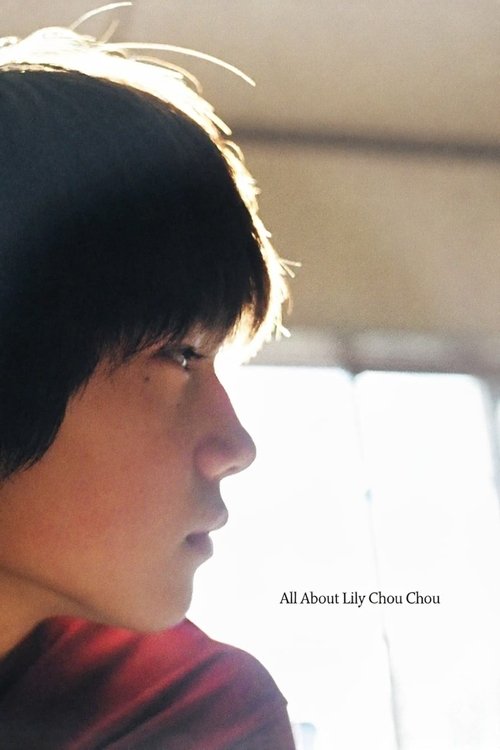
All About Lily Chou-Chou
2001 · Shunji Iwai
When you want to feel something raw about adolescence — this is a challenge, not comfort, best saved for a night when you can sit with heavy emotions and a long runtime.
What it's about
Two junior-high boys in provincial Japan drift from friendship into a shifting, poisonous power dynamic against a backdrop of bullying, extortion, and shame. Their one refuge is the ethereal music of pop star Lily Chou-Chou, whose anonymous fan forum floats across the screen in glowing text — an online sanctuary where fourteen-year-olds confess what they could never say out loud.
The experience
Dreamlike and bruising in equal measure — long, drifting passages of rice fields and pop reverie collide with scenes of real cruelty, and the fractured chronology asks you to piece the story together. It leaves you aching, and it lingers for days.
The craft
Shunji Iwai layers anonymous forum posts directly over luminous, handheld imagery, folding the timeline so memory and message board blur together. The sound world is its own character — the ethereal songs of Lily Chou-Chou, voiced by the singer Salyu, threaded with Debussy — and it deserves headphones or good speakers.
Why it matters
Made in 2001 from an experimental internet novel, it saw the coming world of anonymous cruelty and parasocial refuge with eerie clarity, which is why generations raised online have claimed it as their own.
Shunji Iwai's portrait of Japanese adolescence began as an experimental internet novel, composed in real time on a message board where readers posted alongside the author; the finished film keeps that DNA, floating anonymous forum posts across the screen in glowing type as fourteen-year-olds confess their devotion to the ethereal pop star Lily Chou-Chou. Offline, their provincial lives are a wasteland of bullying, extortion, and shame; online, in what the fans call the ether of Lily's music — sung by Salyu, a persona invented for the film, with Debussy threaded through the score — they find the only tenderness on offer. Made in 2001, it saw with eerie clarity the coming world of anonymous cruelty and parasocial refuge, which is partly why generations raised inside that world have claimed it so fiercely. Iwai folds chronology like a rumor passed between classrooms, and Noboru Shinoda's pioneering digital cinematography delivers the indelible image: a boy alone in a rice field of impossible green, headphones on, the ether holding.
A Deleuzian reading
A boy stands in a rice field with headphones on.
The full Deleuzian reading of All About Lily Chou-Chou →
Reception
Divisive on release — Western critics in 2001 often found it sprawling and punishing — it's since been reclaimed by a generation that grew up online, now widely seen as one of the first great films about internet life.
How All About Lily Chou-Chou was received, from release to now →
Influences: the films it descends from and the films it influenced
- Love Letter (1995) — Iwai's own blueprint for overexposed, diffused natural light and communication routed through a mediating channel (letters there, forum posts here) that lets strangers confess what they can't say face to face.
- Swallowtail Butterfly (1996) — Iwai first built a fictional pop star (Glico/YEN TOWN BAND) whose songs were actually recorded and charted in the real world — the exact diegetic-persona-made-real trick he perfects with Lily Chou-Chou and Salyu.
- Days of Heaven (1978) — The template for shooting adolescents small against vast magic-hour crop fields, treating landscape and weather-light as the emotional register — the direct forebear of the saturated rice-field green.
- Chungking Express (1994) — Handheld, smeared-light urban youth alienation scored to an obsessively repeated pop refrain that functions as a character's private emotional lifeline.
- The 400 Blows (1959) — Founding grammar of coming-of-age cruelty — truancy, institutional and peer brutality, and the boy fleeing across open ground toward an ambiguous horizon.
- Festen (1998) — Legitimized cheap consumer-DV handheld as a serious dramatic texture, giving Iwai license to shoot on early Sony digital and let the format's rawness carry intimacy.
- Perfect Blue (1997) — Maps the parasocial idol-and-fan bond and the splitting of an online-projected self from the real one, the fan's worship curdling into pathology.
- Picnic at Hanging Rock (1975) — Pastoral dread built from gauzy diffused light and drifting Romantic/classical music — the ethereal-menace mode that Debussy's Arabesques serve here.
- A Brighter Summer Day (1991) — Epic, naturalistic anatomy of East Asian teen gang hierarchy and its escalation into fatal violence, staged with documentary patience rather than genre thrill.
- Velvet Goldmine (1998) — Structures its whole narrative around devotion to an invented pop icon, using fandom and myth-making as the film's organizing principle rather than plot.
- Ritual (2000) — Iwai's own DV feature carrying forward the digital-video melancholy and diffuse-light adolescence he brought to Ritual as its lead actor-director.
- Elephant (2003) — Extends the drifting-Steadicam-through-school-corridors staging and non-linear, multi-POV chronology to detonate ordinary adolescence into sudden violence.
- Hana and Alice (2004) — Iwai carries the same digital-shot, diffuse-light teen naturalism forward, softening the online-cruelty theme into gentler comedy while keeping the observational texture.
- Searching (2018) — Pushes the floating on-screen-text device to its endpoint, telling the entire story through interfaces and message threads as the primary narrative surface.
- Eighth Grade (2018) — Inherits the parasocial-refuge theme — adolescence lived through screens and an online persona that consoles more reliably than any peer — updated to the social-media era.
- One Million Yen Girl (2008) — Discovers and calibrates Yu Aoi's signature stillness — expressivity held in the face and posture rather than dialogue — the precise performance register Tanada later builds a whole film around.
- The Last 10 Years (2022) — Pushed handheld, ambient-light naturalism and restrained youth performance into melodramatic material, the actor-trusting observational mode Fujii applies here.
- Linda Linda Linda (2005) — Pioneers the lived-in, ambient rendering of Japanese school spaces with pop music as the load-bearing structure of adolescent interiority — the precedent for treating a band's songs as the film's emotional architecture.
- The Virgin Suicides (1999) — Same-era gauzy adolescent myth-making set to a dream-pop score (Air) that functions exactly as Lily's music does — an ambient 'ether' of collective teenage longing.
- Blue Spring (2001) — Contemporary Japanese school-rooftop nihilism and peer-cruelty rendered with a rock-scored, elliptical cool — the aggressive counterpart to Iwai's melancholy.
- Nobody Knows (2004) — Digital-handheld naturalism drawing unforced performances from real children, observing abandoned kids' cruelty and tenderness without adult framing.
Similar films
- Swallowtail Butterfly (1996) — influence & lineage · same viewing thread
- Nobody Knows (2004) — influence & lineage
- Moving (1993) — same viewing thread
- A Silent Voice: The Movie (2016) — shared sensibility
- Liz and the Blue Bird (2018) — shared sensibility
- Confessions (2010) — shared sensibility
- Dou kyu sei – Classmates (2016) — shared sensibility
- Happyend (2024) — shared sensibility
All the films related to All About Lily Chou-Chou →
Watch it with: curated runs of related films
- Unmoored in Modern Japan — Watch these when you want Japanese cinema at its most restless — lives knocked off their axis by divorce, disaster, migration, or heartbreak, and the strange grace of piecing them back together.