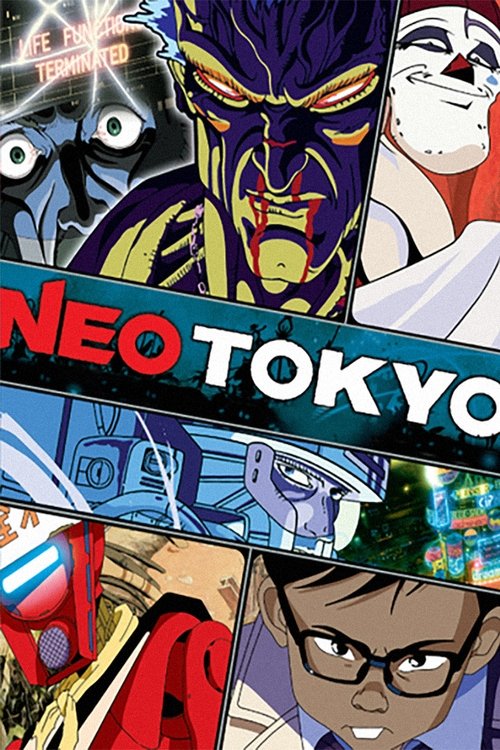
Neo Tokyo
1989 · Rintaro
For when you want something short, strange, and visually maxed-out — a perfect late-night pick when a full feature feels like too much but you still want your mind bent.
What it's about
Three of Japan's most distinctive animation directors each take a segment of this fifty-minute anthology. A girl and her cat slip through a mirror into a carnival-strange labyrinth that frames the whole film; a burned-out racer in a lethal future sport pushes himself against the ultimate opponent; and a hapless company man is sent to a jungle outpost to shut down a construction site run entirely by robots that refuse to stop building.
The experience
A compact hit of pure animation ambition — eerie, adrenalized, and blackly funny by turns, with each segment operating in a completely different register. It's over before you've caught your breath, and the images linger much longer than the running time suggests.
The craft
Produced at Madhouse with Rintaro, Yoshiaki Kawajiri, and Katsuhiro Ōtomo each directing in their own unmistakable style — dreamlike carnival surrealism, speed-blurred neon intensity, and deadpan mechanical absurdity respectively. It's hand-drawn animation flexing at the end of the 1980s, and it rewards good speakers and a dark room.
Why it matters
A showcase of Japanese animation's late-1980s golden moment, uniting three directors at the peak of their powers and standing as a touchstone for the adult-oriented anthology form in anime.
Snapshot
Neo Tokyo is the English-language title of Meikyū Monogatari (迷宮物語, "Labyrinth Tales"), a fifty-minute Japanese animated anthology whose own title card reads Manie-Manie. Three of the most consequential directors working in Japanese animation at the end of the 1980s each took a segment: Rintaro's "Labyrinth Labyrinthos," which doubles as the film's frame story; Yoshiaki Kawajiri's "The Running Man"; and Katsuhiro Ōtomo's "Construction Cancellation Order" (often rendered "The Order to Stop Construction"). The project was conceived and produced by Madhouse co-founders Masao Maruyama and Rintaro, with executive production by the publisher Haruki Kadokawa, and it draws on the linked short fiction of the science-fiction writer Taku Mayumura, whose 1986 collection supplied the film's Japanese title.
The dating is genuinely tangled, and the "1989" attached to this dossier is the least intuitive of the available dates. The film premiered at the Tokyo International Fantastic Film Festival on 25 September 1987, went to Japanese home video on 10 October 1987, and only reached Japanese theaters, via Toho, on 15 April 1989. Streamline Pictures — the American distributor founded in 1988 by Carl Macek and Jerry Beck — licensed and dubbed it for the North American market under the title Neo Tokyo, screening it theatrically on a double bill with Silent Möbius. That retitling is worth pausing on: no segment of the film takes place in Tokyo, and the name is borrowed wholesale from the city of Ōtomo's Akira, which had made "Neo-Tokyo" a marketable word in English-speaking fandom. The film is, in effect, three unrelated tales sold under a fourth work's brand.
Industry & production
Meikyū Monogatari is a product of the OVA boom — the original video animation market that opened in Japan after Dallos (1983) and which, by 1987, was financing work too short, too strange, or too adult for either television or the Toei-style theatrical program picture. The economics of that market are what make a film like this possible: an anthology of three roughly fifteen-minute pieces, each with a distinct art direction and no obligation to a franchise, recovers its cost through video rental and sell-through rather than through ticket sales.
Two studios share the credit. Madhouse, founded in 1972 by Maruyama, Osamu Dezaki, Rintaro, and Kawajiri after the collapse of Osamu Tezuka's Mushi Production, was by the mid-eighties the industry's most reliable home for directors with strong personal signatures. Project Team Argos was Rintaro's own production vehicle. Kadokawa Shoten's involvement situates the film inside the media-mix strategy Haruki Kadokawa had built through the 1970s and 1980s — book, film, and music released as a single commercial event — and explains the Mayumura source material, since the stories were Kadokawa property.
The film belongs to a very short moment when anthology showcases were a live commercial form in Japanese animation: Robot Carnival, produced by A.P.P.P., appeared the same year and drew on an overlapping talent pool, including Ōtomo and Atsuko Fukushima. Detailed production records for Meikyū Monogatari — budget, schedule, division of resources between the three units — are not well documented in English-language scholarship, and no reliable box-office figure exists for a film whose primary Japanese release was on videocassette. Claims about its commercial performance should be treated with suspicion.
Technology
Everything here is pre-digital: cel animation photographed on 35mm under a rostrum camera, with effects achieved optically and in-camera. That constraint is the film's real subject at the level of craft. Kawajiri's segment builds its sensation of speed out of smeared drawings, streaked backgrounds, held cels, and camera moves rather than motion blur applied in post; the psychic energy that destroys rival racers is drawn light — airbrushed glows, backlit effects cels, high-contrast masks — not a particle system. Ōtomo's segment achieves its density of mechanical detail through sheer draughtsmanship, with rain, steam, and jungle haze handled as painted and photographed layers.
The film sits roughly eight years before digital compositing became standard in Japanese animation, and it represents something near the ceiling of what the photochemical cel process could deliver. Part of its continuing reputation rests on that: the effects have a physical grain that later, cleaner pipelines do not reproduce.
Technique
Cinematography
Three virtual cameras, three grammars. Rintaro stages "Labyrinth Labyrinthos" frontally, like a proscenium: flattened planes, silhouetted figures against saturated fields, sudden shifts of scale as the girl Sachi passes through the face of an old clock into a space with no fixed ground. Depth arrives through layered cutouts and lateral drift rather than through perspective.
Kawajiri does the opposite. "The Running Man" is built on simulated wide-angle distortion, extreme low angles, driver-eye point of view, whip pans across the Death Circus arena, and a chiaroscuro so hard that faces resolve into a lit plane and a black one. It is the visual signature Kawajiri had established in Wicked City, released earlier the same year, pushed toward abstraction.
Ōtomo's "Construction Cancellation Order" is the most classically composed of the three: rigorous single-point perspective, wide and often static setups that let mechanical business fill the frame, and a flat, unglamorous light that reads as documentary next to Kawajiri's expressionism. The camera holds; the machines move.
Editing
The anthology structure imposes its own rhythm — three sustained tonal blocks rather than a developing arc — and each director cuts to a different clock. Rintaro's passages proceed by dissolve and association, closer to dream logic than to continuity; Kawajiri accelerates, shortening shots and superimposing hallucinated imagery until the race sequence dissolves into pure graphic pulse; Ōtomo works in longer takes with comic timing, letting a beat sit so a salaryman's exasperation can register. The frame story's bookends are the only structural device holding the three together, and it is a loose hold by design.
Mise-en-scène / staging
Art direction is where the segments most obviously part company. Yamako Ishikawa's work on the Rintaro segment conjures a carnival dreamscape — a circus tent, a viewing screen, a procession of grotesques — with a European-illustration lineage closer to Carroll's Wonderland and to fairground iconography than to any anime house style. Katsushi Aoki's Death Circus is an arena of scaffolding, floodlight, and asphalt, with mechanical design by Takashi Watabe and Satoshi Kumagai giving the racing machines a plausible industrial weight. Ōtomo's Facility 444, in the fictional Aloana Republic, is a jungle construction site rendered with the anthropological specificity that characterizes Ōtomo's manga: cabling, mud, prefabricated housing, robots designed as tools rather than characters.
Sound
The score is by Mickie Yoshino, keyboardist of the rock band Godiego — a choice that plants the film in the synthesizer-and-rock idiom of late-eighties Japanese genre cinema rather than in orchestral scoring. Kawajiri's segment leans hardest on sound design, alternating engine roar with abrupt near-silence to mark the intrusion of the telekinetic; Ōtomo's is scored largely by industrial ambience, the site's clanking persistence functioning as an antagonist. Two soundtracks circulate in the West — the Japanese original and Streamline's English dub — and they produce noticeably different films, the dub flattening some of the tonal shifts between segments.
Performance
There is no live performance to assess, but there is animation-as-acting, and the three segments demonstrate three schools of it. Takashi Nakamura, animation director on Ōtomo's segment and shortly afterward on Akira, gives Tsutomu Tsujioka a fully observed physical life: sweat, fatigue, the small deflating gestures of a middle manager losing an argument to a machine. Kawajiri animates faces as masks — Zack Hugh barely changes expression across a decade of victories, which is the point. Atsuko Fukushima's character design and animation direction for the frame story render Sachi with a light, almost silent-film physicality, a child who reacts rather than speaks.
Narrative & dramatic mode
The film is a portmanteau with a wrapper, and the wrapper is the strangest part. Sachi and the cat Cicerone pass through a clock into a labyrinth, arrive at a circus tent, and watch the other two segments on a screen; when the tales end, the troupe performs for them, and the film closes by revealing that the watching itself has been happening on a screen adrift in the void. It is a mise en abyme about spectatorship, and it converts the anthology's structural arbitrariness into a theme.
Within that frame, the modes could hardly be more distinct. "The Running Man" is retrospective reportage — the journalist Bob Stone narrates a career already over — which drains the race of suspense and leaves only spectacle and dread. "Construction Cancellation Order" is bureaucratic farce with a cruel button: Tsutomu destroys the erratic supervisory unit 444-1 and traces the power line, without learning that the deposed government has been restored and the contract reinstated. The joke lands on the audience, not on the character.
Genre & cycle
Formally, this is a science-fiction anthology in the Twilight Zone / Métal Hurlant mode; industrially, it belongs to the OVA cycle; visually, the Kawajiri segment is adjacent to cyberpunk without belonging to it. The literary parentage matters more than the generic label. Mayumura's fiction — including the Shiseikan ("Administrator") stories about colonial bureaucrats managing distant worlds — is a strain of Japanese SF preoccupied with institutions, procedure, and the small functionary caught between them, and Ōtomo's segment is its most faithful expression here. English-language sources do not reliably map individual Mayumura stories onto individual segments, and the correspondence should not be asserted more precisely than that.
Authorship & method
Rintaro (Shigeyuki Hayashi) came up through Mushi Production on Astro Boy and became one of the defining theatrical directors of Japanese animation with Galaxy Express 999 (1979) and Harmagedon (1983); the ornamental, retro-futurist, deliberately artificial register of "Labyrinth Labyrinthos" points directly forward to Metropolis (2001).
Kawajiri, a Madhouse co-founder, had released Wicked City in 1987 and would direct Ninja Scroll (1993) and Vampire Hunter D: Bloodlust (2000); "The Running Man" is arguably the purest distillation of that style, unencumbered by plot.
Ōtomo came to the film from manga, at the point where Akira was in production for its 1988 release — the same period, and partly the same personnel, since Nakamura served as animation director on both.
The key collaborators do not map onto live-action job titles. There is no cinematographer or editor in the conventional sense; the equivalent authorship sits with the art directors (Ishikawa, Aoki), the animation directors and character designers (Fukushima, Kawajiri, Nakamura), the mechanical designers (Watabe, Kumagai), and the composer (Yoshino). Each director also wrote their own segment. Maruyama's role as producer is the connective one: assembling directors and letting the differences stand rather than harmonizing them.
Movement / national cinema
The film is a document of Japanese animation's late-1980s claim to auteur status. Against Studio Ghibli's humanist, narrative-forward model, Madhouse offered a director-driven, stylistically heterogeneous alternative in which the visual signature was the product. The OVA market functioned, briefly, as Japan's art-cinema channel — a distribution route for short, difficult, adult animation with no television standards board and no need for a broad theatrical audience.
Era / period
1987 to 1989 is the crest of Japan's bubble economy, and Ōtomo's segment is unmistakably about it: a Japanese corporation building an enormous automated facility in a South American republic, indifferent to the local politics that make the project meaningless, staffed by machines that cannot be told to stop. That is Japanese capital abroad, rendered as farce. The Japanese theatrical release in April 1989 fell months after the death of Emperor Hirohito and the end of the Shōwa era, and within a year of Akira's release — the moment at which anime became a global export category rather than a domestic industry.
Themes
Three preoccupations recur across the segments despite their independence. First, the labyrinth as a figure for spectatorship: Sachi enters a maze and is given a screen, and the film's last move is to reveal that watching is itself the trap. Second, the machine that will not stop — 444-1's refusal is comic, but the underlying proposition, that automated systems outlive the intentions that created them, is not. Third, spectacle and death: the Death Circus makes killing into entertainment, and Zack Hugh is destroyed by a phantom competitor, the self-consuming logic of celebrity given a literal form. Underneath all three sits a wry pessimism about human agency — a child who can only watch, a champion who cannot stop racing, a salaryman whose one victory is silently reversed.
Reception, canon & influence
Contemporary Japanese critical reception is thinly documented in English, and the film's Western reputation was built retroactively, through Streamline's dub and the fan-critical apparatus of the 1990s. What survives is a cult standing as a showcase piece — the film one shows to demonstrate what three distinct directorial sensibilities look like side by side. The Science Fiction Encyclopedia judges the Ōtomo segment the strongest and most conventional of the three and finds the Kawajiri segment somewhat overlong for its material; Paste placed the film eleventh in a 2021 ranking of the hundred best anime films, citing its technical mastery and aesthetic ambition. Reviews are not uniform, and the film's brevity and structural looseness have always divided viewers.
Looking backward, the frame story's debts are explicit: Carroll's Alice books, European fairground and circus iconography, and an illustrative tradition of impossible architecture. Kawajiri's segment sits in the lineage of the dystopian motor-spectacle — Death Race 2000, Mad Max — crossed with the psychic-power strain that ran through Japanese SF from Mayumura and Sakyo Komatsu through Ōtomo's own Akira and Domu. Ōtomo's segment descends most directly from Mayumura's bureaucratic SF and from the deadpan observational manner of Ōtomo's manga.
Looking forward, its clearest issue is the director-anthology as a recurring form. Ōtomo produced Memories (1995) — three segments by Kōji Morimoto, Tensai Okamura, and Ōtomo — on essentially this template, and the model resurfaces in The Animatrix (2003), for which Kawajiri directed "Program," and in later multi-studio anthologies including Star Wars: Visions (2021). The personnel overlap with Akira means the film also functions as a laboratory notebook for that production. Beyond that, its influence is diffuse and easily overstated: Neo Tokyo is a hinge object more than a source, valuable because it captures three careers at the moment just before each became internationally legible.
Reception
A festival curio in 1987 Japan (as *Manie-Manie: Labyrinth Tales*), it reached the West in dubbed form via Streamline and was mostly a video-store obscurity; it's since been reappraised as a time capsule of three anime auteurs caught mid-ascent — Otomo on the eve of *Akira*, Kawajiri just before *Wicked City*.
How Neo Tokyo was received, from release to now →
How to watch Neo Tokyo: what to notice on a first viewing
- Notice how the camera style changes with each segment. Rintaro shoots his frame story flat and frontal like a stage, Kawajiri twists his race into wide angle distortion and hard shadow, and Otomo holds a static, classical perspective. Three directors share one anthology but never share one way of looking at anything.
- Notice how harshly light splits faces into shadow. In the racing segment, Kawajiri lights faces so hard that each one resolves into one lit plane and one black one, with almost no gray between them. The lighting turns every face into a mask before you know anything about the person wearing it.
- Listen for how differently each segment fills the silence. A synthesizer rock score by Mickie Yoshino runs under all three tales, but each segment adds its own layer, engine roar and sudden quiet, or the clank of machinery. The music unifies the anthology while the sound design keeps insisting the three worlds are not the same one.
- Notice how unlike each other the three worlds look. One segment builds a circus tent full of grotesques, one an arena of scaffolding and floodlight, and one a muddy jungle construction site strung with cable. Each world is imagined by a different hand, and the anthology never pretends otherwise.
- Watch how differently each segment animates a face. One director gives a salaryman visible sweat and fatigue, another keeps a racer's face nearly frozen through every scene, and a third lets a child react mostly in silence. Animated acting has just as many styles as live performance does, only drawn instead of filmed.
The whole guide to watching Neo Tokyo, with the keys for a rewatch →
Influences: the films it descends from and the films it influenced
- The Cabinet of Dr. Caligari (1920) — Establishes the fairground barker's tent as a portal device and stages depth through painted flats with deliberately impossible vanishing points — exactly Rintaro's method in 'Labyrinth Labyrinthos,' where the circus is built from decorative planes and false single-point perspective rather than dimensional space.
- Belladonna of Sadness (1973) — Mushi Production's economy of panning a camera across held illustrative artwork instead of animating it — the Art Nouveau flattened-plane tableau as a shot unit — is the technique Rintaro (a Mushi alum) reuses for the frame story's ornamental dreamscape.
- Death Race 2000 (1975) — Supplies the televised-bloodsport architecture Kawajiri borrows wholesale: the race as arena spectacle scaffolded entirely by a broadcast commentator, which 'The Running Man' reduces to Bob Stone's retrospective voiceover as its sole expository device.
- Galaxy Express 999 (1979) — Rintaro's own signature grammar of receding single-point corridors and slow ceremonial procession staging, with retro-futurist ornament drawn as flat decorative surface rather than modeled volume, is transposed directly onto Labyrinthos' clockwork carnival.
- Mad Max 2: The Road Warrior (1981) — Miller's low-mounted wide-angle chase coverage and crash-cutting on matched vehicle eyelines is the shot grammar Kawajiri re-executes by hand — the lens distortion Miller got optically becomes drawn barrel-warp and streak effects in the Death Circus.
- Harmagedon (1983) — The prior Rintaro/Ōtomo collaboration (Ōtomo on character designs) that codified the Madhouse convention of psychic force rendered as environmental deformation — buckling architecture and combusting air — which 'The Running Man' compresses into a single wordless duel.
- Wicked City (1987) — The immediate source of Kawajiri's chiaroscuro method — a single hard key carving figures out of flat black, faces held in simulated wide-angle distortion — with 'The Running Man' functioning as the same technique stripped of narrative obligation.
- Roujin Z (1991) — Carries forward Ōtomo's 'Order to Stop Construction' register intact: a low-level functionary versus a runaway machine, played in flat observational staging, with mechanical design drafted to blueprint-level plausibility so the comedy comes from engineering detail, not caricature.
- Ninja Scroll (1993) — Extends the 'Running Man' impact vocabulary — one-frame white flash on contact, bodies opened along drawn arcs of motion, foreground limbs distorted by simulated wide-angle — into feature-length choreography.
- Memories (1995) — Built on this film's exact production template by Ōtomo as producer: three segments, three directors, deliberately divergent visual systems, with Ōtomo again taking the deadpan-satirical closing piece.
- Vampire Hunter D: Bloodlust (2000) — Migrates Kawajiri's hand-inked chiaroscuro into digital compositing — the same hard-edged key light and black-void backgrounds now achieved with layered gradient masks rather than airbrushed cels.
- Metropolis (2001) — The full-length realization of Labyrinthos' register: a city drawn as tiered single-point perspective, retro-futurist ornament treated as flat graphic pattern, and animation that foregrounds its own artificiality instead of hiding it.
- The Animatrix (2003) — Reinstates the multi-director SF anthology as a commercial form, with Kawajiri's 'Program' reprising his own segment's structure — a single combat set-piece staged as psychological trap, no third act, drawn speed effects doing the storytelling.
- Paprika (2006) — Systematizes the frame story's two devices: the parade of animate objects as carnival dreamscape, and the match-dissolve that carries a figure across diegetic levels mid-motion, turning Rintaro's mise-en-abyme gag into a whole editing scheme.
- Redline (2009) — Koike, trained under Kawajiri at Madhouse, builds an entire feature from the 'Running Man' toolkit — hand-drawn smear and speed distortion, extreme wide-angle vehicle foreshortening, high-contrast black shadow shapes — with no CG assistance in the race animation.
- Short Peace (2013) — Ōtomo's third pass at the same producer-curated portmanteau, again bracketing the segments with an ornamental animated frame sequence in the manner of Rintaro's Labyrinthos wrapper.
- Robot Carnival (1987) — The parallel experiment in producer-assembled director anthology where the style breaks between segments are the point: no harmonizing house look, each director's line quality and timing left deliberately incompatible with the next.
- Akira (1988) — Shares personnel and workshop practice — Takashi Nakamura as animation director on both, prescored dialogue driving full-animation lip sync, and the same obsessive multi-layer debris cascades — making Ōtomo's segment a deadpan bureaucratic miniature of Akira's Neo-Tokyo.
Similar films
- Memories (1995) — influence & lineage
- Akira (1988) — influence & lineage
- Redline (2009) — influence & lineage
- Ninja Scroll (1993) — influence & lineage
- Paprika (2006) — influence & lineage
- The Garden of Sinners: Paradox Spiral (2008) — shared sensibility
- 100 METERS (2025) — shared sensibility
- Cowboy Bebop: The Movie (2001) — shared sensibility