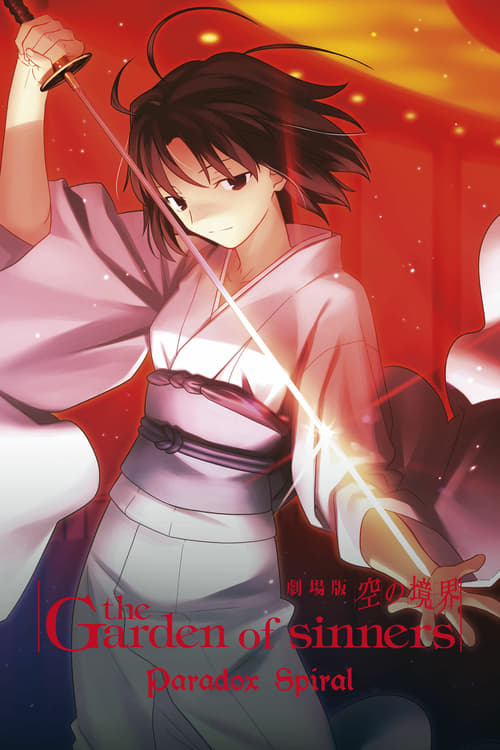
The Garden of Sinners: Paradox Spiral
2008 · Takayuki Hirao
When you want a film to chew on for days — a dark puzzle-box you lean into rather than relax with. Best when you're in the mood for something demanding, strange, and emotionally heavier than its genre trappings suggest.
What it's about
A young man named Tomoe Enjou, on the run and convinced he has committed a murder, is rescued from street toughs by Shiki Ryougi and hides out in her apartment. But the crime he confesses to leaves no trace — no news reports, no bodies, and the supposed victims turn up alive. The trail leads back to his family's apartment block, where the days themselves seem to be folding into a pattern, and Shiki and the puppet-maker Touko Aozaki are drawn into a confrontation with the mind arranging it.
The experience
Disorienting by design and then ferociously satisfying — it loops, fragments, and repeats until the pieces snap together, punctuated by some genuinely stunning bursts of action. It's melancholy and violent in equal measure, and it trusts you to keep up.
The craft
This is ufotable animation at full power: rain-slicked cityscapes, an apartment building rendered with eerie geometric precision, and fight scenes of remarkable fluidity, all under Yuki Kajiura's haunting score. The editing is the real star — the film's structure is itself the mystery, with scenes recontextualized as the timeline spirals. Rewards good speakers and your full attention.
Why it matters
Widely regarded as the keystone of the Garden of Sinners series and a landmark that helped establish ufotable's reputation for cinematic, effects-heavy anime — a touchstone for fans of ambitious adult animation.
Snapshot
Paradox Spiral — Japanese title Kara no Kyōkai: Mujun Rasen, literally "Contradiction Spiral" — is the fifth of seven theatrical chapters in ufotable's adaptation of Kinoko Nasu's novel Kara no Kyōkai (1998, first circulated in Type-Moon's doujin sphere before commercial publication). Released to Japanese cinemas in 2008, it is by consensus the series' keystone: the longest chapter (running roughly two hours, well beyond the fifty-to-sixty-minute lengths of its siblings) and the one where the saga's scattered threads — Shiki Ryōgi's dual personality, her "Mystic Eyes of Death Perception," the puppet-maker Tōko Aozaki, and the murders orbiting a single apartment block — converge into a coherent metaphysical design. The plot braids two protagonists: Tomoe Enjō, a boy who believes he has murdered his abusive parents yet finds the crime endlessly undone, and the magus Sōren Araya, whose reconstruction of the Ogawa apartment building into a sealed spiral is an engine for reaching the "Root," Nasu's Akasha-like origin of all things. It is at once a locked-room mystery, a time-loop horror, and a philosophical thriller about identity and free will.
Industry & production
The film is a product of ufotable, the Tokyo studio founded in 2000, working from Nasu Kinoko's source material under the Type-Moon banner, with Aniplex (a Sony Music subsidiary) and the media firm Notes among the backing partners. The Kara no Kyōkai project was ufotable's breakout prestige undertaking — seven films released across 2007–2009 as an ongoing theatrical event rather than a television series, an unusual distribution model that treated a niche literary property as an art-house serial. Paradox Spiral arrived in 2008 as the penultimate-but-climactic installment. The series' commercial architecture depended on limited theatrical runs feeding into a lucrative home-video and soundtrack market for the devoted Type-Moon fanbase; precise theatrical grosses for the individual chapters are not well documented in reliable public sources, and I will not invent them. What is clear is that the films' success — critical and commercial within their niche — established ufotable as a premium studio and set the template for its later, far larger Fate adaptations. Chapter direction rotated among ufotable staff across the series; Paradox Spiral was helmed by Takayuki Hirao, with overall creative supervision and character design tied to Type-Moon co-founder Takashi Takeuchi, whose original illustrations anchor the visual identity.
Technology
Paradox Spiral belongs to the first full generation of digitally composited Japanese animation, and ufotable's house method is central to how it looks. The studio built its reputation on an in-house digital compositing pipeline that fuses hand-drawn 2D character animation with 3D CGI environments and heavy layered digital effects — light bloom, particulate atmosphere, depth-of-field simulation, and post-processing "grades" applied to whole sequences. The Ogawa apartment, a structure whose geometry is itself the antagonist's spell, is exactly the kind of subject that rewards CGI-assisted architecture: repeating corridors, impossible spatial folds, and a hexagram/mandala logic are far easier to render consistently and to warp expressively with digital tools than by hand alone. The result is the "ufotable look" — glossier and more cinematic than contemporaneous TV animation, with a photographic sense of lighting. Beyond the general pipeline, granular technical specifications for this individual chapter are thin in the reliable record, and I won't fabricate specifics.
Technique
Cinematography
Working in a fully digital "virtual camera" idiom, Paradox Spiral favors an architecture-driven visual grammar. Because the story literally takes place inside a building designed as a metaphysical trap, the film leans on vertical compositions, stairwells, elevator shafts, and long recessive corridors that make the spiral motif legible as image. The camera stages Araya's domain as a space that cannot be trusted — repetitions and near-repetitions of framing cue the audience to the loop before the characters grasp it. Against these cold, deep-focus interiors, Shiki's action set-pieces are given the series' signature kinetic staging, with fluid tracking and dynamic angles that ufotable would later refine in Fate. Nasu's world is a nocturnal, rain-slicked contemporary Japan, and the palette runs to desaturated blues and shadow, punctuated by the red of Shiki's kimono and of violence.
Editing
The chapter's editing carries an unusually heavy structural burden, because Paradox Spiral withholds and reorders information as a matter of design: Tomoe's undone murder and the apartment's temporal recursion require the cut to conceal a paradox until the narrative is ready to disclose it. The film's greater length gives it room for slower, more deliberate scene construction than the shorter chapters, alternating expository dialogue passages with compressed bursts of action. Specific editorial credits for the individual chapter are not something I can confirm from memory, so I won't attribute them.
Mise-en-scène / staging
Staging is the film's most expressive register. The apartment building is production design as thesis: a mandala rendered in reinforced concrete, its residents unwitting components of a ritual. Araya is typically framed in stillness and enclosure, a figure who has made himself part of the architecture; Shiki is framed as the disruptive intruder whose "eyes of death" can cut through the design's premise. The visual contrast between designed, sealed interior space and Shiki's principle of severance organizes nearly every scene.
Sound
Yuki Kajiura's score (see Authorship) is inseparable from the staging — her sound design of choral swells, strings, and ambient dread does much of the work of signaling the uncanny before the images confirm it. The film's sound world is otherwise built on the hush of the sealed building, footsteps in corridors, and the punctuating sharpness of violence, so that Kajiura's music enters as the emotional and metaphysical commentary.
Performance
As animated performance, the film rests on its voice cast, with Maaya Sakamoto voicing Shiki Ryōgi across the series — a performance that must hold together Shiki's fractured selfhood, alternating restraint and lethal decisiveness. The chapter's dramatic weight also falls on its guest leads, Tomoe Enjō and Sōren Araya, whose vocal performances carry the philosophical debate at the film's center. The animation performance — ufotable's detailed acting in gesture and stillness — matches the vocal work, particularly in Araya's monologues, where near-motionless framing throws emphasis onto voice and micro-expression.
Narrative & dramatic mode
Paradox Spiral operates in a hybrid mode that is the series' signature: detective mystery fused with metaphysical horror and philosophical dialogue. Structurally it is a puzzle film. The opening premise — a confessed murder that leaves no corpse, no news report, no consequence — is a mystery hook, but the solution is not a whodunit so much as a "what-is-this-place." Nasu's storytelling, faithfully transposed, delays comprehension deliberately: the audience is made to experience the paradox before it is explained, so that revelation arrives as conceptual vertigo rather than tidy deduction. The dramatic mode is dialectical — long stretches are effectively debates about determinism, identity, and whether a self that is designed can be said to choose — bracketed by sudden, decisive violence. This oscillation between talk and action, contemplation and rupture, is the chapter's rhythm.
Genre & cycle
The film sits at the intersection of several genres — supernatural mystery, dark fantasy, action, and psychological horror — and belongs to a specific cycle within Japanese animation: the ambitious, literary-minded "seinen" adaptation aimed at adult audiences rather than children or teens. Within the Type-Moon franchise it is foundational: Kara no Kyōkai predates and philosophically underwrites the Fate universe, sharing concepts like the Root, magi, and the Aozaki lineage of sorcerers. As a cycle marker, ufotable's Kara no Kyōkai helped consolidate the late-2000s vogue for theatrically released, high-gloss animated films drawn from cult prose properties, treating animation as a vehicle for serious genre literature.
Authorship & method
Authorship here is layered. The originating author is Kinoko Nasu, whose 1998 novel supplies the plot, philosophy, and the distinctive conceit of the Mystic Eyes of Death Perception; his prose's dense metaphysical argumentation is the film's DNA. Takashi Takeuchi, Type-Moon's co-founder and illustrator, provides the original character designs that ufotable animates, lending visual continuity across the seven chapters. The chapter director is Takayuki Hirao, who would go on to direct works including the Junji Ito adaptation Gyo and later feature and franchise projects; Paradox Spiral, the series' most structurally demanding chapter, is a significant early credit for him. The composer is Yuki Kajiura, whose scores across all seven films — and the associated songs performed by Kalafina, the vocal group she assembled in connection with the project — are among the most celebrated elements of the whole enterprise; her music is arguably co-authorial in shaping the films' tone. The lead voice is Maaya Sakamoto as Shiki. I want to be candid where the record thins: the precise screenwriting and editing credits for this specific chapter, and the exact Kalafina theme song attached to it, are details I cannot verify from memory, and I decline to invent attributions or titles.
Movement / national cinema
As Japanese animation, Paradox Spiral participates in the medium's long tradition of using drawn film for adult, philosophically serious genre storytelling — a lineage that runs through the OVA boom and the theatrical-anime prestige tradition. It is not tied to a self-conscious "movement" in the way live-action new waves are, but it is representative of a distinct current in 2000s anime: studio-driven auteurism, where a production house's craft identity (ufotable's compositing and lighting) becomes the primary authorial signature alongside the original author. Within the national industry it exemplifies the media-mix ecosystem, in which a doujin-origin literary property matures into a theatrical franchise, soundtrack line, and merchandising universe.
Era / period
The film is firmly of its moment — the late 2000s, when digital compositing had matured enough to give theatrical anime a consistently "cinematic" polish, and when the media-mix model made a seven-part theatrical serial commercially viable. Its 2008 release places it at the hinge between the OVA/television-dominated earlier decade and the 2010s ascendancy of studios like ufotable as producers of premium franchise cinema. Diegetically, the story's contemporary-Japan setting — an anonymous cityscape of apartment blocks and rainfall — is deliberately unmarked and slightly out-of-time, in keeping with Nasu's atmosphere of urban unease.
Themes
The chapter's governing theme is the paradox of a designed self: whether identity, choice, and even life can be authored by an external will, and what it means to sever such a design. Araya's project literalizes determinism — a building, a person, a fate all engineered toward the Root — and Shiki's power, the ability to perceive and cut the "lines of death" inherent in all things, is its dialectical opposite: the principle that everything, however constructed, contains the point at which it can end. The "spiral" and "contradiction" of the title name a structure that folds back on itself, a loop of undone violence and repeated existence. Surrounding this are the series' persistent concerns: the boundary between life and death, the duality and instability of the self (Shiki's fractured personhood), and the ethics of killing framed as a metaphysical rather than merely moral act. Tomoe's arc — a boy trapped in a crime that will not stay committed — personalizes the abstract argument, asking whether a life that is not one's own is a life at all.
Reception, canon & influence
Within its constituency, Paradox Spiral is widely regarded as the high point of the Kara no Kyōkai series — the chapter where the narrative ambition, the animation craft, and Kajiura's score cohere most fully — and the series as a whole is treated as a landmark of 2000s theatrical anime and a cornerstone of the Type-Moon canon. I should be honest that detailed English-language critical documentation of the individual chapter is comparatively thin, and I won't manufacture specific reviews, ratings, or figures.
The influences on the film run backward along two lines. Textually, it descends from Kinoko Nasu's own dense synthesis of detective fiction, urban horror, and occult-philosophical worldbuilding — a sensibility shaped by Japanese mystery and light-novel traditions and by a magical-metaphysics framework Nasu would extend into the wider Type-Moon universe. Visually and structurally, it inherits the OVA-era tradition of adult animated genre film and the puzzle-box narrative logic of time-loop and locked-room storytelling.
Its legacy forward is substantial for its maker. Kara no Kyōkai proved ufotable's capacity for prestige theatrical animation and directly informed the studio's later, industry-defining Fate/Zero and Fate/stay night: Unlimited Blade Works productions, which carry over the compositing, lighting, and action-staging craft honed here — and which draw on the same Type-Moon metaphysics that Paradox Spiral dramatizes so centrally. The project also launched Kalafina, a musical act whose subsequent career grew out of Kajiura's work on these films. In sum, Paradox Spiral stands as both the artistic climax of an influential cult serial and an early proof-of-concept for a studio that would go on to shape the look of mainstream franchise anime in the 2010s.
Reception
Within the seven-film Kara no Kyoukai project it was embraced on release as the obvious peak, and time has only hardened that verdict — it's now routinely the entry cited when people argue the whole series belongs in the 2000s anime canon.
How The Garden of Sinners: Paradox Spiral was received, from release to now →
Influences: the films it descends from and the films it influenced
- Ghost in the Shell (1995) — Established the multi-plane photographic digital compositing and city-as-labyrinth framing — rain, glass reflections, and vertical architecture layered into a desaturated whole — that ufotable's compositors extend in Paradox Spiral's Ogawa apartment.
- Blade Runner (1982) — Codified the desaturated neo-noir template where production design carries the narrative and architecture is lit as a character, a look the chapter borrows for its oppressive, deep-shadowed building.
- Perfect Blue (1997) — Pioneered the match-cut nonlinear withholding editing — scrambling chronology and forcing the viewer to reassemble the timeline — which is the exact structural signature of Paradox Spiral.
- Vertigo (1958) — Made the spiral a structural and visual device — the staircase, the coil of obsession and falling — that the chapter literalizes in its spiraling apartment and looped ascent-and-death.
- The Shining (1980) — Modeled the deep-focus, symmetrically framed impossible building as antagonist, where corridor geometry itself generates dread — the method behind the apartment's architecture-driven framing.
- Akira (1988) — Set the OVA/theatrical benchmark for adult animation's hand-detailed urban architecture and layered background density that Paradox Spiral inherits as a baseline of prestige.
- Paprika (2006) — Advanced multilayer digital compositing to render unstable, morphing dream-architecture, the compositing ambition the chapter applies to its metaphysically warping tower.
- Noir (2001) — Where Yuki Kajiura's signature method crystallized — invented-language Latinate choral chant fused with strings and electronica — the scoring approach she carries into the Kara no Kyōkai films.
- Fate/Zero (2011) — Directly inherits the compositing, low-key lighting, and dialogue-heavy staging honed on Kara no Kyōkai, applying the same ufotable toolkit to Type-Moon metaphysics.
- Fate/stay night: Unlimited Blade Works (2014) — Carries forward the studio's digital-compositing action staging and desaturated architectural interiors first proven in the chapter's craft.
- Demon Slayer: Mugen Train (2020) — Extends ufotable's compositing-and-effects integration to a dream-loop narrative, descending from the digital craft and looped-structure sensibility established here.
- Uzumaki (2000) — Turns the spiral into a pervasive architectural and formal horror device warping physical space — the same Junji Ito lineage Hirao would directly adapt in Gyo, sibling to the chapter's spiral-building conceit.
- Donnie Darko (2001) — Builds a time-loop, free-will-versus-determinism puzzle that withholds its rules until a late reframe, the same fate-mechanics structure the chapter dramatizes.
- Primer (2004) — Exemplifies the pure puzzle-film that withholds chronology and demands post-hoc reconstruction, the narrative discipline Paradox Spiral shares in its scrambled timeline.
- Inception (2010) — Treats architecture as a folding, rule-bound mental labyrinth to be navigated as a spatial puzzle — the same architecture-as-narrative-machine logic driving the chapter's tower.
- Puella Magi Madoka Magica (2011) — Pairs a Kajiura score with a time-loop determinism puzzle structure, sharing both the composer's method and the recursive fate-mechanics narrative craft.
Similar films
- Akira (1988) — influence & lineage
- Paprika (2006) — influence & lineage
- Confessions (2010) — shared sensibility
- Ninja Scroll (1993) — shared sensibility
- Demon Slayer: Kimetsu no Yaiba Infinity Castle (2025) — shared sensibility
- Outrage (2010) — shared sensibility
- Neo Tokyo (1989) — shared sensibility
- Ghost in the Shell 2: Innocence (2004) — shared sensibility
All the films related to The Garden of Sinners: Paradox Spiral →