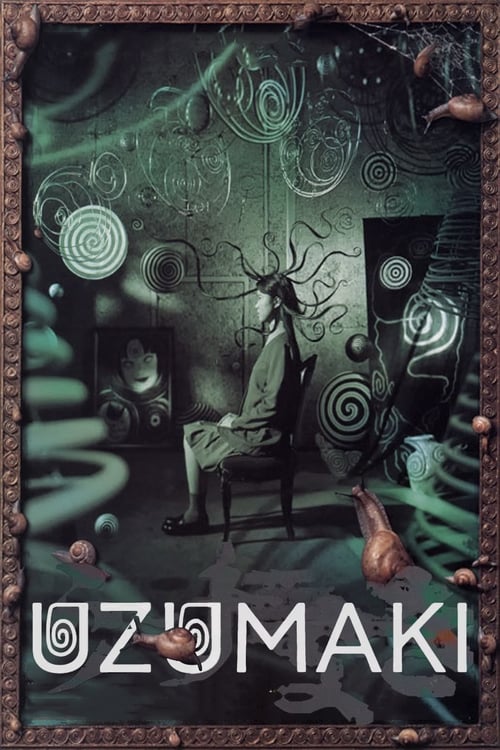
Uzumaki
2000 · Higuchinsky
When you're craving something genuinely strange — midnight-movie horror that trades jump scares for creeping, giggly wrongness. A cult oddity, not a comfort watch.
What it's about
In a fog-bound coastal town, people start becoming obsessed with spirals — in pottery, in whirlpools, in their own bodies. A high-school girl and her withdrawn friend watch the fixation spread from his father outward through family, classmates, and the town itself, as the pattern stops being a shape and starts being a fate.
The experience
Deadpan, green-tinted, and gleefully weird — less a ghost story than a slow-motion hallucination with a straight face. It's unsettling and absurd at the same time; you laugh, then feel a bit queasy about laughing.
The craft
Director Higuchinsky came from music videos and it shows: sickly colour grading, canted frames, and spiral motifs tucked into nearly every composition, so the whole image feels infected. The body-horror effects are handmade and proudly bizarre, honoring the warped linework of Junji Ito's manga panels. It looks like nothing else from its moment.
Why it matters
As the first screen adaptation of Junji Ito's famous manga, it became a cult touchstone for fans of his work and a reference point for how his impossible imagery might survive the leap to live action.
Snapshot
Uzumaki ("spiral" or "whirlpool") is the first screen adaptation of Junji Ito's horror manga of the same name. The manga ran in Shogakukan's Big Comic Spirits from 1998 to 1999. The film is set in Kurouzu-cho, a fog-bound coastal town where a spiral pattern spreads into the residents' minds and bodies. Kirie Goshima (Eriko Hatsune), a high-school girl, and her withdrawn friend Shuichi Saito (Fhi Fan) watch as Shuichi's father becomes obsessed with spirals. His mother then develops a terror of them, and the epidemic moves outward through classmates, neighbours and the town itself.
The director was Higuchinsky, a self-styled, Russian-sounding version of the name Akihiro Higuchi, who came to features from music videos. He treated the material less as a conventional ghost story than as deadpan, colour-graded visual delirium. The film appeared at the peak of the Japanese horror boom that followed Ringu (1998), but it stands apart from that cycle's long-haired-ghost formula. Its horror is geometric, absurd and bodily, not spectral. It has had a long second life as a cult object and as the reference point for later Ito adaptations.
Industry & production
The film belongs to the late-1990s rush to adapt horror manga and novels after the commercial success of Hideo Nakata's Ringu and the arrival of a young, genre-literate audience on video and in theatres. Ito's work had already been adapted in Tomie (1999, dir. Ataru Oikawa), which launched a long-running series of low-budget sequels. Uzumaki followed quickly.
The most important production fact is timing. The film went into production and was released while Ito's serial was still finishing or had only just finished, so the screenplay could not follow the manga's escalating final movement: the storm-wracked isolation of the town, the row-house labyrinth and the descent into the spiral beneath Kurouzu-cho. The script, credited to Kengo Kaji, condenses selected episodes from the early and middle chapters and supplies its own abrupt, ambiguous ending. Critics have pointed to this ending as the film's main structural weakness ever since.
The budget was modest, in keeping with the J-horror production model of the time, and the film's ambitions are carried more by art direction, colour treatment and inexpensive digital effects than by large-scale practical work. Detailed English-language sources on the financing, producing companies and box-office performance are thin, and this dossier does not speculate about them. The film did receive international home-video distribution in the early 2000s, sometimes under the title Spiral, and that is how most non-Japanese viewers came to know it.
Technology
Uzumaki is an early, conspicuous example of digital colour manipulation in low-budget Japanese genre cinema. Its best-known visual trait is a pervasive green and sickly sepia cast across much of the film. The palette makes the town look aged, damp and slightly unwell, and the grading is clearly deliberate and stylised, not naturalistic.
Spirals are inserted into the image with simple digital compositing and CG: in clouds, smoke, water, hair and the background of shots, sometimes so subtly that they register only on a second look. Key transformations, notably Kyoko Sekino's hair coiling into living spirals and a student turning into a snail-like creature, combine practical make-up and prosthetics with digital augmentation. By later standards these effects are visibly rough. Many viewers and critics have argued that the roughness suits the film's uncanny, slightly off-register world, while others find that it undercuts the horror. Both readings recur in the reception.
Technique
Cinematography
The camera work favours canted angles, wide lenses, and compositions that put characters off-centre against architecture, foliage or sky. Circular and spiral forms are planted in the frame: staircases, ripples, whorls in plants, the coiled shapes of household objects. As a result the audience is gradually drawn into the same hunting-for-spirals habit that destroys the characters. Fog, haze and the green grade flatten depth and give exteriors a theatrical, slightly artificial quality. The camera occasionally makes rotating or circling movements that echo the motif, but the film relies more on static, graphic compositions than on bravura camera choreography. English-language sources do not consistently document the cinematographer's identity and working methods.
Editing
The film is built episodically, mirroring the chapter structure of Ito's serial: a string of case studies (the father, the mother, Kyoko, the snail boy, the lighthouse and kiln motifs) loosely tied together by Kirie's point of view. The cutting is often brisk and elliptical, and the film introduces several characters' fates in passing and leaves them unresolved, which adds to a sense of the town coming apart. The final movement accelerates into a montage of victims and spiral images rather than resolving the plot. Some read this as dream-logic, others as a sign of a script with no source ending to adapt.
Mise-en-scène / staging
The production design turns Kurouzu-cho into an old-fashioned provincial town: wooden houses, narrow lanes, a school, a hospital and a potter's kiln (Kirie's father is a ceramicist, and his kiln becomes a site of horror). The staging often plays outlandish events with a straight face. Shuichi's father, Toshio Saito (Ren Osugi), stares at a snail shell, collects spiral objects, eats spiral-patterned fishcake and finally meets his end in a washing machine's rotating drum. The flat, quotidian staging set against grotesque content recalls Ito's own drawing style, in which ordinary panels and calm faces surround impossible images.
Kyoko's hair, swelling into enormous, animate coils that drain its wearer, is the film's most widely reproduced image. It shows the production's preference for transforming ordinary features of the human body (hair, ears, posture, skin) over introducing an external monster.
Sound
The score is credited to Keiichi Suzuki, best known as a founder of the rock group Moonriders and later as a composer for Takeshi Kitano. It mixes eerie, melodic cues with lighter, almost whimsical passages, which supports the film's blend of dread and black comedy. The sound design uses wind, creaking, and the spiralling noise of machinery and water to carry the motif into the soundtrack, but the film is better remembered for its images than for its sound.
Performance
Eriko Hatsune plays Kirie as a mostly reactive observer, fitting the manga's conception of her as the reader's surrogate. Fhi Fan's Shuichi is the brooding prophet of the curse, the first to see that the town itself is the source. Ren Osugi, a veteran character actor associated with Kitano and Kiyoshi Kurosawa, gives the most memorable turn as the father, sliding from mild eccentricity into rapt monomania with a beatific calm that is funny and disturbing at once. Hinako Saeki plays Shuichi's mother as her fear of spirals grows into self-mutilation, and Shin Eun-kyung plays the vain classmate Kyoko. The acting overall is mannered and slightly stylised, more in keeping with manga-derived caricature than with the restrained naturalism of Nakata's or Kurosawa's horror.
Narrative & dramatic mode
The film works by accumulation, not plot development. Instead of a mystery being solved, the spiral's influence spreads by contagion from household to school to town. Its logic is never explained: no backstory, no ritual remedy, no villain. This deliberate withholding is the most important thing the film keeps from Ito.
The dramatic mode moves between horror and deadpan absurdist comedy, sometimes within a single scene. A man's devotion to fishcake or a boy's snail-like crawl to school is presented with the same seriousness as death and mutilation. The film adds a police-procedural thread and some connective scenes the manga lacks, and its ending stops at a point of total contamination with no catastrophe or revelation. This leaves the drama feeling unfinished: a portrait of obsession more than a story with a resolution.
Genre & cycle
Uzumaki belongs to the J-horror cycle of roughly 1998–2005, and specifically to its strand of manga adaptations alongside the Tomie films and other Ito adaptations of the period, including Higuchinsky's own television film Long Dream (Nagai Yume, 2000). It also fits within "cosmic" or Lovecraftian horror, in which the threat is a vast, impersonal pattern beyond human understanding, and within body horror, given its focus on physical transformation.
Within J-horror it is an outlier. Most of the cycle built its fear on spectral women, cursed technology, slow reveals and urban alienation. Uzumaki replaces the ghost with a shape, the city with a village, and suspense with surreal spectacle. That deviation is a large part of its continued interest and of its uneven commercial and critical standing at the time.
Authorship & method
Higuchinsky (Akihiro Higuchi) came from music video direction, and the film shows that background: emphasis on strong single images, colour as a mood device, graphic composition and visual motif over performance-led storytelling. Uzumaki was his feature debut, and his feature career after it was limited and has received little critical attention outside Japan. His main contribution was a coherent, heavily stylised visual concept: the spiral as a design principle running through every level of the image.
Junji Ito, the source author, is the film's dominant authorial presence. His manga took the spiral as a single obsessive premise and varied it chapter by chapter, drawing on influences he has acknowledged, including the horror manga of Kazuo Umezu and the fiction of H. P. Lovecraft. The film's best sequences are those that most directly translate his panels.
Kengo Kaji, the screenwriter, had to compress an unfinished serial into a feature, which explains the film's anthology-like shape and its invented ending.
Keiichi Suzuki (music) brought a pop-and-art-rock sensibility that leans away from the drones of contemporary J-horror toward something stranger and more playful. English-language sources do not reliably document the cinematographer and editor or their specific methods, so they are not characterised in detail here.
Movement / national cinema
The film is a product of late-1990s Japanese genre cinema, when cheap horror features made in the V-cinema and low-budget theatrical sectors became one of Japan's most visible cultural exports. Like many films in this field, it draws directly on manga, which supplied the industry with a ready stock of pre-tested stories and imagery. Its visual excess also links it to an image-driven tendency in Japanese commercial filmmaking of the period, often led by directors from music videos, commercials and television, and distinct from the austere art-horror of Kiyoshi Kurosawa.
The town setting draws on a long Japanese tradition of the closed provincial community as a site of the uncanny. It is set in a land of coastlines, kilns and old customs, but the film gives that folkloric setting a modern, almost abstract horror rather than a traditional yūrei story.
Era / period
Uzumaki appeared at the turn of the millennium. Japan was in its "lost decade" after the asset bubble, and its genre cinema was absorbing anxieties about social isolation, contagion and the breakdown of community. The film does not engage these openly, and over-reading it as allegory would be unwise. Even so, its picture of a town where an irrational, infectious idea spreads from person to person sits comfortably alongside the era's other fictions of viral dread, from Ringu's cursed videotape to Kurosawa's Pulse (Kairo, 2001).
Technologically, the film comes from the moment when affordable digital grading and compositing first became available to low-budget productions, which allowed its striking colour scheme and spiral insertions.
Themes
- Obsession as contagion. The spiral spreads not through a monster but through attention: looking at, desiring or fearing the shape is itself the infection. The father's love of spirals and the mother's terror of them are presented as two forms of the same disease.
- The body as pattern. Hair, ears, posture and skin all bend to the spiral. Humanity is reduced to material that can be reshaped by an abstract form.
- The indifferent cosmos. As in Ito's Lovecraftian source, the curse has no motive, no moral and no explanation. Horror comes from realising that the universe may be governed by patterns indifferent to human meaning.
- Community and isolation. Kurouzu-cho is both claustrophobically close and fatally isolated. Its residents can neither help one another nor escape, and the town's identity eventually merges with the curse.
- The absurd. The film treats the ridiculous and the terrible as continuous, a Kafkaesque logic in which absurdity heightens the dread.
Reception, canon & influence
Critical reception. On release, and later in international home-video circulation, Uzumaki drew mixed but often affectionate responses. Critics commonly praised its imaginative visuals, colour design, black humour and how well it renders Ito's imagery. The same critics commonly faulted its episodic structure, uneven pacing, rough effects and, above all, its unsatisfying ending. Many reviewers noted that viewers coming from Ringu or Ju-on would find it a very different kind of horror. Over time it has become a cult film, valued as an oddity of the J-horror boom. Its reputation now rests more on the strength of its images than on its effectiveness as a narrative.
Backward influences. The main influence is Ito's manga itself, and through it Ito's own touchstones: Kazuo Umezu's horror manga and Lovecraft's cosmic horror. Critics have often compared the film's eccentric small town, its mix of the banal and the uncanny, and its deadpan tone to David Lynch, especially Twin Peaks. The canted angles and artificial, expressive treatment of space have also been compared to German Expressionism. These are readings by critics, not documented statements of intent by the director.
Forward legacy. For two decades Uzumaki was the definitive screen version of one of horror manga's most celebrated works. It helped establish Ito as a source for filmmakers, alongside the Tomie series, and it shaped the expectation that Ito adaptations should be strongly visual and surreal. Its images, especially Kyoko's spiral hair, circulated widely in genre fandom and were one of the routes by which Ito's work reached Western audiences before his manga became widely available in translation. Later adaptations, including the anthology series Junji Ito Maniac: Japanese Tales of the Macabre (2023) and the animated Uzumaki miniseries produced for Adult Swim (2024), returned to the source with the full manga available and were inevitably measured against the 2000 film's choices. Within J-horror history, the film remains the main example of the boom's surreal, non-spectral alternative, proof that the cycle could produce cosmic and absurdist horror as well as ghost stories.
Influences: the films it descends from and the films it influenced
- The Cabinet of Dr. Caligari (1920) — Its painted, slanted sets and off-kilter frames make the space itself look deranged, the model for Uzumaki's canted angles and spiral-warped production design that put Kurouzu-cho's madness into its architecture.
- Kwaidan (1964) — A Japanese horror film built from separate tales and filmed on openly artificial, colour-saturated studio sets, the precedent for Uzumaki's chapter-by-chapter structure and its non-naturalistic colour.
- Matango (1963) — Tōhō's fungal-transformation film shows people slowly turning into soft, glistening non-human matter through practical make-up, a direct forerunner of Uzumaki's snail-people metamorphosis.
- Suspiria (1977) — It uses non-naturalistic primary colour as the main carrier of dread rather than lighting for realism, the approach Uzumaki brings into digital grading with its green-washed, sickly palette.
- Hausu (1977) — A TV-commercial director's feature debut that treats horror as optical play, with mattes, superimpositions and deadpan absurdity, exactly the route Higuchinsky took from music video into horror.
- Blue Velvet (1986) — It sets a deadpan, over-ordinary small town against a grotesque undertow and keeps the performances eerily flat, the tonal register critics see in Uzumaki's Kurouzu-cho.
- Tetsuo: The Iron Man (1989) — It set the template for Japanese body horror in which an obsession becomes a literal remaking of the flesh, which Uzumaki's spiralling bodies carry from industrial metal to organic coils.
- In the Mouth of Madness (1994) — Its Lovecraftian small town, where reality gradually reshapes itself around one cosmic pattern until the townspeople mutate, is the screen model for Uzumaki's town-as-infected-system.
- Cure (1997) — Compulsion spreads from person to person through a repeated visual sign (the carved X, circling water and flame), the J-horror model for obsession passed on by a recurring motif.
- Gozu (2003) — It stretches Uzumaki's deadpan provincial absurdism, a straight-faced protagonist moving through a town of inexplicably warped locals, into full-length surreal horror-comedy.
- Marebito (2004) — It carries J-horror's non-spectral, explicitly Lovecraftian strand, which Uzumaki opened, into a story of obsessive looking that leads to a cosmic underworld.
- Funky Forest: The First Contact (2005) — Commercial and music-video directors build a feature from deadpan, disconnected episodes and digitally composited body-surrealism, extending the method of Uzumaki's MV-trained director.
- Color Out of Space (2019) — Lovecraftian contagion is carried by saturated, otherworldly colour grading as it warps a family's bodies and minds, the same strategy Uzumaki uses for its town.
- Uzumaki (miniseries) (2024) — The Adult Swim/Production I.G adaptation reproduces Ito's linework panel for panel and keeps the manga's full apocalyptic arc, an answer to the 2000 film's compression and invented ending.
- Ringu (1998) — The film that defined the boom's curse-by-contagion structure; Uzumaki keeps the viral spread but swaps the vengeful ghost for an impersonal geometric pattern.
- π (Pi) (1998) — A monomaniac fixated on the golden spiral, shot in a fast, music-video-style montage, is the Western twin of Uzumaki's spiral fixation and graphic, rhythmic cutting.
- Tomie (1999) — The first Junji Ito screen adaptation, it faced the same problem of turning Ito's self-contained manga episodes into one feature and shaped the early Ito-on-film template.
- Long Dream (Nagai Yume) (2000) — Higuchinsky's companion Ito adaptation for TV uses the same digital colour treatment and graphic, motif-led framing to show a man's dreams stretching out as his body changes.
- Pulse (Kairo) (2001) — Its contagion builds up until the town empties into apocalypse, the same 'contagion by accumulation' structure that ends Uzumaki in a depopulated, consumed town.
- The Garden of Sinners: Paradox Spiral (2008) — Turns the spiral into a pervasive architectural and formal horror device warping physical space — the same Junji Ito lineage Hirao would directly adapt in Gyo, sibling to the chapter's spiral-building conceit.
Similar films
- Cure (1997) — influence & lineage · same viewing thread
- Gozu (2003) — influence & lineage
- House (1977) — same viewing thread
- Exit 8 (2025) — same viewing thread
- Retribution (2007) — same viewing thread
- Ju-on: The Grudge (2002) — shared sensibility
- The Garden of Sinners: Paradox Spiral (2008) — shared sensibility
- Jigoku (1960) — shared sensibility
All the films related to Uzumaki →
Watch it with: curated runs of related films
- Doubles, Dreams, and Dissolving Selves — Watch these when you want the floor to give way — dream machines, hypnotists, doppelgängers, and haunted houses where perception and identity quietly come undone.