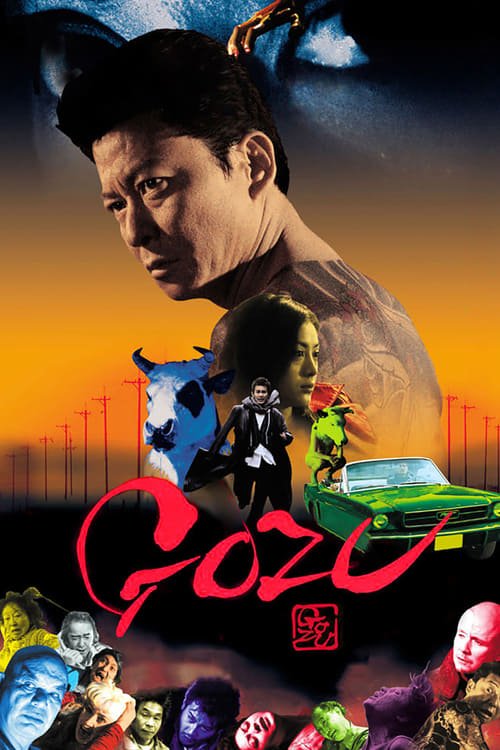
Gozu
2003 · Takashi Miike
For the adventurous night when you want a film that will genuinely weird you out — a midnight movie to spring on friends with strong stomachs and a taste for the surreal. Firmly on the challenge end of the dial; not the pick for casual comfort.
What it's about
A low-ranking yakuza is ordered to get rid of his beloved mentor, whose paranoia has made him a liability to the clan. The job goes wrong on the road, the body vanishes, and the search leads him into the outskirts of Nagoya — a limbo of unnerving innkeepers, wrong-feeling hotels, and apparitions that seem escaped from a nightmare, where the rules of the ordinary world quietly stop applying.
The experience
Deadpan and deeply strange — it plays its most outrageous images with a completely straight face, so you're never sure whether to laugh, recoil, or both. The pace is slow and trance-like, and the unease accumulates until the film goes places you genuinely cannot predict.
The craft
Takashi Miike stages the surreal with a matter-of-fact, low-key style — flat, patient shots that make each intrusion of the impossible land harder than any effects showcase could. The film runs on dream logic, its gangster-movie framework slowly dissolving into body horror and absurdist comedy, and its imagery is designed to lodge in your head for days.
Why it matters
A cult landmark of 2000s Japanese extreme cinema that cemented Miike's international reputation as one of film's true wild cards, endlessly passed between viewers as a you-have-to-see-this dare.
Snapshot
Gozu — full Japanese title Gokudō kyōfu dai-gekijō: Gozu ("Yakuza Horror Theater: Cow's Head") — is Takashi Miike's deadpan fever-dream, a yakuza picture that dissolves into surreal horror-comedy and finally into a hallucinatory parable of desire and rebirth. The premise is brutally simple: a low-ranking gangster, Minami (Hideki Sone), is ordered to dispose of his beloved older "brother" Ozaki (Shō Aikawa), whose mounting paranoia has made him a liability to the clan. Minami accidentally kills Ozaki on the way, then loses the corpse, and his search drags him into Nagoya's outskirts — a limbo of cow-headed apparitions, a lactating innkeeper, transvestite restaurateurs, and a yakuza boss with a fetish that defies summary. The film's notorious final act, in which Ozaki returns from the dead through the body of a woman, has made Gozu a touchstone of midnight-movie strangeness. Premiering in the Directors' Fortnight at the 2003 Cannes Film Festival, it arrived at the crest of Miike's international cult ascendancy and remains, alongside Audition and Ichi the Killer, one of the films most responsible for his Western reputation as cinema's great provocateur of the uncanny.
Industry & production
Gozu was produced within the low-budget, fast-turnaround Japanese ecosystem of the early 2000s that made Miike's astonishing productivity possible. By 2003 Miike was directing several features a year, moving fluidly between theatrical films, V-Cinema (the straight-to-video format in which he had built his craft through the 1990s), and television. Gozu originated in this V-Cinema-adjacent space — its very subtitle, "Yakuza Horror Theater," frames it as a genre-bracket entertainment — before its festival selection repositioned it as art-house export. The screenplay was written by Sakichi Satō, who had scripted Ichi the Killer (2001) for Miike and who shared the director's taste for tonal whiplash and grotesque comedy. Production values are deliberately modest: much of the film unfolds in nondescript interiors, roadside diners, and a single eerie inn, with effects achieved practically and cheaply. This economy is inseparable from the film's aesthetic — its flatness and banality of setting are precisely what make the eruptions of the bizarre so destabilizing. International distribution came through specialty and cult-oriented labels rather than major studios; in the English-speaking world Gozu circulated through art-house theatrical runs and home-video editions aimed at the festival and genre audience that Miike's name had by then assembled. Precise budget and box-office figures are not reliably part of the public record, and I will not invent them; the film's significance was always cultural and critical rather than commercial.
Technology
Gozu was shot on 35mm film, the standard for Japanese theatrical features of its moment, and its image carries the grain and naturalistic color of unglamorous location work rather than the polished digital sheen that would soon become common. The film makes no ostentatious use of technology; its effects belong to an older, tactile tradition. The cow-headed apparition (the gozu of the title, drawn from the Buddhist hell-guardian Gozu and his counterpart Mezu) is realized through a practical costume and mask rather than digital imagery, and its physical, slightly clumsy presence is far more unsettling than seamless CGI would have been. The climactic birth sequence — among the most discussed practical effects in 2000s horror — was achieved with prosthetics and puppetry, staged for queasy physical credibility. Miike's broader method depended on the speed and flexibility that lightweight production afforded: small crews, available locations, and rapid shooting schedules. The "technology" of Gozu is therefore best understood as the technology of restraint and practical craft — analog tools deployed to keep the surreal grounded in the textures of the real.
Technique
Cinematography
The photography, credited to Kazunari Tanaka, is notable for its refusal to signal the uncanny. Where conventional horror reaches for expressionist shadow, Gozu favors flat, even, often daylight-bright compositions and a static or slowly observing camera. Scenes of grotesque content are framed with the same unhurried, frontal composure as scenes of bureaucratic tedium, so that the horror seeps in through content rather than style. This deadpan visual register — clean, slightly drab, almost documentary in its attention to mundane interiors — is the film's central formal strategy. The camera lingers, holds, and watches with an affectless patience that amplifies discomfort; the viewer is denied the reassurance of genre cues. When the bizarre arrives, it does so within the same calm frame as the ordinary, collapsing the boundary between them.
Editing
The cutting sustains long, uncomfortable durations rather than accelerating toward shock. Scenes are allowed to run past the point of conventional comfort — conversations extend, pauses stretch, reactions are held — generating a mounting unease that is more dread than fright. This patient rhythm is essential to the film's comedy as well: the deadpan timing of its absurdities depends on stillness and delay. Across its roughly two-hour length the editing structures a gradual slide from recognizable yakuza-thriller logic into dream logic, with no single rupture marking the transition; the film modulates so steadily that the viewer realizes only belatedly how far from realism it has drifted.
Mise-en-scène / staging
Miike's staging is the film's richest expressive instrument. The world of Gozu is built from aggressively ordinary spaces — a café, a roadside diner, an auto-junkyard, a provincial inn — into which singular grotesqueries are inserted: an innkeeper who dispenses her own breast milk, a ladle-wielding clerk, the cow-headed visitor who licks the sleeping Minami. The contrast between banal setting and aberrant detail is the engine of the film's effect. Props and bodies carry symbolic charge — milk, ladles, the bovine head, the recurrent imagery of fluids and birth — building a dense network of motifs around lactation, gestation, and bodily emission. The provincial Nagoya setting (the film's geography is pointedly unglamorous, far from neon Tokyo) reinforces a sense of liminal nowhere, a purgatorial backwater where the rules of the ordinary world no longer hold.
Sound
The sound design works, like the image, by understatement and ambient unease rather than by stingers. Naturalistic location sound — the hum of rooms, the small noises of mundane activity — dominates, so that the world feels flatly real even as its content turns impossible. Music is used sparingly. Detailed authoritative documentation of the score is thin in the English-language record, and I will not attribute specific compositional choices I cannot verify; what is clear is that Gozu withholds the musical signposting that would tell an audience how to feel, leaving its silences and ambient textures to do the unsettling work.
Performance
The acting is calibrated to the deadpan key. Hideki Sone plays Minami as a bewildered, increasingly anxious everyman, his blankness and mounting panic the audience's anchor through the irrational. Shō Aikawa — a frequent Miike collaborator — gives Ozaki a volatile, paranoid intensity in the early scenes before the character returns, transformed, in the film's surreal final movement. The supporting players inhabit their grotesques with a straight-faced commitment that makes the absurd feel matter-of-fact; no one in Gozu signals that anything is strange, and this collective composure is what renders the strangeness so effective. The film's emotional through-line — the homoerotic devotion of Minami to his "brother," made literal and bodily by the ending — depends on Sone carrying an undertow of longing beneath the comic bafflement.
Narrative & dramatic mode
Gozu begins as a yakuza thriller with a clear engine — dispose of the body, find the body — and methodically dismantles that scaffolding until it becomes a free-associative dream. Its dramatic mode is the picaresque quest mutated into Kafkaesque ordeal: Minami passes through a series of encounters, each more inexplicable than the last, in pursuit of a vanished corpse and, beneath that, of his lost brother. The narrative operates by oneiric logic in its second half, where cause and effect loosen and symbolism takes over from plot. Tonally it is a tightrope walk between horror and comedy, sustaining both at once so that the viewer is never permitted to settle into either. The structure is essentially a descent — into a liminal underworld, an afterlife of the everyday — and a return, culminating in a literalized rebirth that resolves the buried emotional logic of the story even as it shatters narrative realism. It is a film about searching that withholds conventional resolution while delivering an emotionally and symbolically complete one.
Genre & cycle
Gozu sits at the intersection of several cycles. It belongs, first, to the long Japanese yakuza tradition, whose codes of loyalty and fraternal bond it both honors and perverts. It belongs, second, to the early-2000s wave of Japanese horror (J-horror) that had achieved global visibility through Ringu and Ju-on, though Gozu stands apart from that cycle's ghost-and-curse formula, trading supernatural mechanics for surreal body-horror and the uncanny. Third, it is a key entry in Miike's own personal cycle of genre-detonating provocations — the run of films, including Audition, Ichi the Killer, and Visitor Q, through which he became internationally synonymous with transgression. The film's "Yakuza Horror Theater" framing announces its hybridity openly. It is best understood not as a pure example of any genre but as a deliberate collision of genres, using the audience's familiarity with yakuza and horror conventions as the stable ground against which its surrealism detonates.
Authorship & method
Gozu is a quintessential Miike work and a clear index of his method. Trained through the 1990s in the high-volume, low-budget discipline of V-Cinema, Miike developed a practice of working fast, embracing genre frameworks, and then exceeding or subverting them from within. His authorial signatures are all present here: tonal instability, eruptions of the grotesque, a fascination with the body and its emissions, deadpan absurdism, and a refusal of conventional catharsis. Crucial to the film is his collaboration with screenwriter Sakichi Satō, whose script supplies the surreal architecture and the black comedy; the partnership, following Ichi the Killer, was central to this strain of Miike's output. Cinematographer Kazunari Tanaka realizes the essential flat, affectless look. Actor Shō Aikawa, a recurring presence across Miike's filmography, embodies the director's brand of unhinged intensity. The film exemplifies Miike's recurring strategy of taking a recognizable popular form — the yakuza picture — and pushing it, scene by deadpan scene, into territory that is at once funnier, more disturbing, and more emotionally peculiar than the genre permits. Where the documentary record on specific below-the-line collaborators is thin in English-language sources, I have refrained from speculative attribution.
Movement / national cinema
Gozu is a product of a particular moment in Japanese national cinema: the early-2000s convergence of domestic genre production and the international festival/cult market. Miike was the most visible figure in a generation of Japanese filmmakers whose work, incubated in the unglamorous economies of V-Cinema and genre cinema, found a second life abroad through festivals, specialty distributors, and a globalizing home-video and internet fan culture. Gozu does not belong to a formal "movement" in the manifesto sense; rather it belongs to this transnational circuit, in which Japanese genre extremity became a recognized export brand. The film's provincial Japanese textures — its diners, inns, and roadsides — are authentically local, even as its sensibility was consumed largely by a Western art-house and cult audience hungry for the transgressive image of Japanese cinema that Miike, more than anyone, had come to personify.
Era / period
The film is firmly of its early-2000s moment. It arrives after the international breakthroughs of J-horror had made Japanese genre cinema a global commodity, and after Miike's own Audition (1999) and Ichi the Killer (2001) had established him as a festival provocateur whose screenings were attended by reports of walkouts and fainting. Gozu's 2003 Cannes Directors' Fortnight selection placed it at the height of this cult ascendancy. It belongs to the last years of the predominantly photochemical, pre-digital production landscape, and to a pre-streaming distribution era in which a film like this reached its audience through festival circuits, midnight screenings, and the physical-media cult market. It is, in retrospect, a high-water mark of a specific configuration of Japanese cinema's relationship to the wider world that the subsequent decade would substantially transform.
Themes
At its core Gozu is a film about love, loss, and the desire to recover what has died — and about the literalization of that desire through the body. The bond between Minami and Ozaki, framed in the fraternal idiom of yakuza loyalty, carries an unmistakable homoerotic charge that the film's ending renders explicit and corporeal: Ozaki returns reborn through a woman's body, and the brothers are reunited in a new, transformed family. Birth, gestation, lactation, and bodily fluid form a relentless thematic network — milk, the cow imagery of the title, the climactic delivery — binding the film together around the maternal and the generative even as its surface is violent and grotesque. The cow-headed gozu, borrowed from Buddhist hell mythology, frames the journey as a passage through an underworld, a purgatory of the everyday from which rebirth is the only exit. Beneath the absurdism runs a serious meditation on attachment, on the refusal to let the beloved go, and on transformation as the price and reward of that refusal. The film also probes the codes of masculinity and yakuza brotherhood, exposing the tenderness and panic those codes ordinarily contain.
Reception, canon & influence
Gozu's 2003 Cannes Directors' Fortnight premiere conferred art-house legitimacy on a film that might otherwise have been confined to the genre margins, and it became a fixture of subsequent festival and midnight-movie programming. Critical reception in the West was divided in the manner typical of Miike's provocations: admirers praised its audacity, its deadpan surrealism, and its unclassifiable command of tone, while others found its strangeness gratuitous or impenetrable. Over time it has settled into the canon as one of Miike's essential films — frequently cited alongside Audition and Ichi the Killer in accounts of his work, and a regular reference point in discussions of cult and surreal cinema. I will not attach specific review quotations or aggregate scores I cannot verify; the durable fact is its consolidation as a cult classic.
Looking backward, the film's influences are legible. It draws on the Japanese yakuza tradition for its codes and characters, on Buddhist hell iconography for its cow-headed guardian, and on a broader lineage of cinematic surrealism — the unsettling banality of David Lynch is the comparison critics have most often reached for, and Gozu's flat-lit ordinariness shading into nightmare invites it. Looking forward, the film's principal legacy has been to cement Miike's international reputation and, through it, the early-2000s Western appetite for Japanese genre extremity. As a model — genre framework as launchpad for surreal, body-centered horror-comedy delivered in a deadpan register — it has been widely admired and frequently invoked, an enduring example for filmmakers and audiences drawn to cinema that refuses the comfort of category. Its specific, traceable influence on later individual films is harder to document with precision than its broad contribution to Miike's mythos, and I note that limit rather than overstate the claim.
A Deleuzian reading
A cow-headed man kneels over Minami while he sleeps in a cheap provincial inn and slowly, deliberately, licks his face.
The full Deleuzian reading of Gozu →
Reception
It landed at the 2003 Cannes Directors' Fortnight as the 'respectable' festival face of Japan's most notorious provocateur, baffling and delighting critics in equal measure — and it's since settled in as the Miike film cinephiles hand each other when they want to prove he's a surrealist, not just a shock merchant.
How Gozu was received, from release to now →
Influences: the films it descends from and the films it influenced
- Eraserhead (1977) — The template for flat-lit industrial banality sliding into bodily nightmare — Gozu borrows its deadpan dread, its grotesque births/lactations, and its refusal to mark where waking ends and dream begins.
- Blue Velvet (1986) — The provincial-ordinary-surface-concealing-perversion structure and the affectless small-town staging that Miike transposes onto liminal Nagoya, where mundane diners and inns become portals to the uncanny.
- Lost Highway (1997) — The mid-narrative identity dissolution and oneiric logic where a character is reborn as another body — directly echoed in Gozu's climactic rebirth of Ozaki out of a woman's vagina.
- Audition (1999) — Miike's own prior experiment in long static-camera realism luring the viewer into false security before a deadpan slide into surreal body-horror — the realism-to-dream slide perfected in Gozu.
- Ichi the Killer (2001) — The immediately preceding Miike–Sakichi Satō collaboration that established the yakuza-genre-pushed-into-grotesque-extremity register and the black-comic bodily-fluid fixation Gozu extends.
- Dead or Alive (1999) — Established the Shō Aikawa unhinged-yakuza persona and Miike's strategy of detonating genre convention with an absurdist eruption — the same actor and the same form-breaking impulse carry into Gozu.
- Hausu (1977) — Japanese precedent for surreal body-horror played as deadpan comedy with practical/prosthetic gags — a domestic space turning devouring, anticipating Gozu's banal-space-grotesque-insert staging.
- Tetsuo: The Iron Man (1989) — Japanese body-horror lineage of flesh mutating and emitting, with desire and transformation fused — the bodily-fluid-as-rebirth motif Gozu renders in its lactating-innkeeper and birth finale.
- Un Chien Andalou (1929) — The foundational surrealist editing grammar of dream-logic juxtaposition where images follow associative rather than causal sequence — Gozu's picaresque quest advances by this same non-sequitur logic.
- Branded to Kill (1967) — Japanese precedent for hijacking the yakuza programmer and warping it into absurdist, near-incoherent surrealism — the V-Cinema-to-art-house subversion Miike inherits wholesale.
- Pulse (Kairo) (2001) — Sibling of the early-2000s J-horror wave deploying static observing cameras and naturalistic ambient sound to make flat, depopulated provincial spaces radiate dread.
- Visitor Q (2001) — Sibling V-Cinema-budget Miike provocation built on lactation, bodily emissions, and deadpan transgression of taboo within a banal domestic frame — the same desire-rebirth-bodily-fluids theme.
Similar films
- Ichi the Killer (2001) — influence & lineage
- Branded to Kill (1967) — influence & lineage
- Cure (1997) — shared sensibility
- House (1977) — shared sensibility
- The World of Kanako (2014) — shared sensibility
- Sonatine (1993) — shared sensibility
- Demons (1971) — shared sensibility
- Survive Style 5+ (2004) — shared sensibility