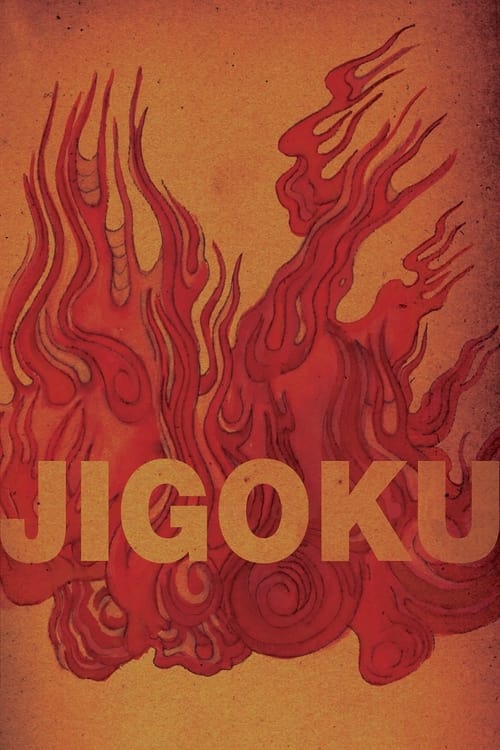
Jigoku
1960 · Nobuo Nakagawa
When you want horror as a full-on vision rather than a jump-scare machine — something ancient, morbid, and visually unforgettable to sink into on a dark night. Challenge viewing, and proud of it.
What it's about
Shirō, a Tokyo theology student, is riding with his sinister friend Tamura when their car kills a drunken gangster — and they drive on. From that unreported death a web of guilt spreads outward, pulling lovers, parents, and strangers into betrayals and crimes of their own, until the story leaves the human world entirely for a long descent through the Buddhist hell, where every sin is answered in the flesh.
The experience
Two films in one: a doomy, fatalistic melodrama that keeps tightening the noose, then a plunge into a hallucinatory inferno of lurid color and grisly torments. It's less scary than overwhelming — strange, feverish, and unlike anything else from its era.
The craft
Nakagawa stages hell as a sequence of studio-built tableaux — rivers of filth, fields of spikes, bodies in torment — lit in saturated reds and sickly greens, with gore that was shockingly explicit for 1960. It's theatrical rather than realistic, which is exactly what makes it haunting, and it rewards the biggest, darkest screen you can give it.
Why it matters
A milestone of Japanese horror whose graphic underworld imagery was years ahead of its time, now regarded as the capstone of Nakagawa's horror career and a touchstone for extreme and supernatural horror that followed.
Snapshot
Jigoku ("Hell") is a Japanese horror film made at Shintoho, the studio where Nobuo Nakagawa directed most of his best-known horror work. It has two halves. The first is a sleazy, fatalistic melodrama of guilt in the human world. The second is a long, tableau-like journey through the Buddhist underworld, staged on studio sets with an explicit gore that was very unusual in Japanese cinema of the time.
The film follows Shirō Shimizu (Shigeru Amachi), a theology student. One night he rides in a car driven by his sinister double-friend Tamura (Yōichi Numata), which hits and kills a drunken yakuza. Shirō does not report the death, and from then on a growing circle of people around him becomes tied together by deaths, betrayals and hidden crimes. Almost all of them die, and all of them meet again before King Enma.
The film was released in 1960, near the end of Shintoho's life; the studio went bankrupt the following year. Jigoku is widely seen as the peak of Nakagawa's career and of the studio's horror cycle. It is now one of the canonical works of classic Japanese horror, and later critics have read it as a forerunner of the graphic, transgressive horror that followed in Japan and elsewhere.
Industry & production
In the late 1950s Shintoho was the least respectable of Japan's major studios. It had been founded in 1947 by staff who broke away from Toho during that studio's labour disputes. Under president Mitsugu Ōkura, who took control in 1955, it turned to low-budget exploitation: war spectacles, erotic thrillers, female-diver pictures, detective serials and ghost stories (kaidan). Its directors worked on tight schedules and small budgets. In return they often got a surprising amount of freedom, as long as the films delivered sensation.
Nakagawa had already made Shintoho's horror reputation with Ghost Story of Kasane Swamp (1957), The Ghost of Yotsuya (1959) and other titles. Jigoku went further. Accounts of the production, including recollections gathered for later home-video releases, describe a strained shoot. The studio's finances were failing, money was tight, and the elaborate hell sets were reportedly built with heavy, improvised help from cast and crew. These accounts come mostly from interviews given decades later, and specific figures about cost or schedule are not reliably documented.
The film did not save Shintoho, which stopped production in 1961. Jigoku is therefore both the most ambitious film of the studio's horror line and one of its last.
Technology
Jigoku was shot in colour and in anamorphic widescreen. Both were still fairly new for a low-budget Japanese genre film, and both matter to how it works.
- Colour: the film depends on saturated, artificial colour. The hell sequences use red, orange, sickly green and violet light against black space and dry-ice fog.
- Effects: the infernal tortures are made with practical means: prosthetic flesh, fake blood, skeletal dummies, smoke, and painted or lit cycloramas. There is no optical trickery to speak of.
- Widescreen: the wide frame lets Nakagawa lay hell out as a horizontal panorama, with sinners scattered across a broad plain. This recalls the sideways-unrolling format of Japanese picture scrolls.
The film's technical means are modest. Its power comes from design and lighting rather than technical polish, and some effects (rubbery limbs, visible set edges) look crude by later standards. Much of the critical writing treats that crudeness as part of its dreamlike, theatrical charge.
Technique
Cinematography
Mamoru Morita shot the film, and the two halves have different visual regimes.
- The earthly section uses fairly conventional set-ups for Shintoho melodrama. Even so, its nighttime exteriors, rain-wet roads and the cramped, ugly interiors of the rural home are lit to feel oppressive.
- The hell section uses deep shadow, coloured gels and fog. Figures emerge from blackness and sink back into it.
The camera is often static and frontal in the underworld, presenting each punishment as a picture to be contemplated. This fits the film's sources in devotional painting.
Editing
The first half is built from crosscut threads and coincidences that move with deliberate, almost mechanical speed. Characters are introduced, linked through sins, and killed off with little transition. This compression makes the plot read as a chain of karmic cause and effect rather than psychological drama.
In the hell section the editing turns episodic: one punishment tableau after another, with Shirō's search for his lover and their unborn child as a loose connecting line. Some critics find the structure uneven or sagging. Others argue that the shift from plot to procession is the film's formal point.
Mise-en-scène / staging
Nakagawa's staging is the film's most celebrated quality. The hell scenes draw on the iconography of the Buddhist underworld:
- Enma, judge of the dead, presiding over the sinners
- the river Sanzu
- the dry riverbed of Sai no Kawara, where dead children stack stones
- lakes of blood and pus
- demons who flay, dismember and boil the condemned
The violence is explicit and anatomical. There are severed limbs, a skinned body, eyes gouged out and teeth broken out. Japanese cinema had rarely shown such things before.
The human world is also designed as a kind of hell. The run-down retirement home that Shirō's father runs (Shirō's mother is dying there, and his father keeps a mistress under the same roof) is crowded with drunkards and petty frauds and has no dignity. The two halves mirror each other: the second makes literal what the first implies.
Sound
The score is by Michiaki Watanabe, a prolific Shintoho and genre composer. It combines eerie, droning orchestral textures with chanting, sutra-like voices and dissonant effects in the hell section, plus a pop/jazz-inflected strain for parts of the earthly story.
Nakagawa uses sound to build atmosphere: wind, moans, echoing cries and the reverberation of the enclosed studio hell. Detailed documentation of the sound design is limited.
Performance
- Shigeru Amachi, a Shintoho regular who had starred in Nakagawa's The Ghost of Yotsuya, plays Shirō as passive and haunted. He is less a man who acts than one to whom guilt happens.
- Yōichi Numata gives Tamura a sly, knowing presence. Tamura seems to know everyone's sins, appears wherever disaster is coming, and works as a Mephistophelean tempter or a shadow self.
- Utako Mitsuya plays a dual role: Shirō's fiancée Yukiko, and Sachiko, a young woman at the rural home who closely resembles her. The doubling reinforces the film's sense of fate and repetition.
The supporting players are broad by design. They are types of sin more than rounded characters.
Narrative & dramatic mode
Jigoku is a moral allegory built in two movements: a crime melodrama and a visionary katabasis (descent to the underworld).
In the first half the plot is a web of sin. Because Shirō's moment of complicity goes unconfessed, it pulls in:
- the victim's mother and girlfriend, who want revenge
- the death of his fiancée, killed in a car crash while he is in the taxi with her
- his father's adultery and his mother's neglect
- a corrupt professor (Yukiko's father) with his own buried war crime
- a gallery of minor sinners at the rural home
The section ends in a near-total massacre, mostly through poisoning, that sends almost every character to hell together.
In the second half the logic of the plot gives way to the logic of judgment. Shirō wanders, endures punishment, and tries to save his unborn daughter, who is trapped on a wheel in the underworld. The ending offers an ambiguous glimpse of grace.
The tone moves between lurid exploitation, black irony and real religious dread. The insistence that everyone is guilty, and that no one is innocent in the human world, gives the film its bleak, almost satirical edge.
Genre & cycle
The film belongs to the kaidan eiga (ghost-story film) tradition, but it departs from that tradition's usual shape. Most kaidan films of the 1950s, Nakagawa's own included, dealt with a wronged ghost, usually female, taking revenge on the living within a period setting. Jigoku is set in contemporary Japan and has no single avenging spirit. Its supernatural world is a whole cosmology of punishment.
It therefore sits at a meeting point:
- the Shintoho kaidan cycle of the late 1950s
- the studio's lurid contemporary crime and youth pictures
- a much older visual tradition of Buddhist hell imagery
Because of its explicit body horror, it is often discussed alongside the gore films that came after it internationally. Herschell Gordon Lewis's Blood Feast (1963) is the usual comparison. There is no evidence of direct influence either way, and the comparison is one of timing and sensibility, not lineage.
Authorship & method
Nobuo Nakagawa (1905–1984) started in the 1930s and directed comedies, period dramas and melodramas across many studios before Shintoho made him a horror specialist. Japanese critics have long recognised him as the major stylist of the classic kaidan film. Jigoku is the most personal and extreme expression of his interests:
- karmic retribution
- the persistence of guilt
- the visual poetry of decay
- spaces that seem to rot along with the people in them
Key collaborators:
- Screenplay: Nakagawa and Ichirō Miyagawa. The script merges a modern noir-like plot with an older religious frame.
- Cinematography: Mamoru Morita.
- Music: Michiaki Watanabe.
- Art direction: Haruyasu Kurosawa, who was responsible for the infernal sets the film is remembered for.
- Cast: Shigeru Amachi, Utako Mitsuya, Yōichi Numata. All were part of Shintoho's stock company.
Nakagawa's method relied on making a lot from little: theatrical sets, controlled colour and sustained mood instead of expensive effects. That approach suited Shintoho's economics.
Movement / national cinema
Jigoku comes from the commercial genre system of the Japanese studio era. It was not part of the art-film culture that was making Japanese cinema famous abroad at the same moment. It shares little with the Japanese New Wave that was starting at Shochiku in 1960 (Ōshima, Yoshida, Shinoda). Still, it shares that movement's taste for transgression and its harsh view of postwar Japanese society: corrupt academics, an absent father, self-serving adults and a generation of drifting young people.
It also draws on deep native sources:
- Jigoku-zōshi (hell scrolls) of the late Heian and Kamakura periods
- the Pure Land Buddhist tradition of graphic hell descriptions, linked above all to Genshin's Ōjōyōshū (985)
- Edo-period kabuki and kaidan conventions that Nakagawa had already adapted
In the history of Japanese film it stands as a link between those older representations of the underworld and the ero-guro (erotic-grotesque) and gore strands of 1960s and 1970s Japanese genre cinema.
Era / period
The film was released in 1960, a year of upheaval in Japan. There were mass protests over renewal of the US–Japan Security Treaty, rapid economic growth, and a film industry whose audiences were near their peak but about to fall sharply as television spread.
The film's portrait of a modern Japan where no one is clean has invited readings tied to its moment:
- the professor's wartime crime, kept hidden in the present
- careless car deaths in an increasingly motorised society
- a generation that cannot escape its parents' sins
Some critics read these as comments on postwar amnesia about the war and on the moral cost of prosperity. Such readings are interpretive. The film does not openly announce a political programme.
Industrially, Jigoku belongs to the final stage of Shintoho's collapse. The studio system as a whole would enter decline over the decade.
Themes
- Universal guilt: the film rejects the idea of an innocent bystander. Everyone carries sin, and hiding a sin multiplies it.
- Karma and causality: in the first half, chance events turn out to be links in a chain of consequence that ends in judgment.
- The double: Tamura as Shirō's dark other, and Yukiko/Sachiko as the lost beloved repeated, suggest that identity is unstable and that guilt divides the self.
- Hell on earth: the shabby, debased human world anticipates the literal hell. The second half partly literalises what the first already shows.
- Generational sin: parents' crimes (the professor's war guilt, the father's adultery) fall on the children, and the unborn child becomes the film's final emblem of innocence lost and possibly redeemed.
- The body as site of punishment: the explicit tortures present the flesh as the place where moral debt is paid, in line with the didactic purpose of the Buddhist hell scrolls.
- Grace and compassion: the ending, with its fragile image of rescue or mercy, keeps the film from total nihilism. How much hope it offers is still debated.
Reception, canon & influence
Critical reception. On release, Jigoku was a genre product from a failing studio and did not draw serious critical attention. Reliable figures on its box-office performance are not readily documented. Its reputation grew later:
- In Japan, through repertory screenings and the critical re-evaluation of Nakagawa from the 1970s onward. Japanese genre critics and later filmmakers came to treat him as a master.
- Abroad, mainly after the Criterion Collection's DVD release in 2006. That release introduced the film to many Western viewers and presented it as a lost classic of Japanese horror.
Today it is often ranked among the most important Japanese horror films before the J-horror wave of the 1990s. Critics praise its visual audacity and its strangeness. The criticisms that recur concern the jerky plotting of the first half and the episodic drift of the second.
Influences on the film (backward).
- Buddhist hell iconography: the jigoku-zōshi scrolls, Genshin's Ōjōyōshū, and the popular tradition of hell paintings (jigoku-e) used in temple preaching.
- Kabuki and Edo-period kaidan conventions, which Nakagawa had already brought to film in The Ghost of Yotsuya.
- More broadly, the Western tradition of underworld journeys running back to Dante. Critics invoke this comparison often, though there is no documented evidence that Nakagawa drew on it directly.
- Shintoho's own exploitation culture of sensation, sex and violence.
Legacy (forward).
- Remakes: two Japanese films took its title and premise.
- Jigoku (1979), directed by Tatsumi Kumashiro for Toei.
- Jigoku (1999, also known as Japanese Hell), directed by Teruo Ishii. Ishii was a Shintoho alumnus, and his remake turned the hell framework into topical satire, including scenes aimed at the Aum Shinrikyo cult.
- Gore and ero-guro: the film is often cited as a precursor to the Japanese genre cinema of the 1960s–70s that pushed graphic content further, Ishii's own Toei ero-guro films among them.
- Later Japanese horror: directors and critics associated with later Japanese horror have acknowledged Nakagawa's importance. Kiyoshi Kurosawa, for example, has spoken of the classic kaidan tradition, and modern scholars of J-horror routinely trace lines back to Nakagawa's Shintoho films. Specific claims that Jigoku directly influenced particular later films should be treated carefully, because the documented record of individual borrowings is thin.
- International cult canon: since its wider release on home video, Jigoku has become a reference point in surveys of world horror cinema and in discussions of the religious and allegorical horror film. It is regularly cited as proof that graphic, transgressive horror had a serious artistic precedent in Japan in 1960.
Influences: the films it descends from and the films it influenced
- L'Inferno (1911) — Built hell as a series of static, frontal tableaux copied from Doré's engravings and lined up as procession-like stations. Jigoku's second half uses the same devotional, station-by-station staging, with the jigoku-zōshi scrolls taking the place of Doré.
- Häxan (1922) — Brought medieval torment iconography to life as costumed live-action tableaux of devils and damned bodies, framed as painted plates. This set the precedent for Jigoku's practical-effects staging of religious hell imagery as horror spectacle.
- Dante's Inferno (1935) — Its hell sequence is a self-contained set piece of massed, writhing bodies on studio-built crags, framed by a modern morality story about a corrupt man. That pairing of a contemporary sinner with a staged inferno is the frame Jigoku expands into its two-part structure.
- Ugetsu (1953) — Mizoguchi's lateral crane moves and long takes read the frame like an unrolling emakimono scroll and fold a ghost tale into a moral fable of greed and punishment. Jigoku pushes this scroll-panorama approach into anamorphic widescreen.
- The Ghost of Yotsuya (Tōkaidō Yotsuya Kaidan) (1959) — Nakagawa's immediate Shintoho rehearsal for Jigoku, also in colour and Scope. Shigeru Amachi again plays a man dragged along by a tempter-accomplice through a chain of crimes that become karmic hauntings, and the kabuki-derived colour stylization was carried straight into Jigoku.
- Kwaidan (1964) — Extends Jigoku's set-bound, painted-cyclorama kaidan into prestige filmmaking. Its saturated studio skies, theatrical colour lighting and the Hōichi sequence's intercut emaki battle-scroll paintings carry on Jigoku's turn of Buddhist picture-scroll iconography into widescreen production design.
- Tokyo Drifter (1966) — Suzuki's flat, single-colour gel washes and abstract stage-set backdrops apply the anti-realist colour design that Shintoho genre films like Jigoku had already used as a cheap substitute for expensive locations.
- This Night I'll Possess Your Corpse (1967) — Breaks out of black-and-white into a garishly coloured hell sequence of frozen, tortured bodies on a cheap set, which is Jigoku's low-budget recipe of practical gore tableaux and saturated colour, used for a hell the sinner is forced to witness.
- Goke, Body Snatcher from Hell (1968) — Uses blood-red optical skies and lurid colour gels to turn a moral panic about war guilt into body horror. It keeps Jigoku's linking of saturated colour with collective postwar culpability.
- Shogun's Joys of Torture (1968) — Ishii, a Shintoho alumnus, recasts Jigoku's episodic procession of punishments as a string of torture vignettes. It turns the film's proto-gore practical effects into the Toei ero-guro mode.
- House (Hausu) (1977) — Revives the openly artificial kaidan look: painted backdrops, gelled colour fields and handmade practical gore, with the artifice put on show instead of hidden.
- Jigoku (1979) — A Toei remake that rebuilds Nakagawa's sequence of hell-scroll judgments in larger colour studio sets, keeping the descent through Enma's court and the karmic chain linking the earthly sins.
- The Beyond (1981) — Ends on a static, frontal matte tableau of a dead plain filled with the damned, the same devotional hell panorama Jigoku closes on, used as the payoff of a story about inherited guilt.
- Jigoku (Japanese Hell) (1999) — Ishii's remake keeps Nakagawa's two-part structure of earthly crimes followed by Enma's judgment and the hell stations. It points the episodic punishment sequence at current targets such as Aum Shinrikyo, so the karmic tableau becomes topical satire.
- Black Sabbath (1963) — Bava worked out a parallel grammar of unmotivated, saturated red, green and blue gels on theatrical sets. It is the closest Western counterpart to the non-naturalistic coloured lighting Jigoku uses for its underworld.
- Kuroneko (1968) — Rendered otherworldly punishment through stylized, non-naturalistic staging and stark theatrical lighting on near-empty stages — the same theater-of-damnation abstraction Kuroneko uses for its liminal spirit-world thresholds.
Similar films
- Ugetsu (1953) — influence & lineage
- Harakiri (1962) — shared sensibility
- Kuroneko (1968) — shared sensibility
- Demons (1971) — shared sensibility
- Gate of Hell (1953) — shared sensibility
- The Sword of Doom (1966) — shared sensibility
- Ichi the Killer (2001) — shared sensibility
- Onibaba (1964) — shared sensibility