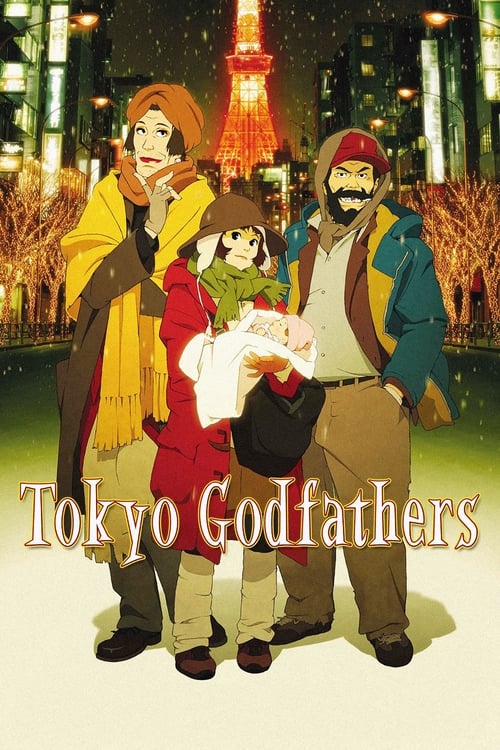
Tokyo Godfathers
2003 · Satoshi Kon
The perfect unconventional Christmas movie — for when you want holiday warmth with grit and tears in it, not sugar. A comfort film that earns the comfort.
What it's about
On Christmas Eve, three homeless people scraping by on the streets of Tokyo — a gruff alcoholic, a trans woman with a fierce maternal streak, and a teenage runaway — find a newborn baby abandoned in the trash. Instead of handing her over, they set out across the city to find her parents themselves, and the search keeps colliding with their own buried histories.
The experience
Funny, rowdy, and then suddenly devastating — it swings between slapstick and heartbreak with total confidence, and the string of wild coincidences driving the plot starts to feel like the universe quietly looking out for people everyone else ignores. You'll laugh a lot and probably cry once, hard.
The craft
Satoshi Kon and the animators at Madhouse push hand-drawn character acting toward glorious caricature — jowls, snaggle teeth, bodies that slump with real weight — realism achieved through exaggeration, which only drawing can do. The Tokyo here is wintry and unglamorous, all tarp shelters and back alleys, rendered with documentary-level care.
Why it matters
The odd film out in Kon's run of reality-bending thrillers, and now widely treasured as one of animation's great humanist works — a fixture of alternative-Christmas-movie lists and proof that adult animation could be warm without being soft.
Satoshi Kon's Christmas miracle: three homeless Tokyoites — a gruff alcoholic, a trans woman with a mother's heart, and a teenage runaway — find an abandoned newborn on Christmas Eve and cross the city to return her. Where Perfect Blue and Paprika fold reality into hallucination, this is Kon's one boots-on-the-pavement film, a loose homage to John Ford's 3 Godfathers co-written with Cowboy Bebop's Keiko Nobumoto. Its engine is coincidence — a cascade of improbabilities so shameless it becomes a theology, chance operating as grace for people the city has agreed not to see. The craft is in the faces: Madhouse's animators push character acting toward caricature — jowls, snaggle teeth, bodies that slump with real weight — realism achieved through exaggeration, which only drawing can do. Kon shows a wintry, unglamorous Tokyo of tarp shelters, cemetery offerings, and neon seeping into slush, rendered with documentary affection. Of his four features completed before his death at forty-six, this is the warmest, and the one that argues most directly for his humanism: nobody in it is disposable, least of all the people sleeping in the park.
A Deleuzian reading
Neon seeping into slush.
The full Deleuzian reading of Tokyo Godfathers →
Reception
In 2003 it was the Satoshi Kon film that got respectful reviews but none of the buzz of Perfect Blue or the awards chatter of Millennium Actress — the 'minor' one. Two decades on it's arguably his most beloved, boosted by GKIDS' 2020 remaster and its adoption as an annual Christmas rewatch.
How Tokyo Godfathers was received, from release to now →
Influences: the films it descends from and the films it influenced
- 3 Godfathers (1948) — Direct plot template: three outlaws shepherd an abandoned infant through a hostile landscape in an explicit Nativity retelling, and Kon transposes Ford's Arizona desert to Tokyo's winter streets while keeping the redemptive-sacrifice structure intact.
- The Kid (1921) — Pairs an abandoned baby with a destitute urban vagrant and fuses broad slapstick caricature with unguarded sentiment — the exact tonal register of comic exaggeration plus tearful humanism that Kon's homeless trio inhabit.
- Miracle in Milan (1951) — Shoots the homeless on real streets in neorealist grime yet resolves their plight through literal miracle, the 'coincidence-as-grace' welding of documentary destitution to providential fantasy that Kon adopts.
- It's a Wonderful Life (1946) — Supplies the Christmas-miracle machinery in which chains of improbable coincidence become providential grace redeeming a suicidal everyman — the grammar behind Kon's cascade of lucky encounters.
- Tokyo Story (1953) — Model for humanist attention to ordinary Tokyo lives and the city's overlooked textures, staging quiet dignity among socially discarded people that Kon extends to his vagrants.
- Magnetic Rose (Memories) (1995) — Kon wrote its screenplay under mentor Otomo, absorbing the method of hyper-dense realist background detail and reality-dissolving montage that he later deploys across Tokyo's streetscapes.
- Only Yesterday (1991) — Pioneers documentary-grade realism in hand-drawn animation — mundane everyday gesture and lived-in detail rendered with near-rotoscopic fidelity — the aesthetic Kon applies to homeless bodies and cluttered alleys.
- Millennium Actress: Tracks (2001) — Kon's next feature carries forward the coincidence-driven match-cut chain and precisely storyboarded staging documented here, applying the same continuity-editing logic to a realist city-wandering plot.
- Paprika (2006) — Pushes Kon's reality/dream match-cut technique to its extreme, extending the same transition grammar Tokyo Godfathers had temporarily disciplined into realism.
- Paranoia Agent (2004) — Continues Kon's urban-Tokyo social observation and interwoven-strangers structure, tracing how coincidental encounters across the city knot ordinary lives together.
- Requiem for a Dream (2000) — Openly borrows Kon's associative match-cut montage (Aronofsky remade Perfect Blue's bathtub cut), carrying the Kon editing signature that Tokyo Godfathers also refines into live-action cinema.
- Your Name (2016) — Inherits Kon's graphic match-cut and place/identity-swapping transitions to bind separated characters across a mapped Tokyo, a debt Shinkai's editing directly extends.
- Weathering with You (2019) — Used precise, recognizable Tokyo geography and a single weather event (snowfall) as the engine of coincidence and plot — the topographic-Tokyo-plus-weather dramaturgy Shinkai adopts.
- Perfect Blue (1997) — Establishes Kon's signature graphic match-cut and associative montage editing; Tokyo Godfathers keeps that seamless transition grammar but deliberately grounds it, refusing the hallucinatory dissolves ('against-hallucination').
- Millennium Actress (2001) — The immediately preceding Madhouse production sharing crew and the match-cut editing that stitches disparate times and spaces into one continuous movement.
- Cowboy Bebop (1998) — Shares screenwriter Keiko Nobumoto, whose method of an ensemble of misfit outcasts bound as a bickering found-family and driven by episodic pathos directly shapes the trio's dynamic.
- Wolf's Rain (2003) — Also written by Keiko Nobumoto, repeating her recurring architecture of an outcast ensemble on a redemptive quest toward a promised destination.
Similar films
- Tokyo Story (1953) — influence & lineage
- Your Name. (2016) — influence & lineage
- Shoplifters (2018) — shared sensibility
- The Boy and the Beast (2015) — shared sensibility
- The Boy and the Heron (2023) — shared sensibility
- My Neighbor Totoro (1988) — shared sensibility
- The Disappearance of Haruhi Suzumiya (2010) — shared sensibility
- Spirited Away (2001) — shared sensibility
All the films related to Tokyo Godfathers →